Skip to content

Chapter 7: Textiles, crafts and motifs

Woven by hand

India's famous handloom weaves, from Banarasi brocade and Kanjeevaram silk to Patola double ikat and Kashmir pashmina, with where each comes from and how to recognise it in a picture.

In one minute

6 facts to know

  1. A woven pattern is built into the cloth on the loom, from the warp (lengthwise threads) and the weft (crosswise threads). Embroidery is stitched on afterwards, so Phulkari and Chikankari are embroidery, not weaves.
  2. Match the weave to the state: Banarasi (Uttar Pradesh), Kanjeevaram (Tamil Nadu), Paithani (Maharashtra), Sambalpuri (Odisha), Pochampally (Telangana), Patola (Gujarat), Baluchari (West Bengal), Muga (Assam).
  3. In ikat the yarn is tie-dyed before weaving. Single ikat dyes the warp or the weft; double ikat dyes both. Patan Patola is the best-known double ikat.
  4. India makes four kinds of silk: mulberry, tussar, eri and muga. Golden muga silk comes only from Assam.
  5. A GI (Geographical Indication) tag means only makers from that place may use the name, for example Kancheepuram Silk or Pochampally Ikat.
  6. National Handloom Day is 7 August, the day the Swadeshi movement began in 1905. It was first held in 2015.

The basics

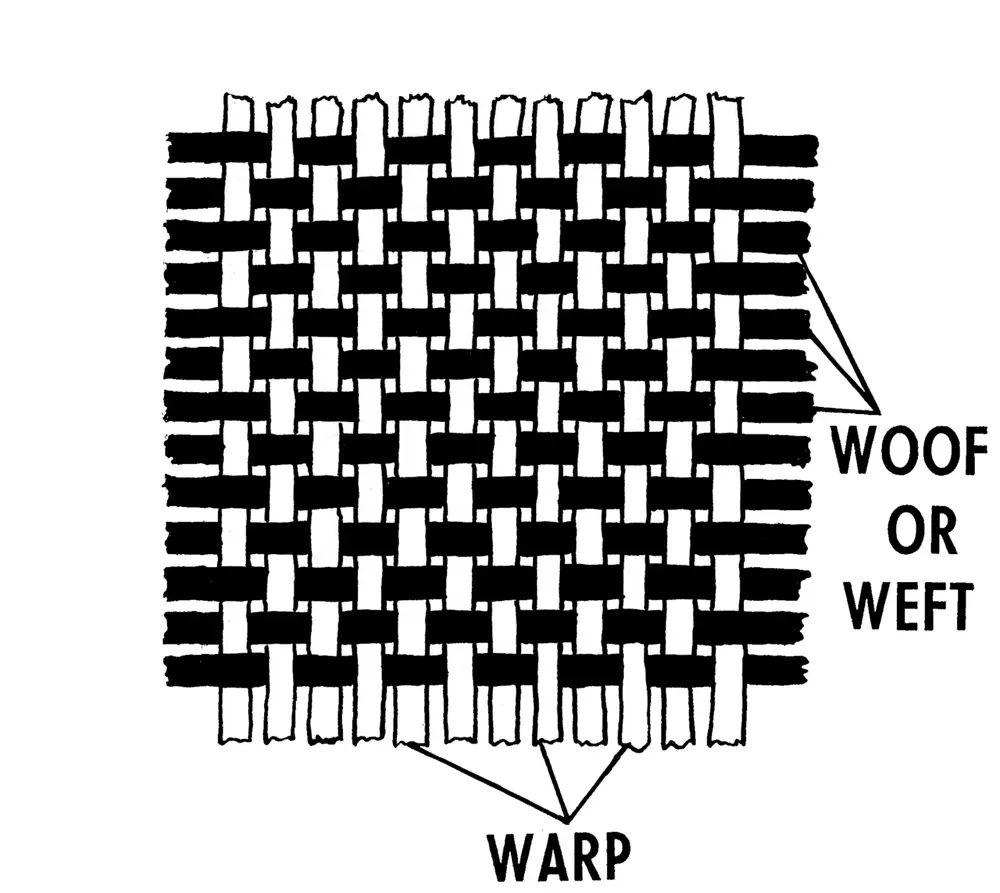
Every woven cloth is made of two sets of threads. The warp is stretched lengthwise on the loom and stays put. The weft is passed across it, over and under, again and again. The edge where the weft turns back is the selvedge, and on a sari that is where the border runs.

A drawing of plain weave, with white vertical threads labelled warp and black horizontal threads labelled weft passing over and under them.

Warp threads run along the length of the cloth; the weft goes across, over one and under the next.

Picture: Pearson Scott Foresman. Public domain.

A handloom is a loom worked by the weaver's hands and feet, with no motor. Patterns are added on the loom in a few ways:

  • Extra weft (brocade): extra threads, often gold or silver zari, are floated across the cloth only where a motif is needed. Banarasi, Baluchari and Jamdani work this way.
  • Tapestry or interlocking weft: blocks of different coloured weft meet and hook around each other. Paithani pallus and the joined borders of Kanjeevaram saris use this.
  • Ikat: the pattern is dyed into the yarn before weaving. Bundles of yarn are tied tightly in places and dipped in dye; the tied parts stay undyed. Because the threads shift a little on the loom, ikat motifs have soft, feathered edges.
    • Single ikat: only the warp or only the weft is tie-dyed.
    • Double ikat: both are tie-dyed, and the weaver lines them up so the colours meet exactly. It is slow and rare. Patan Patola is double ikat, and some Pochampally and Sambalpuri pieces are too.

The four silks. Silk is spun from the cocoons of silkworms, and India produces all four commercial kinds.

Silk Silkworm feeds on Main region Look
Mulberry Mulberry leaves Karnataka and the south; used for Kanjeevaram and Mysore silk Smooth, white, takes dye well
Tussar (tasar) Arjun and asan trees in forests Forests of eastern and central India; woven famously at Bhagalpur, Bihar Rougher, golden brown
Eri Castor leaves Assam and the North-East Soft, woolly, matt
Muga Som and soalu leaves Assam only Natural golden shine

Eri is called ahimsa or peace silk, because the moth can leave its cocoon before the silk is spun. Muga is so linked to Assam that it has its own GI tag, "Muga Silk of Assam".

What a GI tag is. A Geographical Indication is a label for a product whose quality comes from the place it is made. In India they are registered under the Geographical Indications of Goods Act of 1999. Once a name such as "Chanderi Sarees" is registered, a sari woven elsewhere cannot legally be sold under it. Darjeeling Tea was India's first GI, and Pochampally Ikat and Chanderi Sarees were among the very first crafts to get one. Most weaves on this page have a GI tag.

Silk and gold

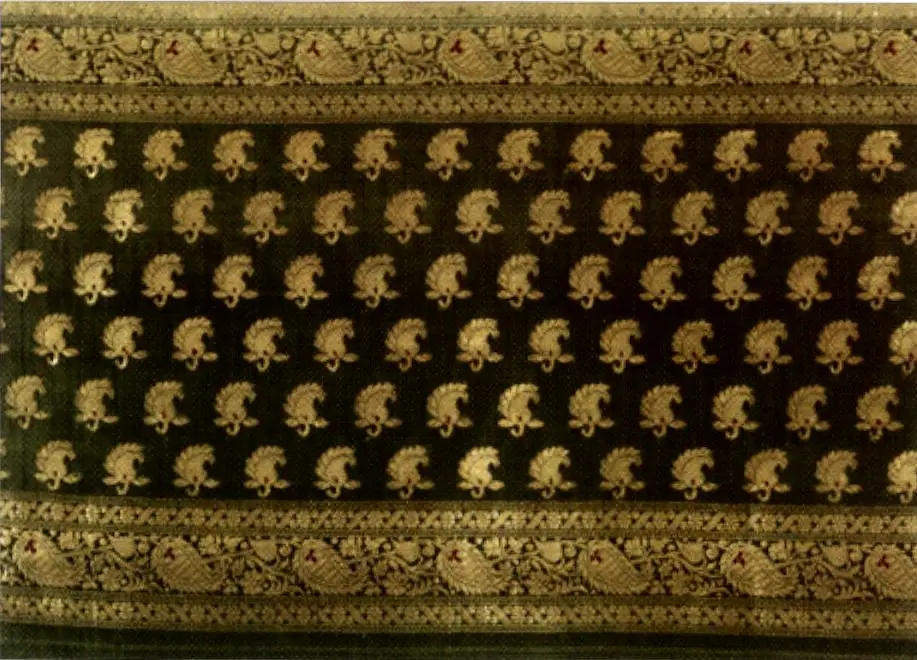
A black silk sari length covered in rows of small gold flower motifs, with wide gold borders of paisleys at top and bottom.
Picture: Unknown weaver, Honolulu Museum of Art. Public domain.

Banarasi

Also called Banarasi brocade

Where
Varanasi (Banaras), Uttar Pradesh
Style
Silk brocade
Made with
Silk with gold and silver zari, woven as extra weft

The classic Indian wedding sari. Gold or silver zari threads are woven in as extra weft to make small flowers (buti), net patterns (jaal), paisleys and leafy borders, so the sari is heavy and shines all over. A complex one can take weeks or months on the loom. Its GI name is "Banaras Brocades and Sarees".

Spot it by

Dense gold patterns standing out on rich silk, rows of small buti, and paisleys and climbing leaves in the border and pallu.

Remember

Banarasi, Banaras, Brocade.

Don't confuse

Kanjeevaram is also silk and zari, but heavier, with a bold border in a contrasting colour. Banarasi is all about the gold patterning across the body.
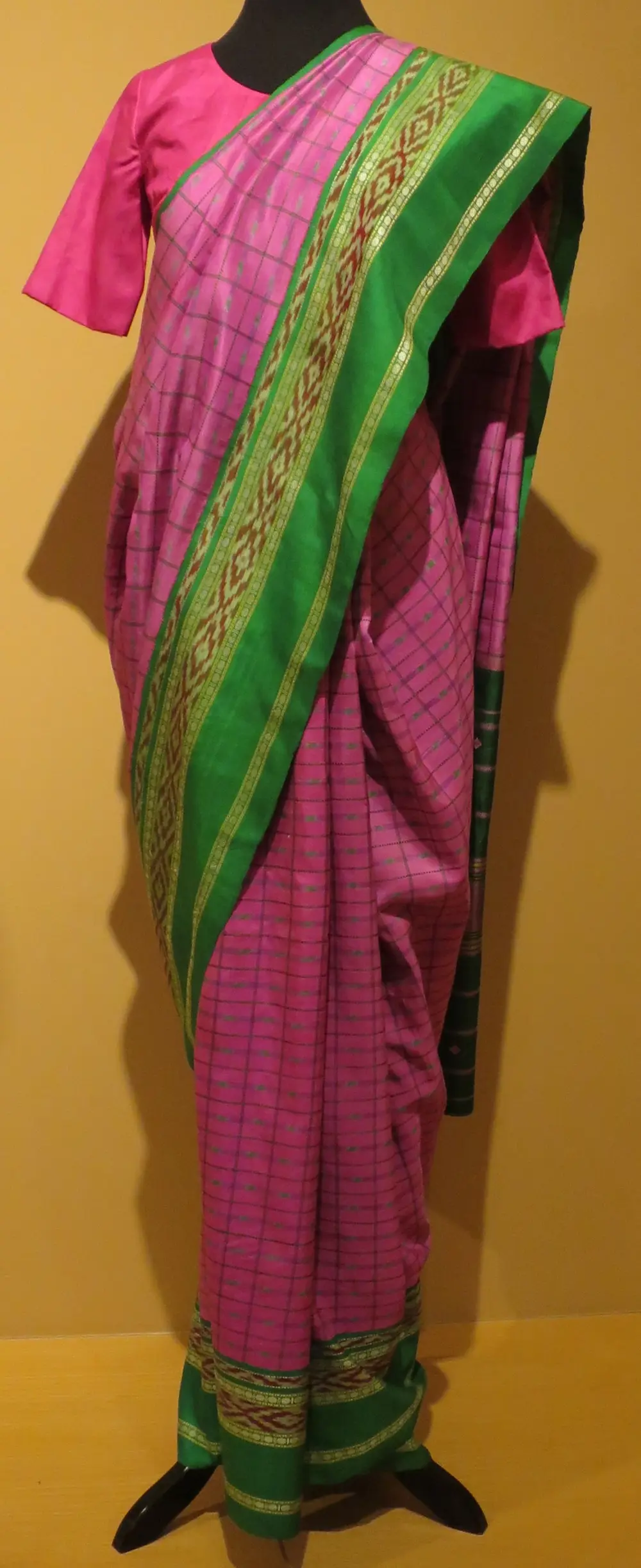
A pink silk sari with a fine check pattern, draped on a stand, with a wide bright green border and pallu edged in gold.
Picture: Hiart. CC0.

Kanjeevaram

Also called Kancheepuram silk, Kanchipuram sari

Where
Kancheepuram, Tamil Nadu
Style
Heavy mulberry silk
Made with
Pure mulberry silk and zari

South India's great bridal sari, woven from thick mulberry silk. The border and pallu are often a completely different colour from the body. In a true Kanjeevaram they are woven separately and then interlocked on the loom, a joint called korvai, which takes three shuttles and often two weavers. Where the body meets the pallu there is often a zigzag line.

Spot it by

Stiff, glossy silk and a wide border in a contrasting colour, such as pink with green or maroon with gold.

Remember

Kanjeevaram, korvai, contrast: the border is joined on in a different colour.

Don't confuse

Banarasi has gold patterns spread over the whole body; Kanjeevaram is mostly about the bold contrast border.
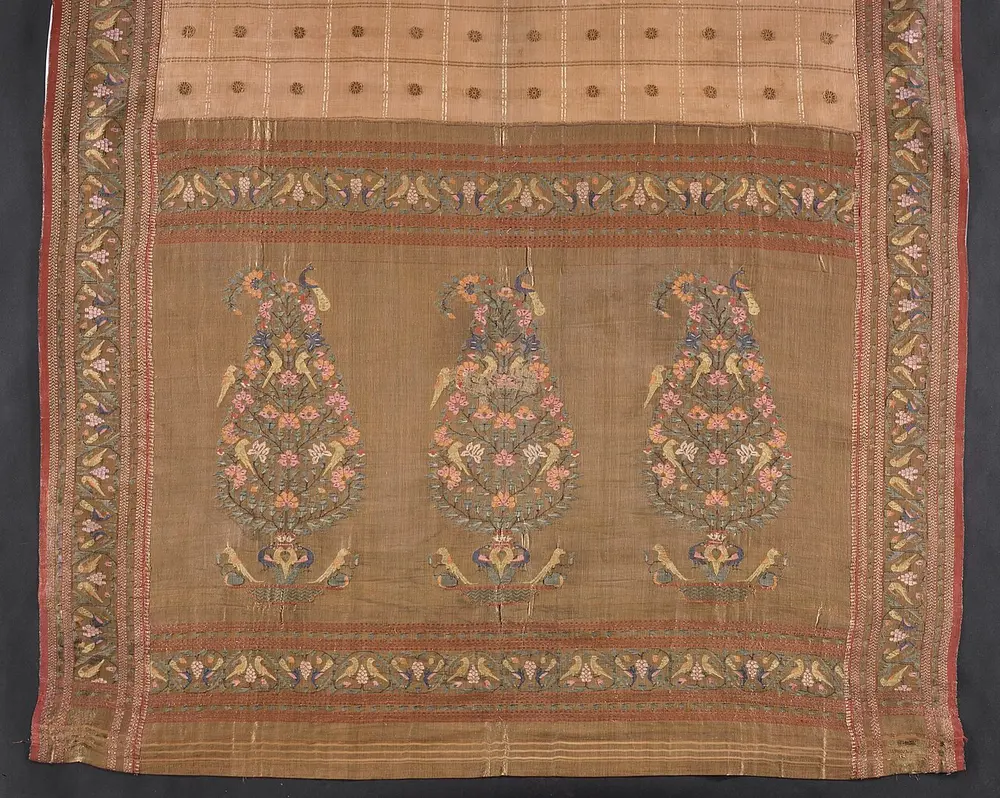
The end of an old silk sari showing three large tree-like motifs filled with flowers and birds, framed by borders of small parrots.
Picture: Los Angeles County Museum of Art. Public domain.

Paithani

Where
Paithan (Chhatrapati Sambhajinagar district) and Yeola (Nashik district), Maharashtra
Style
Tapestry-woven silk
Made with
Silk with a zari ground

Named after the old town of Paithan, though Yeola is now the biggest centre. The pallu is woven like a tapestry: small blocks of coloured silk weft are worked in by hand and locked together over a gold zari ground, so the back looks almost as neat as the front. Peacocks fill the pallu, and parrots (munia) appear in the pallu and border.

Spot it by

A shining gold pallu with a big peacock or parrots in bright colours, and borders of slanting squares.

Remember

Paithani, Peacock, Parrot.

Don't confuse

Baluchari also has a picture pallu, but it shows people from the epics, and it comes from Bengal.
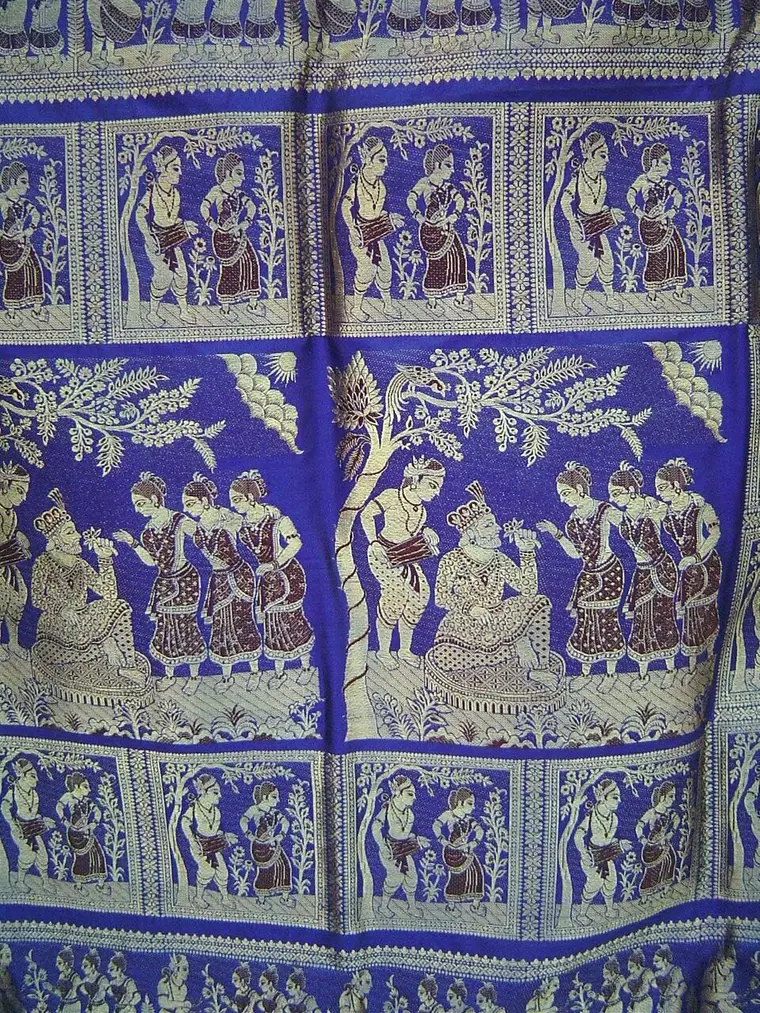
A blue silk sari pallu woven with panels of figures: a king seated under a tree with women around him, and rows of smaller figures in boxes.
Picture: Sumita Roy Dutta. CC BY-SA 4.0.

Baluchari

Where
Bishnupur, Bankura district, West Bengal (first made at Baluchar, Murshidabad)
Style
Figured silk
Made with
Silk, woven with extra weft

A silk sari whose pallu tells a story. Woven panels show scenes from the Ramayana and Mahabharata, and sometimes everyday courtly life. It began in Baluchar village in Murshidabad, nearly died out under British rule, and was revived in the 20th century at Bishnupur, the town of terracotta temples, which is now its only real home. Versions with gold thread are called Swarnachari.

Spot it by

Rows of little people, chariots and trees woven into the pallu, like a comic strip in silk.

Remember

Baluchari is a storybook you can wear.

Don't confuse

Paithani's pallu has birds, not people.
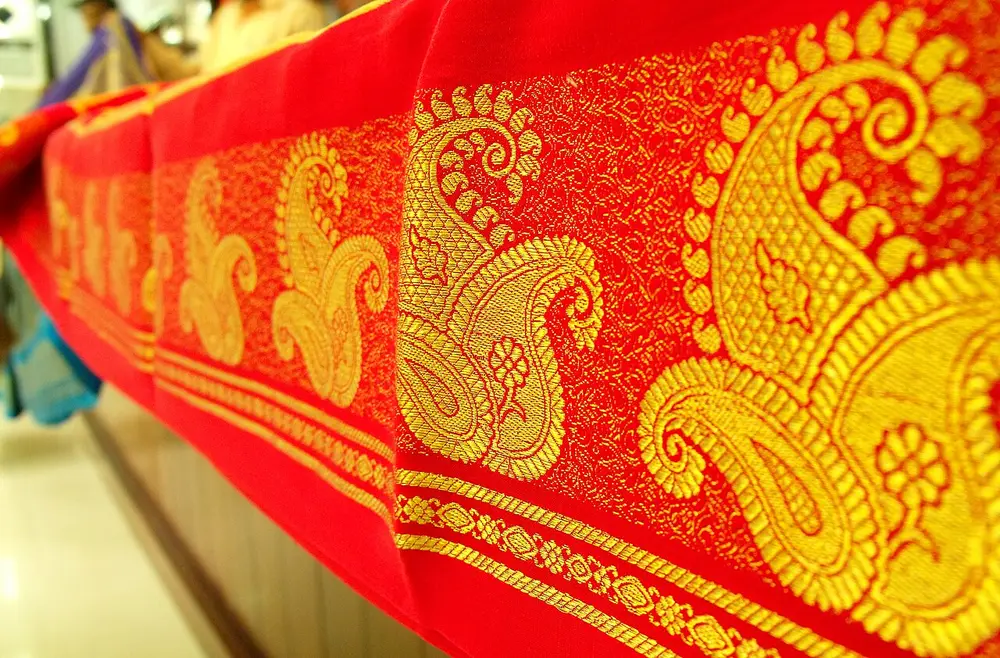
A red silk sari border with large gold zari paisleys, laid over a display counter.
Picture: Kiranravikumar. CC BY-SA 3.0.

Mysore silk

Where
Mysuru, Karnataka
When
Factory set up in 1912
Who
Maharaja Krishnaraja Wodeyar IV; today the Karnataka Silk Industries Corporation (KSIC)
Made with
Pure mulberry silk with gold zari

Karnataka's best-known silk: a light, soft, plain mulberry silk with a gold zari border. Unlike the other weaves on this page, it is made in a government factory, not in weavers' homes. The factory was started by the Mysore maharaja in 1912 with machine looms from Switzerland, and KSIC, which has run it since 1980, holds the GI tag.

Spot it by

Smooth, light silk in one solid colour, with a narrow or medium gold border and little patterning on the body.

Remember

Mysore silk is the factory-made one.

Don't confuse

Kanjeevaram is also Tamil-and-south silk, but it is handwoven, heavier and has a contrast border.

Light cottons of central India and Rajasthan

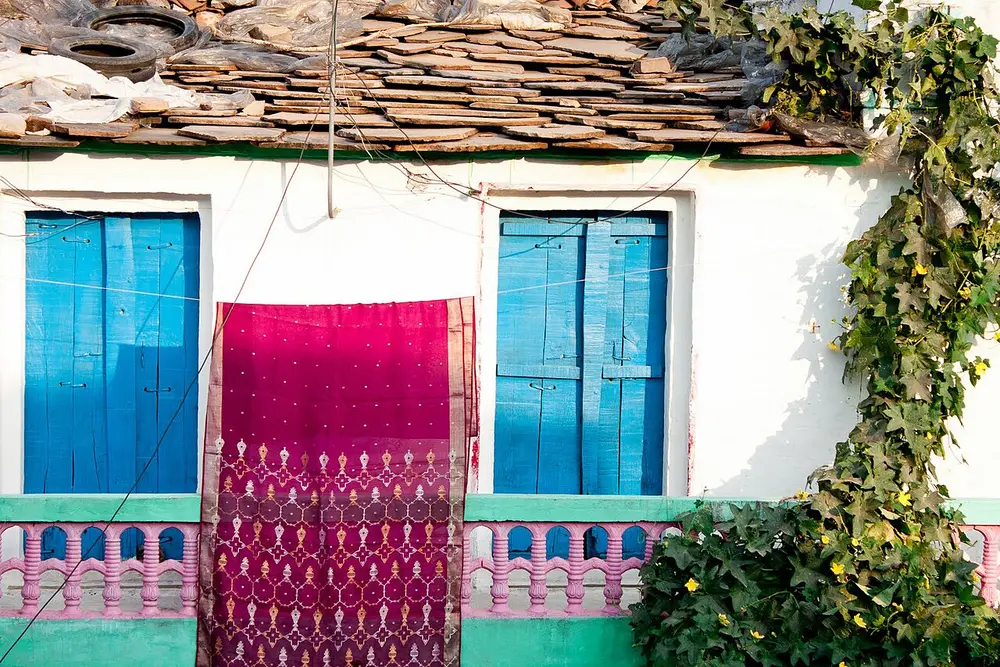
A sheer magenta sari hung over a balcony railing between two blue windows, with small gold and white motifs woven along its lower part.
Picture: India Untravelled. CC BY 2.0.

Chanderi

Where
Chanderi, Ashoknagar district, Madhya Pradesh
Made with
Silk, cotton or a silk and cotton mix, with zari

A sheer, featherlight fabric from a town on the border of Malwa and Bundelkhand. The body is so fine you can see through it, scattered with small woven motifs such as coins, flowers and peacocks in zari or coloured thread. Chanderi Sarees were among the first crafts in India to get a GI tag.

Spot it by

See-through, glossy fabric with tiny scattered gold buti and a thin zari border.

Remember

Chanderi is almost as light as air.

Don't confuse

Kota Doria is also sheer, but it has a grid of tiny square checks.
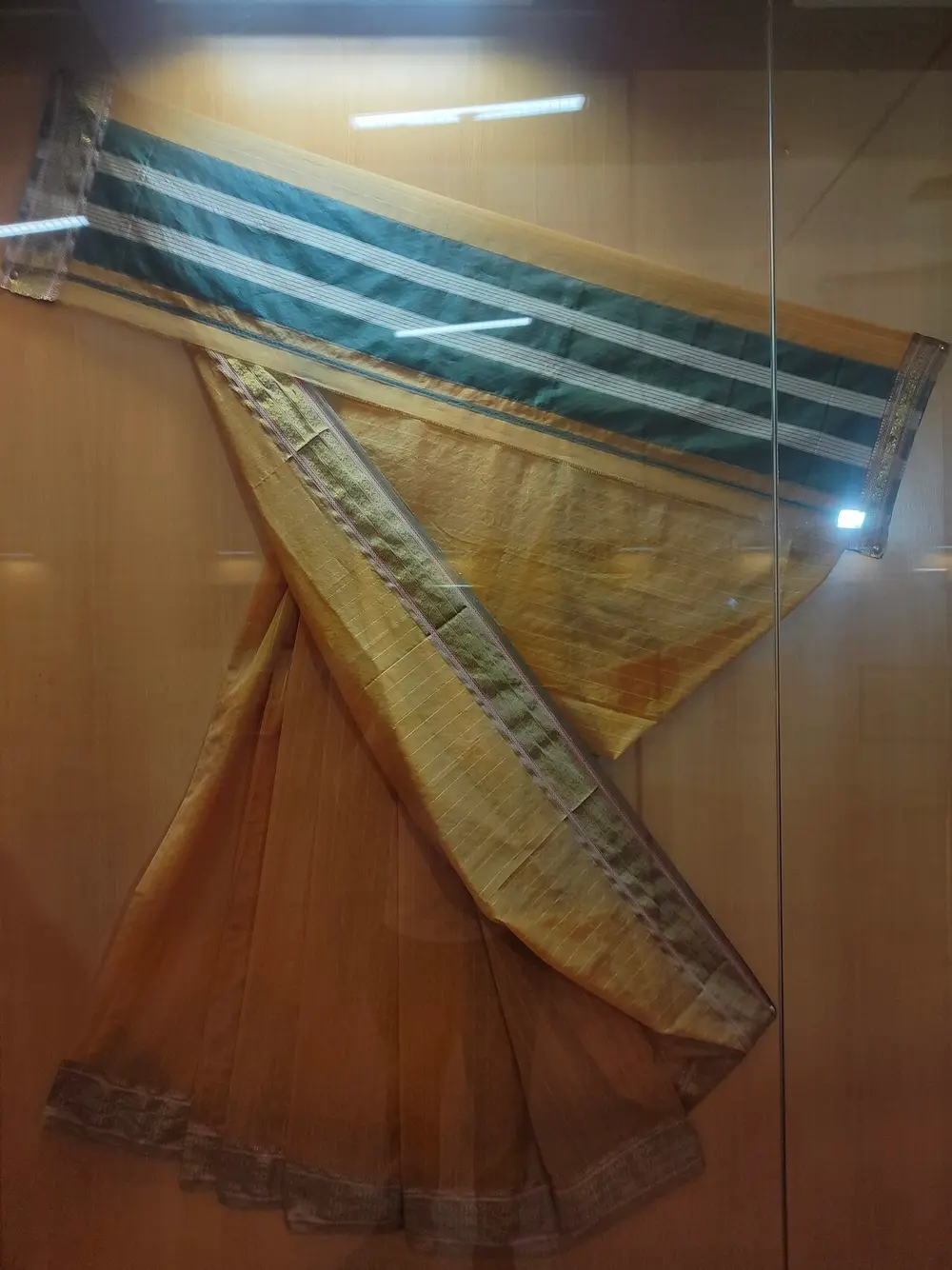
A pale gold sari in a museum case, with a green pallu crossed by white stripes and narrow patterned borders.
Picture: Bhaiyaji Smile 123. CC BY-SA 4.0.

Maheshwari

Where
Maheshwar, on the Narmada, Khargone district, Madhya Pradesh
When
18th century
Who
Queen Ahilyabai Holkar of Indore
Made with
Cotton, silk and zari

Ahilyabai Holkar brought weavers to her capital at Maheshwar to make saris for her court and as royal gifts. Its motifs are said to come from the riverside fort: woven mats (chatai), bricks (eent), diamonds (heera) and waves (leheriya). The border is reversible, so the sari can be worn either way out, and the pallu usually has bold stripes.

Spot it by

Plain or checked body in soft colours, a reversible border, and a striped pallu.

Remember

Maheshwar sits on the Narmada, and its sari borders flip like the river.

Don't confuse

Chanderi is from the same state but is sheerer, with scattered gold buti.
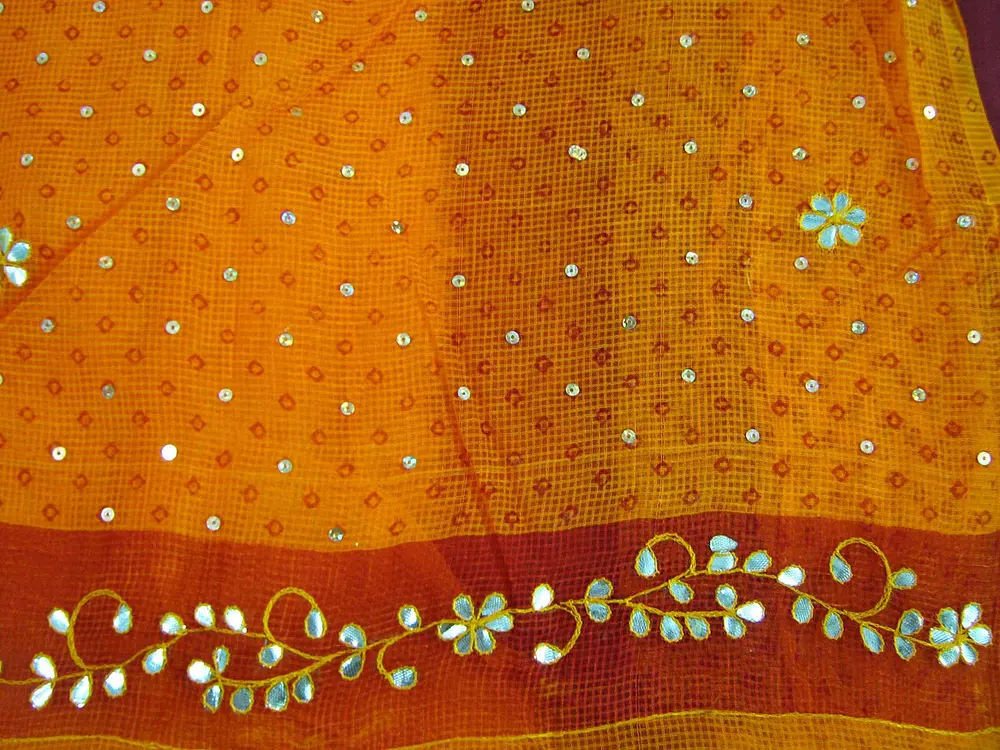
An orange Kota sari with a fine grid of tiny woven squares, scattered sequins and a border of gota leaves and flowers.
Picture: आशीष भटनागर. Public domain.

Kota Doria

Also called Kota Doriya, Kota masuria

Where
Kaithoon, near Kota, Rajasthan
Made with
Cotton and silk, on pit looms

A very light, open fabric whose whole surface is a grid of tiny squares called khats, a little like graph paper. Cotton gives it a crisp feel and a small amount of silk adds strength. The sari in the picture has a gota border and sequins added on top of the woven checks.

Spot it by

Look for the even little square checks right across the cloth.

Remember

Kota Doria, Khats.

Don't confuse

Chanderi is sheer too, but has no check grid.

Ikat: dyed before it is woven

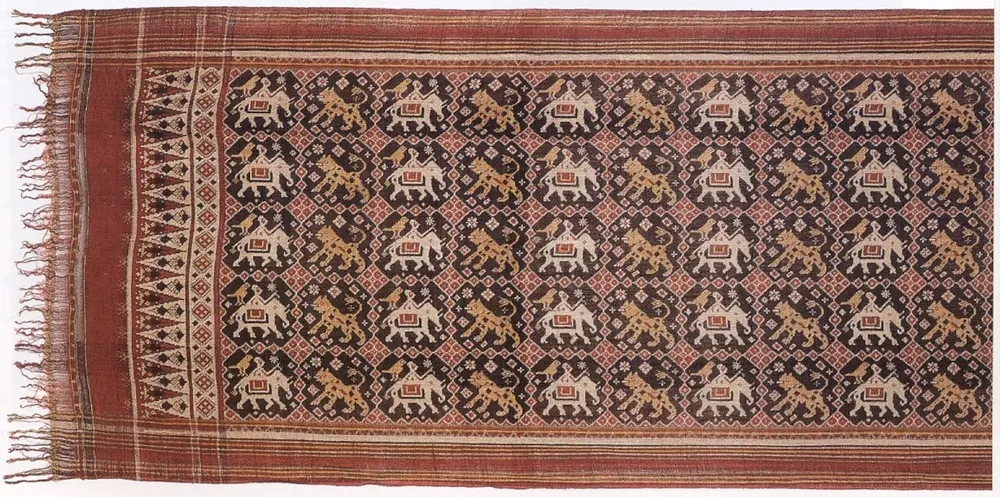
A long silk cloth with fringed ends, patterned in a grid of white elephants with riders and golden lions, all with slightly blurred edges.
Picture: Unknown weaver, Honolulu Museum of Art. Public domain.

Patola

Also called Patan Patola (singular patolu)

Where
Patan, Gujarat
Who
The Salvi weaving families
Style
Double ikat
Made with
Silk, both warp and weft tie-dyed

India's most famous double ikat. Both the warp and the weft are tied and dyed to a planned pattern, then lined up thread by thread on the loom, so one sari can take months. Because the colour is in the threads, both sides of the cloth look the same. Patola were prized trade goods as far away as Indonesia, where they were kept as heirlooms.

Spot it by

Bold grids of elephants, flowers and geometric stars, all with soft, stepped edges, and the same on both sides.

Remember

Patola is double trouble: warp and weft are both dyed.

Don't confuse

Pochampally is also ikat but from Telangana, and mostly uses bold geometric shapes rather than animals and figures.
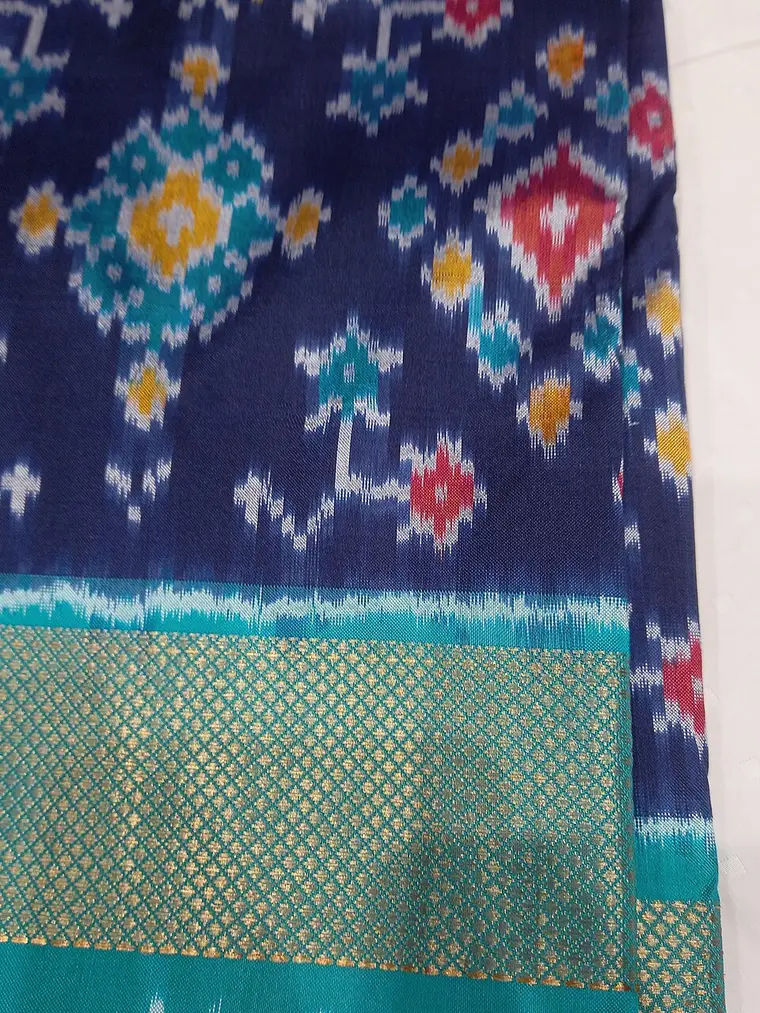
A navy silk sari with diamond and flower shapes in red, yellow and teal, their edges blurred, above a teal border with a gold zari grid.
Picture: Ramkumar Kalyani. CC BY-SA 4.0.

Pochampally

Also called Pochampally Ikat, Paagadu Bandhu

Where
Bhoodan Pochampally, Yadadri Bhuvanagiri district, Telangana
Style
Ikat (single and double)
Made with
Cotton and silk

Telangana's ikat, woven in Pochampally and the villages around it. Its patterns are mainly sharp geometric shapes such as diamonds, zigzags and stepped flowers. It was one of the very first crafts in India to get a GI tag.

Spot it by

Bold diamonds and zigzags with feathery, slightly smudged edges, often in strong colours.

Remember

Pochampally, Polygons.

Don't confuse

Exams sometimes give Andhra Pradesh as an option. Since 2014 Pochampally is in Telangana.
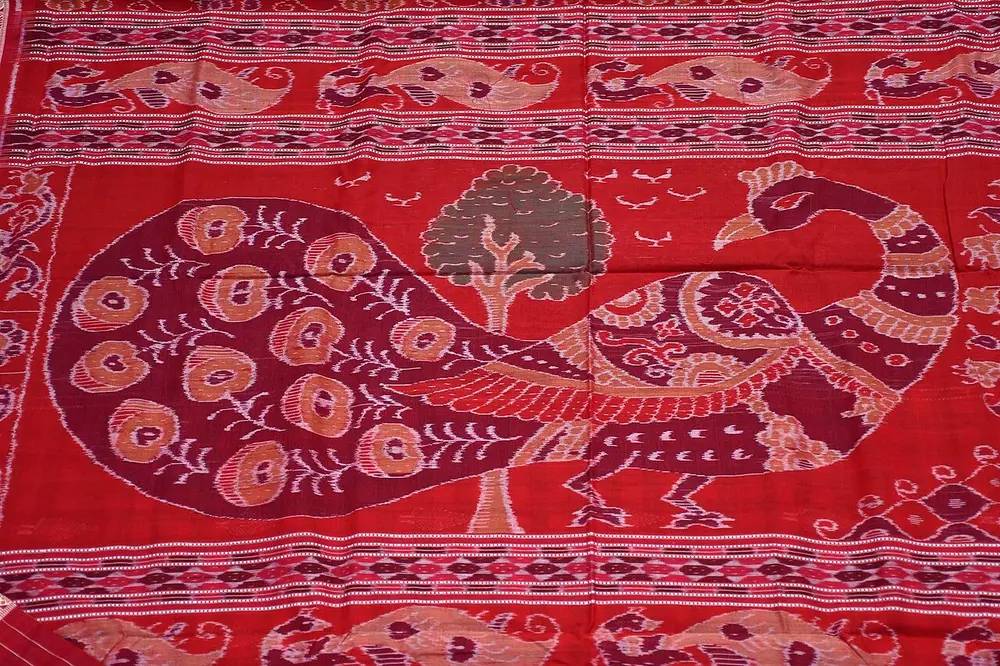
The pallu of a red Sambalpuri sari, with a large peacock and a tree in maroon and beige, their outlines softly blurred, between bands of small motifs.
Picture: Rahul191313. CC BY-SA 4.0.

Sambalpuri

Also called Sambalpuri bandha

Where
Western Odisha: Sambalpur, Bargarh, Balangir, Boudh and Sonepur
Style
Ikat, called bandha in Odia
Made with
Cotton and silk

Odisha's ikat. The yarn is tied and dyed before weaving (bandha means tied), giving motifs such as the conch (shankha), wheel (chakra) and flower (phula), as well as animals such as the peacock in the picture. Its GI name is "Sambalpuri Bandha Saree and Fabrics".

Spot it by

Blurry-edged motifs of conches, wheels, flowers and animals.

Remember

Sambalpuri comes from Odisha, the land of Jagannath's chakra.

Don't confuse

Patola (Gujarat) and Pochampally (Telangana) are ikats too; conch and wheel motifs point to Odisha.

Bengal and Assam

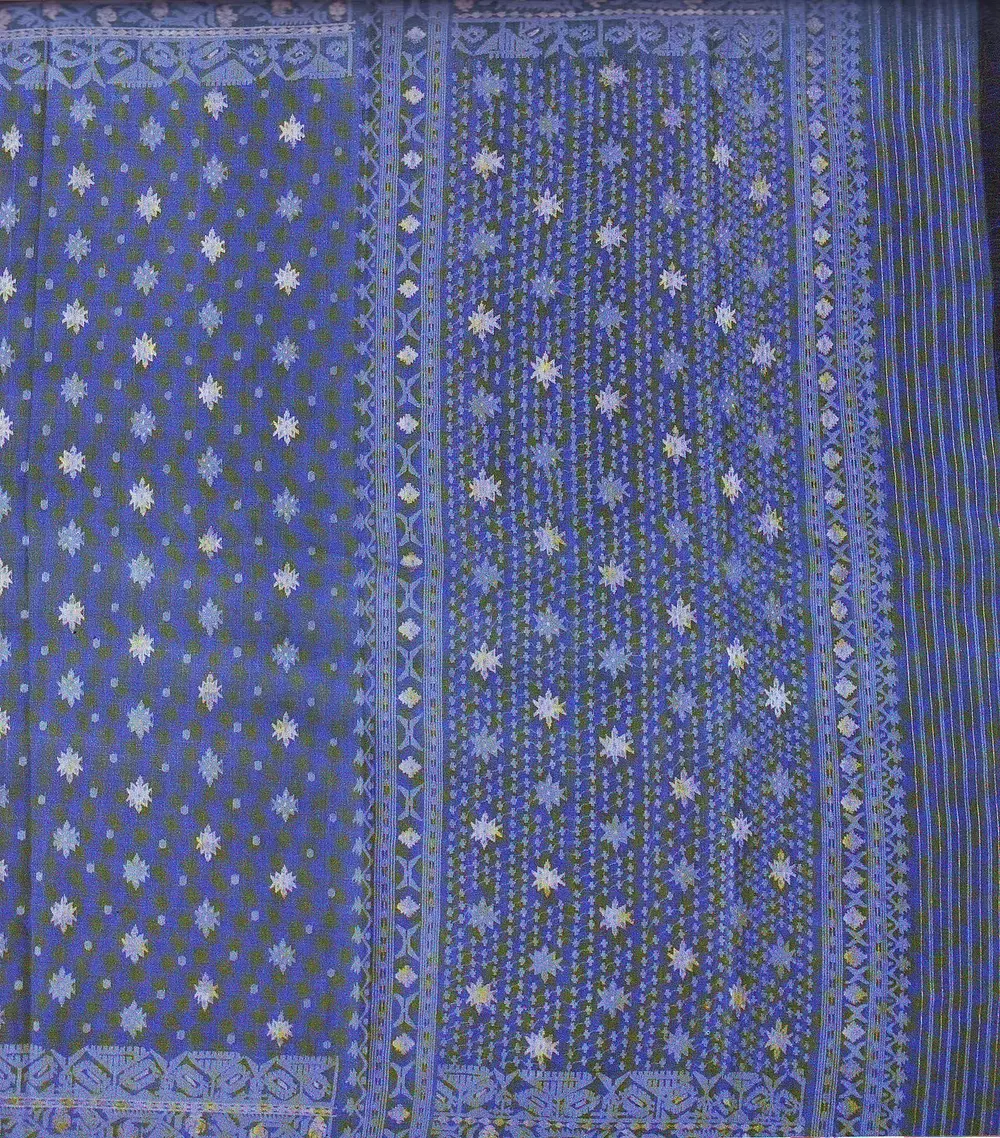
A blue cotton sari with rows of small white star-shaped flowers woven into the fabric and a patterned border.
Picture: A junaid alam khan at en.wikipedia. Public domain.

Jamdani

Also called Dhakai

Where
Dhaka region of Bangladesh; also West Bengal, and Uppada in Andhra Pradesh
Style
Fine cotton with woven motifs
Made with
Cotton muslin, with extra weft added by hand

Jamdani is a sheer cotton cloth whose motifs are made on the loom itself. For each little flower the weaver pushes a separate thread in and out of the warp by hand, only where the motif goes, so the pattern seems to float on the fine cloth. UNESCO listed the traditional art of Jamdani weaving of Bangladesh as Intangible Cultural Heritage in 2013. In India, "Uppada Jamdani Sarees" from Andhra Pradesh have a GI tag.

Spot it by

Light, translucent cotton with small geometric or flower motifs that look painted on but are woven in.

Remember

In Jamdani the flowers are woven, not stitched.

Don't confuse

Chikankari also puts white flowers on fine cotton, but it is embroidery, stitched after weaving.
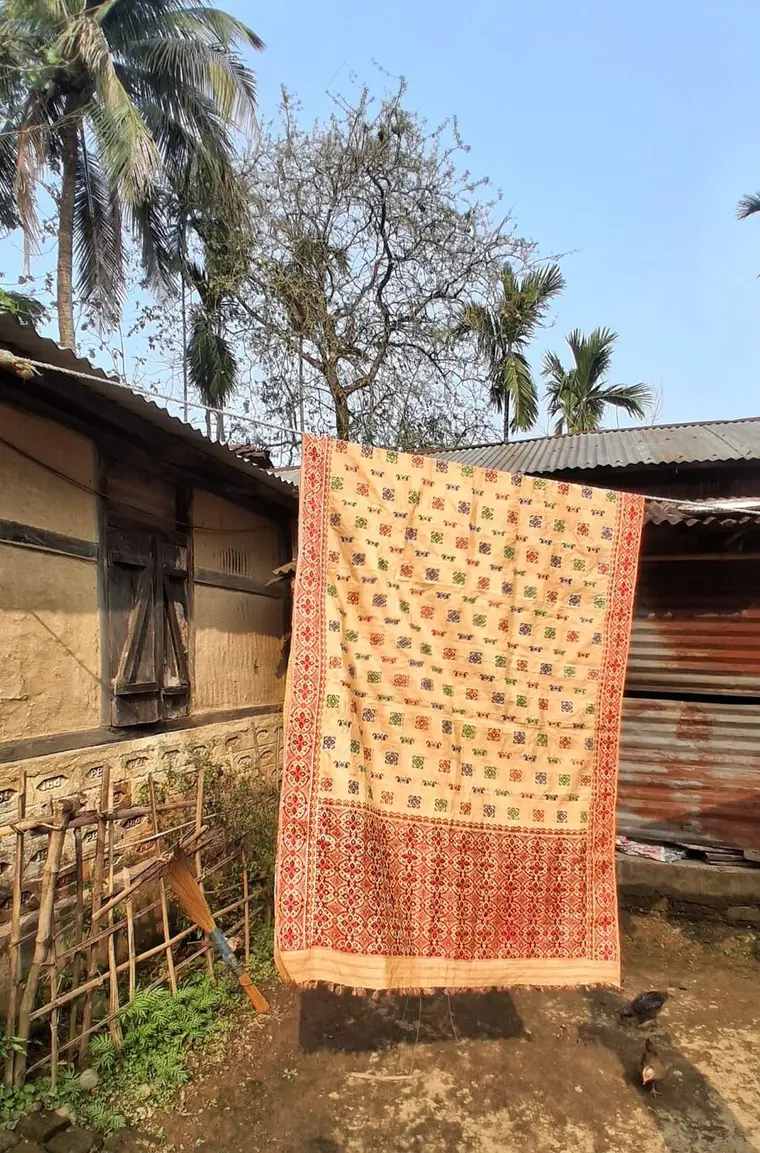
A golden-cream silk mekhela chador hung outside a village house, woven with small red, green and blue motifs and a deep red patterned border.
Picture: পাপৰি বৰা. CC BY-SA 4.0.

Muga silk

Also called Golden silk of Assam

Where
Brahmaputra valley, Assam; Sualkuchi is a famous weaving town
Made with
Silk from the muga silkworm, which feeds on som and soalu leaves

A wild silk found only in Assam, with a natural golden colour that needs no dye. Muga is woven into the mekhela chador, the two-piece dress of Assamese women, often with red motifs. Assam's other silk, eri, is soft and matt, and is made without killing the moth.

Spot it by

A natural golden sheen, usually as a mekhela chador with red woven motifs.

Remember

Muga means gold, and gold means Assam.

Don't confuse

Tussar is also a golden-brown wild silk, but it is rougher and comes from Bihar, Jharkhand and Odisha.

Wool from the mountains

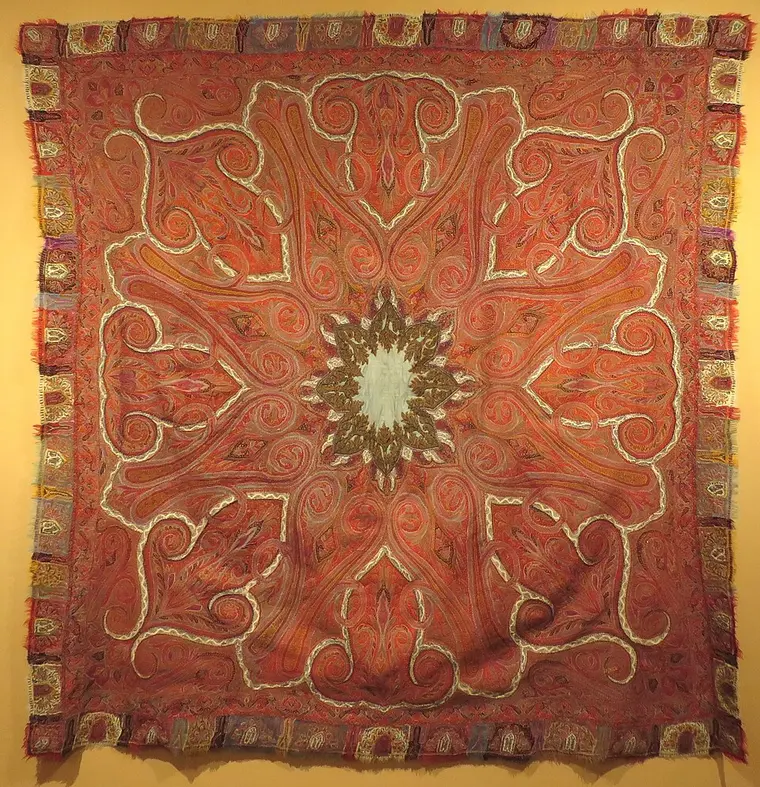
A square red Kashmir shawl in a museum, with a pale star-shaped centre, swirling paisleys and leaves, and a patchwork border.
Picture: Hiart. CC0.

Pashmina

Also called Kashmir shawl

Where
Kashmir valley; the wool comes from Ladakh
Made with
Fine underwool of the Changthangi goat, spun and woven by hand

Pashmina is the soft winter underwool of the Changthangi goat, raised by Changpa herders on the cold plateau of Ladakh. Kashmiri artisans spin it by hand and weave it into very light, warm shawls. The most famous patterned ones, kani shawls, have their designs woven in with many small spools of coloured yarn, a slow tapestry method; others are embroidered afterwards. "Kashmir Pashmina" and "Kani Shawl" each have a GI tag.

Spot it by

A soft, matt wool shawl, often with a paisley (buta) pattern.

Remember

The goat lives in Ladakh; the shawl is made in Kashmir.

Don't confuse

An embroidered Kashmiri shawl (sozni) has the pattern stitched on; a kani shawl has it woven in.
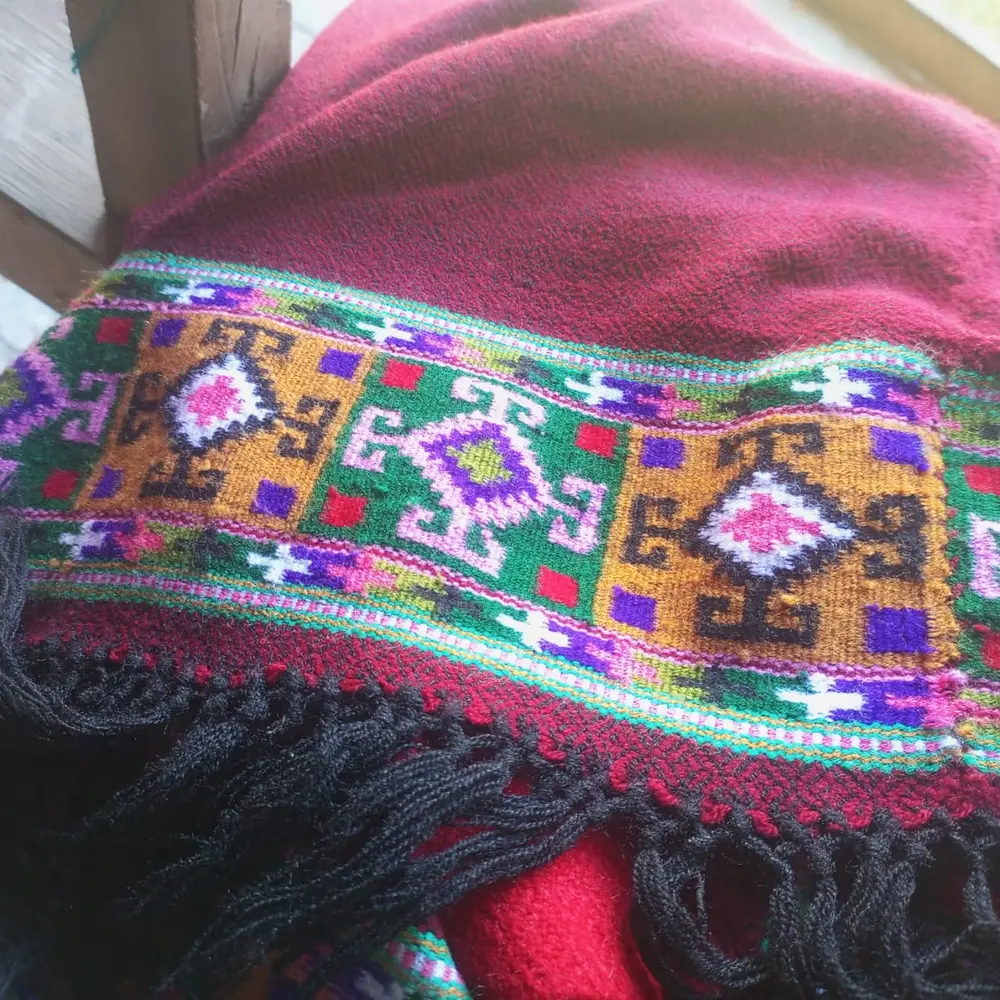
A maroon woollen Kullu wrap with black fringes and a wide woven border of geometric shapes in mustard, green, pink and purple.
Picture: Rajani Gairshail. CC BY-SA 4.0.

Kullu shawl

Where
Kullu valley, Himachal Pradesh
Made with
Sheep wool, and sometimes yak wool or pashmina

A warm woollen shawl from the Himalayan Kullu valley, woven on wooden handlooms. Its trademark is a band of bright geometric patterns, such as diamonds, hooks and stripes, at both ends. The same patterns decorate the pattu, the heavier wrap worn by women of the valley, which is the piece in the picture. Kullu Shawl was one of the first crafts given a GI tag.

Spot it by

A plain body in one colour with wide, bright geometric borders at the ends.

Remember

Kullu borders look like a row of building blocks.

Don't confuse

Pashmina from Kashmir is finer and usually has paisleys, not blocky geometry.

Weave by state

State Weaves to know
Uttar Pradesh Banarasi (Varanasi)
Tamil Nadu Kanjeevaram (Kancheepuram)
Maharashtra Paithani (Paithan, Yeola)
Karnataka Mysore silk
Madhya Pradesh Chanderi, Maheshwari
Rajasthan Kota Doria (Kaithoon, Kota)
Gujarat Patola (Patan)
Telangana Pochampally ikat
Odisha Sambalpuri bandha
West Bengal Baluchari (Bishnupur), Jamdani
Assam Muga silk, eri silk
Bihar Bhagalpur tussar silk
Jammu and Kashmir Pashmina, kani shawls
Himachal Pradesh Kullu shawl
Punjab Khes, a thick handwoven cotton sheet or wrap

UCEED 2025 asked students to place Phulkari, Chikankari, Sambalpuri and Paithani. The answer is Punjab, Uttar Pradesh, Odisha and Maharashtra. Two of those four, Phulkari and Chikankari, are embroidery, and they are in the next note, "Stitched by hand".

Don't confuse

These two How to tell them apart
Banarasi and Kanjeevaram Banarasi: gold brocade all over, Varanasi. Kanjeevaram: heavy silk with a contrast border joined on, Tamil Nadu.
Patola and Pochampally Both ikat. Patola: double ikat with elephants and figures, Gujarat. Pochampally: geometric shapes, Telangana.
Sambalpuri and Pochampally Both ikat. Sambalpuri has conch, wheel and flower motifs and is from Odisha; Pochampally is mostly geometric and from Telangana.
Paithani and Baluchari Both have a picture pallu. Paithani: peacocks and parrots, Maharashtra. Baluchari: scenes with people, West Bengal.
Chanderi and Kota Doria Both sheer. Kota Doria has a grid of tiny checks; Chanderi has scattered buti.
Jamdani and Chikankari Jamdani motifs are woven in. Chikankari is white embroidery stitched on later.
Muga and tussar Muga is golden, glossy and only from Assam. Tussar is rougher and from Bihar, Jharkhand and Odisha.
Kani and sozni shawls Both Kashmiri. Kani is woven; sozni is embroidered.

Test yourself

Question 1 of 8

Which of these is a Patola?

Question 2 of 8

Which of these is a Baluchari sari?

Question 3 of 8

This light cloth with a grid of tiny square checks is from which state?

Question 4 of 8

Which of these is a Jamdani?

Question 5 of 8

Sambalpuri and Paithani saris come from which states?

Question 6 of 8

What makes a cloth double ikat?

Question 7 of 8

Which silk has a natural golden colour and comes only from Assam?

Question 8 of 8

Pochampally ikat comes from which state?

From past papers

Real exam questions on this topic, each with a full solution.

Finished this note?

Mark it as studied to track your progress through the course.

Was this note useful?

Each picture is credited underneath it. Pictures of works still in copyright are shown small, for teaching only. If you hold the rights to a picture and want it removed, tell us through the contact page and we will take it down.