Amrita Sher-Gil
- Where
- Born in Budapest; worked in Paris, Shimla and Lahore; most of her paintings are in the National Gallery of Modern Art (NGMA), New Delhi
- When
- 1913 to 1941
- Who
- Hungarian mother and Sikh father
- Style
- Early Indian modernism
- Made with
- Oil on canvas
- Key works
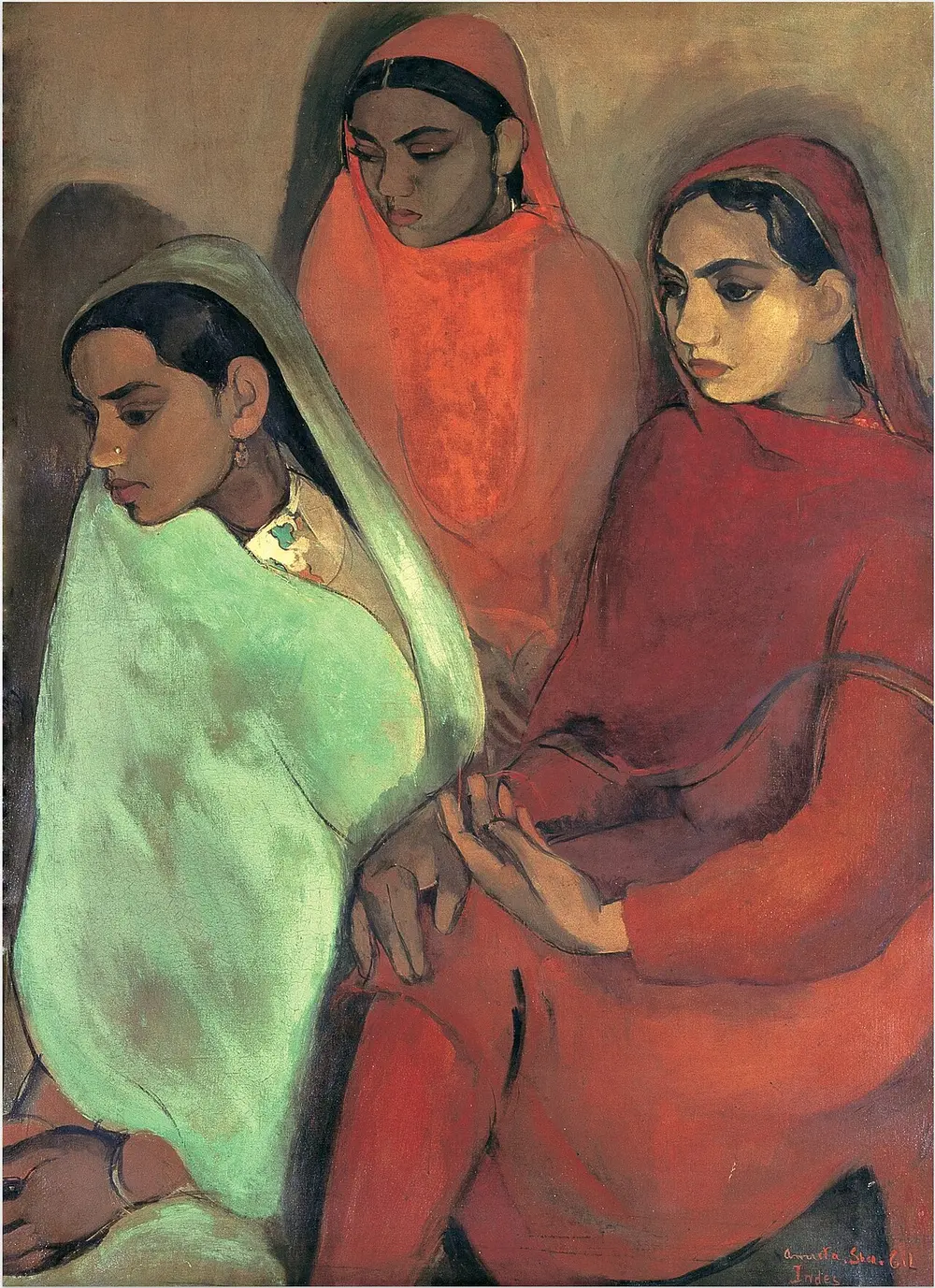
- Group of Three Girls (1935, shown here); the South Indian trilogy of 1937 (Bride's Toilet, Brahmacharis, South Indian Villagers Going to Market); The Story Teller (1937)
Sher-Gil trained in Paris, where her painting Young Girls won her a gold medal in 1933. She came back to India in the mid-1930s and decided her subject would be ordinary Indian people, especially women, painted with quiet sadness. A trip south in 1937 led to her South Indian trilogy, which borrowed from the Ajanta murals. She died in Lahore in 1941, aged only 28, and her works are now protected in India as national art treasures.
Spot it by
Heavy-lidded, downcast eyes, still and silent figures, faces that look a little sad, warm earthy browns, reds and ochres, simple flat backgrounds.Remember
Sher-Gil's girls never smile.Don't confuse
Anjolie Ela Menon. Menon's figures have huge dark eyes and a glassy, glowing surface; Sher-Gil's are painted in thicker, matt oil and look downwards.