India's resist-dyed and block-printed cloth, from Bandhani, Leheriya and Ajrakh to Bagru, Sanganeri, Dabu and Bagh, with batik and shibori, the natural dyes behind them and how a block print is made.
1In resist dyeing, part of the cloth is protected so the dye can't reach it. The resist can be thread (Bandhani, Leheriya, shibori), wax (batik) or mud (Dabu).
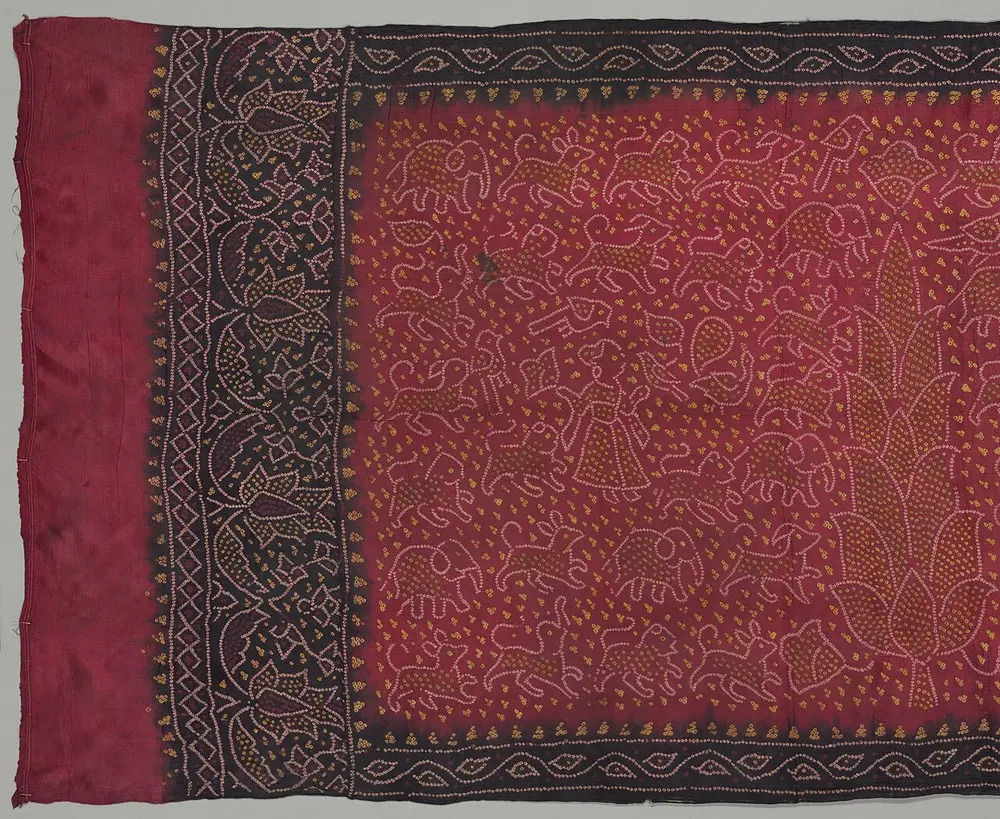
2Bandhani is tie-dye made of tiny dots, from Gujarat (Kutch, Jamnagar) and Rajasthan. Leheriya, from Rajasthan, is rolled and tied to make waves.
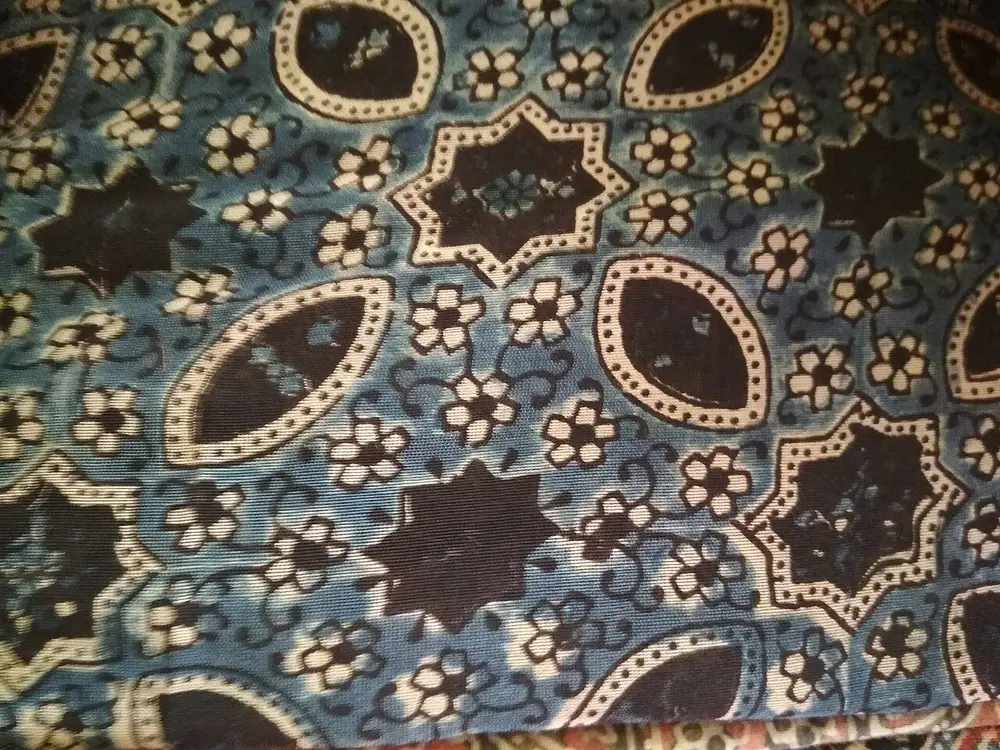
3Ajrakh is a block print in deep indigo and madder red with black and white, made in Sindh, Kutch (Ajrakhpur) and Barmer.
4Bagru and Sanganeri are block prints from near Jaipur. Sanganeri has fine flowers on a white ground; Bagru has a cream ground, black and red, and mud-resist Dabu.
5Bagh prints come from Dhar district, Madhya Pradesh, in red and black on white.
6Indigo gives blue with no mordant. Madder gives red only where the cloth has been treated with a mordant such as alum; harda (myrobalan) with iron gives black.
The basics
Indian cloth gets its pattern in three main ways. It can be woven in on the loom, stitched on with a needle, or put on with dye. This note is about the third.
Tie-dye (tie and dye): parts of the cloth are tied tightly with thread, so the dye can't get in there. Bandhani and Leheriya work this way.
Resist printing: a paste that blocks dye, such as wax or mud, is put on the cloth first. Batik uses wax; Dabu uses mud.
Block printing: a carved wooden block is dipped in colour, or in a mordant (a fixing chemical, explained below), and pressed onto the cloth again and again.
Ikat is tie-dye too, but done to the yarn. The threads are tied and dyed before weaving, so the pattern only appears as the cloth is woven. In single ikat only the warp or the weft is dyed; in double ikat both are. Patola (Gujarat), Pochampally (Telangana) and Sambalpuri (Odisha) are in the note Woven by hand.
Kalamkari from Andhra Pradesh is painted with a pen at Srikalahasti and block-printed at Machilipatnam. It is in the note Folk and tribal painting.
Kutch, Jamnagar and Saurashtra in Gujarat; Jodhpur, Jaipur and other towns of Rajasthan
Who
In Gujarat, families of the Khatri community; the tying is mostly done by women at home
Made with
Cotton or silk, thread and dye
The name comes from the Sanskrit bandh, to tie. The cloth is pinched up into tiny points with the fingernails and each point is wound tightly with thread. When the cloth is dipped, the tied points stay undyed. For more colours, more points are tied and the cloth goes into a darker dye, so the lightest colour always comes first. Untied, the cloth is covered in small dots, called bindi or bheendi, that make up flowers, figures and borders. The sari in the picture is a 19th-century one from Gujarat. GI tags: "Kutch Bandhani" and "Jamnagari Bandhani" (Gujarat) and "Jodhpur Bandhej Craft" (Rajasthan).
Spot it by
Thousands of tiny dots, each a little square or circle with a coloured centre, often on red, yellow or green.
Remember
Bandhani is bound: every dot is a tiny knot.
Don't confuse
Leheriya is also tied, but it makes diagonal stripes and waves, not dots.
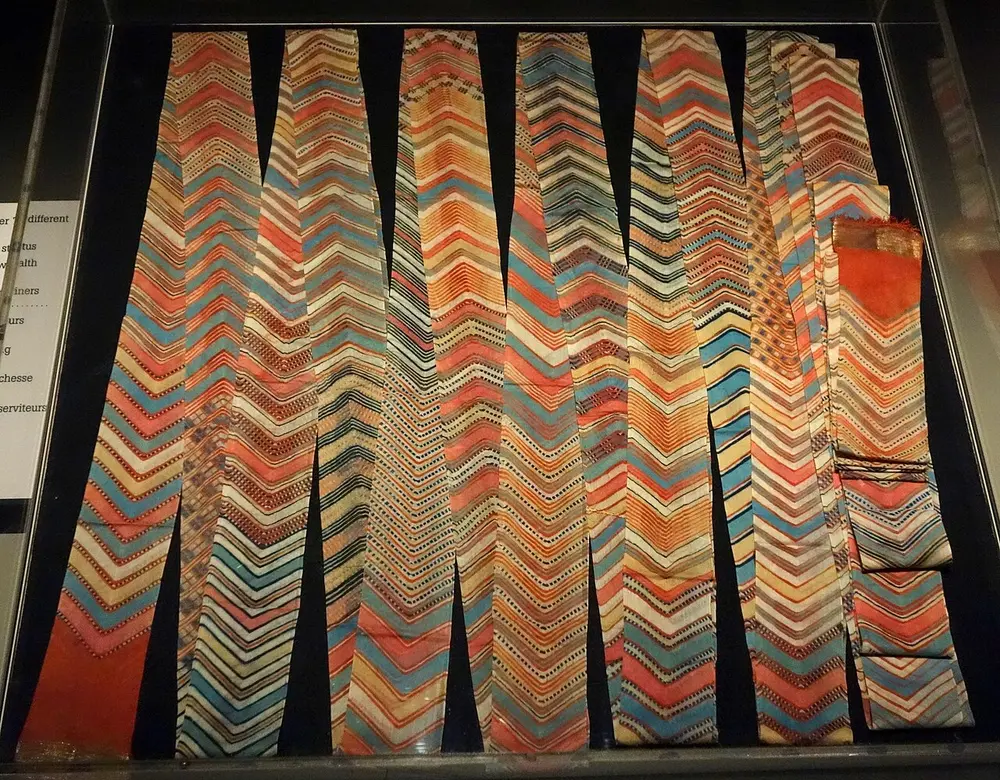
Lahar means wave. The thin cloth is rolled diagonally from one corner to the opposite edge, tied at intervals along the roll, and dipped in dye. Untied, it shows diagonal stripes. Folding the cloth like a fan before rolling turns the stripes into zigzag waves, as in the 19th-century turbans in the picture. If the ties are moved and the cloth is rolled along the other diagonal and dyed again, the stripes cross to make a check called mothara, after moth, a lentil, because the undyed squares are about that size.
Spot it by
Diagonal stripes or zigzag waves in bright colours, usually on a turban, dupatta or sari.
Remember
Leheriya looks like the waves the wind makes in the desert sand.
Don't confuse
Bandhani makes dots. Arashi shibori from Japan also makes diagonal stripes, by wrapping cloth around a pole.
Block prints of Gujarat, Rajasthan and Madhya Pradesh
Ajrakhpur and Dhamadka in Kutch, Gujarat; Barmer, Rajasthan; and Sindh in Pakistan
Who
Khatri printing families, whose craft came from Sindh
Made with
Cotton, natural dyes (indigo, madder, iron black) and resist pastes
Ajrakh is a block print with deep indigo blue and madder red, outlined in black and white. Its patterns are mostly geometric: stars, lens shapes and grids of small flowers, which repeat across the cloth. It takes many rounds of printing resists and mordants, dyeing, washing and drying, so one piece can take days or weeks. Khatri printers settled at Dhamadka in Kutch centuries ago. After the 2001 Gujarat earthquake many moved to a new village they named Ajrakhpur, now the best-known centre. "Kutch Ajrakh" has a GI tag.
Spot it by
Indigo and crimson with black and white, in tight geometric stars and grids.
Remember
Ajrakh is the blue and red star map of Kutch and Sindh.
Don't confuse
Bagru and Sanganeri, from near Jaipur, use flowers and leaves more than geometric stars, on a cream or white ground.
Bagru
Also called Bagru print, syahi-begar
Where
Bagru, about 30 km south-west of Jaipur, Rajasthan
Who
The Chhipa community of printers
Made with
Cotton, carved wooden blocks and natural dyes
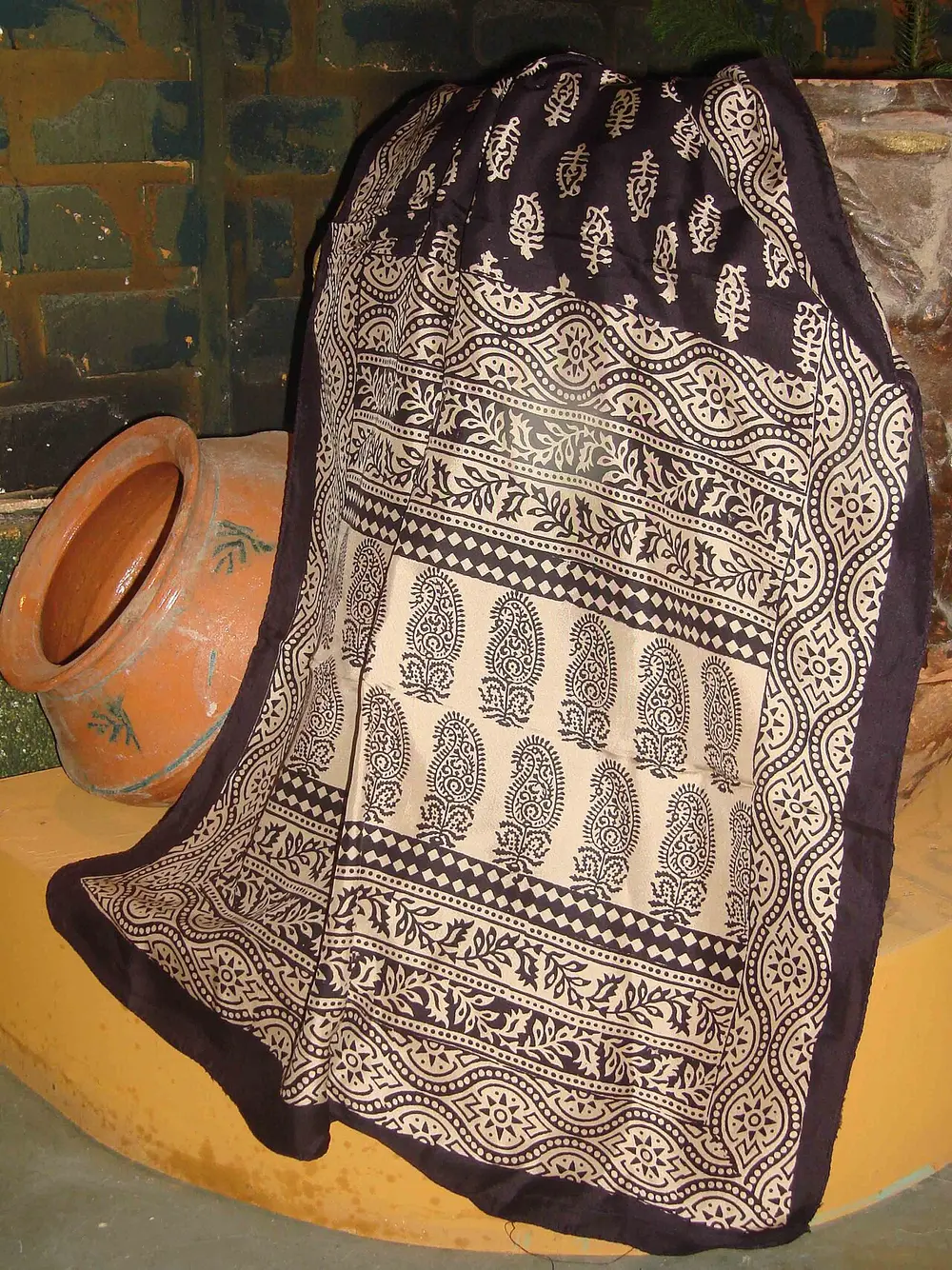
Bagru printers first soak the cloth in harda (myrobalan), which gives it a soft cream or yellowish ground. They then print in two classic colours: syahi, a black made from iron left to ferment with jaggery, and begar, a red that comes from alum and madder. The motifs are bold flowers, leaves and buds. Bagru is also a centre of Dabu, the mud resist. "Bagru Hand Block Print" has a GI tag.
Spot it by
Black and red flowers on a cream or pale yellow ground, or light patterns on indigo if it is Dabu.
Remember
Bagru: black and red on a beige ground.
Don't confuse
Sanganeri, made nearby, is finer and is printed on a bright white ground.
Sanganeri
Also called Sanganeri print
Where
Sanganer, on the southern edge of Jaipur, Rajasthan
Who
The Chhipa community of printers
Made with
Fine cotton or silk, teak blocks, and dyes
Sanganer, next to Jaipur, is famous for delicate block prints on a white ground. The motifs are small, fine-lined flowers and sprigs, called buti when small and buta when larger, often in rows. Fine outline blocks are printed first and the colours are filled in with further blocks. "Sanganeri Hand Block Printing" has a GI tag.
Spot it by
Small, neat, colourful flowers scattered or in rows on a white background.
Remember
Sanganeri is the city cousin: fine and white.
Don't confuse
Bagru, the village cousin, uses a cream ground and heavier black and red.
Akola in Chittorgarh district, Bagru, Sanganer and Pipar in Rajasthan
Made with
A paste of black clay, lime, wheat chaff and gum; wooden blocks; indigo
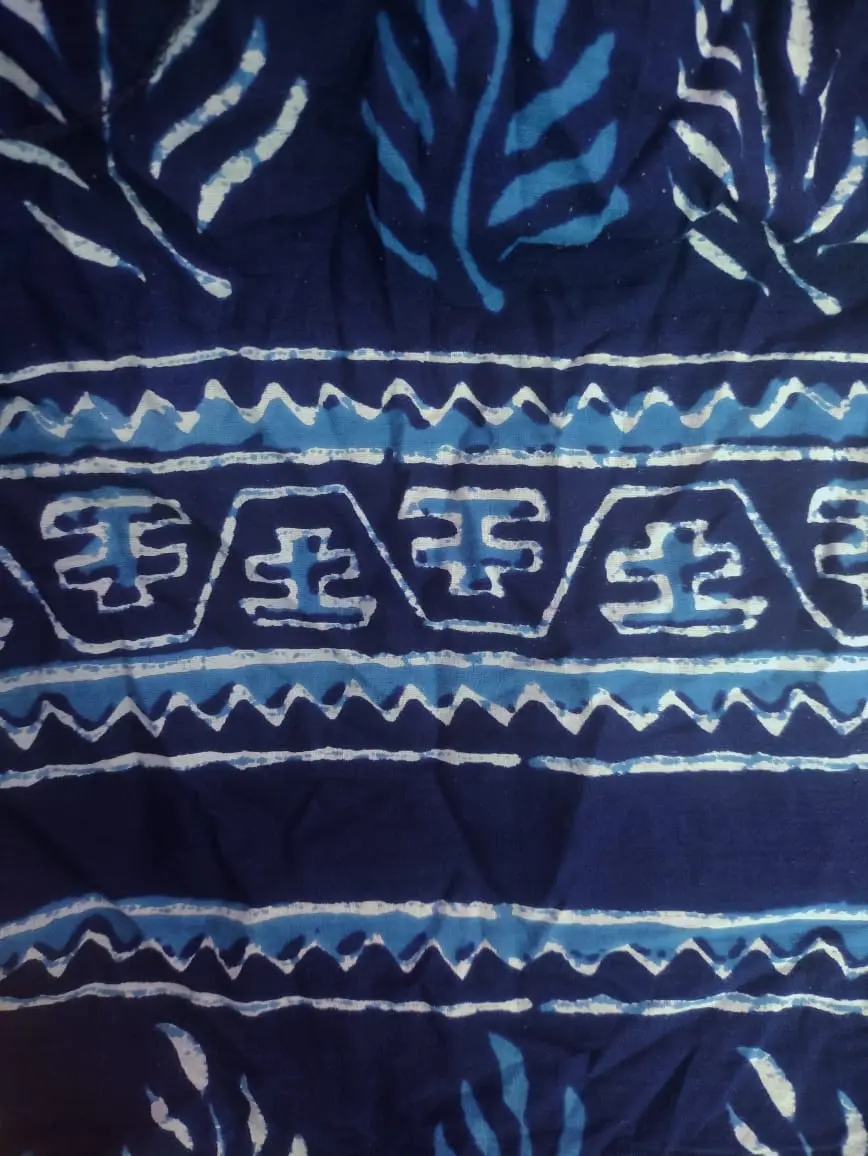
In Dabu the block prints a sticky mud paste instead of colour. Sawdust is sprinkled on the wet mud so it doesn't smudge. When the paste is dry the cloth is dipped in dye, most often indigo, and the mud keeps the dye out. As the dry mud cracks, a little dye seeps through, leaving fine veins. Printing and dyeing again over the first layer gives more shades of blue.
Spot it by
Light patterns on deep indigo, with a slightly cracked, veined look.
Remember
Dabu is a mud mask for cloth.
Don't confuse
Batik also cracks and shows veins, but its resist is wax, not mud.
Bagh, Dhar district, Madhya Pradesh, on the Bagh river
Who
Khatri printers whose families came from Sindh
Made with
Cotton or silk, natural dyes, alum and iron
Bagh prints are block prints in red and black on white. The red comes from alizarin, the colouring of madder, fixed with alum, and the black from iron. The motifs are geometric shapes, paisleys and flowers. The printed cloth is washed in the flowing water of the Bagh river, a tributary of the Narmada, and dried in the sun. "Bagh Prints of Madhya Pradesh" has a GI tag.
Spot it by
Crisp red and black patterns on a white ground.
Remember
Bagh is in Madhya Pradesh, the middle of the map, and its colours are the plain three: red, black, white.
Don't confuse
Ajrakh also uses red and black, but with a lot of indigo blue, and comes from Kutch and Sindh.
Java in Indonesia is its best-known home; in India, Santiniketan (West Bengal) and Ujjain (Madhya Pradesh)
Made with
Cotton or silk, hot wax and dye
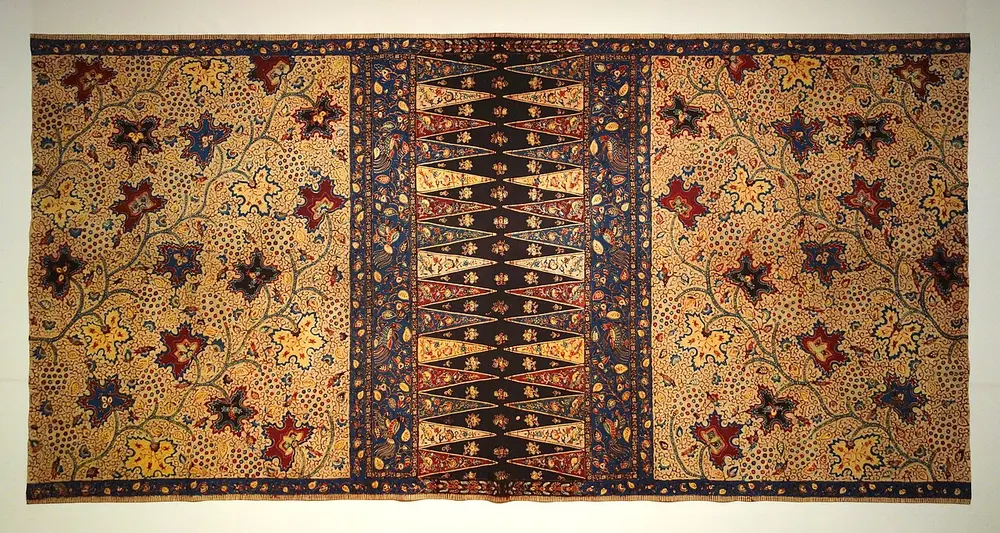
In batik, the resist is wax. Hot wax is drawn onto cloth with a small spouted copper tool, the canting (tjanting), or stamped on with a metal block, and the cloth is dyed. The waxed parts stay the colour underneath. Wax can be added and dyed again for more colours, then boiled or scraped off. Where the wax cracks, dye creeps in and leaves fine lines, the famous crackle. UNESCO listed Indonesian Batik as Intangible Cultural Heritage in 2009. The cloth in the picture is from northern Java, made around 1900 to 1910. In India, "Santiniketan Batik Textile" and "Ujjain Batik Print" have GI tags.
Spot it by
Fine cracked lines running through the colours, and soft-edged shapes drawn in wax.
Remember
Batik: wax keeps out the bath.
Don't confuse
Batik is a dye technique, not embroidery. NID 2020 asked which of Phulkari, Batik, Kashida and Chamba rumal is not an embroidery: the answer was batik.
Cotton or silk, thread, boards and poles; most often indigo
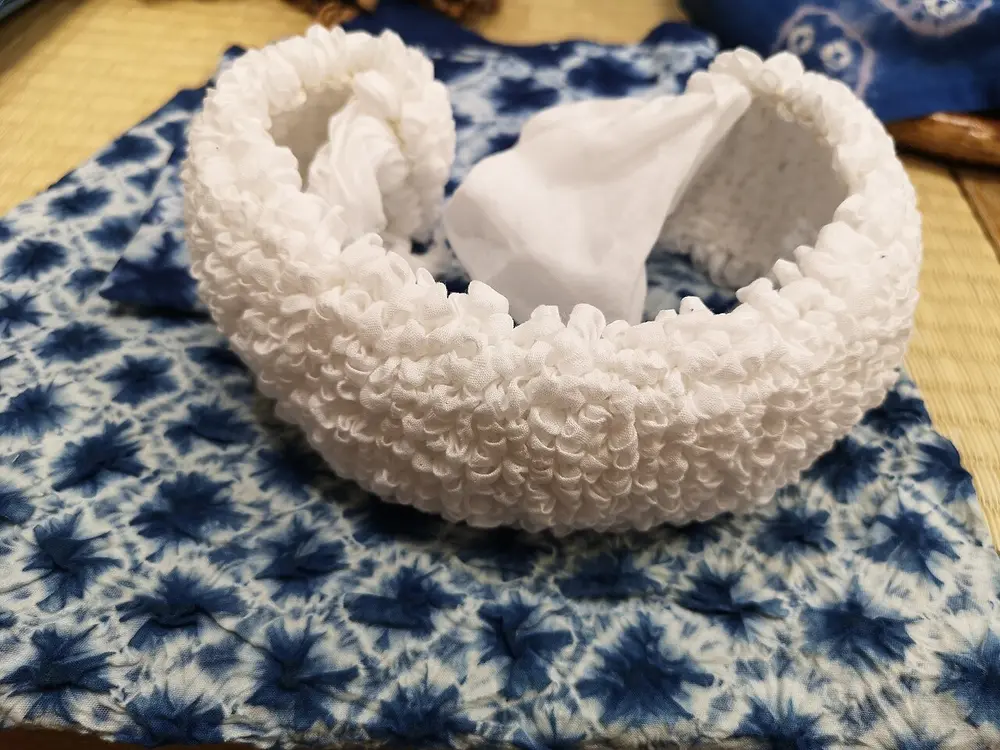
Shibori is Japan's family of resist methods, named from a word meaning to wring or squeeze. The cloth is shaped before it is dyed. In kanoko small bits are bound with thread, much like bandhani. In arashi the cloth is wrapped around a pole, bound and pushed together, giving diagonal lines like rain in a storm. In itajime it is folded and clamped between boards. In nui it is stitched and the thread pulled tight. The picture shows bound cloth from Arimatsu next to a finished piece.
Spot it by
Soft-edged white patterns on indigo: spots, stripes, folds or stitched lines.
Remember
Shibori is shaping, then dyeing.
Don't confuse
Bandhani is the Indian cousin of kanoko, and Leheriya the cousin of arashi. Batik uses wax, not thread.
Batik
Shibori
What keeps the dye out
Wax
Thread, folds, clamps or stitches
How it is put on
Drawn with a canting or stamped
Binding, wrapping, folding, stitching
Best-known home
Java, Indonesia
Japan
Look
Fine crackle lines
Soft spots, stripes and folds
Indian cousins
Santiniketan batik, Dabu (mud)
Bandhani, Leheriya
Natural dyes and mordants
Some dyes stick to cotton on their own. Most need a mordant, from the Latin for "to bite": a substance that fixes the dye to the fibre. Printers use this cleverly. They print the mordant only where they want colour, then dip the whole cloth; the dye holds where the mordant is and washes out everywhere else.
Material
What it is
What it does
Indigo
Leaves of the indigo plant
Blue; needs no mordant
Madder (manjistha)
Roots of the Indian madder vine
Red with alum; dark purple or brown with iron
Harda (myrobalan)
Dried fruit of the harad tree, full of tannin
First soak; gives a pale yellow ground; with iron makes black
Grown in many parts of India; the plant Indigofera tinctoria was first domesticated here
Made with
Leaves of the indigo plant, fermented in water
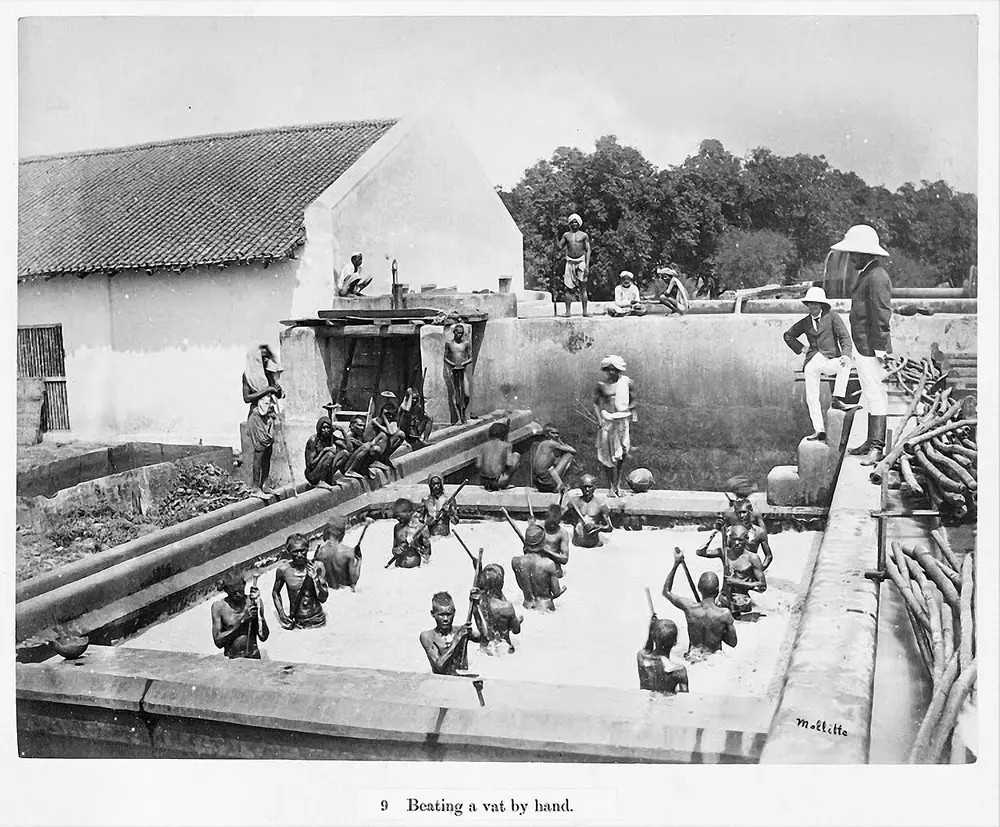
India's great blue dye, and the source of the colour of blue jeans. The leaves are soaked and fermented in tanks, and the liquid is beaten so air reaches it, making blue indigo settle out. It is dried into cakes. In the dye vat the indigo dissolves as a pale yellow-green; when the cloth is lifted out it turns blue in the air, and each dip makes it darker. It needs no mordant. The photograph shows an indigo factory near Allahabad in 1877. Under British rule many farmers were forced to grow indigo, and the Champaran Satyagraha in Bihar in 1917, against this, was Mahatma Gandhi's first satyagraha in India.
Spot it by
Deep blue cloth, often with white or pale patterns from a resist.
Remember
Indigo comes out of the vat green and turns blue in the air.
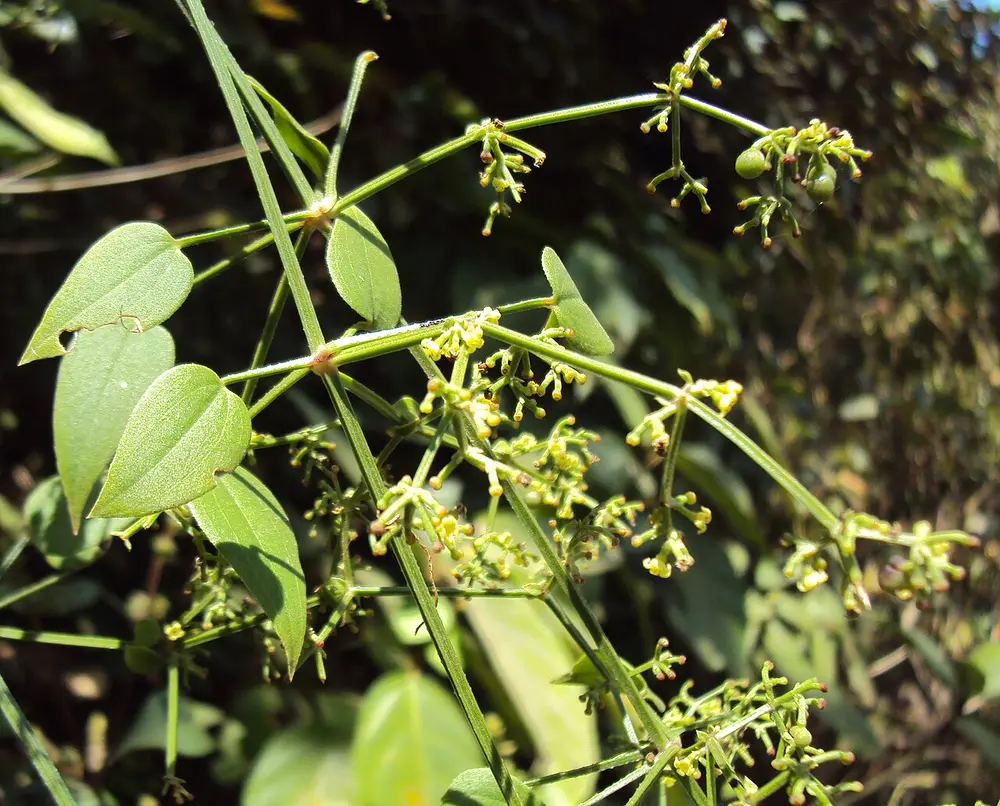
The roots of the madder vine (Rubia cordifolia), dried and ground
Madder is India's classic red. The dye is in the roots, not the leaves or flowers in the picture. On plain cotton it gives only a weak stain; on cloth printed with alum it turns a strong, lasting red, and on cloth printed with iron it goes purple or brown. That is why one dip in madder can give two or three colours on a block print. Many printers today use alizarin, madder's red colouring, made in factories since the 19th century.
Spot it by
The deep reds of Ajrakh, Bagh and Bagru prints.
Remember
Madder needs a mordant to be red; indigo doesn't need one to be blue.
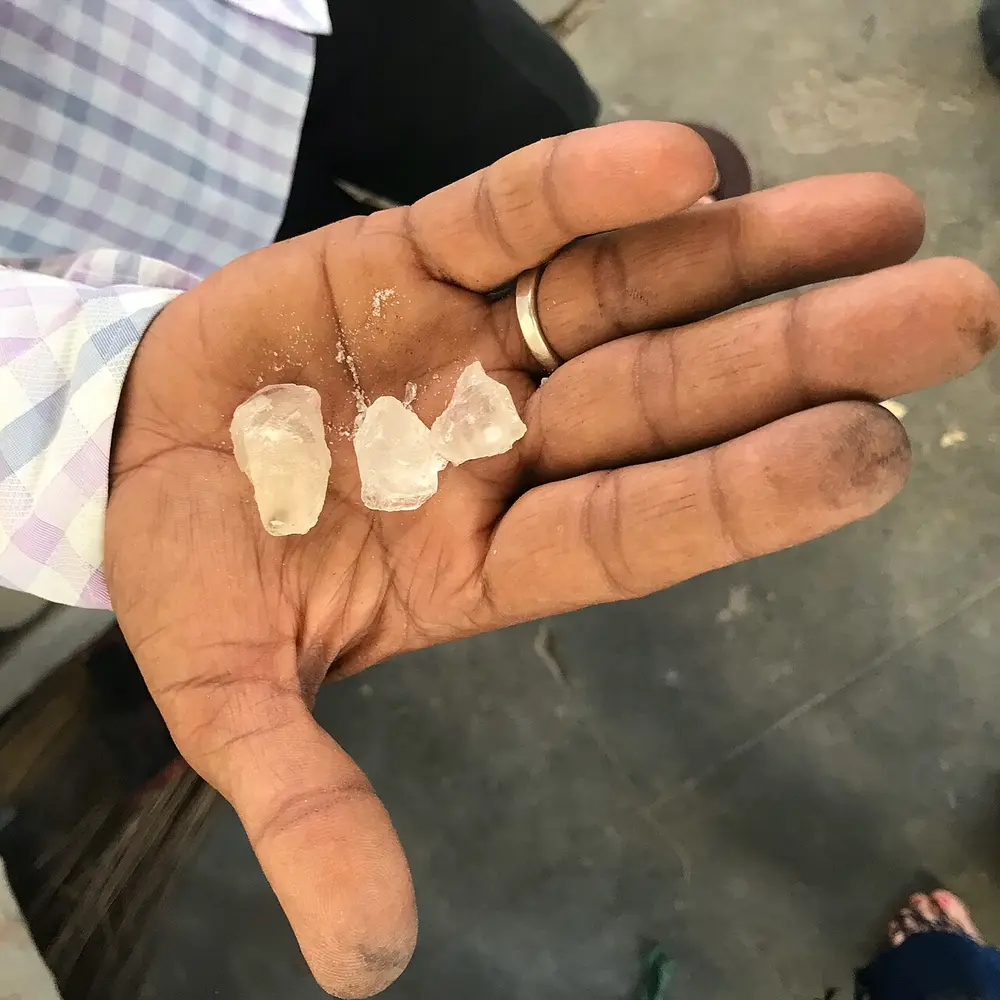
Alum crystals held by a dyer in Bhuj, Kutch. Ground and mixed into a paste, alum is printed where the red should go.
Rajasthan, Gujarat, Madhya Pradesh, Uttar Pradesh and elsewhere
Who
Block carvers, and printers such as the Chhipa of Rajasthan and the Khatri of Gujarat and Madhya Pradesh
Made with
Teak or sheesham wood blocks, cotton, dyes and mordants
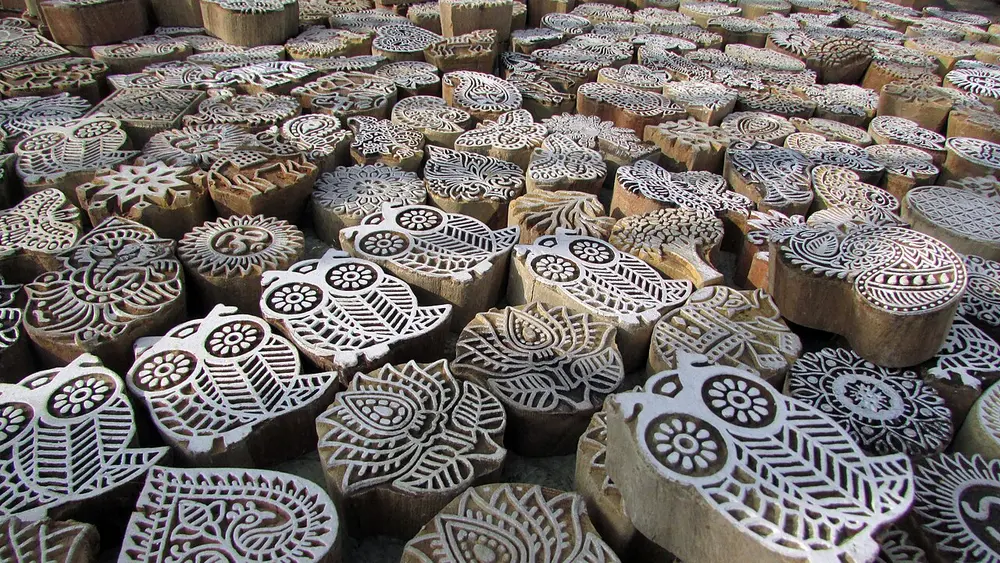
Each design needs a set of blocks: an outline block (rekh) and filling blocks for the colours (datta) and background (gadh). The printer lines up each block by eye against the last print, presses it down and thumps it with a fist, then moves along the cloth. Pethapur, in Gandhinagar district of Gujarat, is famous for carving blocks, and "Pethapur Printing Blocks" has its own GI tag.
Spot it by
Small repeats that don't quite line up, slight changes in colour from one print to the next, and the same pattern on the back showing through faintly.
Remember
One block, one colour.
The steps, in order:
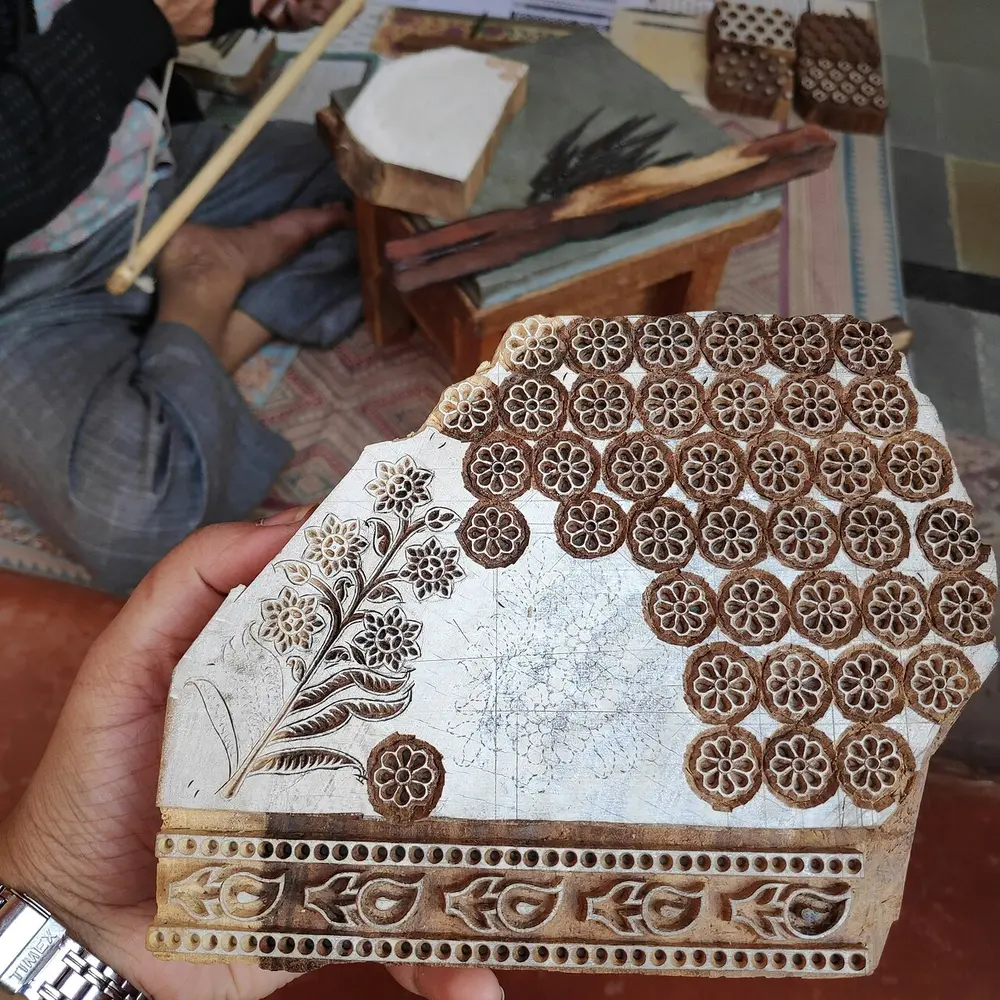
Carve the blocks. The design is drawn on a smooth block of teak or sheesham and cut by hand with small chisels and drills. Fine dots are sometimes made with metal pins hammered in.
Prepare the cloth. It is washed to remove starch and dirt, often soaked and beaten, and usually dipped in harda so it will take the dyes.
Print. The cloth is pinned on a long padded table. The printer dips the block in a tray of colour, mordant or resist paste, presses it on, and repeats, outlines first.
Dye. The cloth goes into the dye bath, such as indigo or madder, or is boiled with dye-producing plants.
Wash and dry. It is washed in a river or tank to remove the extra dye and paste, then dried in the sun. For a print with several colours, steps 3 to 5 are repeated.
A block being carved at the Anokhi Museum of Hand Printing in Jaipur. The flower circles are cut; the pale area is still to be carved.
A GI (Geographical Indication) tag means only makers from that place can sell their goods under that name.
Craft
GI name
State
Bandhani
Kutch Bandhani; Jamnagari Bandhani
Gujarat
Bandhej
Jodhpur Bandhej Craft
Rajasthan
Ajrakh
Kutch Ajrakh
Gujarat
Bagru
Bagru Hand Block Print
Rajasthan
Sanganeri
Sanganeri Hand Block Printing
Rajasthan
Bagh
Bagh Prints of Madhya Pradesh
Madhya Pradesh
Batik
Santiniketan Batik Textile
West Bengal
Batik
Ujjain Batik Print
Madhya Pradesh
Printing blocks
Pethapur Printing Blocks
Gujarat
Tie-dye
Madurai Sungudi
Tamil Nadu
Kalamkari
Srikalahasthi Kalamkari; Machilipatnam Kalamkari
Andhra Pradesh
Leheriya and Dabu don't have GI tags of their own in the registry as of October 2026.
Don't confuse
These two
How to tell them apart
Bandhani and Leheriya
Both tie-dye. Bandhani is dots; Leheriya is diagonal stripes and waves from rolled cloth.
Tie-dye and ikat
Tie-dye ties the finished cloth. Ikat ties the yarn before weaving.
Bagru and Sanganeri
Both near Jaipur. Sanganeri has fine flowers on white; Bagru has bolder black and red on cream.
Dabu and batik
Both crack and show fine veins. Dabu's resist is mud; batik's is wax.
Ajrakh and Bagh
Both use red and black. Ajrakh adds deep indigo and is from Kutch and Sindh; Bagh is red and black on white, from Madhya Pradesh.
Batik and shibori
Batik resists with wax (Java); shibori with thread, folds and clamps (Japan).
Dyeing and embroidery
Batik and Bandhani are made with dye; Phulkari and Kashida are stitched.
UCEED 2026 listed Ajrakh, Paithani, Kalamkari, Phulkari, Khes and Bandhani and asked what they have in common. All six are textiles. Only two, Paithani and Khes, are woven; Ajrakh is printed, Bandhani is tie-dyed, Kalamkari is painted or printed and Phulkari is embroidered. CEED 2023 asked what pattern a folded, rolled and dipped cushion cover would get: wherever the folds stack the cloth, the dye lands in repeating stripes.
Test yourself
Question 1 of 8
Which of these is Leheriya?
Question 2 of 8
Which of these is Ajrakh?
Question 3 of 8
This cloth is covered in tiny dots made by pinching and tying the cloth before dyeing. What is it called?
Question 4 of 8
The pale patterns on this indigo cloth were made by printing a paste of clay, lime and gum before dyeing. What is the technique?
Question 5 of 8
This kind of wax-resist cloth is most closely linked with which country?
Question 6 of 8
In block printing, what does alum do?
Question 7 of 8
This Japanese cloth was bound tightly with thread before it was dipped in indigo. What is the method called?
Question 8 of 8
Bagh prints, in red and black on white, come from which state?
From past papers
Real exam questions on this topic, each with a full solution.
Mark it as studied to track your progress through the course.
Was this note useful?
Each picture is credited underneath it. Pictures of works still in copyright are shown small, for teaching only. If you hold the rights to a picture and want it removed, tell us through the contact page and we will take it down.