How photography began, from Niépce and Daguerre to Kodak, Polaroid and the digital camera, how aperture, shutter speed, ISO and lenses change a picture, and the photographers exams ask about.
1The oldest surviving camera photograph is Niépce's View from the Window at Le Gras (1827). Daguerre's daguerreotype was announced in Paris in 1839, and Fox Talbot invented the negative, from which many prints can be made.
2George Eastman's Kodak (1888) put photography in everyone's hands, the Leica (1925) made 35 mm film popular, Edwin Land's Polaroid (1948) gave instant prints, and Steven Sasson built the first digital camera at Kodak in 1975.
3Three controls set how bright a photo is: aperture (how wide the lens opens), shutter speed (how long it stays open) and ISO (how sensitive the sensor is).
4A smaller f-number means a wider opening, more light and a shallower depth of field. A fast shutter freezes movement; a slow shutter blurs it.
5To blur the background, open the aperture wider, move closer to the subject or use a longer focal length. Shutter speed does not change depth of field.
6Indian names to know: Raja Deen Dayal (court photographer in Hyderabad), Homai Vyarawalla (India's first woman photojournalist), Raghu Rai (Magnum Photos) and Danish Siddiqui (Pulitzer Prize, 2018).
From a dark room to the first photographs
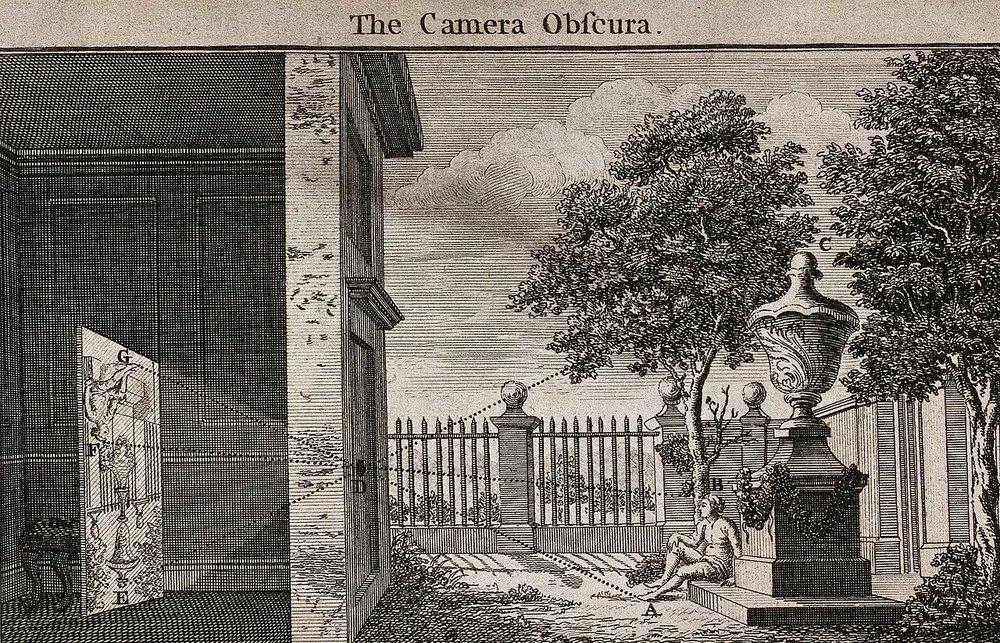
A camera is a dark box with a hole that lets light in. The idea is very old. In a camera obscura (Latin for "dark room"), light from a bright scene passes through a small hole and paints a picture of the scene on the opposite wall, upside down and reversed left to right. For centuries people could watch that picture but not keep it. Photography began when inventors found materials that change when light falls on them, and put them inside the dark box.
Light rays cross as they pass through the hole, so the picture inside the camera obscura is upside down. A camera works the same way, with a lens in the hole and film or a sensor in place of the wall.
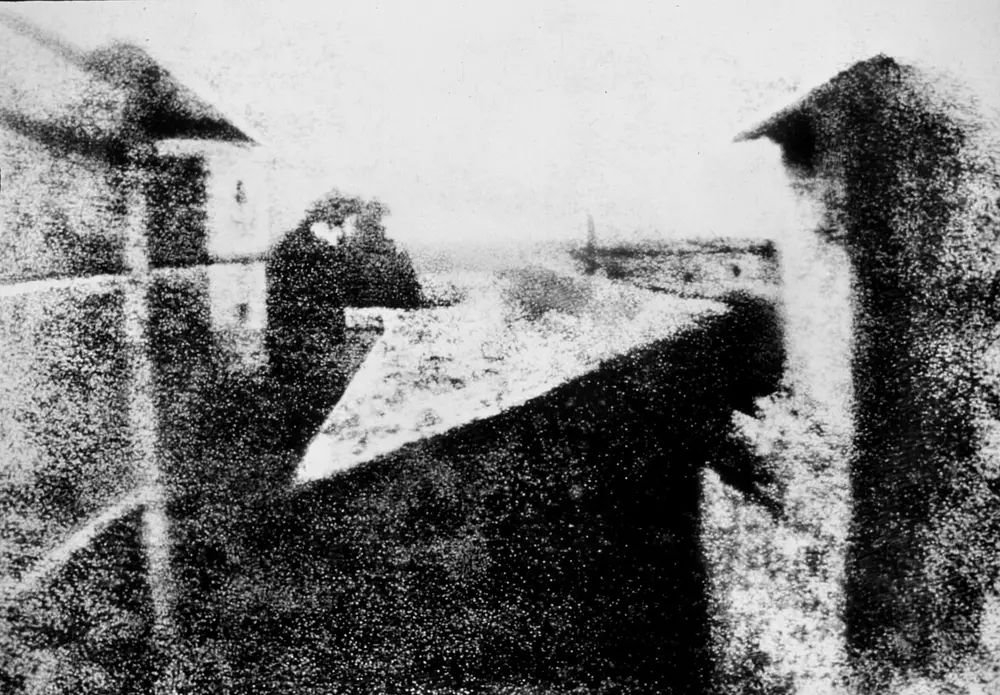
Saint-Loup-de-Varennes, France; now at the Harry Ransom Center, University of Texas at Austin
When
1827
Who
Nicéphore Niépce, France
Made with
Bitumen (a natural tar that hardens in light) on a polished pewter plate, inside a camera obscura
Niépce coated a metal plate with bitumen, put it in a camera obscura facing the window of his upstairs workroom, and waited. The bitumen hardened where light fell on it, and the soft parts were washed away with oil of lavender, leaving a picture of the rooftops outside. The exposure lasted several days. He called his process heliography, "sun writing". It is the oldest surviving photograph taken with a camera.
Spot it by
A dim, grainy view of rooftops, with sunlight on both sides of the scene because the sun moved during the very long exposure.
Remember
Niépce was first; Daguerre made it famous; Talbot made it copyable.
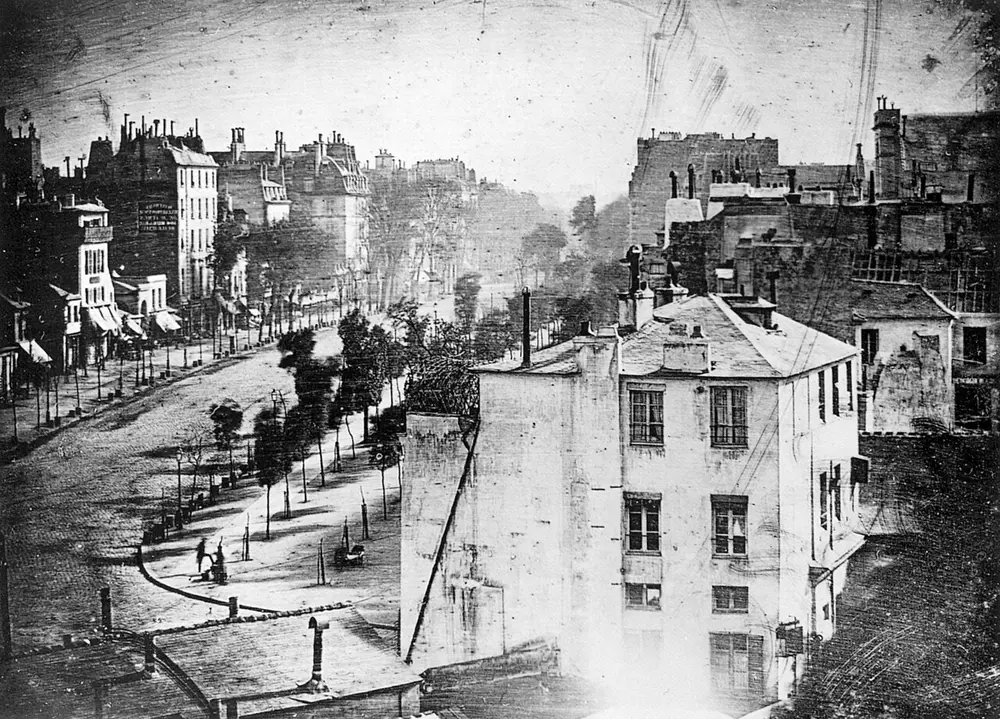
Daguerreotype: a silver-coated copper plate, developed with mercury fumes
Daguerre had worked with Niépce, and after Niépce died he found a much faster process. He announced the daguerreotype to the French Academy of Sciences in January 1839, and on 19 August 1839 the French government gave it "free to the world". A daguerreotype is a sharp, mirror-like picture on metal, but each one is unique: it cannot be copied. In this street scene the exposure took several minutes, so moving carriages and walkers left no trace. Only a man having his boots polished stood still long enough, which makes him one of the first people ever photographed.
Spot it by
A shiny metal plate with very fine detail, kept behind glass in a small case.
Remember
1839 is the year photography was announced to the world.
Don't confuse
A daguerreotype is a single positive picture with no negative. Talbot's paper process made a negative, so it could give many prints.
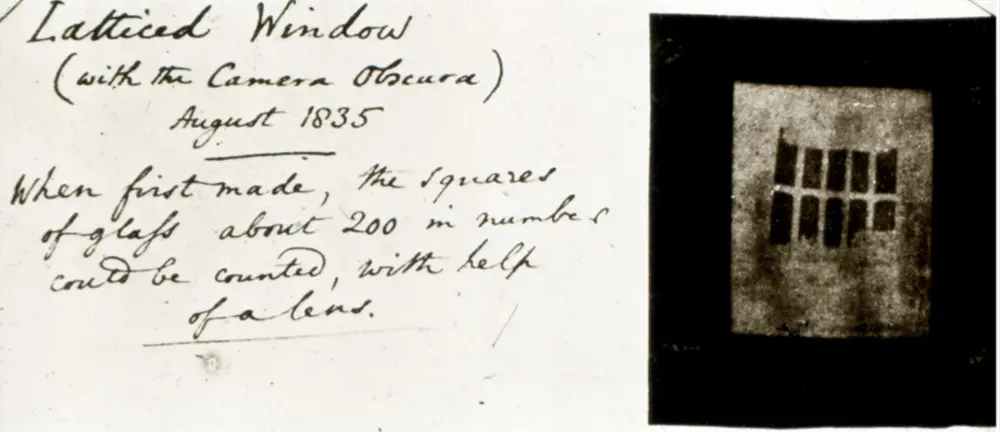
Talbot photographed a window of his home on light-sensitive paper. The result is a negative: light parts come out dark and dark parts light. When light is shone through a negative onto a second sheet of sensitive paper, the tones flip back and you get a positive print, as many times as you like. This negative-to-positive idea was the basis of film photography for the next 150 years. Talbot improved it into the faster calotype, patented in 1841, and published The Pencil of Nature (1844 to 1846), one of the first books illustrated with photographs.
Spot it by
Talbot's own note says that when it was new, the window's 200 or so small panes could be counted with a magnifying lens.
Remember
Talbot gave us the negative, and the negative gave us copies.
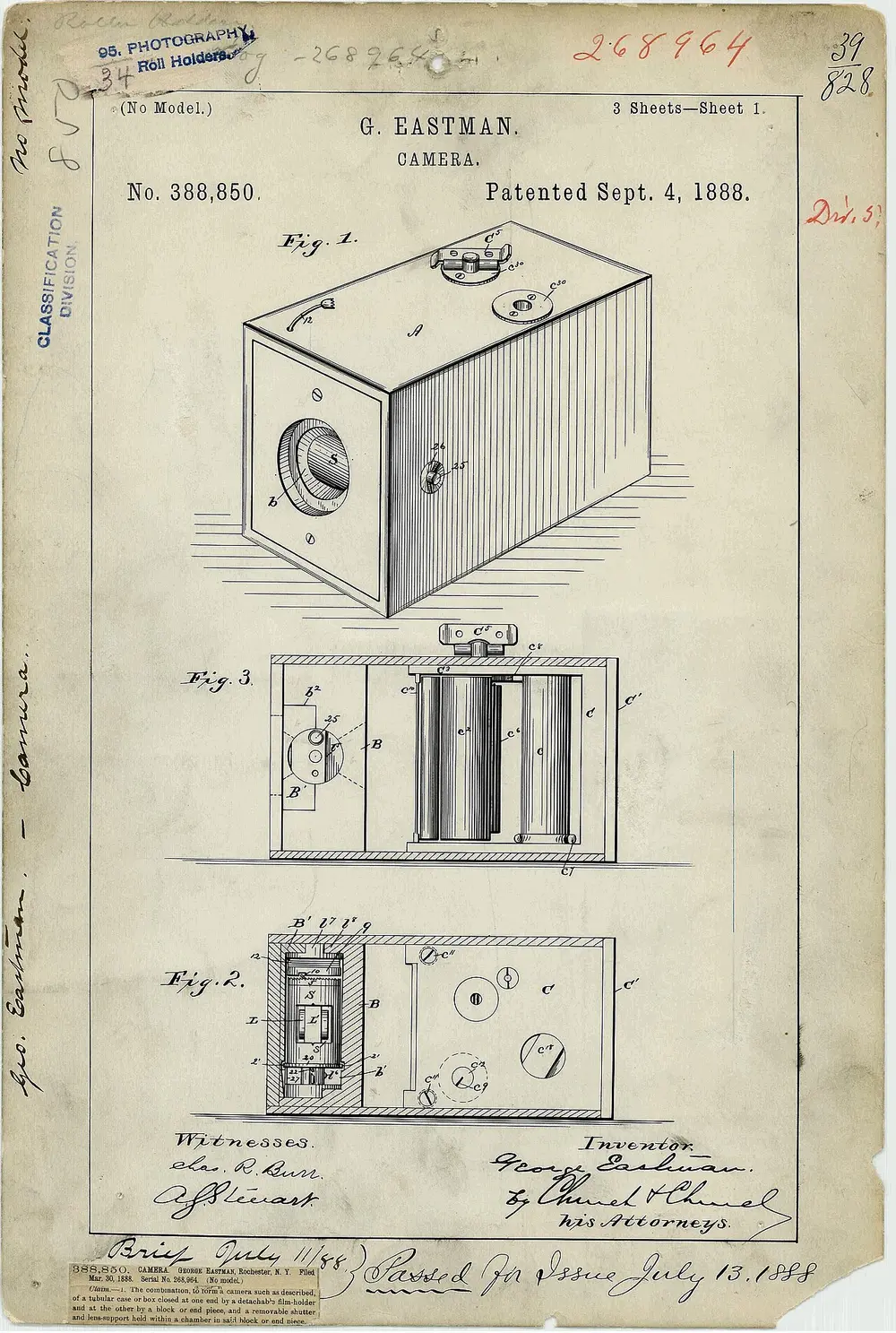
A small wooden box camera loaded with a roll of film for 100 pictures
Early photography needed heavy glass plates and a lot of chemistry. Eastman's Kodak was a simple box, sold already loaded with a roll of film for 100 pictures. When the roll was used up, the owner posted the whole camera back to the factory, which developed the film, printed the photos and sent the camera back reloaded. The slogan said it all: "You press the button, we do the rest." Eastman made up the name Kodak himself. In 1900 Kodak's cheap Brownie camera brought photography to children as well.
Spot it by
This drawing is from Eastman's patent, granted on 4 September 1888.
Remember
Kodak, 1888: you press the button, we do the rest.
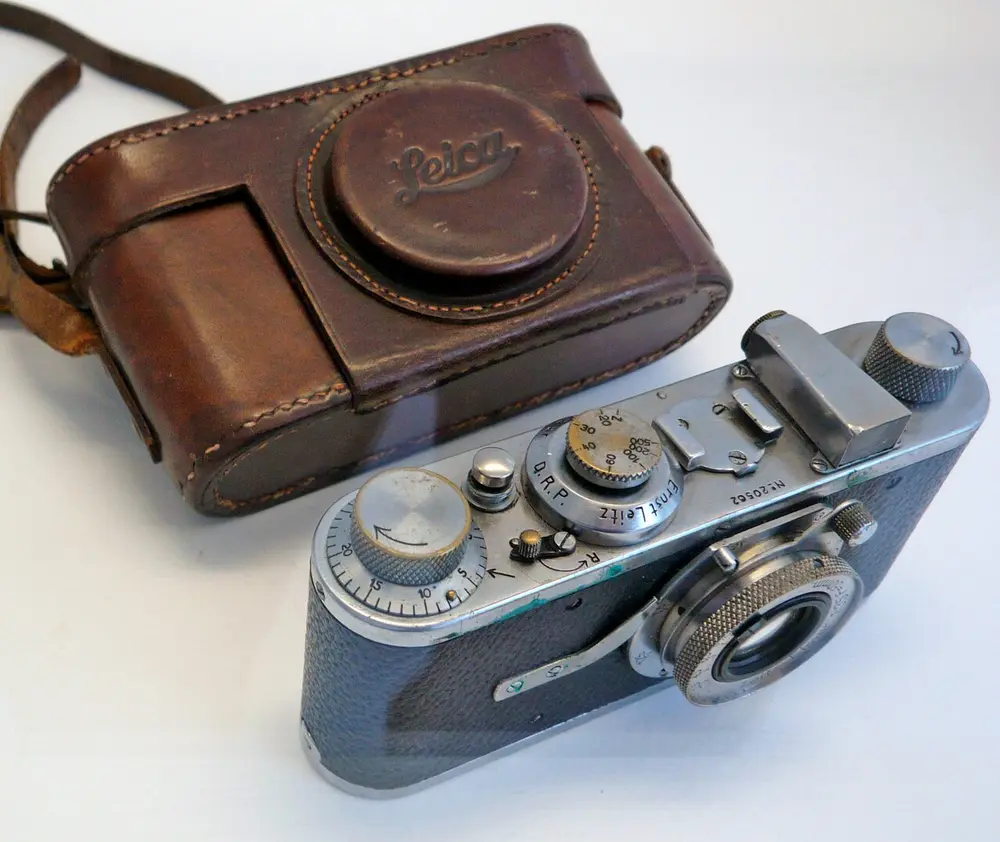
Metal body using 35 mm cinema film, with a 50 mm lens
Barnack, an engineer at the Leitz optics company, wanted a camera small enough to carry on walks. Around 1913 he built one that used the 35 mm film of the cinema, run sideways to give frames 36 by 24 mm. Leitz sold it from 1925 as the Leica, short for "Leitz camera". Small, quiet and quick, it let photographers work in the street without being noticed, and 35 mm became the world's standard film. Today's "full-frame" digital sensors are the same size as one 35 mm frame. The Commons record says this Leica I was Henri Cartier-Bresson's first camera.
Spot it by
A small metal body with dials on top and a short lens, small enough to hold in one hand.
Remember
Leica means Leitz camera, and it made 35 mm famous.
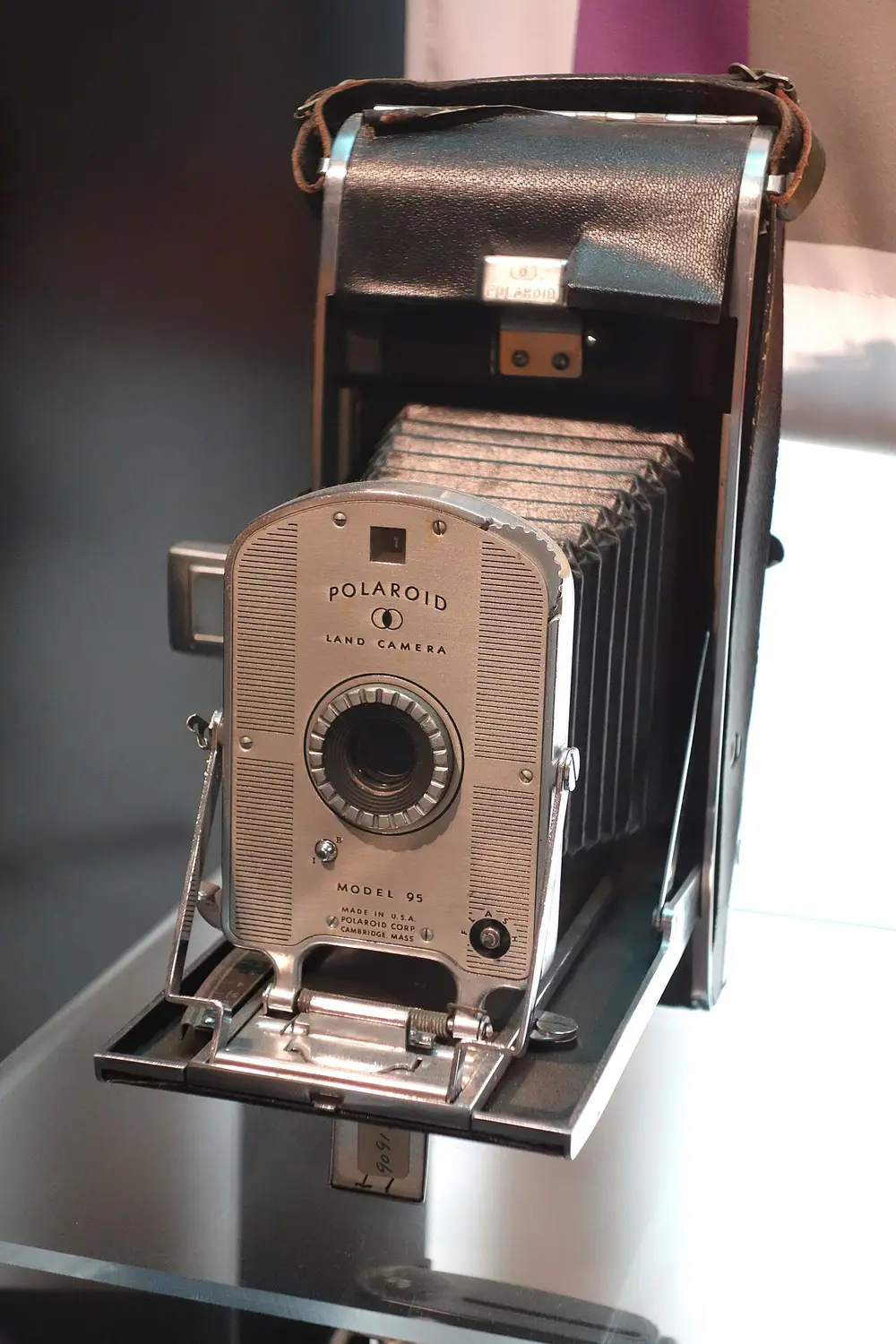
This one is at the MIT Museum, Cambridge, Massachusetts
When
First sold in 1948
Who
Edwin Land and his company Polaroid, United States
Made with
Folding camera with instant film that develops itself
On holiday, Land's three-year-old daughter asked why she could not see the photo he had just taken of her. He set out to make a camera that would develop its own pictures. The first Polaroid Land Camera went on sale at the Jordan Marsh department store in Boston at the end of 1948, and it made a finished print in about a minute. "Polaroid" became the everyday word for an instant photo.
Spot it by
A camera with folding bellows that pushes out its own print, or a square print with a wide white border at the bottom.
Remember
Land's daughter asked "why can't I see it now?", and the answer was Polaroid.
Kodak, Rochester, New York; the camera is now at the Smithsonian's National Museum of American History
When
1975
Who
Steven Sasson, an engineer at Kodak
Made with
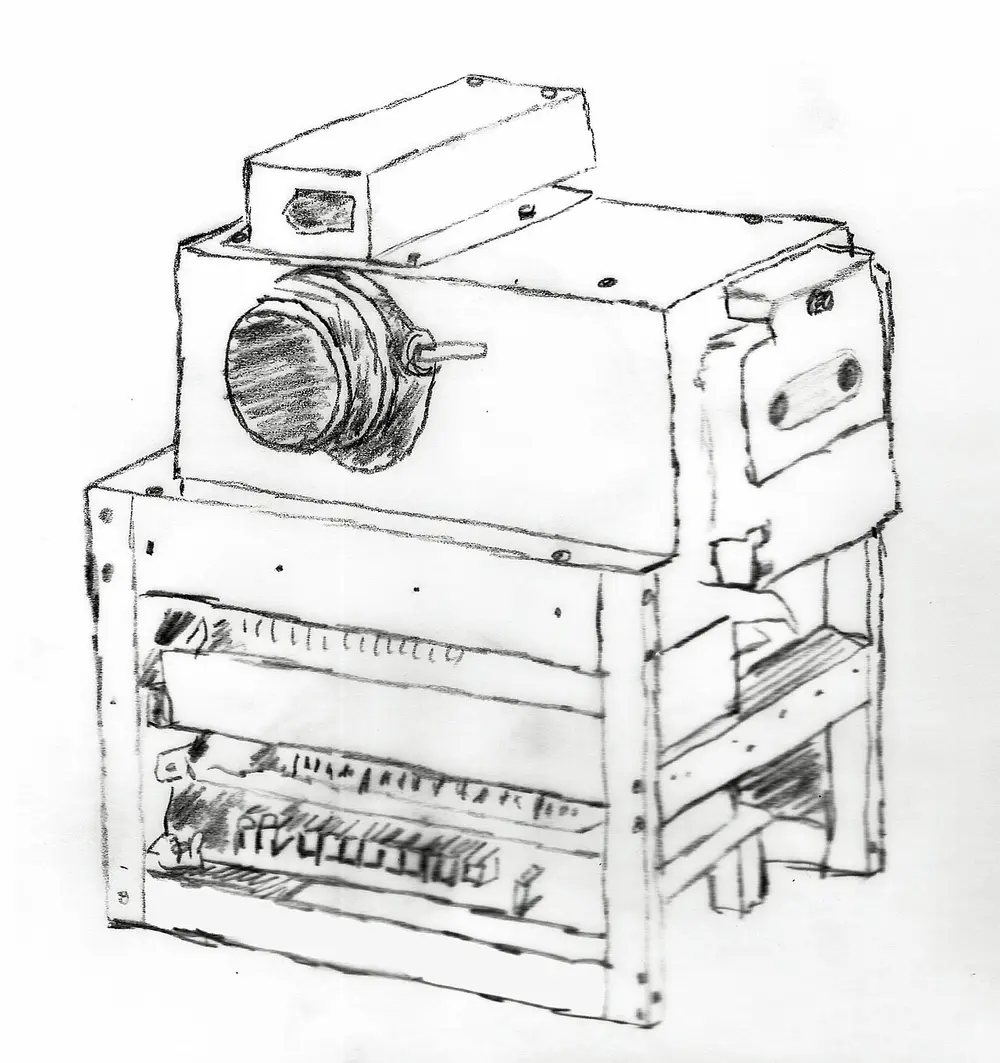
An electronic sensor (CCD) of 100 by 100 pixels, saving pictures onto a cassette tape
Sasson's camera, shown here in a drawing, was about the size of a toaster and weighed 3.6 kg. It took black and white pictures of just 100 by 100 pixels, which is 0.01 megapixels, and took 23 seconds to save each one onto a cassette tape. To see a picture, the tape went into a playback unit attached to a television. Kodak did not sell it, because the company earned its money from film. Digital cameras and later phones did replace film, and in January 2012 Kodak filed for bankruptcy.
Spot it by
A box of circuit boards with a cine-camera lens on top, nothing like a modern pocket camera.
Remember
The company that made film photography popular also invented the digital camera, in 1975.
Aperture and f-numbers
Three controls decide how much light reaches the film or sensor, which is called the exposure. Too little light gives a dark (underexposed) photo; too much gives a washed-out (overexposed) one. The first control is the aperture: the opening in the lens, which can be made wider or narrower, like the pupil of your eye.
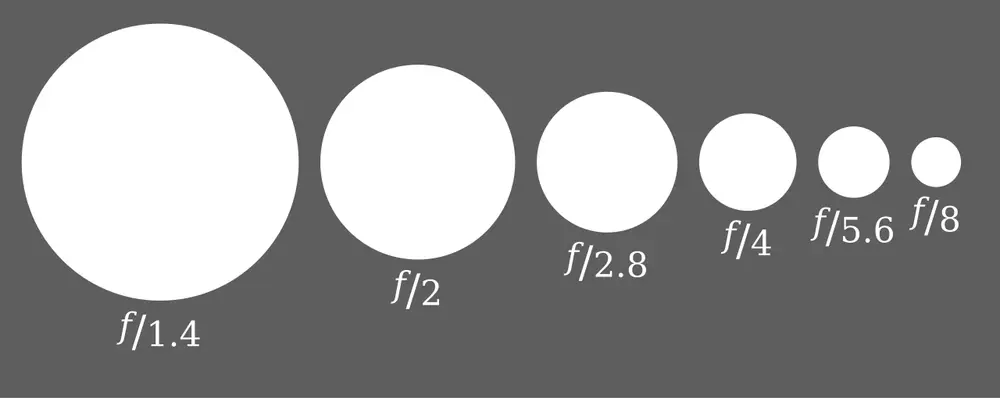
The size of the aperture is given as an f-number, such as f/2 or f/16. The f-number is the focal length of the lens divided by the width of the opening, so the bigger the number, the smaller the hole. f/2 is a wide opening that lets in lots of light; f/16 is a pinhole by comparison. The main steps, called stops, are f/1.4, f/2, f/2.8, f/4, f/5.6, f/8, f/11, f/16 and f/22. Each step lets in half as much light as the one before. Many cameras also have steps of one third of a stop in between, such as f/2.8, f/3.2, f/3.5, f/4: UCEED 2015 asked for the missing f/4 in that series.
The bigger the f-number, the smaller the opening. f/1.4 lets in far more light than f/8.
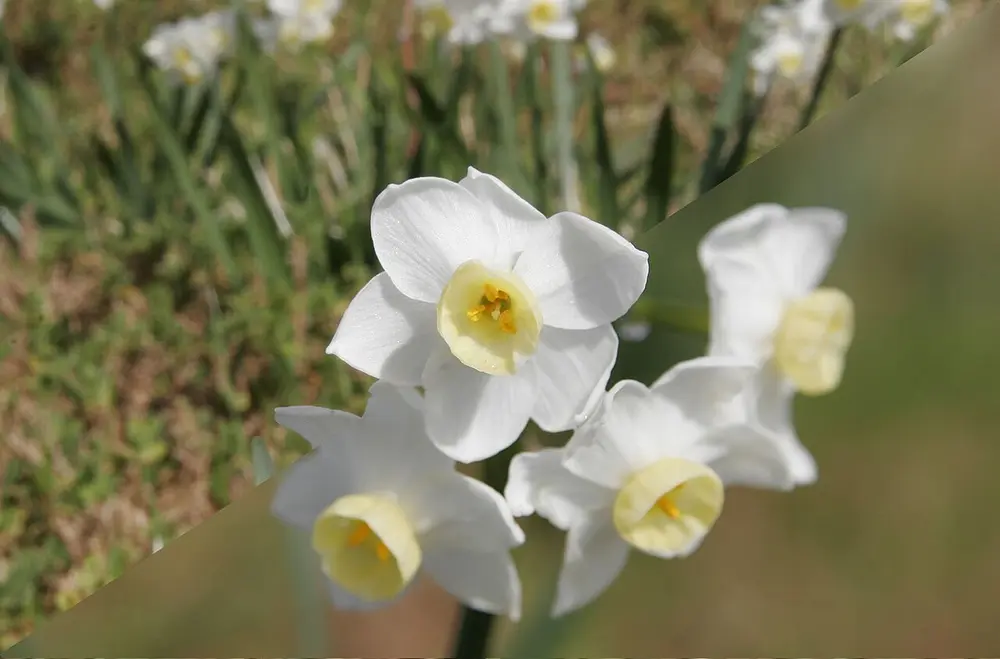
The aperture also changes how much of the picture is sharp from front to back, the depth of field (below). A wide aperture gives a shallow depth of field with a soft, blurred background. A small aperture keeps more of the scene sharp.
Shutter speed
The shutter is a little door in front of the film or sensor. Shutter speed is how long it stays open, and it is written in seconds or fractions of a second: 1/1000 is very fast, 1/60 is ordinary, and 2 seconds is slow. Shutter speed controls exposure through time: open twice as long and twice as much light gets in. UCEED 2024 asked exactly this.
Shutter speed also decides how movement looks:
A fast shutter speed, such as 1/1000 of a second, freezes movement: a cricket ball in the air, a splash of water, a bird's wings.
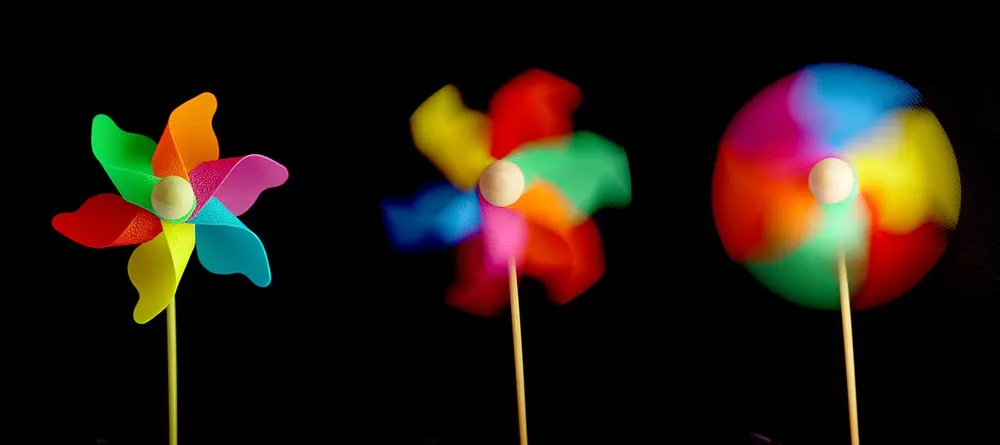
A slow shutter speed, such as 1/15 of a second or longer, lets anything moving smear into a blur along its path: a spinning wheel, flowing water turning silky, the light trails of cars at night. The camera must be held very still, often on a tripod, or the whole picture blurs with camera shake.
The same spinning pinwheel at three shutter speeds. Fast on the left freezes the blades; slow on the right blurs them into a disc. The blur follows the direction of movement.
ISO (named after the International Organization for Standardization, which sets the scale) is how sensitive the film or sensor is to light. ISO 100 suits bright sunshine; ISO 1600 or 3200 helps in a dim room or at night. Doubling the ISO doubles the brightness, but a high ISO adds noise, a speckled, grainy look, and loses fine detail. On film the same number was called the film speed.
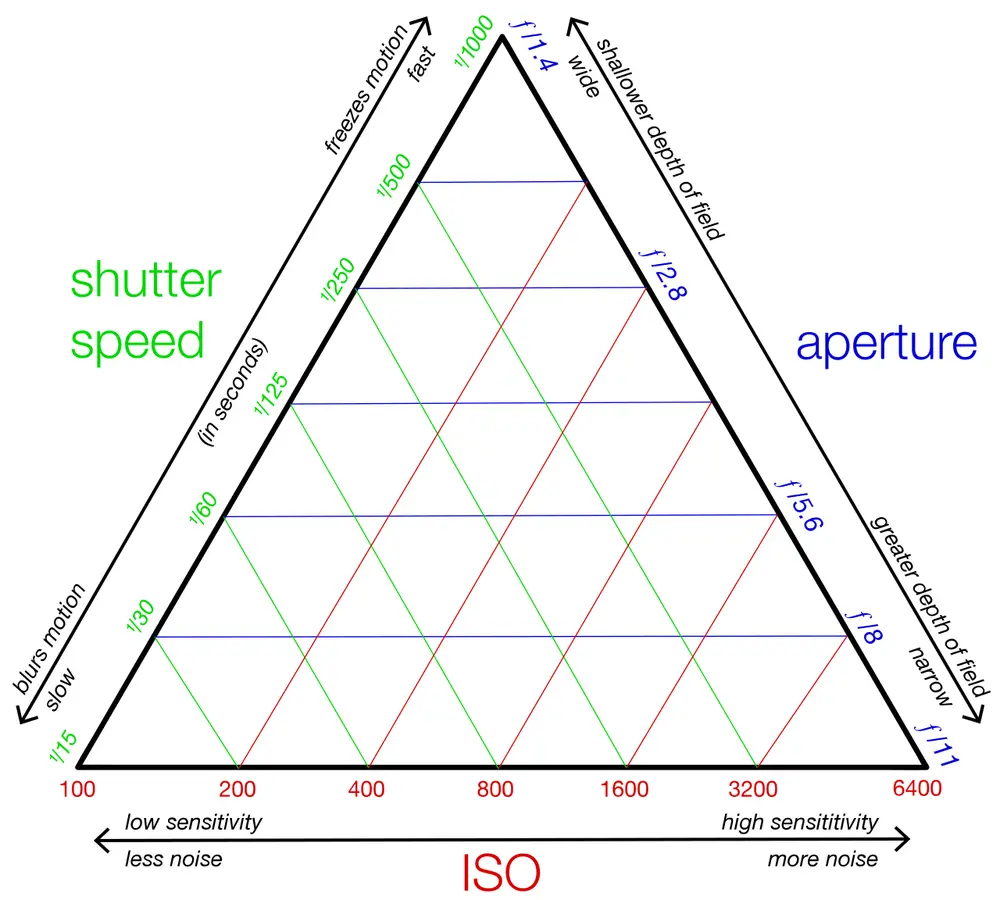
The three controls work together, and photographers draw them as the exposure triangle. If you change one, you can balance it with another and keep the same brightness. For example, f/8 at 1/125 of a second gives the same exposure as f/5.6 at 1/250: the hole is twice as big, but open for half the time. The brightness stays the same, but the depth of field and the way motion looks change. That is why UCEED 2017 could show the same objects shot with different settings that were all equally exposed.
The exposure triangle. Each side is one control, and each has a side effect: shutter speed changes motion blur, aperture changes depth of field, ISO changes noise.
Depth of field gets shallower, so the background blurs
Shutter speed
How long the shutter stays open
A slower speed (1/30 rather than 1/500)
Moving things and shaky hands blur
ISO
How sensitive the sensor or film is
A higher ISO (1600 rather than 100)
More noise and grain, less fine detail
Focal length
How much the lens magnifies
Does not change brightness
Field of view, background size and depth of field
Depth of field
Depth of field is the zone, from near to far, that looks sharp in a photo. A portrait with the person sharp and the background melted into soft blur has a shallow depth of field. A landscape that is sharp from the flowers at your feet to the mountains has a deep one.
Three things change it, and UCEED 2025 asked for all three:
Aperture. A wider opening (smaller f-number) makes the depth of field shallower. A narrow one (f/16) makes it deeper.
Distance to the subject. The closer you are to what you focus on, the shallower the depth of field. A background far behind the subject also blurs more.
Focal length. From the same spot, a longer (telephoto) lens gives a shallower depth of field than a wide-angle lens.
Shutter speed and ISO do not change depth of field; they only change brightness and blur from movement. UCEED 2026 showed four aperture sizes and four photos: the smallest opening gave the photo that was sharp all the way through.
The same flowers at f/32 (upper left) and f/5 (lower right). The wider f/5 opening gives a shallow depth of field, so the background melts away.
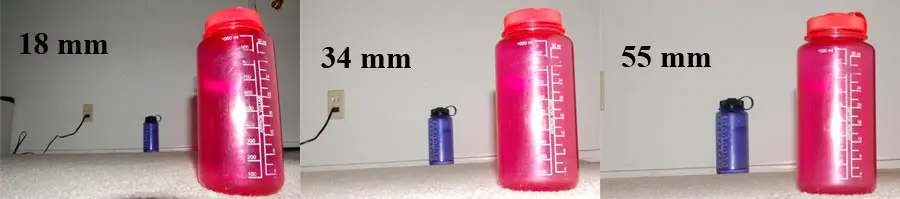
Focal length is the distance, in millimetres, from the centre of the lens to the sensor when the lens is focused on something far away. It decides how much of the scene the lens takes in. On a 35 mm film camera, or a "full-frame" digital one, a lens of about 50 mm sees roughly what your eyes see and is called a normal lens. Shorter focal lengths are wide-angle; longer ones are telephoto and act like a telescope. A zoom lens can change its focal length.
From one spot at a short focal length (24 mm): a wide view.
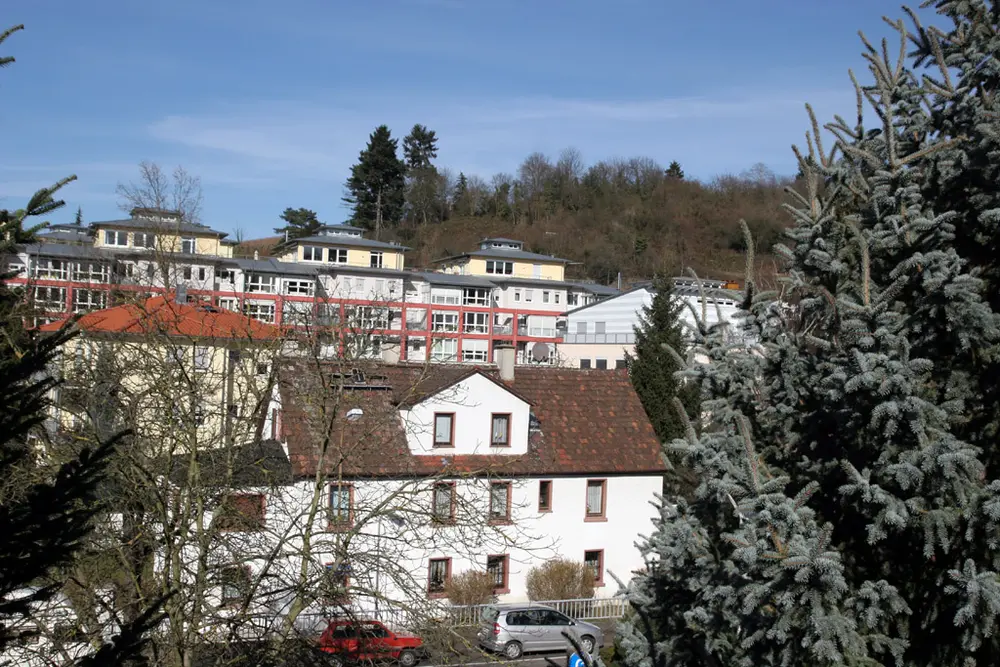
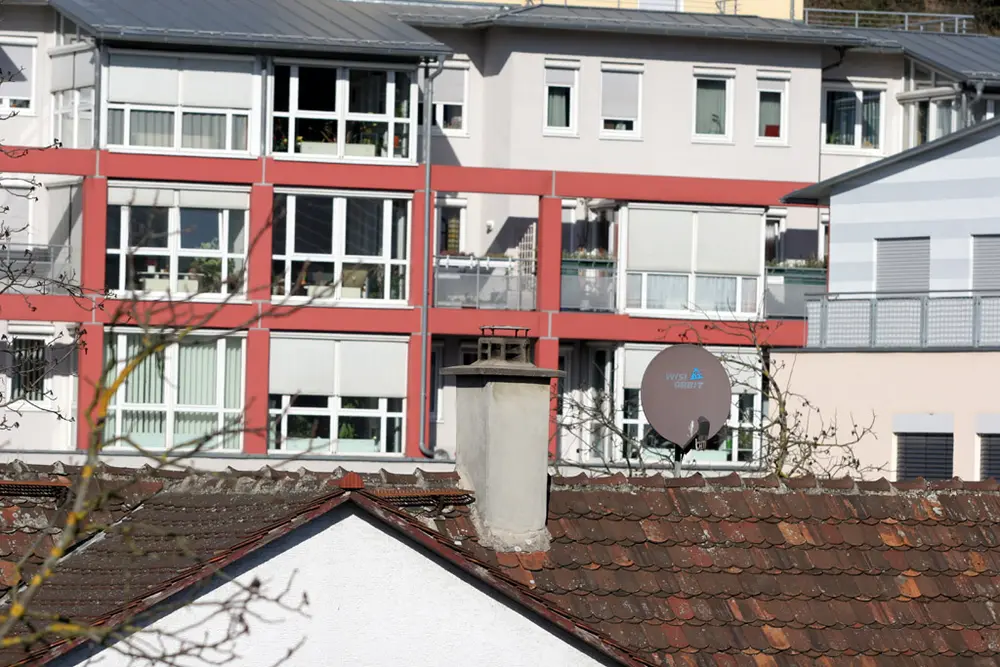
Focal length also changes how near and far things look, because to fill the frame with a subject you stand close with a wide-angle lens and far away with a telephoto. A wide-angle lens used close up stretches space: nearby things look big and the background small and far away. A telephoto lens used from far away squashes space: the background looks large and close behind the subject. This is what CEED 2024 tested with photos of the same basket.
The photographer stepped back and zoomed in each time, so the front bottle stays the same size. The longer the focal length, the bigger and closer the bottle behind looks.
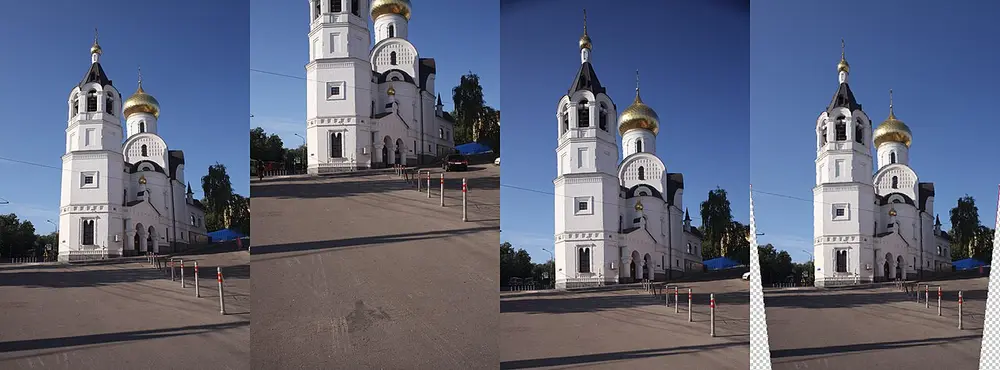
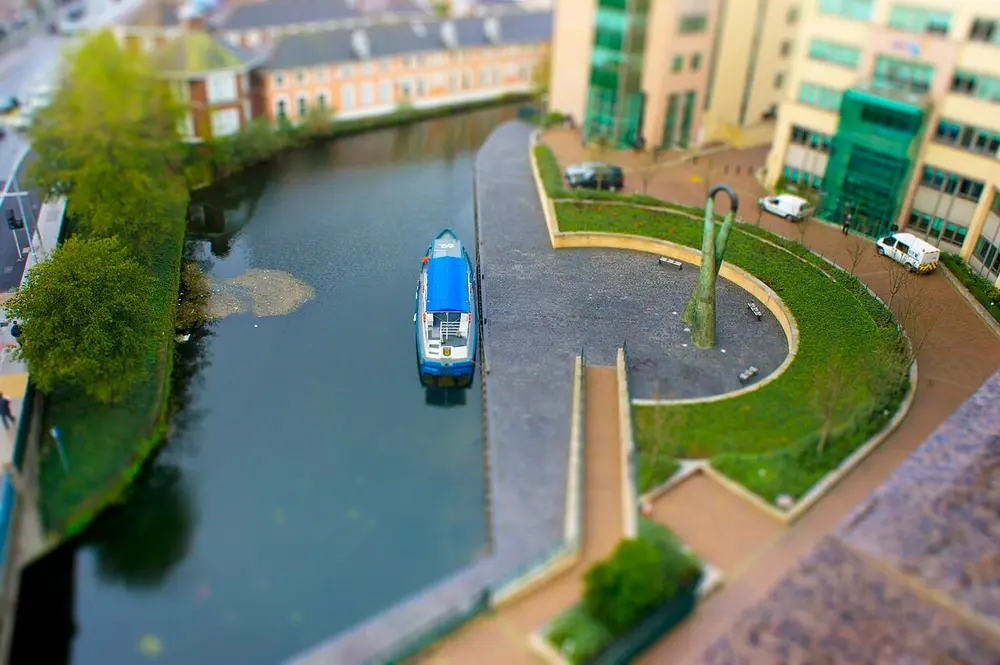
Tilt-shift lenses do two different jobs. To fit a tall building in, you normally tip the camera upwards, and the building's sides then lean in towards the top, as if it were falling backwards. A shift lens slides upwards while the camera stays level, so the whole building fits in and its walls stay upright. UCEED 2015 showed exactly this before-and-after. A tilt angles the lens so that only a thin band of the scene is sharp; seen from above, real streets then look like a toy model, the "miniature" effect.
Left to right: camera tipped up, so the walls lean; camera level, so the top is cut off; camera level with the lens shifted up, so the walls are straight and the church fits; the first photo corrected in software.
A real canal made to look like a toy. Here the blur was added on a computer to copy the look of a tilted lens, which is how most "tilt-shift" photos online are made.
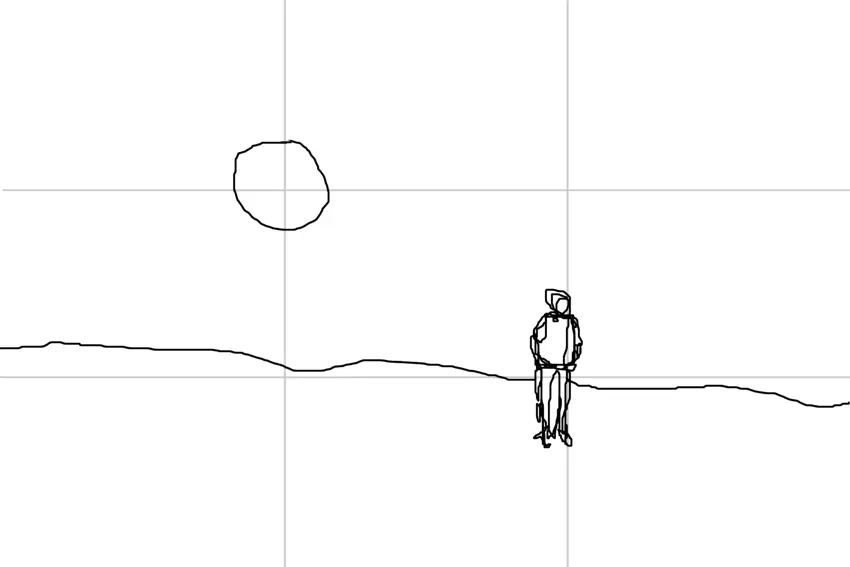
Composition is how you arrange things inside the frame. For the rule of thirds, imagine two lines across and two lines down, dividing the frame into nine equal boxes. Put the main subject on one of the lines, or where two of them cross, rather than in the dead centre, and put the horizon on the upper or lower line rather than across the middle. The result usually looks more balanced and alive. The phrase was first written down by the English artist John Thomas Smith in 1797, long before cameras. UCEED 2026 asked which photos followed it.
The rule of thirds: the sun and the person sit on the grid lines and the horizon sits on the lower third, not in the middle.
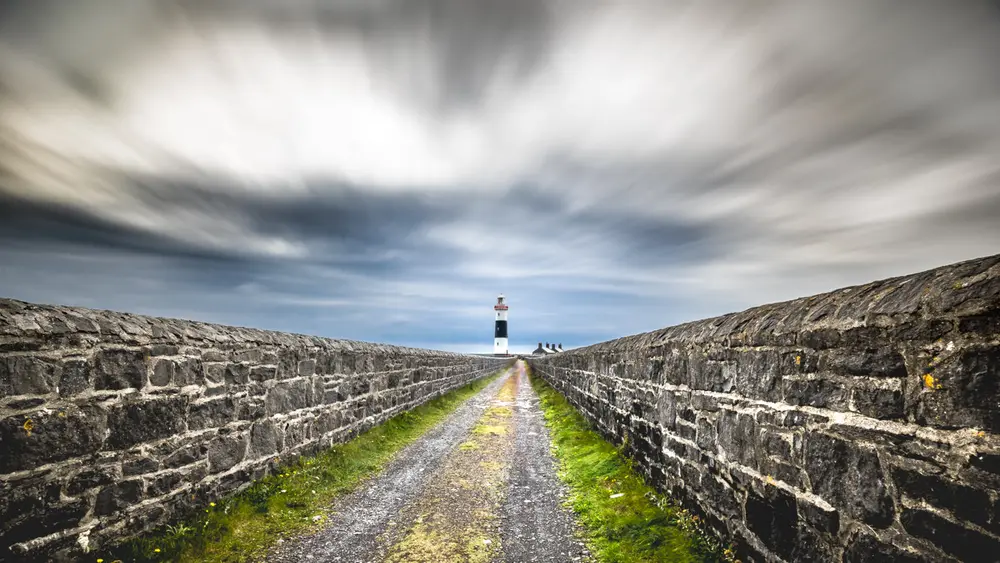
Leading lines are lines inside the picture, such as roads, railway tracks, rivers, fences or walls, that carry the viewer's eye towards the subject. Lines that meet in the distance also give a strong sense of depth.
The path and the two walls all lead the eye to the lighthouse. The streaky clouds show a slow shutter speed too.
Photographs of the palaces, temples and court of Hyderabad and central India
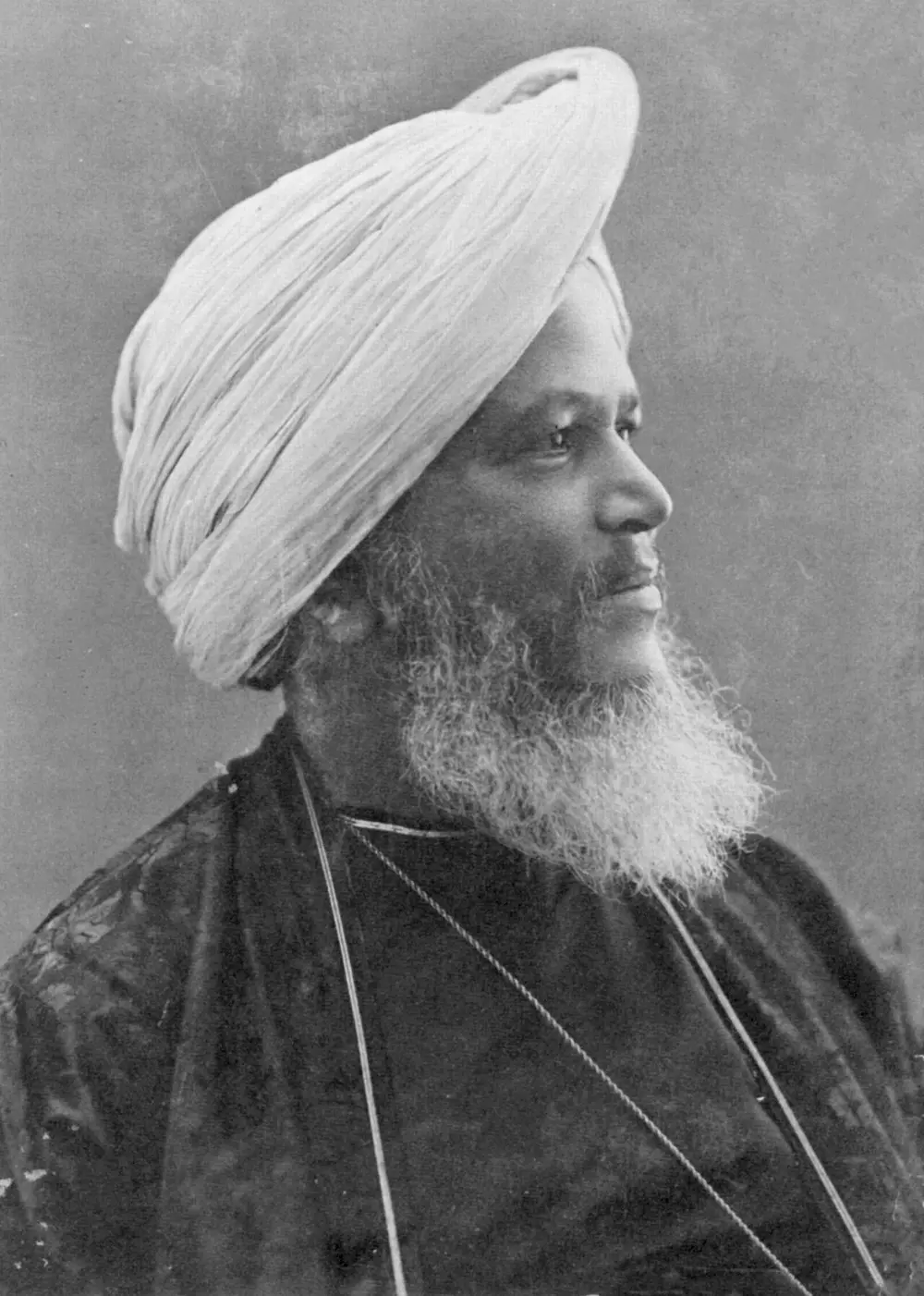
Deen Dayal trained as an engineer at Roorkee and worked as a draughtsman in Indore, where he took up photography in the 1870s. Maharajas and British officials soon commissioned him to photograph their tours, palaces and temples. He became court photographer to the sixth Nizam of Hyderabad, Mahbub Ali Khan, who gave him the title Raja. His studio's collection of nearly 2,900 glass negatives is now at the Indira Gandhi National Centre for the Arts (IGNCA) in New Delhi, and India Post issued a stamp in his honour in 2006.
Spot it by
Formal, carefully posed sepia photographs of rulers and their courts, palaces and monuments of the 1880s and 1890s.
Pictures of Nehru, Gandhi and the years of Indian independence
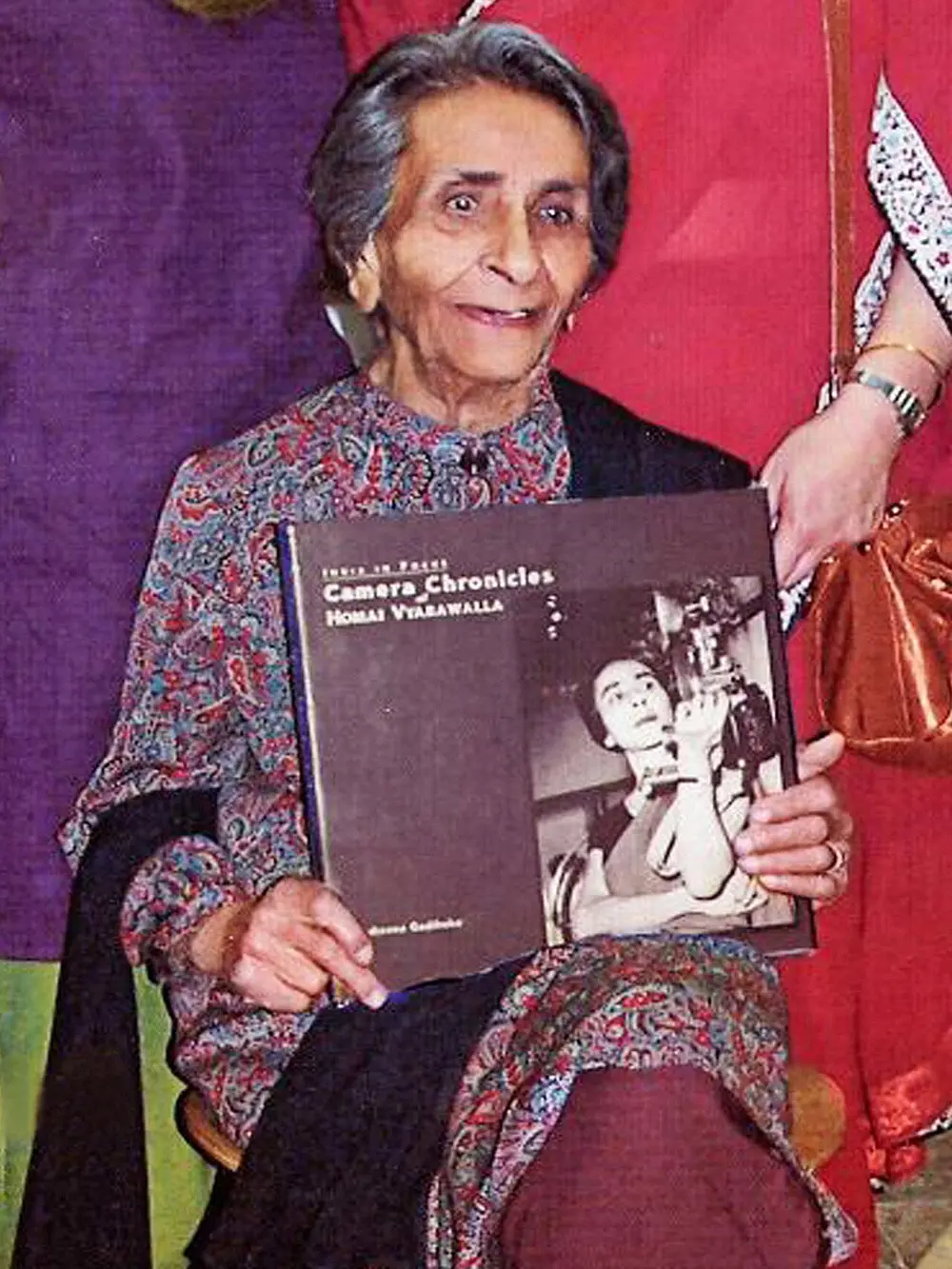
Homai Vyarawalla was India's first woman photojournalist (a photographer for newspapers and magazines). Her pictures appeared in The Illustrated Weekly of India, and from the 1940s she worked in Delhi for the British Information Services, photographing leaders and great events of the independence years. Nehru was her favourite subject. She signed her work "Dalda 13": she was born in 1913, met her husband at 13, and her first car's number plate read DLD 13. She gave up photography in 1970 and received the Padma Vibhushan in 2011. The government released this photo of her, holding a book of her own pictures, when she won the first National Photo Award for lifetime achievement in 2010.
The Bhopal gas tragedy (1984), the 1971 Bangladesh refugees, Mother Teresa, Indira Gandhi
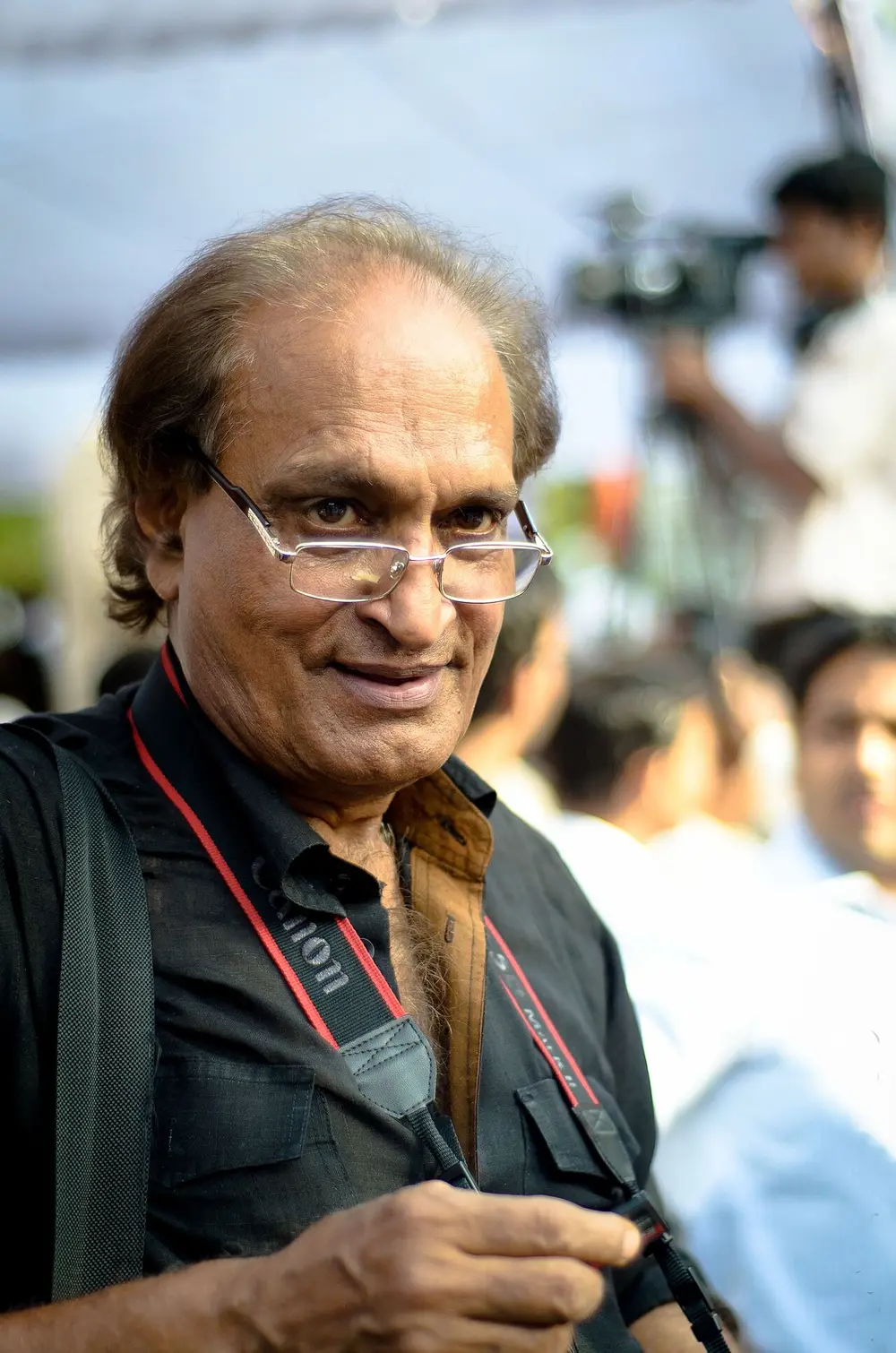
Raghu Rai became a photographer in the 1960s and joined The Statesman newspaper in New Delhi in 1966, later working for India Today. In 1971 Henri Cartier-Bresson saw an exhibition of his work in Paris, and in 1977 he nominated him to join Magnum Photos, the famous photographers' cooperative. He won the Padma Shri in 1972. He photographed the Bhopal gas tragedy of 1984 for India Today and went back for years to record its victims, work that became the book Exposure: A Corporate Crime. He was widely called India's most celebrated photojournalist, and he died in Delhi on 26 April 2026, aged 83. Here he is photographed at work at a protest in Delhi in 2011.
Spot it by
Crowded, layered black and white or colour frames of Indian life, packed with people and detail.
Chief photographer in India for the Reuters news agency
Key works
Photographs of Rohingya refugees, the Delhi riots of 2020 and India's COVID-19 crisis
Danish Siddiqui studied economics and then mass communication at Jamia Millia Islamia in Delhi, and joined Reuters in 2010. In 2018 he and his colleague Adnan Abidi shared the Pulitzer Prize for Feature Photography as part of a Reuters team, for their pictures of Rohingya refugees fleeing Myanmar. The Pulitzer is the top award in American journalism. He was killed in July 2021 near Spin Boldak in Kandahar, Afghanistan, while covering fighting between Afghan forces and the Taliban. In 2022 he was awarded a second Pulitzer for Feature Photography after his death, shared with Reuters colleagues, for their pictures of India's COVID-19 crisis. This photo was taken at the Pulitzer ceremony in New York in 2018.
Remember
Danish Siddiqui: Reuters, two Pulitzers, 2018 for the Rohingya and 2022 for COVID-19.
Two more Indian names come up often. Raghubir Singh (1942 to 1999), from Jaipur, was one of the first photographers anywhere to treat colour as serious art, in the early 1970s, when most art photography was black and white. His 14 books include Ganges (1974) and pictures of India seen through the windows of an Ambassador car. Dayanita Singh (born 1961) studied visual communication at NID in Ahmedabad. She makes photobooks and portable "museums" of her pictures, such as Museum Bhavan, and in 2022 she won the Hasselblad Award, one of the world's top photography prizes. For film cameras in India, see the note on Indian cinema.
Paris; photographed in France, India, China and many other countries
When
1908 to 2004
Who
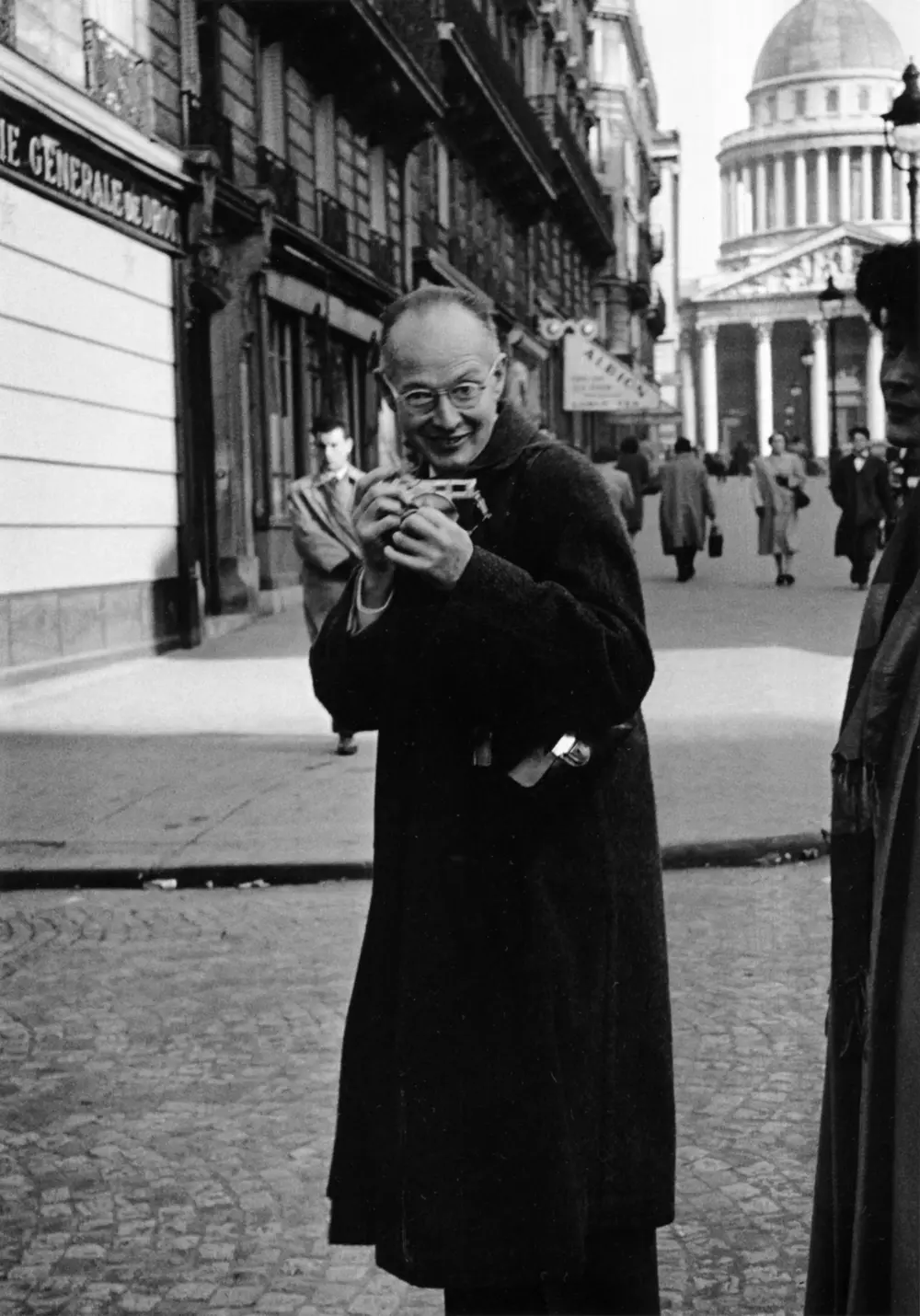
French; photographed here in Paris in 1954 by the Japanese photographer Ihei Kimura
Key works
Behind the Gare Saint-Lazare; Gandhi's funeral (1948); the book The Decisive Moment (1952)
Cartier-Bresson trained as a painter, then in 1932 picked up a small Leica and never let it go. He wandered the streets catching ordinary people at exactly the right instant, and is seen as a founder of street photography. His 1952 book, called The Decisive Moment in English, gave a name to his idea: the split second when everything in the frame comes together. In 1947 he founded Magnum Photos with Robert Capa, George Rodger, David Seymour and William Vandivert. He was in India in 1948 and photographed Gandhi's funeral, and he later nominated Raghu Rai to Magnum.
Spot it by
Black and white, natural light, no posing, and a perfectly timed moment of everyday life.
Remember
Cartier-Bresson, the Leica and the decisive moment.
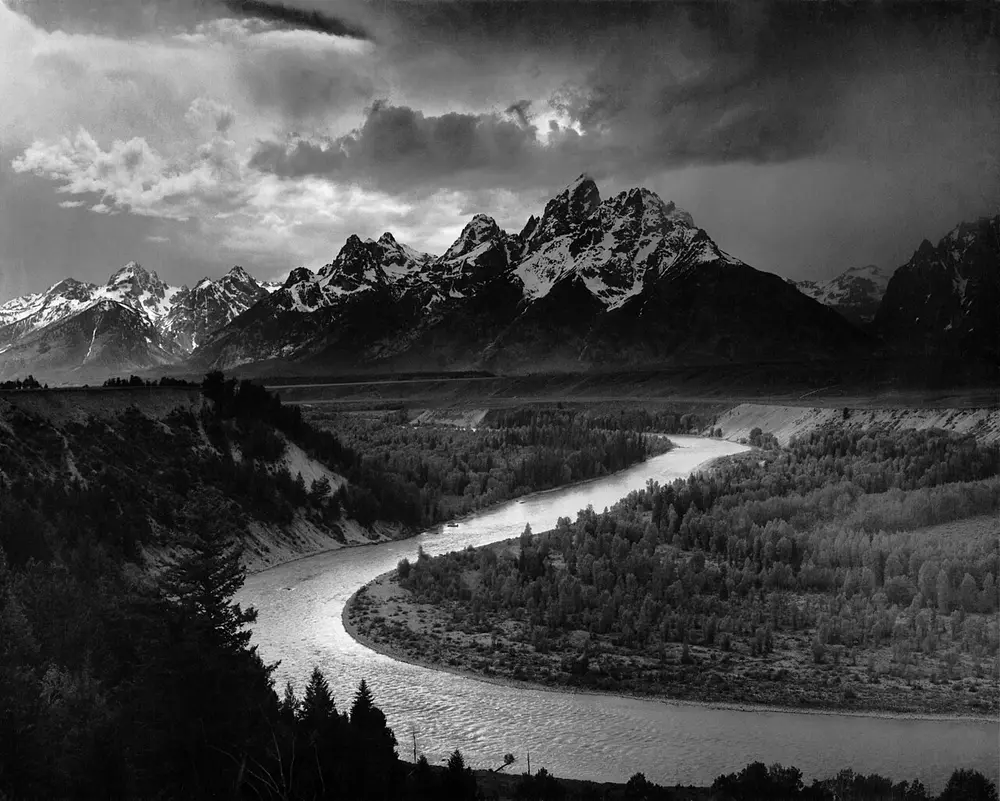
Adams photographed the national parks of the American West, above all Yosemite, in rich black and white. This picture was made for a mural project for the US National Park Service, which commissioned him in 1941, and so it belongs to the US public. In 1932 he and other photographers formed Group f/64, named after a very small aperture that keeps everything sharp from front to back: a deep depth of field. With Fred Archer he worked out the Zone System, a method for planning the exposure so that a print shows the full range of tones from black to white. A copy of this photo travels through space on the Voyager spacecraft's Golden Record, launched in 1977.
Spot it by
Huge, sharp-everywhere black and white landscapes with deep blacks, bright whites and dramatic skies.
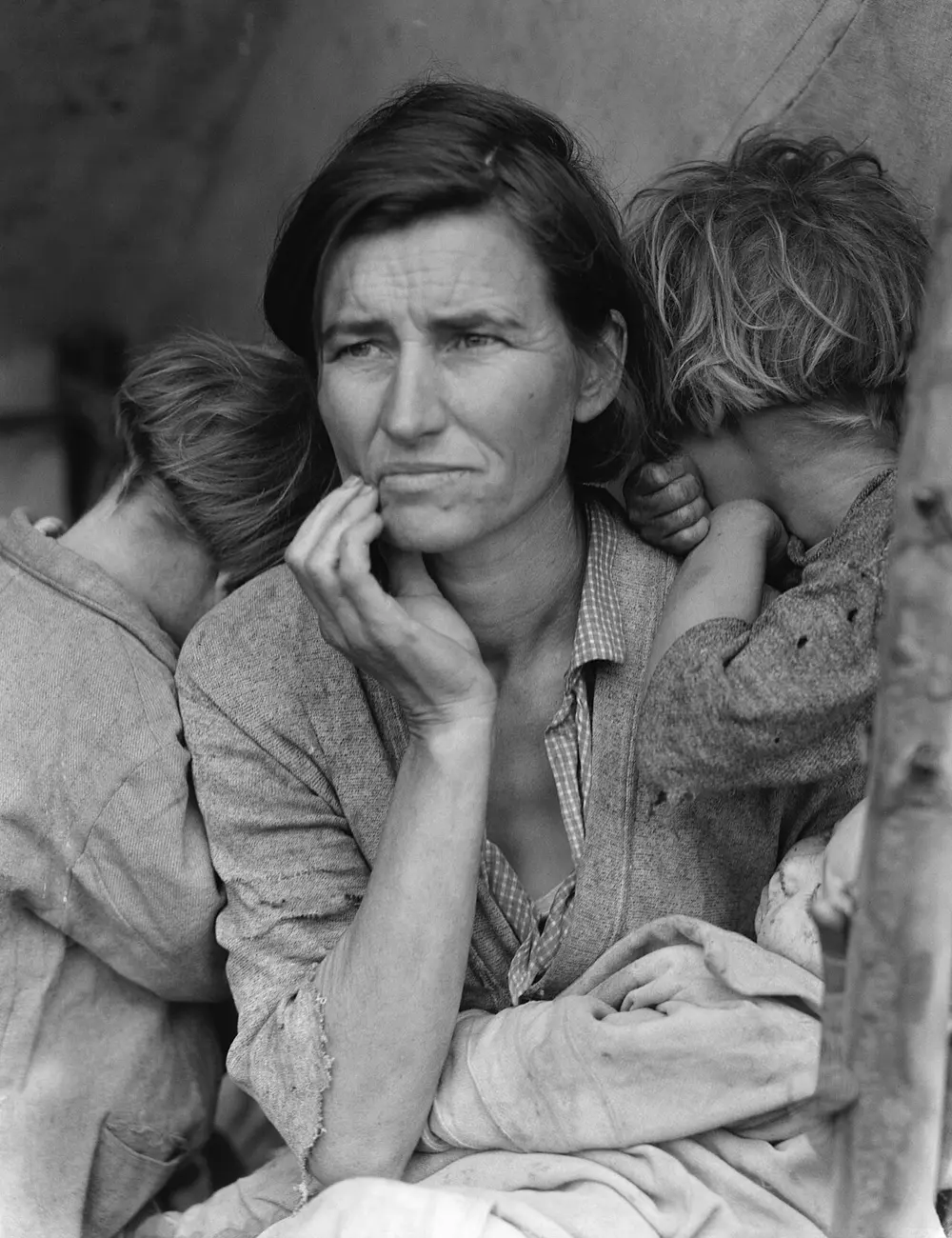
During the Great Depression of the 1930s, the US government sent photographers to record the hardship of poor farm workers, so that people would support its relief programmes. Lange, working for the Resettlement Administration (later the Farm Security Administration), met Florence Owens Thompson and her children at a camp of pea pickers and took a short series of pictures. This one became the symbol of the Depression. Because it was made for the government, it is in the public domain, and the Library of Congress keeps it.
Spot it by
A worried mother's face, hand to her chin, with children hiding their faces against her: hardship in black and white.
Remember
Lange's Migrant Mother is the face of the Great Depression.
United States, the Soviet Union, Europe, India and South Africa
When
1904 to 1971
Who
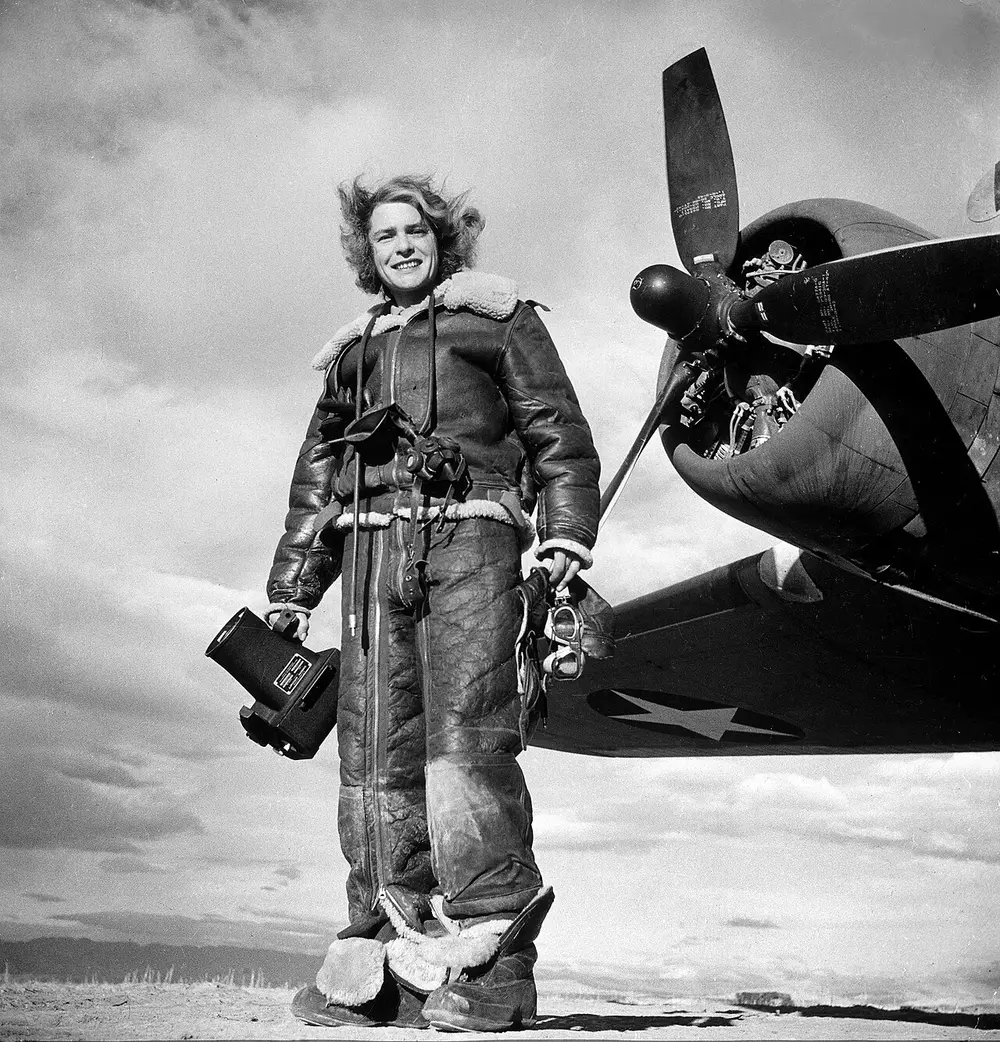
American photojournalist; photographed here with the US 8th Air Force in the Second World War
Key works
Fort Peck Dam, the first cover of Life magazine (1936); photographs of Gandhi and the Partition of India
Bourke-White began by photographing steel works, factories and skyscrapers. In 1930 she became the first foreign photographer allowed to photograph Soviet industry. In 1936 she was one of the first four photographers hired by Life, the new picture magazine, and her photograph of the Fort Peck Dam was its first cover. In the Second World War she worked with the US Air Forces and was there when American soldiers freed the Buchenwald concentration camp in 1945. For Life she photographed Gandhi and the violence of the Partition of India in 1947, and she spoke to Gandhi only hours before he was killed in 1948.
Spot it by
Bold, dramatic black and white: giant machines, wartime scenes and powerful portraits.
Remember
Bourke-White shot Life's first cover and photographed Gandhi.
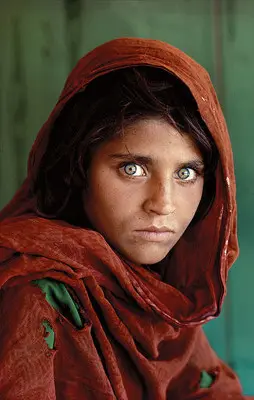
Picture: Steve McCurry. Copyright Steve McCurry, shown for teaching.
Afghan Girl
Where
Nasir Bagh refugee camp, near Peshawar, Pakistan
When
Taken in 1984; National Geographic cover, June 1985
Who
Steve McCurry (born 1950), United States
Style
Colour portrait
McCurry photographed Sharbat Gula, a 12-year-old Afghan refugee who had fled the Soviet war in Afghanistan, at a school in a refugee camp in Pakistan. He did not write down her name. The portrait appeared on the cover of National Geographic magazine in June 1985 and became one of the most famous photographs in the world; she was only identified in 2002. McCurry, a member of Magnum Photos since 1986, is known for rich, glowing colour and has photographed India for decades.
Spot it by
Piercing green eyes, a red headscarf and a direct gaze into the camera.
Remember
McCurry's Afghan Girl was the green-eyed National Geographic cover of 1985.
Timeline
1827
Niépce makes View from the Window at Le Gras, the oldest surviving camera photograph
1835
Fox Talbot makes his latticed window negative at Lacock Abbey
1838
Daguerre photographs the Boulevard du Temple in Paris
1839
The daguerreotype is announced in January and given "free to the world" on 19 August
1841
Talbot patents the calotype process
1888
George Eastman launches the Kodak camera
1925
The Leica goes on sale, making 35 mm film popular
1932
Ansel Adams and others form Group f/64; Cartier-Bresson takes up the Leica
1936
Dorothea Lange's Migrant Mother; Bourke-White's photo on the first cover of Life
1942
Ansel Adams photographs The Tetons and the Snake River
1947
Cartier-Bresson, Capa and others found Magnum Photos
1948
The first Polaroid Land Camera goes on sale in Boston; Cartier-Bresson photographs Gandhi's funeral
1975
Steven Sasson builds the first digital camera at Kodak
1977
Raghu Rai joins Magnum Photos
1984
Steve McCurry photographs Sharbat Gula; Raghu Rai photographs the Bhopal gas tragedy
2011
Homai Vyarawalla receives the Padma Vibhushan
2018
Danish Siddiqui shares the Pulitzer Prize for Feature Photography
2022
Dayanita Singh wins the Hasselblad Award
2026
Raghu Rai dies in Delhi on 26 April
Test yourself
Question 1 of 8
Which camera setting was changed between the two halves of this photo?
Question 2 of 8
Which pinwheel was photographed with the slowest shutter speed?
Question 3 of 8
The third photo keeps the church's walls upright with the camera held level. Which lens made that possible?
Question 4 of 8
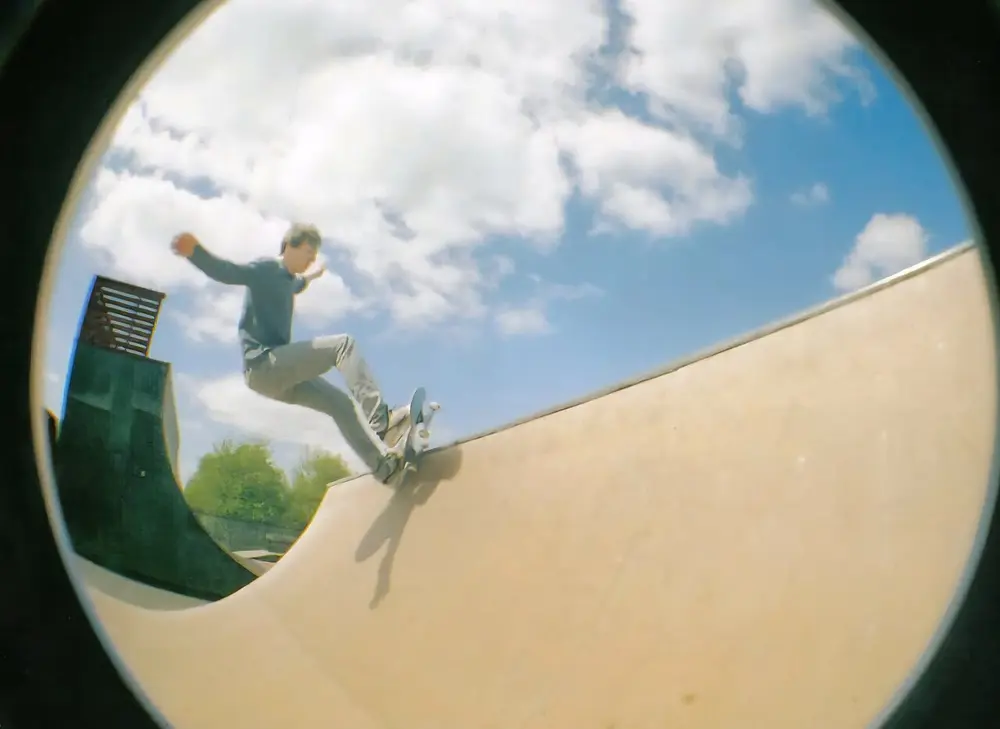
Which of these photos was taken with a fisheye lens?
Question 5 of 8
Who took this photograph?
Question 6 of 8
Which of these is the oldest surviving photograph taken with a camera?
Question 7 of 8
A photographer wants to blur the background more. Which change will not help?
Question 8 of 8
Who was India's first woman photojournalist, working under the name "Dalda 13"?
From past papers
Real exam questions on this topic, each with a full solution.
Mark it as studied to track your progress through the course.
Was this note useful?
Each picture is credited underneath it. Pictures of works still in copyright are shown small, for teaching only. If you hold the rights to a picture and want it removed, tell us through the contact page and we will take it down.