Skip to content

Chapter 7: Textiles, crafts and motifs

Motifs and what they mean

The peacock, lotus, paisley, tree of life, kalash, conch and other motifs of Indian design, what each stands for, where to spot it, and the floor art of each state.

In one minute

6 facts to know

  1. The lotus grows out of mud but flowers clean, so it stands for purity. Gods such as Lakshmi and Brahma sit on it.
  2. The paisley began as the buta or boteh, a flowering plant on Kashmir shawl borders. In Hindi it is kairi (raw mango) and in Punjabi ambi (mango).
  3. The Paithani pallu is famous for peacocks, Patola for elephants, and Kalamkari palampores for the tree of life.
  4. The kalash, a pot topped with mango leaves and a coconut, means abundance and a lucky start. A kalash also crowns the top of a temple tower.
  5. Floor art has a different name in each state: kolam (Tamil Nadu), muggulu (Andhra Pradesh and Telangana), alpana (West Bengal), mandana (Rajasthan), aripan (Bihar) and rangoli (Maharashtra and much of India).
  6. A jaali is a stone screen pierced with patterns. A mandala is a sacred diagram, a square with four gates inside a circle.

A motif is a single design unit: one peacock, one lotus, one mango shape. Repeat it in rows and it becomes a pattern. A block printer, for example, carves the motif once and stamps the same block again and again across the cloth (UCEED 2022 showed a printed pattern and asked which block made it). In India most motifs also carry a meaning, so the same few shapes turn up on saris, temple walls, floors and wedding doorways all over the country.

Birds and animals

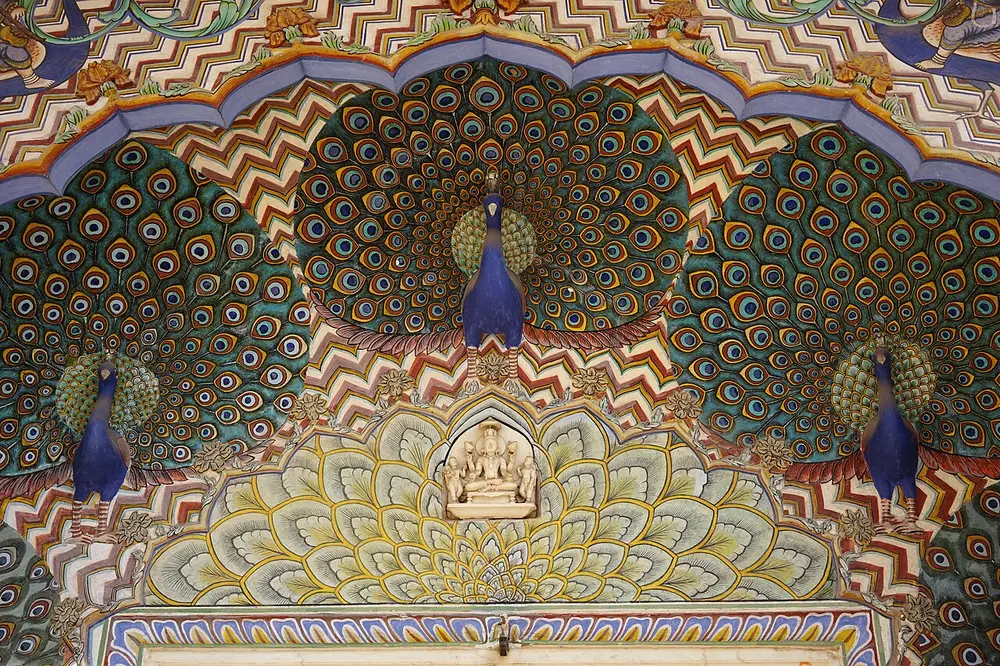
A doorway arch covered in painted plaster relief, with three peacocks spreading huge green and blue tail feathers in a fan, set among zigzag bands of orange, cream and green.
Picture: Jan Bockaert. CC BY-SA 2.0.

Peacock

Also called Mor

Where
Peacock Gate, Pritam Niwas Chowk, City Palace, Jaipur

The peacock stands for beauty, love and the monsoon rains, when it dances. Krishna wears its feather in his crown, and it is the mount of the war god Kartikeya (Murugan). It has been India's national bird since 1963. In textiles, it is the star of the Paithani sari of Maharashtra, whose gold pallu is filled with peacocks, often with green parrots in the borders. In buildings, one of the four painted gates around the Pritam Niwas Chowk courtyard of Jaipur's City Palace, shown here, is covered with peacocks.

Spot it by

A long neck, a small crest on the head and a fan of tail feathers with eye spots.

Remember

Paithani pallu, peacock pallu.

Don't confuse

A parrot (munia or tota) in a Paithani is small, green and has a hooked beak; a peacock has a crest and a big tail.
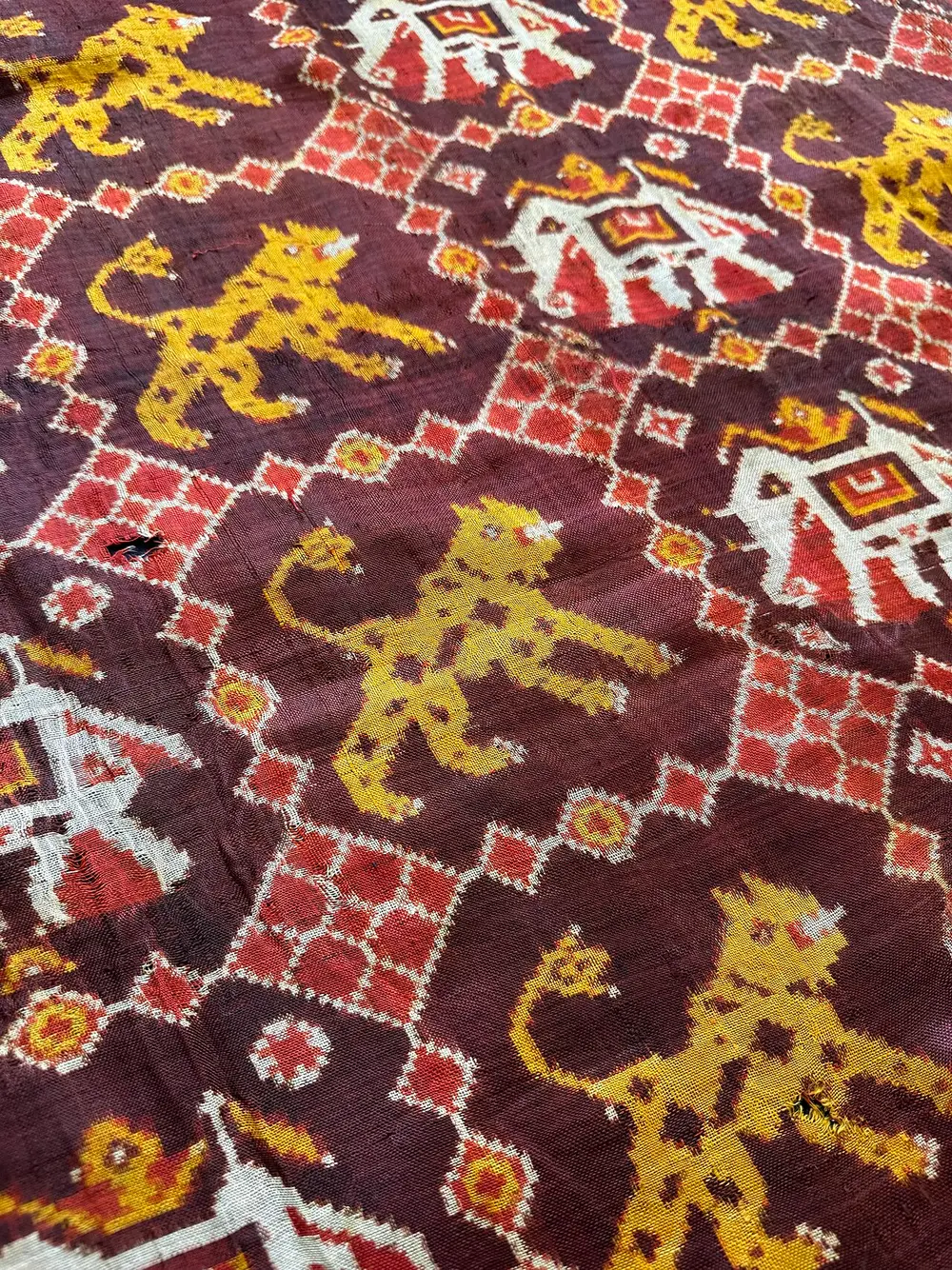
A close view of a silk cloth in deep red, with rows of white elephants carrying decorated saddle cloths and yellow tigers, all with soft, stepped edges, between small diamond patterns.
Picture: Jainamishra. CC BY-SA 4.0.

Elephant

Also called Gaja, hathi

Where
This patola was woven in Patan, Gujarat, for the Indonesian market
Made with
Silk, double ikat

The elephant stands for strength, wisdom, royal power and good fortune. It is the head of Ganesha, the god of beginnings, and in the Gajalakshmi image two elephants pour water over the goddess Lakshmi, a sign of wealth and plenty. Patola saris from Patan in Gujarat are famous for their elephants. Patola are double ikat: both sets of threads are tied and dyed before weaving, which gives every shape its soft, stepped edge. Cloths with big elephants were made for export to Indonesia, where families kept them as treasured heirlooms. In stone, a long row of elephants forms the lowest band round the base of the Hoysaleswara Temple at Halebidu.

Spot it by

Elephants in rows with decorated saddle cloths, often beside parrots, tigers or dancers, with stepped, slightly blurred edges.

Remember

Patan's patola parades elephants.

More on the saris and how they are woven is in Woven by hand.

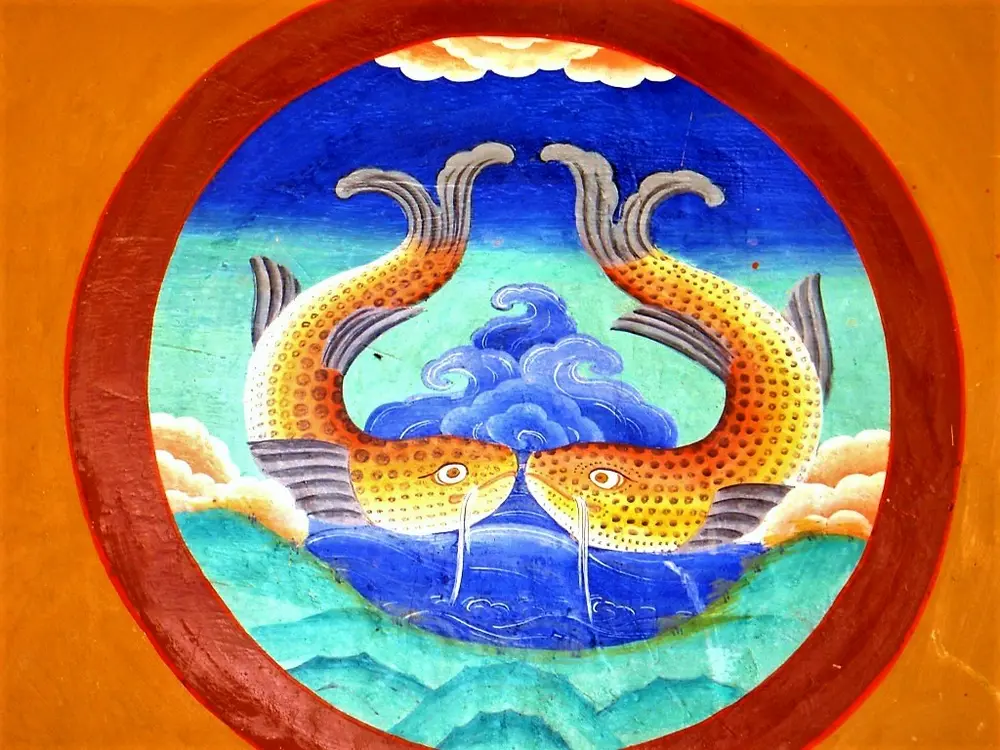
A round wall painting of two orange fish with spotted scales, their tails curling up, facing each other above blue and white waves.
Picture: John Hill. CC BY-SA 4.0.

Fish

Also called Matsya, a pair of fish

Where
This one is painted in the courtyard of Likir Monastery, Ladakh

Fish stand for good luck, plenty and fertility. Vishnu's first avatar, Matsya, is a fish. A pair of golden fish is one of the eight auspicious symbols of Buddhism, painted at monasteries, where it stands for happiness and freedom, because fish move freely in water. Fish fill Madhubani wedding paintings in Mithila (see Folk and tribal painting). In Lucknow, a pair of fish was the emblem of the Nawabs of Awadh, so fish are carved over gateways such as those of the Bara Imambara and on objects made in the city, such as carved rock-crystal cups.

Spot it by

Two fish facing each other, often with patterned scales and curling tails.

Remember

Two fish for a lucky pair: weddings in Mithila, nawabs in Lucknow.
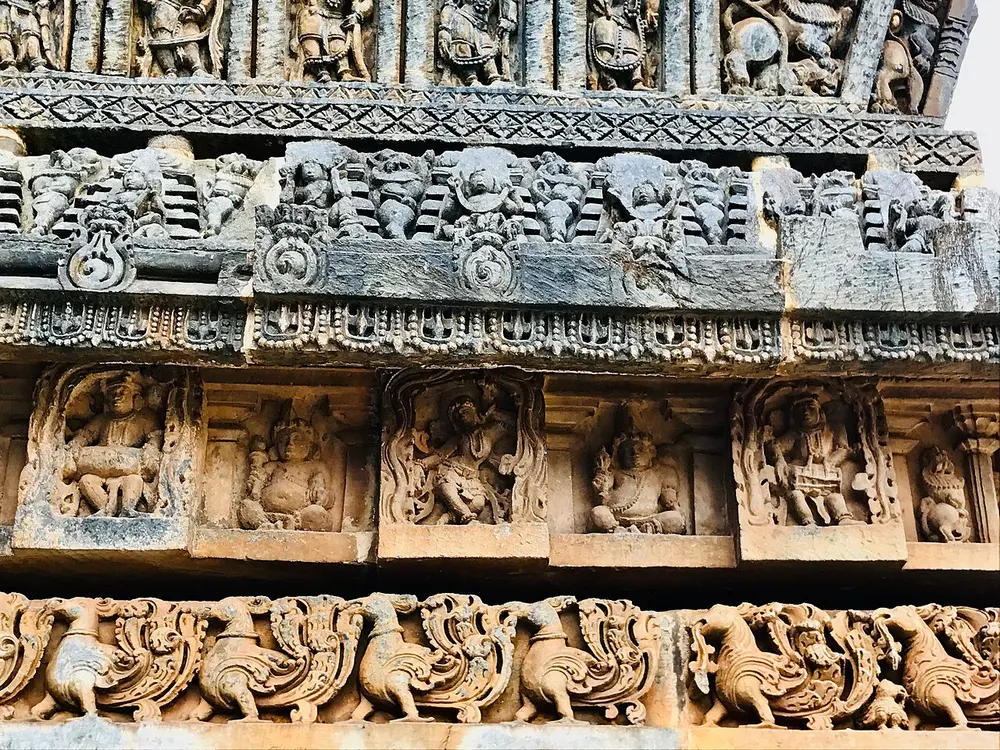
Bands of grey stone carving on a temple wall. At the bottom runs a row of plump birds with curling tails; above it, a row of small dancers and musicians in panels; higher up, figures and pierced stonework.
Picture: Ms Sarah Welch. CC0.

Hamsa

Also called Swan or goose

Where
Hoysaleswara Temple, Halebidu, Karnataka
When
12th century

The hamsa is a sacred water bird, usually translated as swan, though some scholars think the old texts meant the bar-headed goose. It carries Saraswati, the goddess of learning, and Brahma. Old stories say it can drink the milk out of a mix of milk and water, so it stands for wisdom: telling the good from the bad. The hamsa is one of the oldest Indian motifs, painted at Ajanta and carved in long rows round temple walls, as in the band of birds above.

Spot it by

A plump bird with a curling tail, usually in a long row or a border.

Remember

Saraswati's swan separates milk from water.

Plants and trees

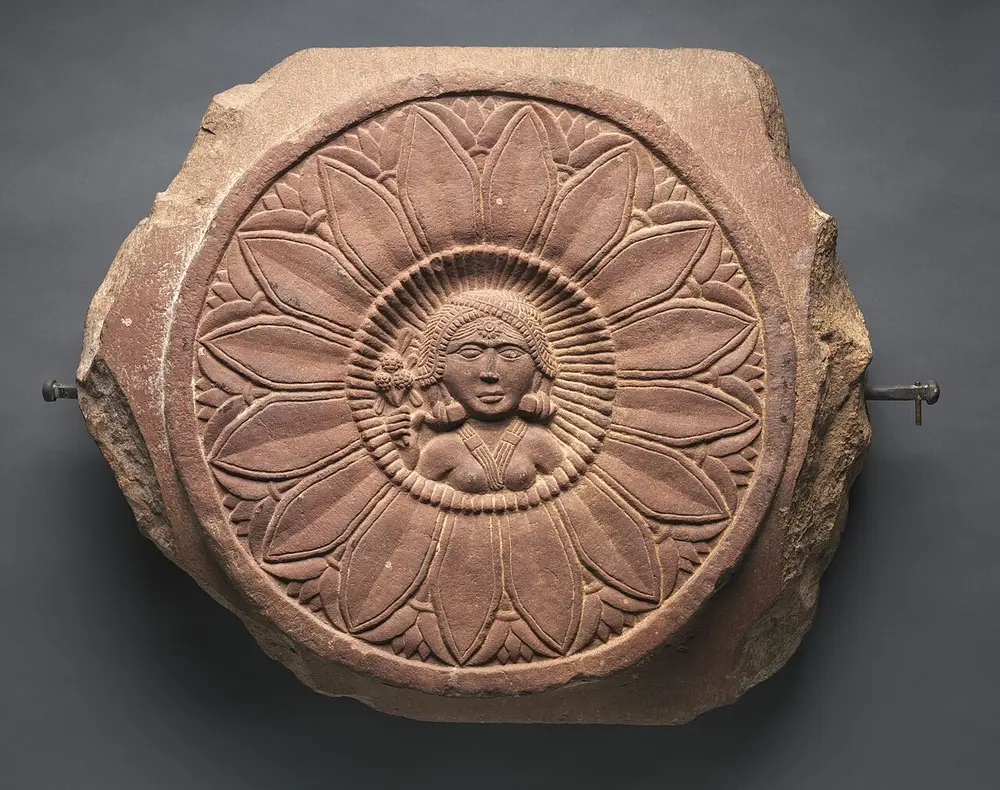
A round, reddish sandstone carving of a big open lotus with two rings of pointed petals, and the head and shoulders of a woman wearing a headdress at its centre.
Picture: Cleveland Museum of Art. CC0.

Lotus

Also called Padma, kamal

Where
From the stupa railing at Bharhut, Madhya Pradesh; now in the Cleveland Museum of Art
When
About 150 BCE (Shunga period)
Made with
Sandstone

The lotus grows from the mud at the bottom of a pond, yet its flower opens clean above the water. So in Hindu, Buddhist and Jain art it stands for purity, and also for creation and wealth. Lakshmi, Saraswati and Brahma sit or stand on lotus thrones, and the Buddha compared himself to a lotus rising unstained. Lotus medallions like this one decorated the stone railings of early Buddhist stupas such as Bharhut and Sanchi. The flower is everywhere since: on temple ceilings, in Paithani borders, on the base of the Sarnath Lion Capital, and in modern buildings such as the Lotus Temple in Delhi (1986).

Spot it by

Rings of pointed petals round a round centre, seen from above as a medallion or from the side as a seat.

Remember

Out of the mud, into the light.
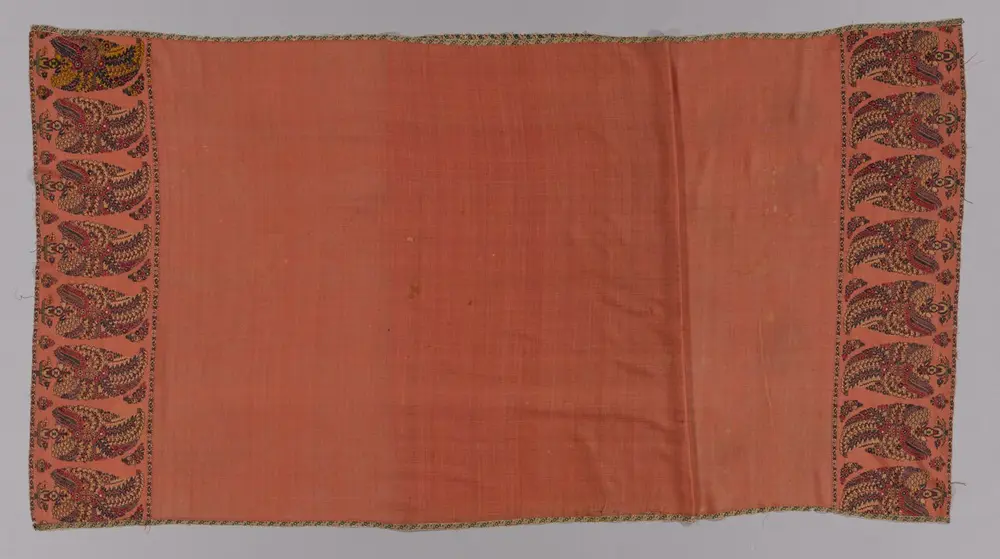
A long apricot-coloured wool shawl with a plain centre. Each end has a deep band of tall, leaning teardrop shapes with curled tips, filled with tiny flowers in red, blue and green.
Picture: Cleveland Museum of Art. CC0.

Paisley

Also called Buta or boteh; kairi or ambi (mango)

Where
Kashmir
When
This shawl dates from 1785 to 1800
Made with
Goat-hair wool, woven in the twill tapestry method

The paisley is a teardrop with a curled tip. It began in Persia, where boteh means a bush or a flowering plant. On early Kashmir shawls it was a single flowering plant in the end panels, but over the 18th and 19th centuries it grew into a tight cone of flowers with a bent tip, the buta. Kashmir shawls became the height of fashion in Europe, and weavers in the town of Paisley in Scotland copied them on machines, which gave the shape its English name. Many Indian languages name it after the mango: kairi (raw mango) in Hindi and Urdu, ambi (mango) in Punjabi. The mango has its own lucky meaning too: mango leaves top the kalash and are strung over doorways for festivals.

Spot it by

A curved teardrop or cone, its tip bending to one side, often filled with tiny flowers and set in rows.

Remember

Persian bush, Kashmiri shawl, Scottish name, Indian mango.
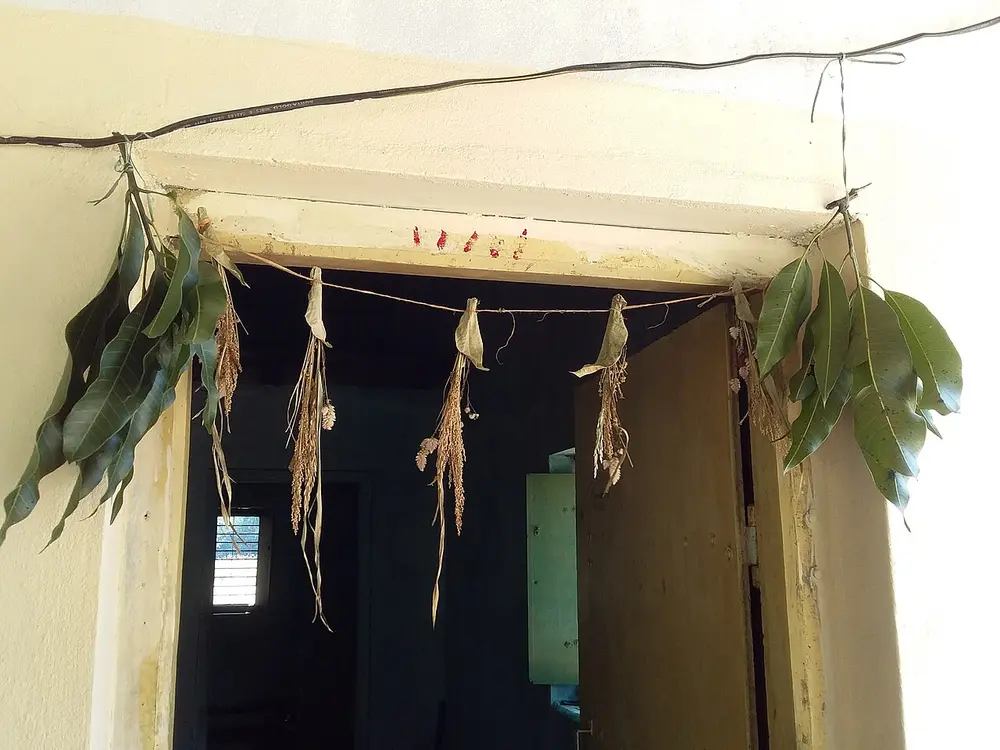
A string tied across the top of a doorway, hung with bunches of green mango leaves at both ends and small bundles of dried paddy stalks and flowers between them.

Mango leaves, new paddy and flowers strung over a doorway in Maharashtra to welcome the harvest. Mango leaves are one of the commonest signs of a happy occasion in Indian homes.

Picture: ज्ञानदा गद्रे-फडके. CC BY-SA 4.0.
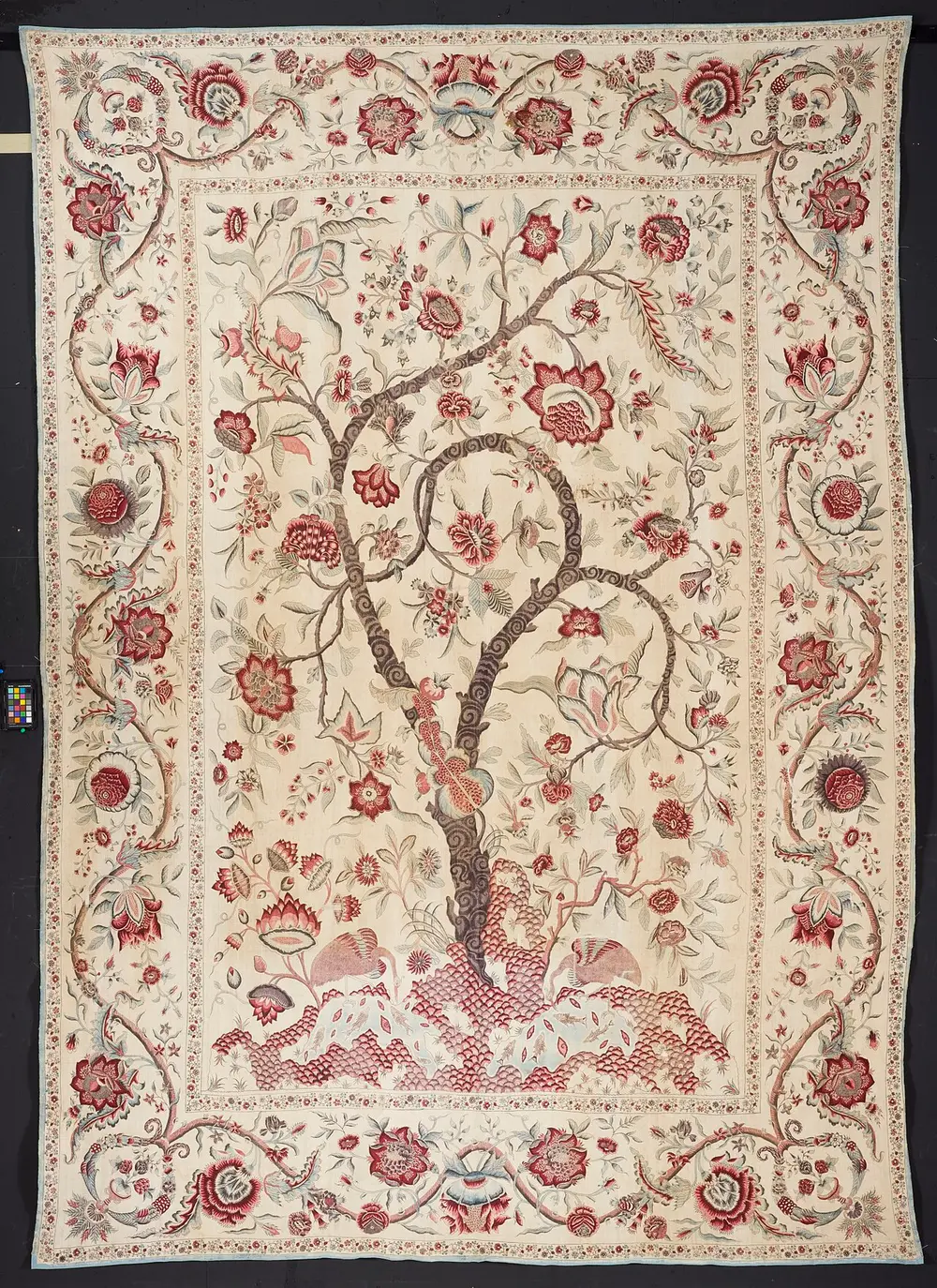
A large cream cotton bedcover painted in red, pink and brown with one tall, curving flowering tree growing from a small hill, birds and animals at its foot, and a wide border of flowering stems.
Picture: Los Angeles County Museum of Art. Public domain.

Tree of life

Where
Coromandel Coast, south-east India, made for the European market
When
1700 to 1740
Made with
Cotton, painted with mordants and dyed (the kalamkari method)

A single great tree, with its roots in the earth and its branches in the sky, stands for life itself: growth, fertility and the link between earth and heaven. Its most famous Indian form is the palampore, a painted bedcover or wall hanging made on the Coromandel Coast for export to Europe in the 18th century. The artists drew with a kalam (pen) dipped in mordant, a fixing chemical, so that the dye stuck only where they had drawn: the same method as Kalamkari. A palampore usually shows one flowering tree rising from a rocky mound, with birds, animals and exotic flowers. The same idea appears in stone in the famous jaali of the Sidi Saiyyed mosque in Ahmedabad, with its curling branches.

Spot it by

One big central tree with a wavy trunk and huge flowers, growing from a little hill, often with birds and animals.

Remember

Kalamkari pen, palampore tree.

Don't confuse

The Srikalahasti style of Kalamkari mostly shows gods and story panels; the tree of life belongs mainly to the export palampores and the block-printed Machilipatnam style.

Sacred objects

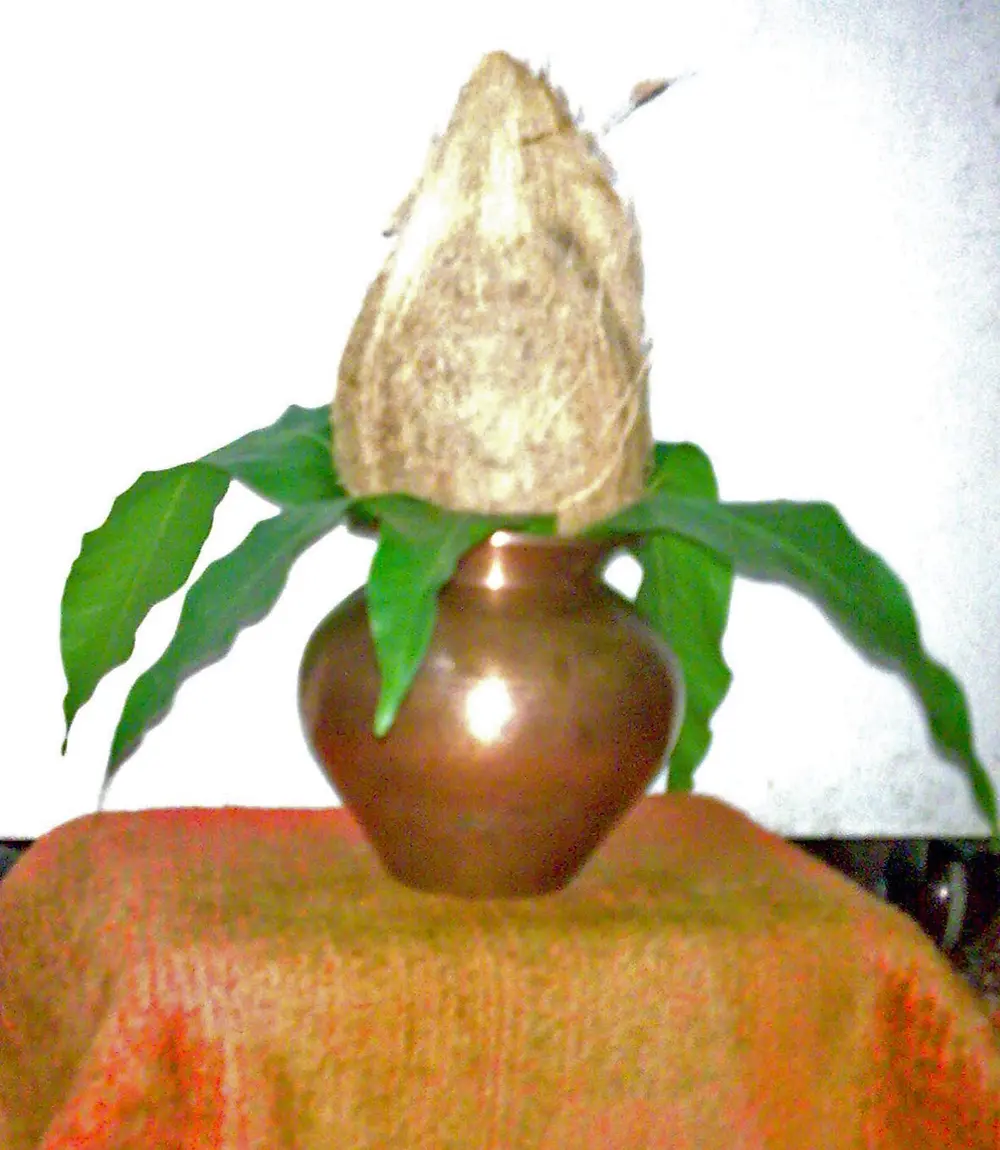
A round copper pot on an orange cloth, with a ring of green mango leaves at its mouth and a husked coconut standing upright in the middle.
Picture: Redtigerxyz. CC BY 3.0.

Kalash

Also called Purna kalasha, purna kumbha, purnaghata

Made with
A metal or clay pot, water, mango leaves and a coconut

The purna kalasha ("full pot") is a pot of water with a ring of mango leaves and a coconut on top. It stands for abundance, fertility and life, and it is set up at the start of weddings, house-warmings and pujas so that the new beginning is full and fortunate. It is one of the oldest Indian motifs, known since the Vedas, and is carved as a "vase of plenty" on Hindu, Buddhist and Jain shrines. You also see it at the very top of a temple tower, where the pot-shaped finial is called the kalasha, and in floor art, as in Pongal kolams and the wedding alpana further down this page.

Spot it by

A round-bellied pot, mango leaves fanning out of its mouth, and a coconut on top.

Remember

A full pot for a full life.
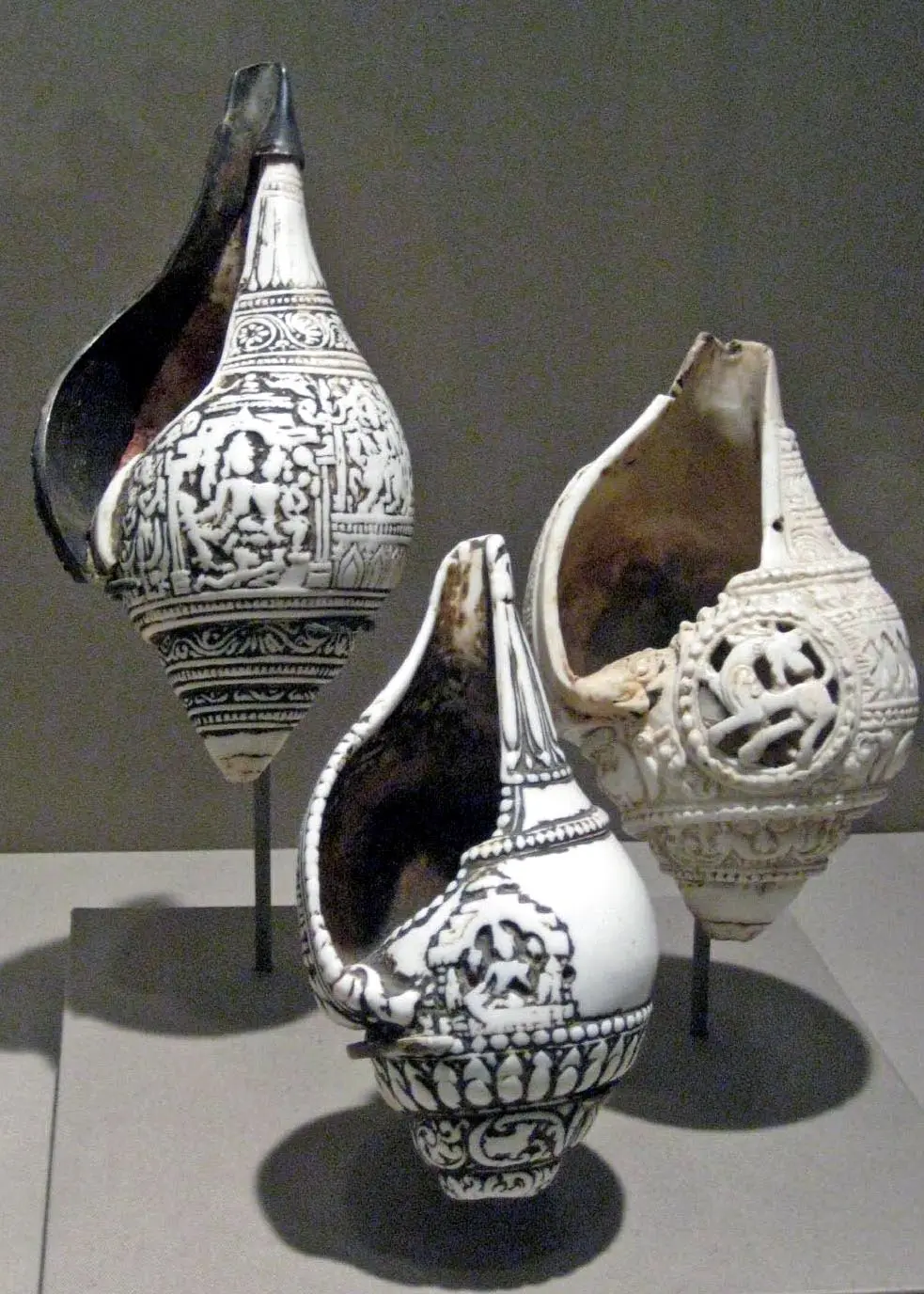
Three large white conch shells on stands in a museum case, their surfaces carved with fine black lines showing gods, flowers and patterns.
Picture: Claire H. CC BY-SA 2.0.

Conch

Also called Shankha

Where
Bengal
When
Pala period, about 11th to 12th century
Made with
Carved conch shell

The conch is blown like a trumpet at pujas and in temples, and heroes in the epics blew conches before battle. It is said to be the home of Lakshmi, so it also means good fortune. Vishnu holds a conch, called Panchajanya, in one hand and the chakra (a spinning discus) in another, so the two appear together in countless images of him. The white conch is also one of the eight auspicious symbols of Buddhism. Bengal has carved conch shells for centuries, from finely engraved shells like these to the white shell bangles still made there.

Spot it by

A spiral shell with a long opening down one side, often shown in Vishnu's hand.

Remember

Vishnu's set: conch, chakra, mace and lotus.
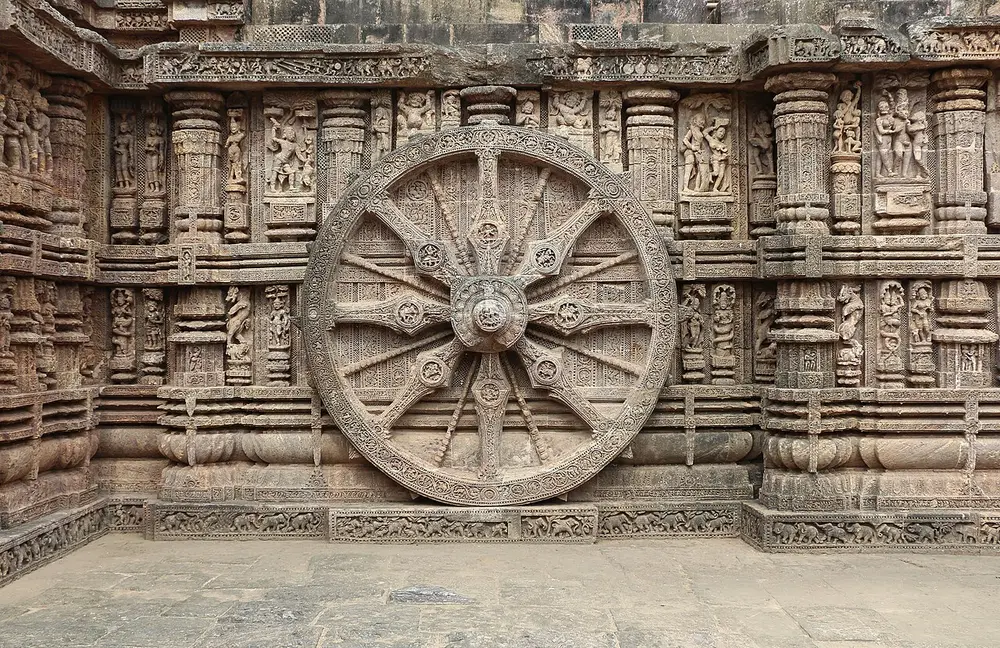
A huge carved stone chariot wheel set against the base of a temple wall, with eight thick spokes and eight thin ones round a big hub, and rows of small carved figures on the wall around it.
Picture: Bernard Gagnon. CC BY-SA 3.0.

Chakra

Also called Wheel

Where
Sun Temple, Konark, Odisha
When
13th century

The wheel stands for time, movement and the law that keeps the world turning. In Buddhism the Dharmachakra, the wheel of the teaching, recalls the Buddha's first sermon at Sarnath, and Ashoka's wheel from the Sarnath capital sits, with 24 spokes, in the middle of India's flag. Vishnu's chakra, the Sudarshana, is his weapon. The grandest wheels are at Konark, where the whole temple is the chariot of the Sun god, Surya: 24 carved stone wheels run along its base and stone horses pull it.

Spot it by

A round wheel with a hub and evenly spaced spokes, often carved with tiny figures.

Remember

Konark rolls on 24 wheels; the flag's wheel has 24 spokes.
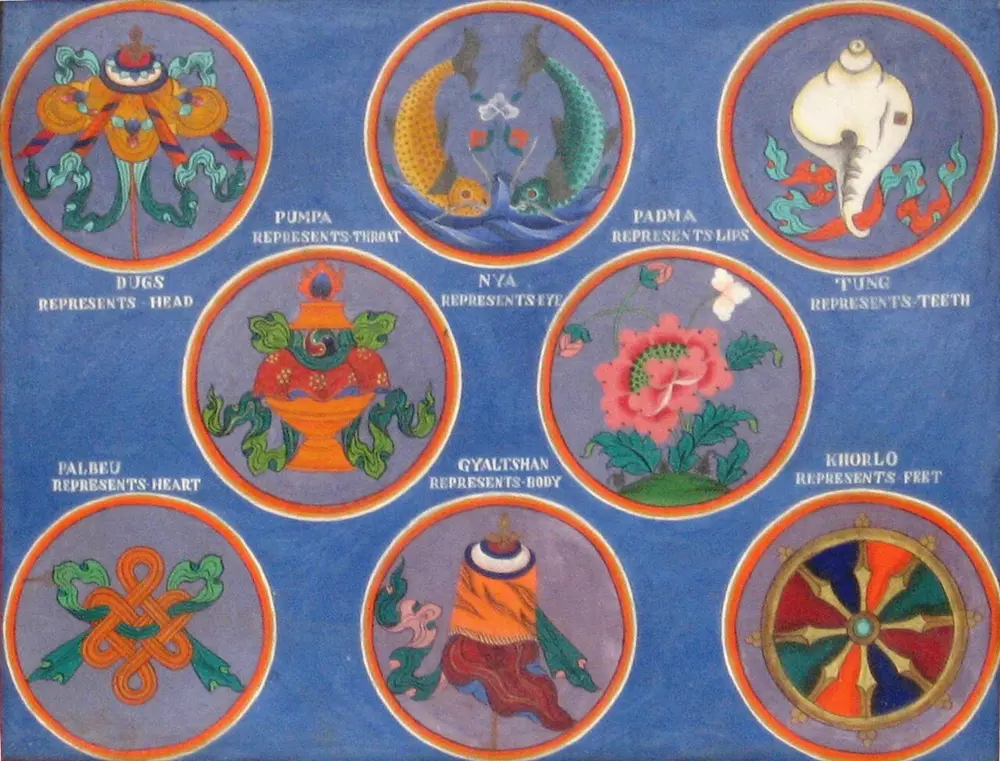
A blue painted wall with eight round panels, each showing one symbol: a parasol, a pair of fish, a white conch, a treasure vase, a lotus, an endless knot, a victory banner and a wheel, with their Tibetan names written below.

The eight auspicious symbols of Buddhism, painted at the Hall of Fame in Leh. Three motifs from this page are among them: the pair of fish, the conch and the wheel, along with a lotus and a treasure vase like the kalash.

Picture: Redtigerxyz. CC BY-SA 3.0.

Motifs at a glance

Motif Stands for Where to spot it
Peacock Beauty, love, the monsoon; Krishna and Kartikeya Paithani pallu; Peacock Gate, City Palace, Jaipur
Elephant Strength, royalty, good fortune; Ganesha, Gajalakshmi Patola saris; the base of the Hoysala temples
Fish Good luck, fertility; Vishnu's Matsya avatar Madhubani wedding paintings; the Awadh emblem in Lucknow
Hamsa Wisdom; Saraswati's and Brahma's mount Temple friezes; Ajanta paintings
Lotus Purity, creation; seat of the gods Bharhut and Sanchi railings; Lotus Temple, Delhi
Paisley A flowering plant, later the mango Kashmir shawls
Tree of life Life, fertility, earth joined to heaven Kalamkari palampores; Sidi Saiyyed jaali
Kalash Abundance, a lucky beginning Wedding and puja altars; the top of temple towers
Conch Good fortune, the call to worship; Vishnu Vishnu's hand; Bengal's carved shells and bangles
Chakra Time, dharma; Vishnu's weapon Konark wheels; the Ashoka Chakra on the flag

Floor art

Across India, women draw patterns on the ground at the doorway or in the courtyard to welcome guests and gods, above all Lakshmi, the goddess of wealth. The drawings are made with rice flour or rice paste, chalk, coloured powder or flowers, usually after the floor has been swept, washed or coated with cow dung. Most are meant to last only a day or a festival. Each region has its own name, materials and style.

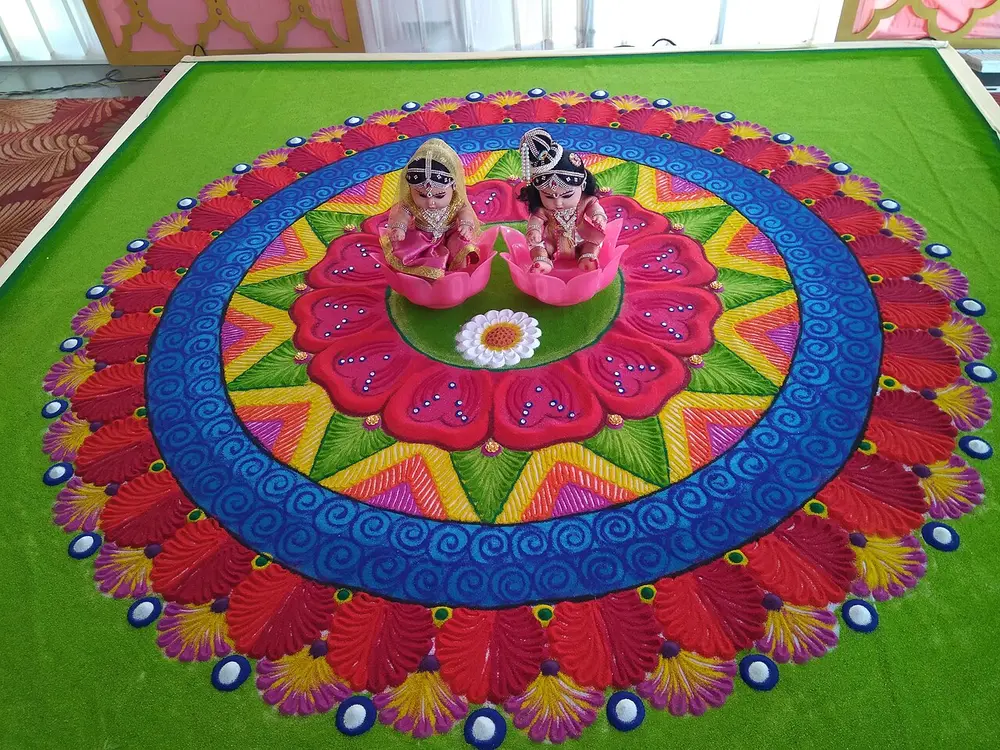
A large round floor design in bright coloured powders, with rings of red petals, blue and yellow zigzags and a pink lotus, and two small doll figures of a bride and groom at its centre, laid on a green mat.
Picture: SreeramKalyan. CC0.

Rangoli

Where
This one was made for a wedding in Karur, Tamil Nadu; the name is used in Maharashtra and across India

Rangoli is the best-known name for Indian floor art, used in Maharashtra and now across the country. It is made with bright coloured powders, rice flour or flower petals, and is drawn above all for Diwali, when lamps (diyas) are often set into it. In Maharashtra and Karnataka a rangoli at the door is also meant to keep evil away. In Keralam (Kerala until 2026), the flower carpet made for Onam, the pookalam, grows bigger every day of the festival.

Spot it by

Large, colourful, often round designs in powder or petals, with flowers, lamps, peacocks and lotuses.

Remember

Rangoli is colour; kolam is line.
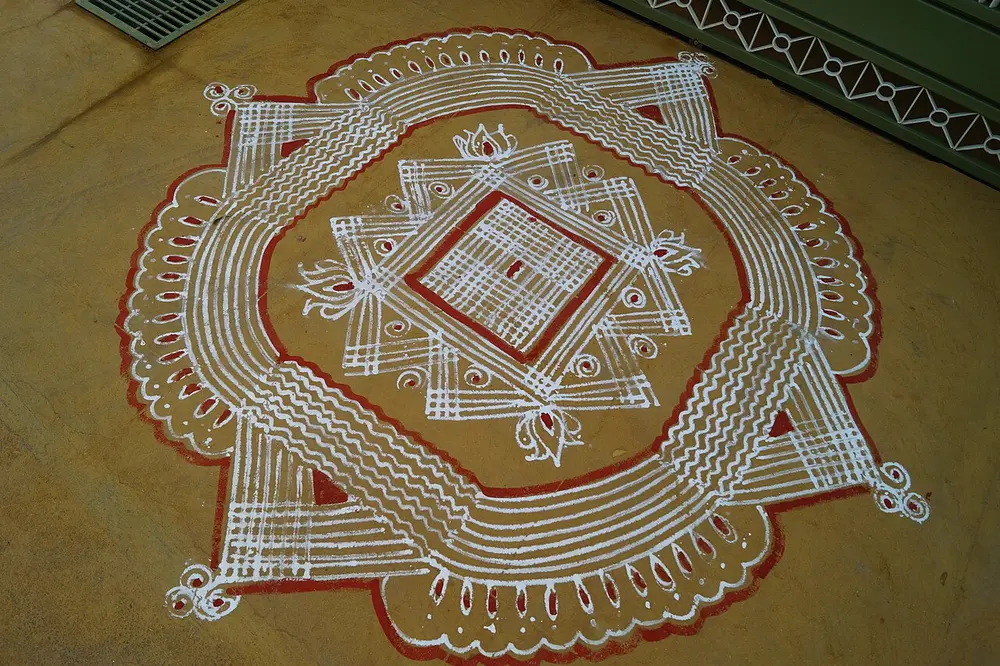
A large white line drawing on a swept floor, made of looping rice-flour lines that weave round a central square grid, with a thin red border painted round its outer edge.
Picture: SKsiddhartthan. CC BY-SA 4.0.

Kolam

Also called Muggu or muggulu in Telugu

Where
Tamil Nadu and across South India
Made with
Rice flour, often with a red border of kaavi (red earth)

Every morning before sunrise, women across Tamil Nadu sweep the doorstep, sprinkle it with water and draw a kolam in white rice flour. Most kolams start from a grid of dots, called pulli, which the lines either join or loop around, so a good kolam is a puzzle of symmetry. The rice flour feeds ants and birds, and the drawing is walked over and redrawn the next day. Bigger, more colourful kolams are made in the month of Margazhi (December to January) and for Pongal, the harvest festival. In Andhra Pradesh and Telangana the same art is called muggulu, drawn especially for Sankranti.

Spot it by

Fine white lines looping round a grid of dots, mostly in one colour, at a doorstep.

Remember

Kolam starts from dots (pulli) and feeds the ants.
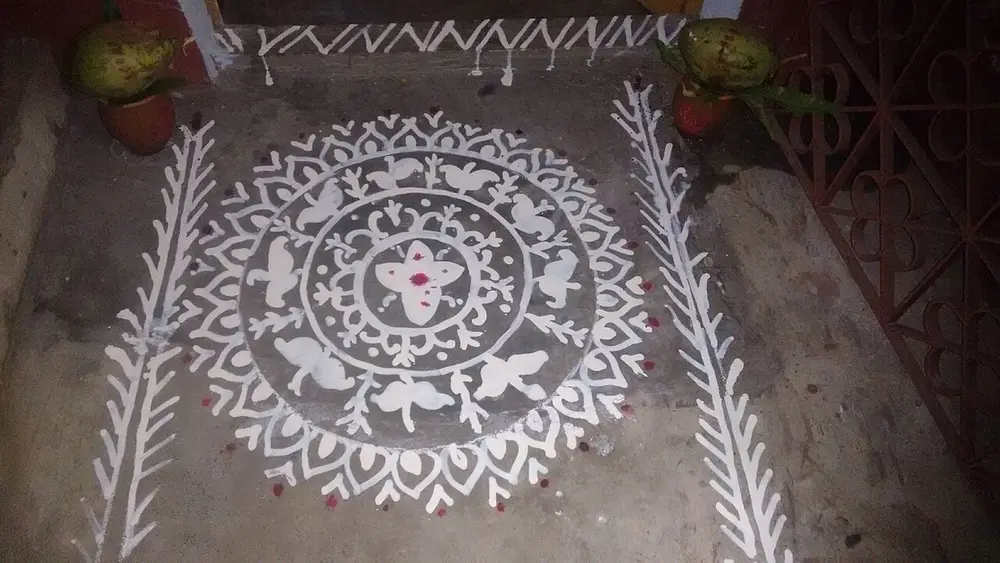
A white design painted on a grey doorstep at night: a round medallion of rings, petals and small birds, between two long leafy borders, with a pot topped by a green coconut and mango leaves at each corner.
Picture: Shonamug. CC BY-SA 4.0.

Alpana

Also called Alpona

Where
West Bengal (and Bangladesh)
Made with
A white paste of rice flour and water, or chalk and water, applied with the fingertips

Alpana is the floor and wall art of Bengal. It is painted with the fingertips in a white paste of ground rice and water, so it shows up white on a dark floor. It is drawn for weddings, for Lakshmi puja and for festivals such as Durga Puja. An alpana for Lakshmi often includes her owl, a granary, a conch and lotuses, and in the monsoon a sheaf of rice for the sowing of paddy. Artists such as Nandalal Bose at Santiniketan, and Abanindranath Tagore, who wrote about its motifs, carried alpana into modern Indian art.

Spot it by

White, flowing, painted (not powdered) lines on a dark floor, with lotuses, creepers, birds and fish.

Remember

Alpana is Bengal's white rice-paste painting.
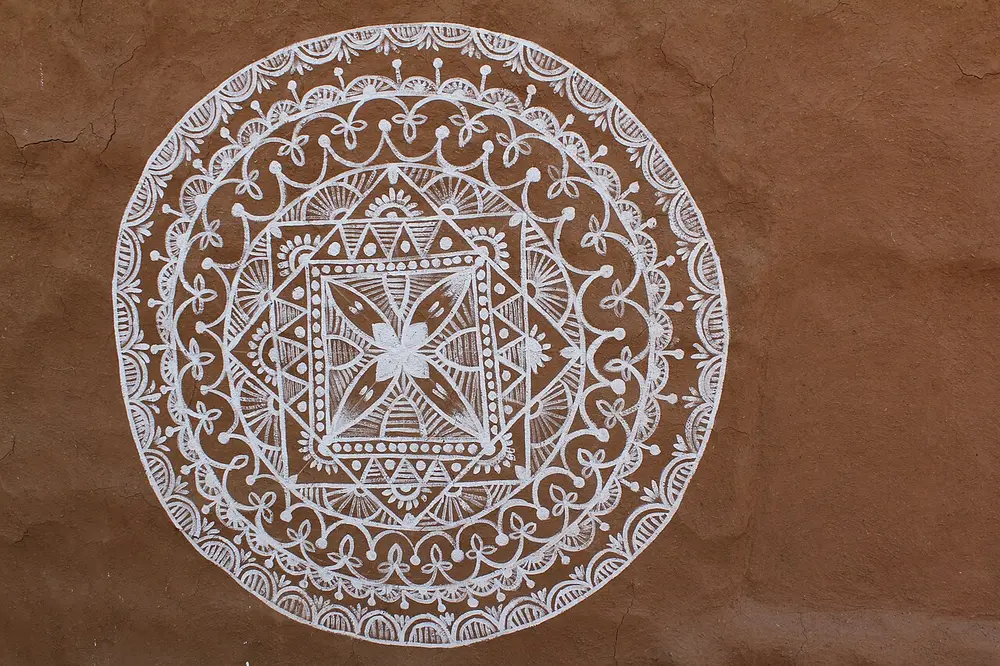
A round white design painted on a smooth brown mud wall, with a four-petalled flower inside a square, surrounded by rings of arches, dots, triangles and small loops.
Picture: Chinmayisk. CC BY-SA 4.0.

Mandana

Where
Rajasthan and Madhya Pradesh; this one is at Shilpgram, Udaipur
Made with
White lime or chalk on a ground of cow dung, clay and red ochre

Mandana is painted on the floors and walls of village homes in Rajasthan and Madhya Pradesh, to protect the house, welcome the gods and mark festivals. The surface is first coated with cow dung mixed with local clay and red ochre, and the design is drawn on it in white lime or chalk with a piece of cotton, a tuft of hair or a twig. The Meena women of the Hadoti region, around Kota and Bundi, are known for perfectly symmetrical mandanas. Designs include geometric squares and circles, flowers, peacocks and Ganesha.

Spot it by

White designs on a red or brown earth ground, often geometric and symmetrical.

Remember

Mandana is white on red, in Rajasthan.

Two more names to know. Aripan is the floor art of Mithila in Bihar, the same region as Madhubani painting. Women draw it with their fingers in pithar, a paste of soaked and ground raw rice, and add red vermilion and yellow turmeric, for weddings, the sacred-thread ceremony and festivals. Muggulu is the Telugu name for kolam in Andhra Pradesh and Telangana.

Floor art State Made with Drawn for
Kolam Tamil Nadu Rice flour, over a grid of dots Every morning; Margazhi month and Pongal
Muggulu Andhra Pradesh, Telangana Rice flour or white powder, with colour Every morning; Sankranti
Alpana West Bengal Rice paste, painted with the fingers Weddings, Lakshmi puja, Durga Puja
Mandana Rajasthan, Madhya Pradesh White lime on cow dung and red ochre Festivals; protecting the home
Aripan Bihar (Mithila) Rice paste (pithar), vermilion, turmeric Weddings and rituals
Rangoli Maharashtra, and across India Coloured powders, rice flour, petals Diwali and other festivals
Pookalam Keralam Flower petals Onam

Jaali and mandala

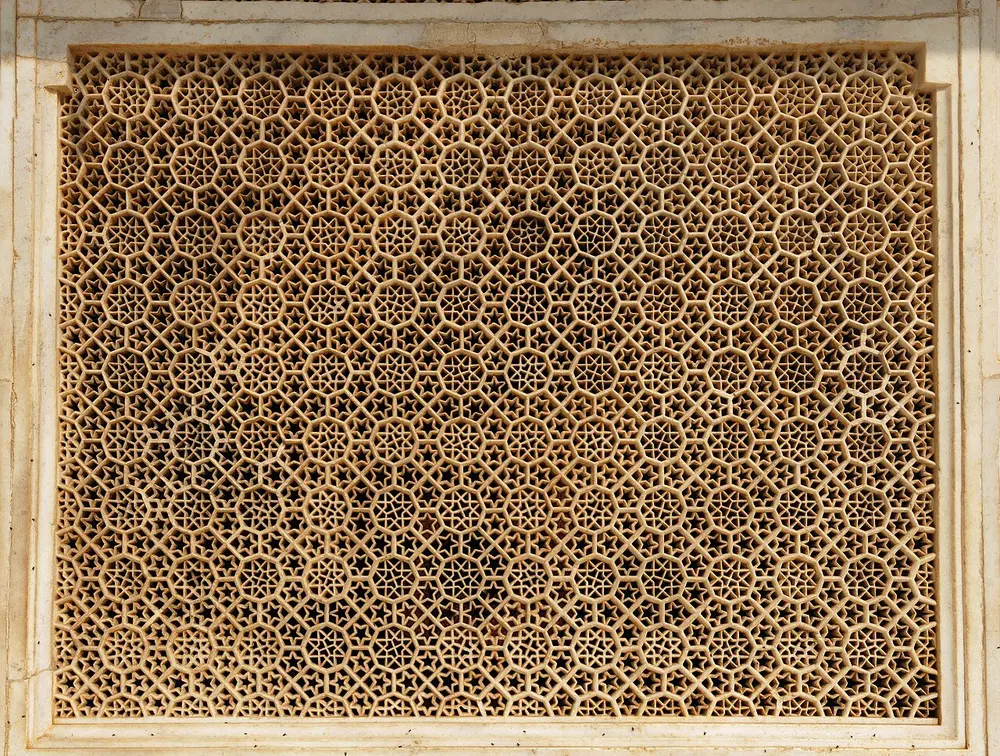
A large white marble window screen cut right through into a dense, even lattice of six-sided and star-shaped holes, set in a plain marble frame.
Picture: Marcin Białek. CC BY-SA 4.0.

Jaali

Also called Jali, meaning "net"

Where
Tomb of Salim Chishti, Fatehpur Sikri, Uttar Pradesh
When
Built 1580 to 1581, under Akbar
Made with
Marble

A jaali is a stone screen pierced with a pattern. It lets light and cool air in, keeps out harsh sun and rain, and lets people inside see out without being seen. Early temples used jaalis to soften the light, and in Indo-Islamic buildings they became a high art. Geometric jaalis repeat stars, hexagons and polygons, like this marble screen round the tomb of the Sufi saint Salim Chishti at Fatehpur Sikri. Natural jaalis show plants and trees, like the curling tree of the Sidi Saiyyed mosque in Ahmedabad (1572 to 1573) and the fine floral screens of the Taj Mahal. Architects today use brick and concrete jaalis again to cool buildings without air conditioning.

Spot it by

A window or wall of stone cut through with many small holes in a repeating pattern, glowing with light behind it.

Remember

Jaali means net: a stone net for light and air.
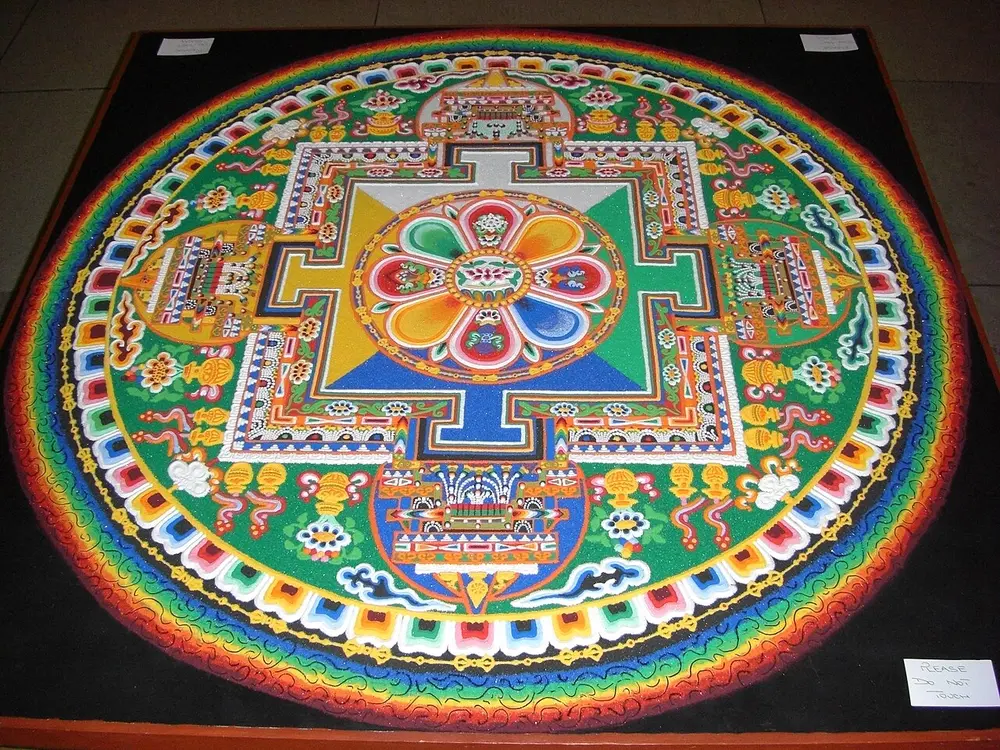
A large round design made of coloured sand on a table: inside rainbow-coloured outer rings sits a square palace with a gate in the middle of each side, and a red and blue eight-petalled lotus at its centre.
Picture: Colonel Warden (English Wikipedia). CC BY-SA 3.0.

Mandala

Also called Sanskrit for "circle"

Where
This sand mandala was made by Tibetan Buddhist monks in London in 2008
Made with
Coloured sand

A mandala is a sacred diagram of the universe. Its basic form is a square with a gate in the middle of each side, set inside a circle, with a centre point where the deity lives. In Buddhist art the square is a palace for a god, seen from above, and a person meditating imagines travelling inward to its centre. Tibetan monks build mandalas grain by grain from coloured sand over days or weeks, then sweep them away to show that nothing lasts. The idea of a sacred square grid also lies behind the plans of Hindu temples.

Spot it by

A circle containing a square with T-shaped gates on all four sides, built around a centre, often a lotus.

Remember

Circle outside, square palace inside, four gates, god at the centre.

Don't confuse

A kolam or mandana may also be round and symmetrical, but it is floor or wall art for the home; a mandala is a religious map of the universe used in worship and meditation.

Test yourself

Question 1 of 8

This gate at the City Palace, Jaipur, is decorated with which bird, also woven into the pallu of the Paithani sari?

Question 2 of 8

Which of these is a kolam from Tamil Nadu?

Question 3 of 8

This painted cotton bedcover from the Coromandel Coast shows which motif?

Question 4 of 8

Which of these is a jaali?

Question 5 of 8

Alpana, painted in white rice paste with the fingertips, is the floor art of which state?

Question 6 of 8

The paisley is called kairi in Hindi. What does kairi mean?

Question 7 of 8

The kalash in this picture is topped with mango leaves and a coconut. What does it stand for?

Question 8 of 8

The hamsa, carved in the band of birds on this temple wall, is the mount of which goddess?

From past papers

Real exam questions on this topic, each with a full solution.

Finished this note?

Mark it as studied to track your progress through the course.

Was this note useful?

Each picture is credited underneath it. Pictures of works still in copyright are shown small, for teaching only. If you hold the rights to a picture and want it removed, tell us through the contact page and we will take it down.