Skip to content

Chapter 2: Sculpture and the story of Indian art

Gandhara, Mathura and Amaravati

The three great schools of early Buddhist sculpture in India, from about the 1st century BCE to the 3rd century CE. Who paid for them, what stone they used, how each shows the Buddha, and how to tell them apart in a photo.

In one minute

6 facts to know

  1. Three schools of sculpture flourished at about the same time: Gandhara in the northwest (today Pakistan and Afghanistan), Mathura on the Yamuna in Uttar Pradesh, and Amaravati in the Krishna valley of Andhra Pradesh.
  2. Gandhara and Mathura were among the first to show the Buddha as a human figure, and both grew under the Kushana kings, above all Kanishka.
  3. Gandhara carved grey schist, and later stucco, in a Greek and Roman manner: wavy hair in a topknot, a heavy toga-like robe and a calm, Greek-looking face.
  4. Mathura carved red sandstone with cream spots in an Indian manner: a round smiling face, a shaven head or a single coiled knot, and a thin robe that leaves the right shoulder bare.
  5. Amaravati carved pale limestone slabs crowded with slim figures in motion, mostly under the Satavahanas; Nagarjunakonda carried the style on under the Ikshvakus.
  6. In the late 5th century CE, under the Guptas, Sarnath made the most famous Buddha of all: calm, with a see-through robe and a richly carved halo.

Before about the 1st century CE, Buddhist carvers did not show the Buddha as a person. They showed him through signs: an empty throne, his footprints, the Bodhi tree, an umbrella or a stupa (a dome-shaped mound built over relics). This note is about the three workshops that changed that, and how their Buddhas look different.

Who ruled, and when

After the Mauryan empire broke up, a series of rulers from the northwest and Central Asia took over Gandhara. Exams ask for their order.

  1. 2nd century BCE

    Indo-Greek kings from the Greek kingdom of Bactria (in today's Afghanistan) rule Gandhara and bring Greek coins and art

  2. 1st century BCE

    The Shakas (Indo-Scythians), nomads from Central Asia, take over much of the northwest, followed by the Indo-Parthians

  3. 1st century CE

    The Kushanas build an empire from Central Asia to the Ganga plain; the Buddha begins to appear in human form at Gandhara and Mathura

  4. 2nd century CE

    Kanishka, the greatest Kushana king, rules from Gandhara to Mathura and beyond

  5. 2nd century CE

    The Satavahanas rule the Deccan, and the Amaravati stupa gets its finest carved slabs

  6. 3rd century CE

    The Ikshvakus rule the Krishna valley from their capital Vijayapuri, today's Nagarjunakonda

  7. Late 5th century CE

    Under the Gupta empire, Sarnath carves its famous preaching Buddha

Remember the order after the Mauryas: Indo-Greeks, then Shakas, then Kushanas.

The three schools side by side

Feature Gandhara Mathura Amaravati
Region The northwest: the Peshawar valley, Taxila and Swat (today Pakistan and eastern Afghanistan) Mathura, on the Yamuna in Uttar Pradesh The lower Krishna valley in Andhra Pradesh (Amaravati, Nagarjunakonda)
Period Mainly 1st to 5th century CE, at its height under the Kushanas Buddha images from the 1st to 3rd century CE (Mathura carving is older) Stupa begun around the 3rd century BCE; finest carving 1st to 3rd century CE
Patrons Mainly the Kushana kings Kushana kings, plus Jain and Hindu donors Satavahana kings, then the Ikshvaku kings and queens
Material Grey or blue-grey schist; later stucco (lime plaster) Red sandstone with cream spots, quarried around Fatehpur Sikri Pale, almost white limestone, often called the "Amaravati marbles"
Outside influence Strong Greek and Roman, with some Persian Mostly Indian; grew out of the old yaksha statues Indian, with its own lively local style
Religion Almost all Buddhist Buddhist, Jain and Hindu Almost all Buddhist

How the Buddha is shown

Feature Gandhara Mathura Amaravati
Hair Wavy locks swept up into a topknot Shaven head, or one spiral knot like a snail shell Small snail-shell curls
Robe Thick robe over both shoulders, in deep heavy folds like a Roman toga Thin robe over the left shoulder only; right shoulder bare Robe with rippling folds running in slanting lines
Face Oval, Greek-looking, sharp nose, half-closed eyes; sometimes a moustache Round and smiling, with full cheeks Often small, one figure among many in a story scene
Halo A plain disc Large, with a scalloped or patterned edge Not a key clue
Body and posture Calm and still; often standing, or seated in meditation Broad shoulders and a strong body; seated cross-legged, right hand raised Slim figures that bend and turn, crowded into story panels

Yaksha: a nature spirit, linked to trees, water and wealth. Mathura's big stone yakshas of the 2nd and 1st centuries BCE gave its Buddha his sturdy, upright body.

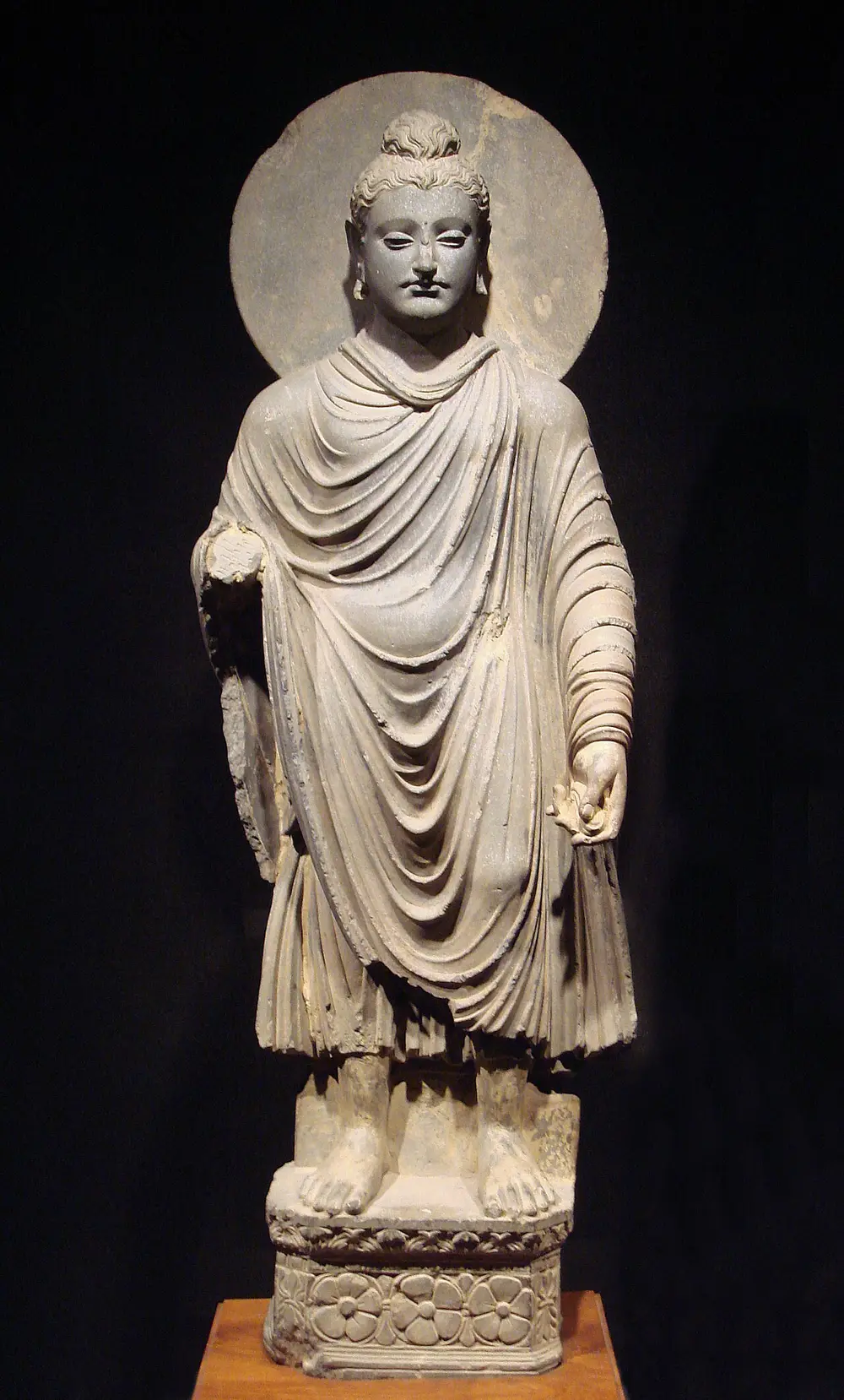
Gandhara

A grey stone statue of the standing Buddha against a plain round halo, with wavy hair in a topknot and a heavy robe falling in deep folds to his ankles.
Picture: World Imaging. Public domain.

Standing Buddha, Tokyo

Where
Gandhara; now in the Tokyo National Museum, Japan
When
1st to 2nd century CE
Style
Gandhara (Greco-Buddhist)
Made with
Grey schist

This is the textbook Gandhara Buddha. His wavy hair and topknot, his straight nose and his robe, which hangs like a Greek or Roman cloak over both shoulders, all show how Greek art travelled east with the Indo-Greeks and stayed under the Kushanas. Many museums have Buddhas very like it, including the National Museum in New Delhi.

Spot it by

Grey stone, deep rope-like folds over both shoulders, wavy hair, a thin moustache and a plain round halo.

Remember

Gandhara dresses the Buddha in a Greek god's toga.

Don't confuse

A Mathura Buddha is in red stone and shows a bare right shoulder.
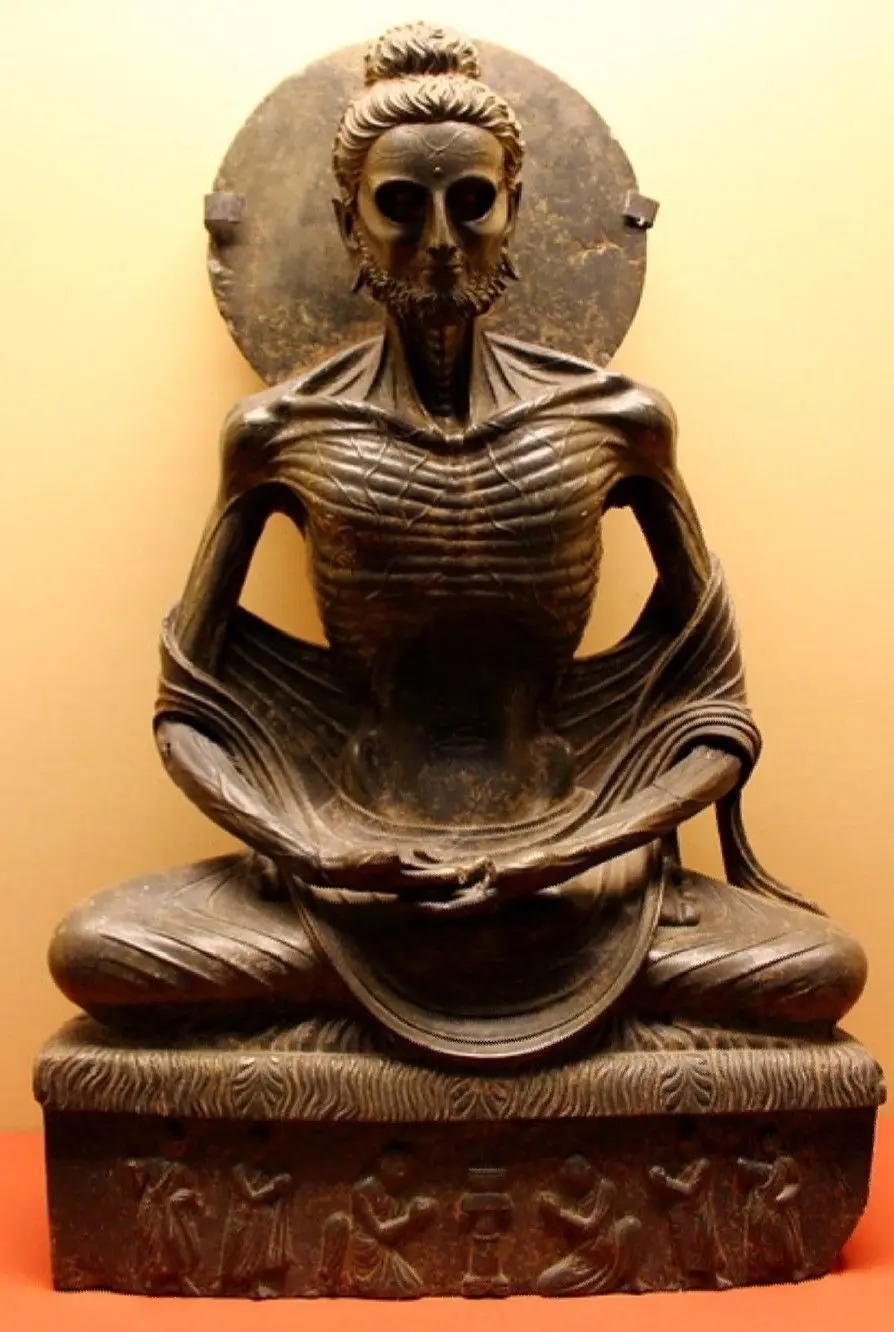
A dark grey stone figure of a seated man so thin that every rib and vein shows, with sunken eyes, a beard and a round halo behind his head.
Picture: SpeakingArch. CC BY-SA 4.0.

Fasting Buddha

Also called Fasting Siddhartha

Where
Found at the Sikri stupa in Gandhara; now in the Lahore Museum, Pakistan
When
2nd to 3rd century CE
Style
Gandhara
Made with
Grey schist, about 84 cm tall

Before his enlightenment, Prince Siddhartha tried to find the truth by starving himself, then gave this up as the wrong path. This statue shows him at the end of that fast, a living skeleton still sitting calmly in meditation. It is one of the Lahore Museum's most prized objects and one of the finest pieces of Gandhara art. The carving of every bone and vein shows the realism Gandhara learned from Greek art.

Spot it by

Ribs, veins and sunken eyes, a beard, and a plain round halo, all in dark grey stone.

Remember

The thinnest Buddha in art lives in Lahore.

Don't confuse

This Sikri is in northwest Pakistan. It has nothing to do with Fatehpur Sikri near Agra, where Mathura's red stone came from.
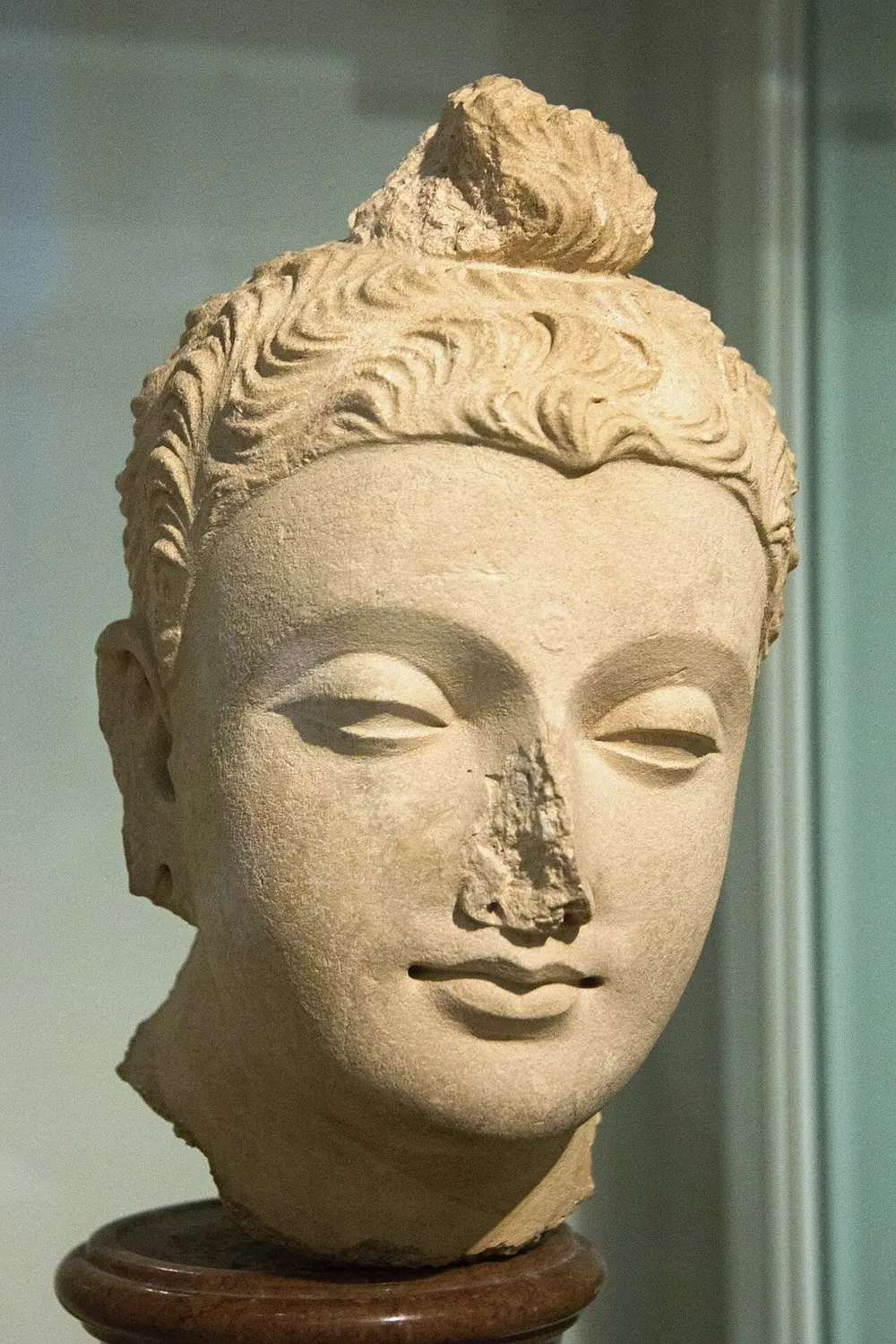
A pale cream plaster head of the Buddha with deep wavy hair, a high topknot, half-closed eyes and a broken nose.
Picture: Zde. CC BY-SA 4.0.

Stucco head of the Buddha

Where
Gandhara; now in the National Gallery, Prague
When
3rd to 4th century CE
Style
Late Gandhara
Made with
Stucco (lime plaster), once painted

Up to about the 3rd century CE, Gandhara carvers worked almost only in schist. After that, stucco took over, because it was cheaper and easier to model by hand over a core of wood, rope and straw. Stucco heads like this one keep the Gandhara look, with wavy hair, a topknot and half-closed eyes, but in a soft, pale material.

Spot it by

Pale, chalky surface with the same wavy Gandhara hair and dreamy, half-closed eyes.

Remember

Grey stone first, white plaster later: both are Gandhara.

Don't confuse

A pale head is not automatically Amaravati. Amaravati made flat panels full of figures in limestone; wavy hair and a topknot mean Gandhara.

Mathura

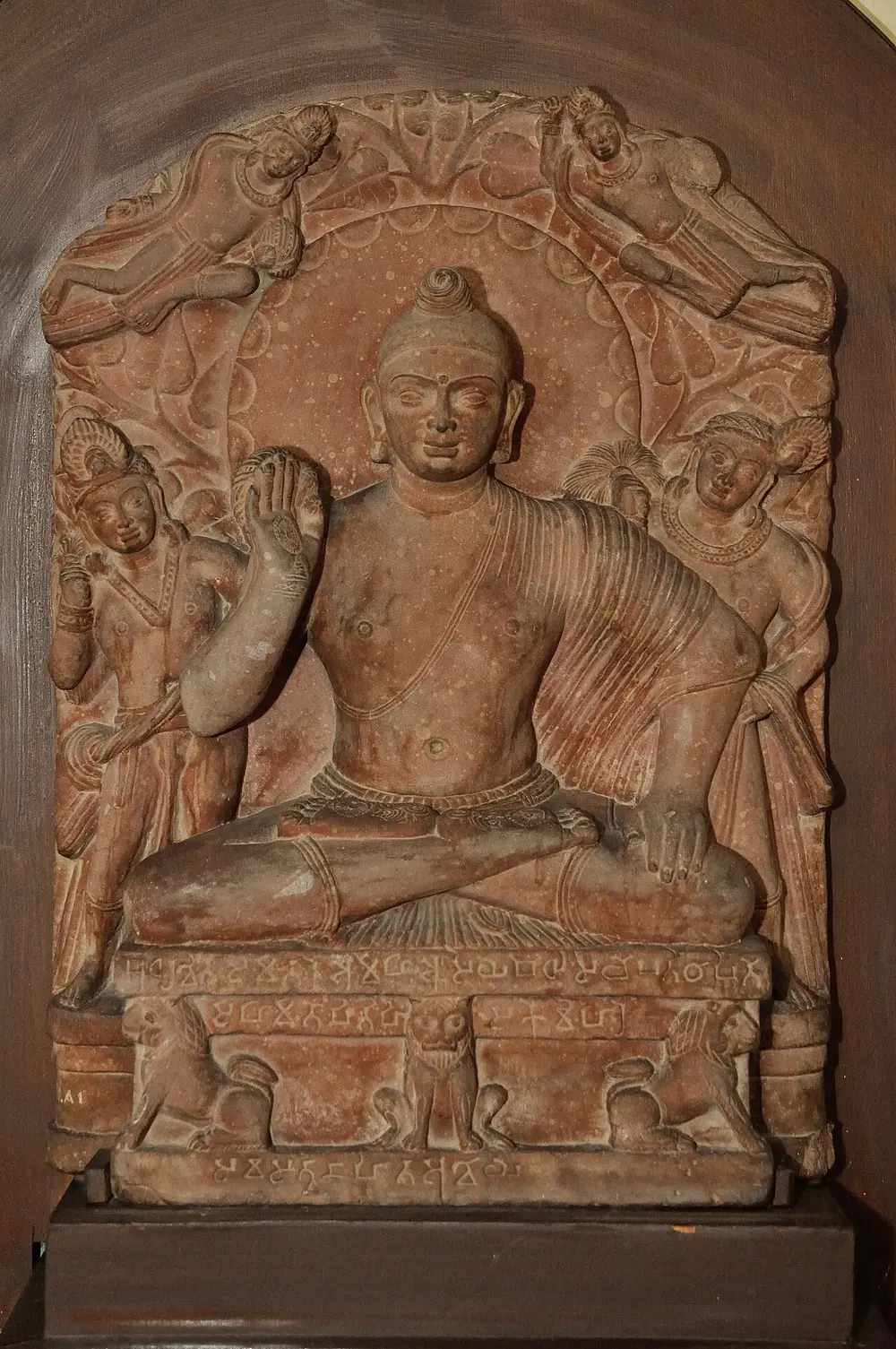
A red sandstone panel of the Buddha seated cross-legged on a lion throne, right hand raised, with a large halo, two standing attendants and two flying figures above.
Picture: Biswarup Ganguly. CC BY 3.0.

Katra Buddha

Also called Katra Bodhisattva

Where
Found at the Katra mound, Mathura; now in the Government Museum, Mathura
When
Around the 2nd century CE
Style
Mathura
Made with
Spotted red sandstone

This is the classic early Mathura Buddha. He sits cross-legged on a throne held up by lions, with his right hand raised in abhaya mudra, the gesture that says "do not fear". Two attendants stand beside him, flying figures float above, and the branches of the Bodhi tree spread behind his huge halo. Early scholars catalogued it as a Bodhisattva, a being on the way to becoming a Buddha, so it is also called the Katra Bodhisattva.

Spot it by

Red stone with pale spots, a round smiling face, broad shoulders, a thin robe with the right shoulder bare, and one coiled knot of hair.

Remember

Mathura's Buddha is a strong, smiling Indian prince in red stone.

Don't confuse

The Gupta Buddha from Sarnath is slimmer, has a curly head and a see-through robe over both shoulders.
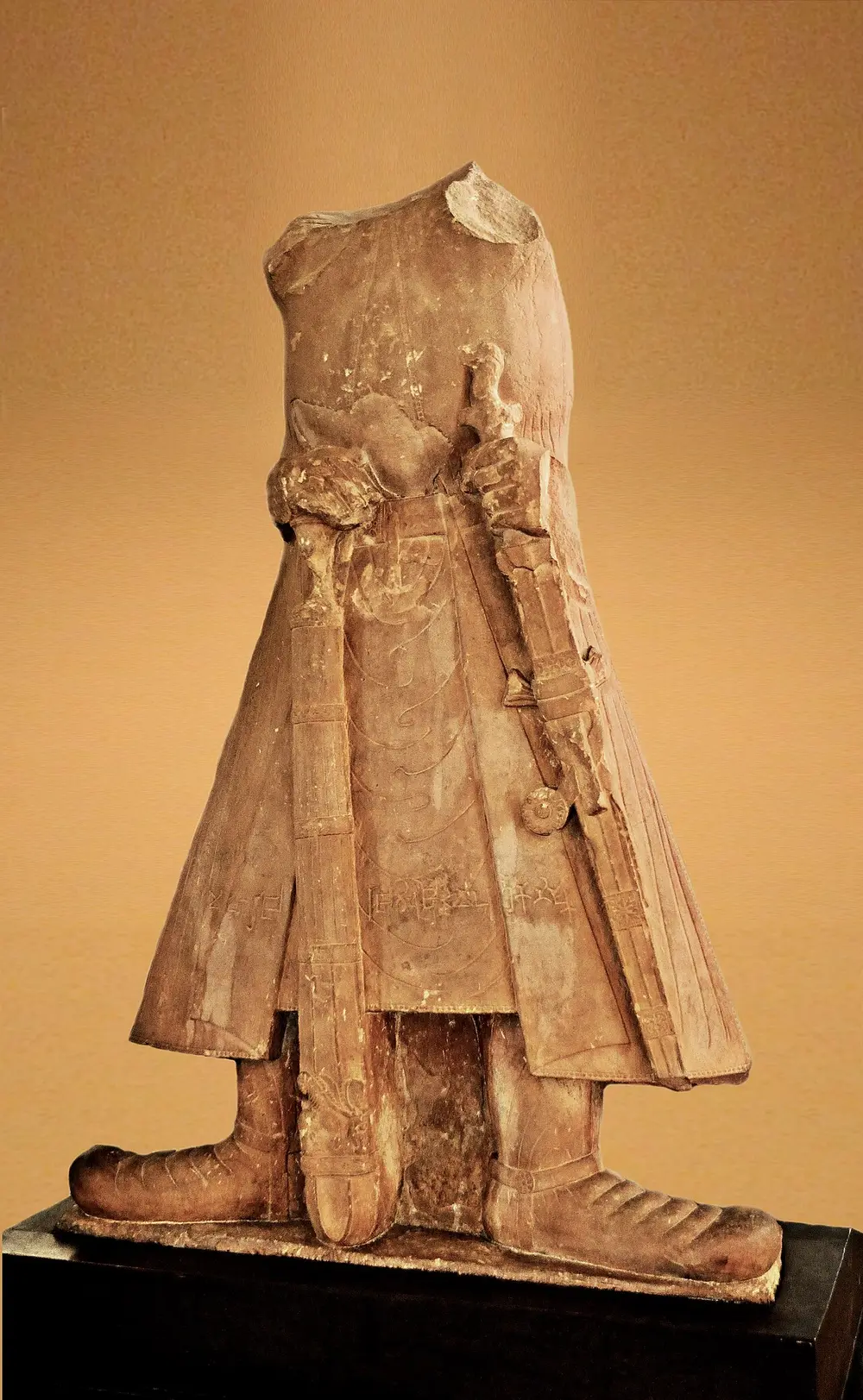
A headless red sandstone statue of a king in a long stiff coat and heavy padded boots, holding a sword at his side and a large mace.
Picture: Biswarup Ganguly. CC BY-SA 3.0.

Headless statue of Kanishka

Where
Found at Mat, near Mathura; now in the Government Museum, Mathura
When
2nd century CE
Who
Kanishka, Kushana emperor
Style
Mathura, royal portrait
Made with
Red sandstone, about 1.85 m tall

The head and arms are lost, but an inscription on the statue names the king as Kanishka, the "great king, king of kings, son of god". He is dressed like a horseman from Central Asia, in a long tunic and coat with heavy padded boots, and he grips a sword and a mace. It shows that Mathura carved Kushana kings as well as gods.

Spot it by

No head, a stiff coat flaring like a bell, boots with the toes turned out, and a long sword.

Remember

The king with no head is Kanishka, the patron of both Gandhara and Mathura.
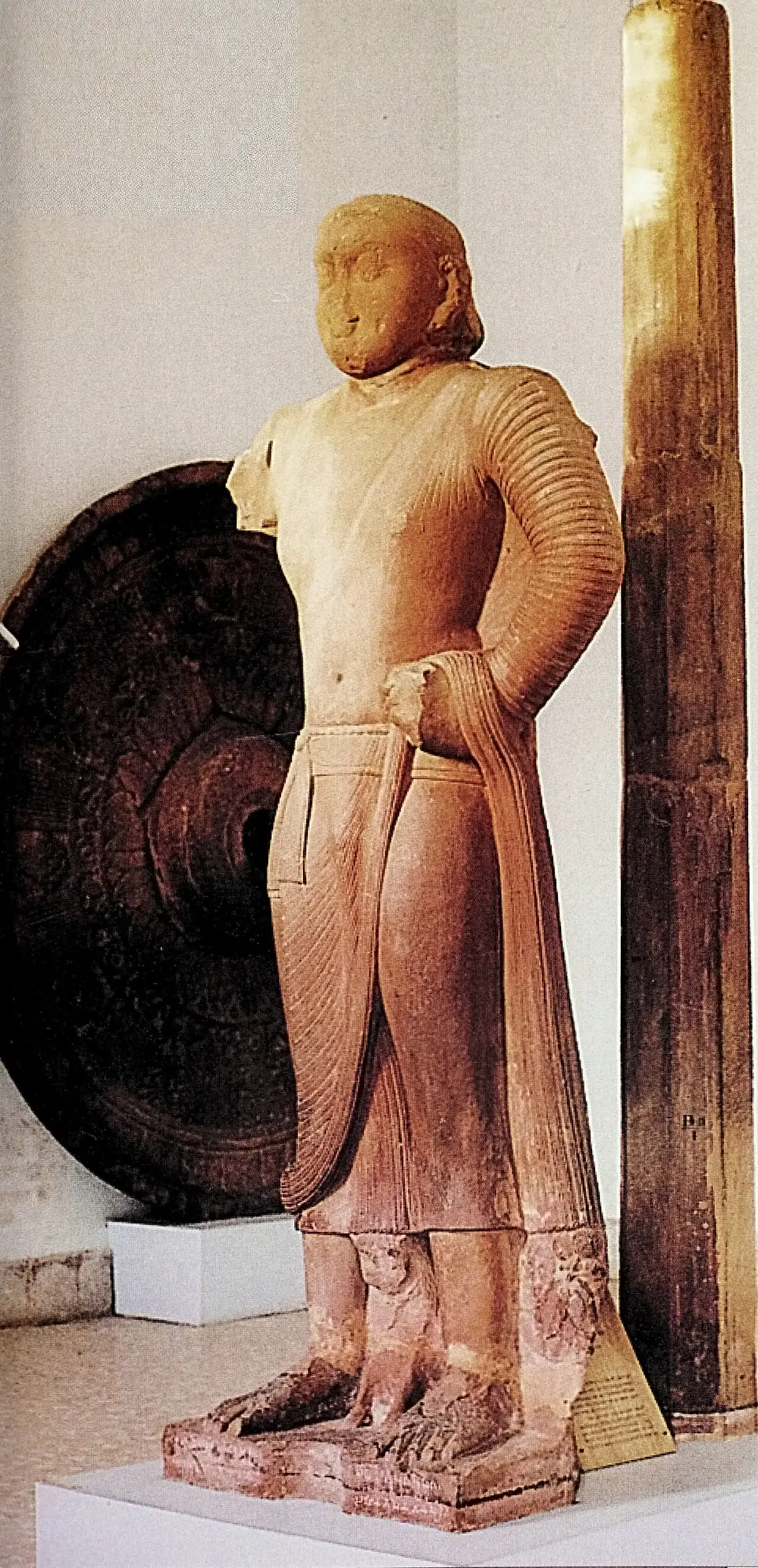
A tall standing red sandstone figure with a round face and a shaven head, his robe gathered at the waist, with a large carved stone umbrella and its tall shaft displayed beside him.
Picture: B. R. Mani, Archaeological Survey of India (Ministry of Culture). GODL-India.

Bala Bodhisattva

Where
Made at Mathura, found at Sarnath; now in the Sarnath Museum
When
Year 3 of Kanishka's reign, usually worked out as about 123 to 130 CE
Who
Given by a Buddhist monk named Bala
Style
Mathura
Made with
Red sandstone, about 2 m tall

This giant standing Bodhisattva was carved in Mathura and carried all the way to Sarnath, which shows how widely Mathura's red stone images travelled. It once stood under a huge carved stone umbrella (chhatra) on a tall pillar, a sign of high status. Its inscription gives a date in Kanishka's reign, which helps historians date the whole Mathura style.

Spot it by

Red stone, a big sturdy body, a shaven head, and a thin robe over one shoulder gathered in the left hand.

Remember

Bala's Bodhisattva is a Mathura giant that went on a trip to Sarnath.

Don't confuse

Being found at Sarnath does not make it Gupta. The red spotted stone and sturdy body mark it as Kushana Mathura work, three centuries older than the Sarnath Buddha below.

Amaravati and Nagarjunakonda

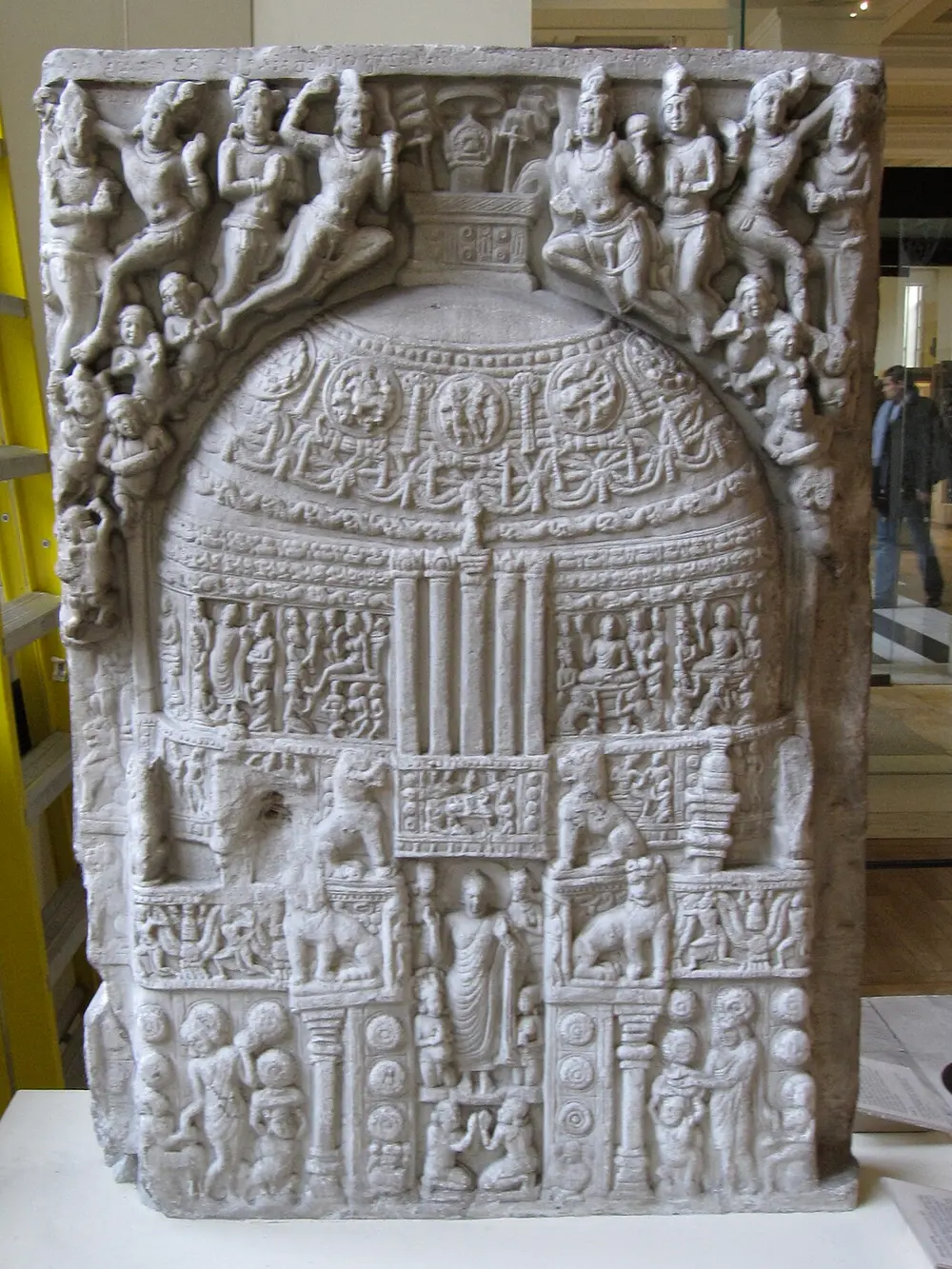
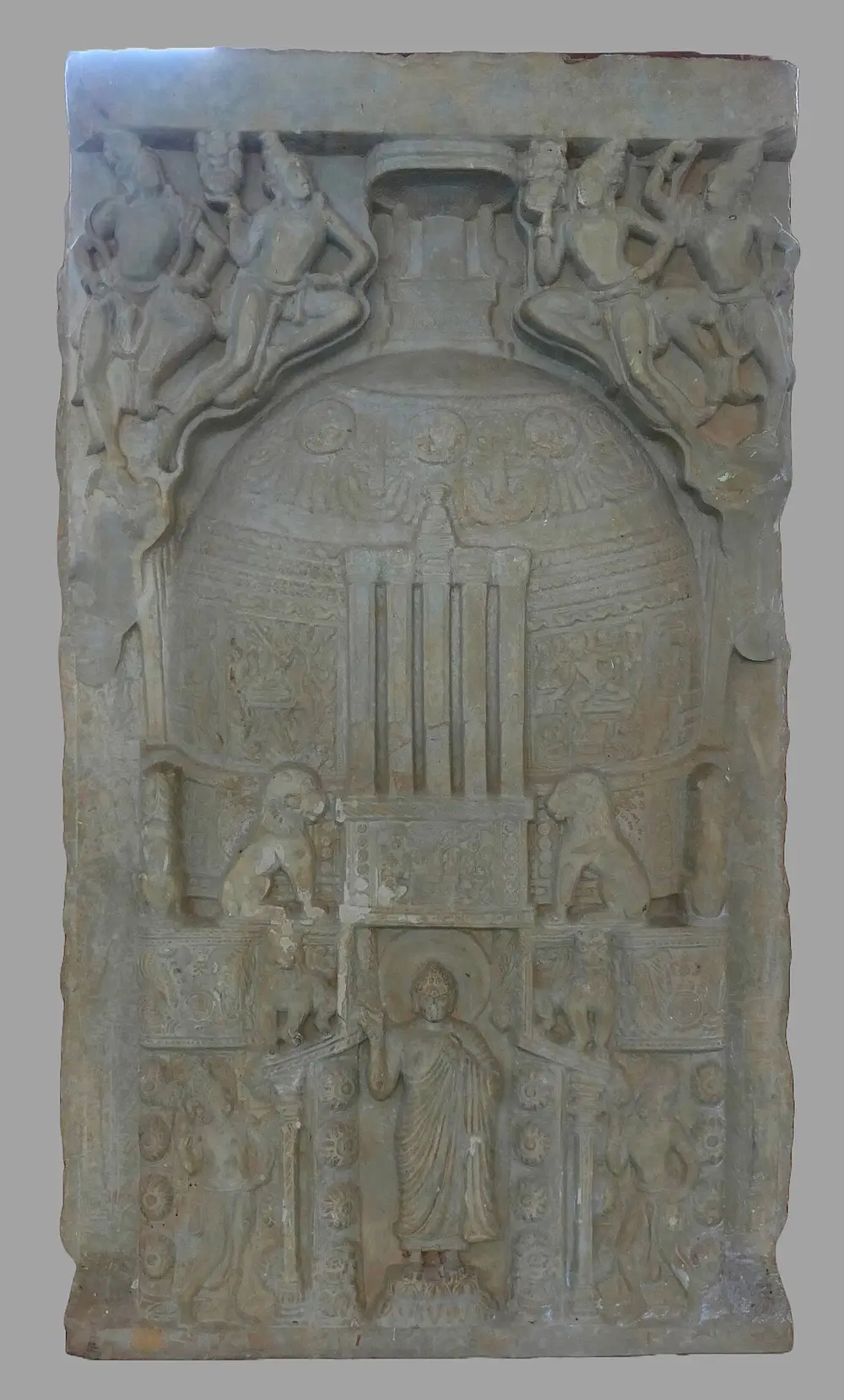
A pale limestone slab carved with a stupa covered in garlands and small scenes, with lions on pillars, the Buddha standing in the gateway and crowds of flying figures above.
Picture: Gryffindor. CC BY-SA 3.0.

Amaravati drum slab

Where
Great Stupa of Amaravati, Andhra Pradesh; now in the British Museum, London
When
3rd century CE (the other side was carved around the 1st century BCE)
Style
Amaravati
Made with
Limestone

Slabs like this once covered the base of the dome of the great stupa at Amaravati, and many show a picture of the stupa itself. Here the Buddha stands in human form in the gateway. The other side of this same slab, carved centuries earlier, shows him only as an empty throne with footprints under the Bodhi tree. The largest collections of Amaravati carving are in the Government Museum in Chennai, the Amaravati site museum and the British Museum.

Spot it by

Pale stone, a flat panel packed with small, slim figures, a domed stupa in the middle and lots of movement.

Remember

Amaravati tells stories; Gandhara and Mathura make statues.

Don't confuse

Gandhara also made story panels, but in grey schist, with stiffer figures in Greek-style robes.
A grey-white limestone slab carved with a large domed stupa, two lions at its base and a standing Buddha with a halo in the gateway, with flying figures at the top.
Picture: Anandajoti. CC BY-SA 4.0.

Nagarjunakonda

Also called Vijayapuri

Where
Krishna valley, Andhra Pradesh; this slab is in the Nagarjunakonda Museum, on an island in the Nagarjuna Sagar lake
When
3rd to early 4th century CE
Who
Ikshvaku kings and queens
Style
Amaravati school, later phase
Made with
Limestone

After the Satavahanas, the Ikshvaku kings ruled from Vijayapuri, and their queens paid for many of its stupas and monasteries. The carving carries on the Amaravati style, in lower relief and with calmer figures. In the 1950s and 1960s the Nagarjuna Sagar Dam flooded the valley, so archaeologists moved the most important remains to the hilltop, which is now an island with a museum.

Spot it by

The same pale stone and stupa scenes as Amaravati, but flatter and quieter.

Remember

Nagarjunakonda is Amaravati's younger sibling, saved from a dam by moving to an island.

What came next: Sarnath under the Guptas

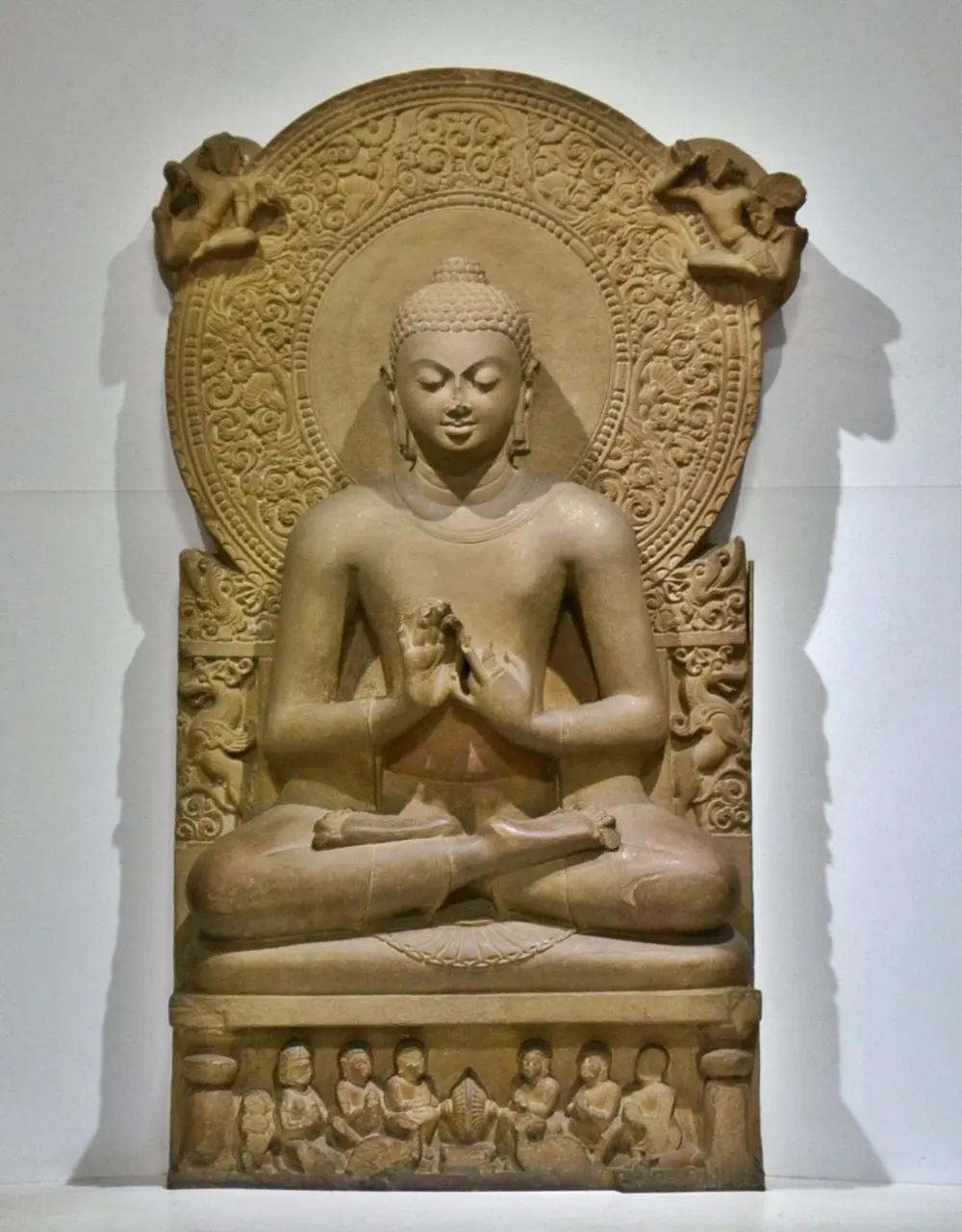
A buff sandstone Buddha seated cross-legged with his hands held at his chest, eyes lowered, in front of a huge round halo carved with flowers and creepers; small figures and a wheel are carved on the base.
Picture: Tevaprapas Makklay (พระมหาเทวประภาส วชิรญาณเมธี). CC BY-SA 3.0.

Preaching Buddha of Sarnath

Where
Sarnath, near Varanasi; now in the Sarnath Museum
When
Late 5th century CE
Style
Sarnath school, Gupta period
Made with
Chunar sandstone

This Buddha shows his first sermon at Sarnath. His hands are in dharmachakra mudra, the gesture of turning the wheel of the teaching, and the base shows the wheel, two deer and his first disciples. The robe is so thin that it almost disappears into the body. Compared with the Kushana Buddhas of Mathura, the body is slimmer and the cheeks less round.

Spot it by

Buff stone, a see-through robe with no visible folds, small snail-shell curls, lowered eyes, hands at the chest, and a halo richly carved with flowers.

Remember

Gupta Sarnath has the plain robe and the fancy halo; Gandhara has the fancy robe and the plain halo.

Don't confuse

Mathura's Kushana Buddha is red, round-faced and shows a bare right shoulder.
How to tell them apart in a photo

A UCEED question once showed four Buddha heads and asked which belonged to the Gandhara style. Run through these clues in order.

  1. Look at the colour of the stone. Grey, blue-grey or nearly black means Gandhara schist. Red with pale spots means Mathura. A pale panel packed with figures means Amaravati. Buff or yellowish, with a smooth body, usually means Gupta Sarnath.
  2. Look at the hair. Wavy locks pulled into a topknot mean Gandhara. A shaven head or one coiled knot means Kushana Mathura. Neat rows of small snail-shell curls point to Amaravati or the later Gupta style.
  3. Look at the robe. Heavy, deep folds over both shoulders mean Gandhara. A thin robe with the right shoulder bare means Mathura. A robe so thin you can hardly see it means Gupta Sarnath.
  4. Look at the face. A Greek-looking face, sharp nose, half-closed eyes or a moustache means Gandhara. A round, smiling face with full cheeks means Mathura.
  5. Look at the halo. A plain disc means Gandhara. A scalloped edge means Kushana Mathura. A big halo ringed with carved flowers and creepers, as on the Sarnath Buddha, is a Gupta-period sign.
  6. Pale plaster is still Gandhara. A chalky white head with wavy hair is Gandhara stucco, not Amaravati.

Test yourself

Question 1 of 8

Which of these sculptures belongs to the Gandhara school?

Question 2 of 8

This statue shows Siddhartha at the end of his long fast. Where is it kept?

Question 3 of 8

Which clues in this sculpture point to the Mathura school?

Question 4 of 8

This headless statue was found near Mathura. Whom does it show?

Question 5 of 8

Which school does this seated Buddha belong to?

Question 6 of 8

The Amaravati stupa sculptures were mostly carved in which stone?

Question 7 of 8

Which dynasty is most closely linked with the Amaravati stupa?

Question 8 of 8

Which is the correct order of rulers in the northwest after the Mauryas?

From past papers

Real exam questions on this topic, each with a full solution.

Finished this note?

Mark it as studied to track your progress through the course.

Was this note useful?

Each picture is credited underneath it. Pictures of works still in copyright are shown small, for teaching only. If you hold the rights to a picture and want it removed, tell us through the contact page and we will take it down.