Skip to content

Chapter 7: Textiles, crafts and motifs

Crafts in clay, metal, wood and fibre

India's best-known handicrafts, from Jaipur blue pottery, Longpi and the Bankura horse to Bidriware, Dhokra, Channapatna toys, Kashmiri papier-mâché, Sikki grass and Kathputli puppets, with what a GI tag is.

In one minute

6 facts to know

  1. Dhokra is metal cast by the lost-wax method, made in Chhattisgarh (Bastar), West Bengal, Odisha, Jharkhand and Telangana. Exams ask about it more than any other craft here.
  2. Bidriware from Bidar, Karnataka, is a blackened zinc alloy inlaid with shining silver.
  3. Jaipur blue pottery uses no clay: it is made of quartz powder and powdered glass. Longpi pottery from Manipur is black, made of ground stone and clay, without a wheel.
  4. The Bankura horse is terracotta from Panchmura, West Bengal; Molela plaques are terracotta reliefs of folk gods from Rajasthan.
  5. Turned and lacquered wooden toys come from Channapatna (Karnataka) and Etikoppaka (Andhra Pradesh); Kondapalli toys (Andhra Pradesh) are carved from light wood and painted.
  6. The Aranmula kannadi from Keralam (Kerala until 2026) is a mirror made of polished metal, not glass.

What a GI tag is

A Geographical Indication (GI) is a name for a product whose quality comes from the place where it is made, such as "Channapatna Toys & Dolls". Once a name is registered, only makers from that place can sell their goods under it. India registers GIs under the Geographical Indications of Goods (Registration and Protection) Act of 1999, at the GI Registry in Chennai. A registration lasts ten years and can be renewed. Darjeeling Tea was India's first GI, and the Aranmula Kannadi was among the very first crafts. Most crafts in this note have one; the table near the end lists them.

Clay and stone

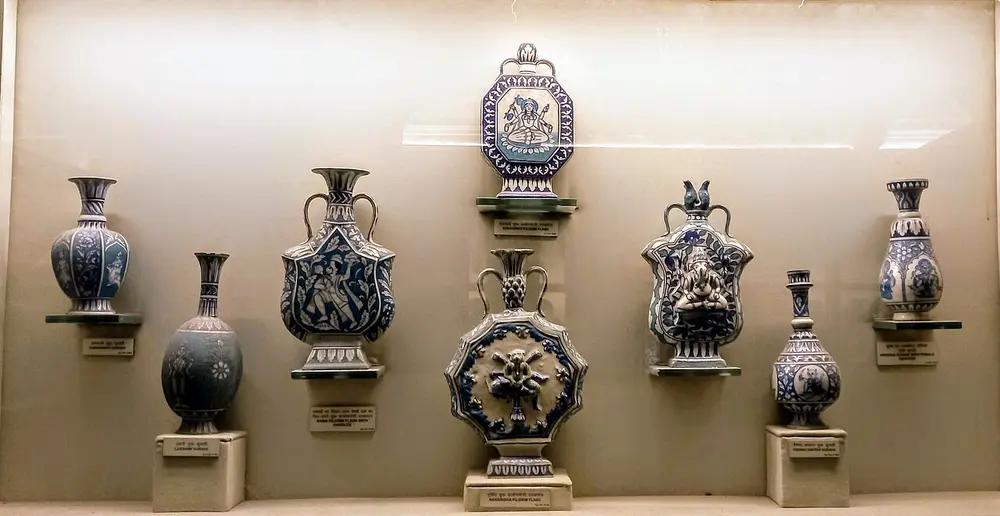
A museum wall case of blue and white glazed vases and flasks of different shapes, painted with flowers, figures and patterns.
Picture: Neek-Theri. CC BY-SA 4.0.

Jaipur blue pottery

Where
Jaipur, Rajasthan
When
In Jaipur since the 19th century; revived in the 20th
Made with
Quartz powder, powdered glass, multani mitti (fuller's earth), borax and gum; cobalt and copper colours

The odd thing about Jaipur's blue pottery is that no clay is used. The "dough" is a mix of ground quartz, powdered glass, fuller's earth, borax and gum. The pieces are painted in cobalt blue, a green-blue from copper, and white, glazed, and fired only once at a low heat, which makes them glassy but fragile. The style came from Persian blue-and-white ware, and it was encouraged in Jaipur by Sawai Ram Singh II in the 19th century. The pieces in the picture were made at the Jaipur School of Art in the late 19th century and are in the Albert Hall Museum, Jaipur. "Blue Pottery of Jaipur" has a GI tag.

Spot it by

Shiny white pots, tiles and bowls with bright blue and turquoise flowers, birds and arabesques.

Remember

Jaipur blue pottery is pottery without clay.

Don't confuse

Khurja pottery from Uttar Pradesh is also glazed and often blue and white, but it is made of clay, as ordinary ceramics are.
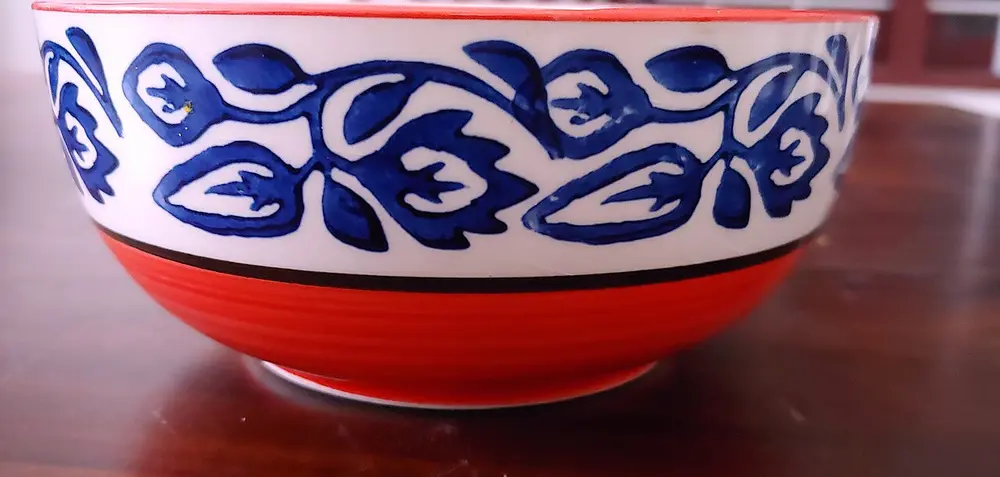
A white bowl painted with dark blue leafy scrolls, with a bright orange-red lower half.

Khurja pottery, from Khurja in Bulandshahr district, Uttar Pradesh: glazed ceramic tableware in bright colours. "Khurja Pottery" has a GI tag.

Picture: Atcelsius. CC BY-SA 4.0.
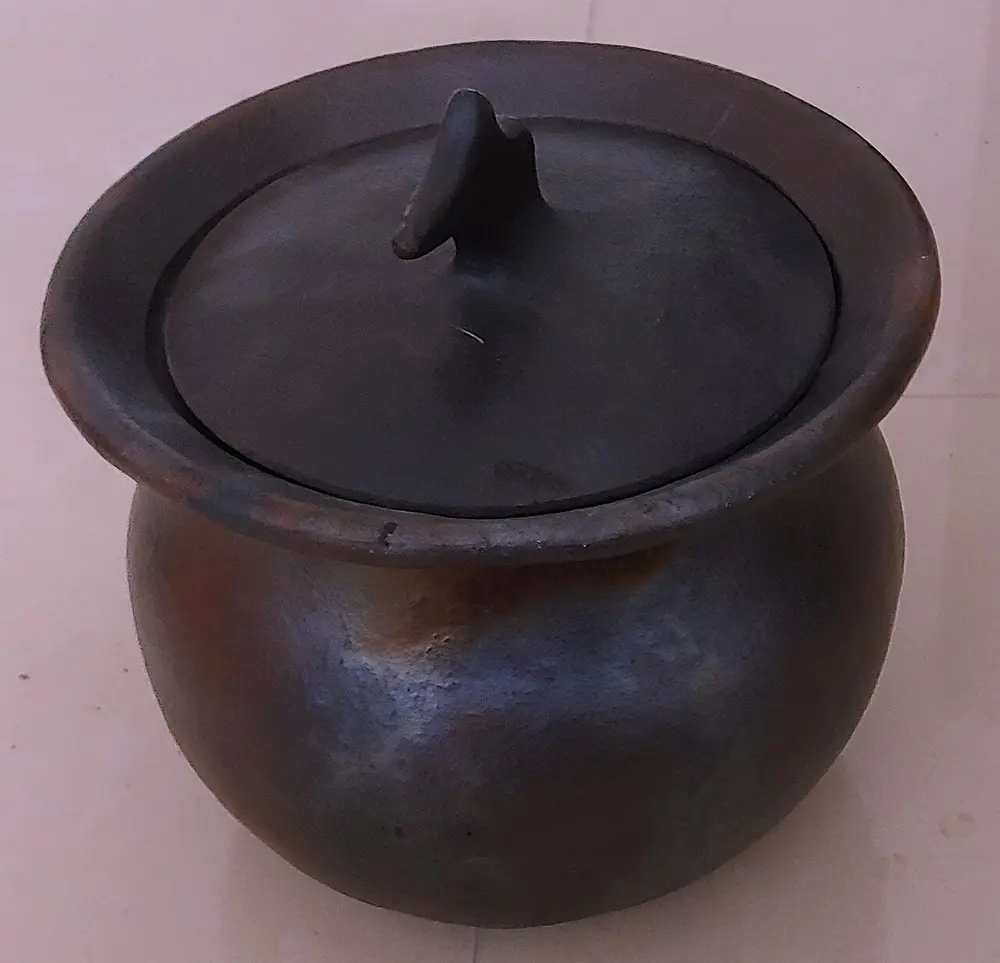
A round, dull black pot with a matching lid that has a small curved knob.
Picture: Atcelsius. CC BY-SA 4.0.

Longpi pottery

Also called Black stone pottery

Where
Longpi villages, Ukhrul district, Manipur
Who
Tangkhul Naga potters
Made with
Ground black serpentine stone mixed with a local brown clay

Longpi pots are black, heavy and plain. Ground black stone and clay are mixed into a paste and shaped by hand and with moulds, without a potter's wheel. The pots are fired in an open bonfire and rubbed with a local leaf while still hot, which gives them their dark, soft shine. They are used for cooking and serving, and kettles and mugs often get handles wrapped in cane.

Spot it by

Dull black or dark grey pots, kettles and mugs, often with cane handles.

Remember

Longpi is long-lasting black stone from Manipur.

Don't confuse

It is made by the Tangkhul, a Naga people, but Longpi itself is in Manipur, not Nagaland.
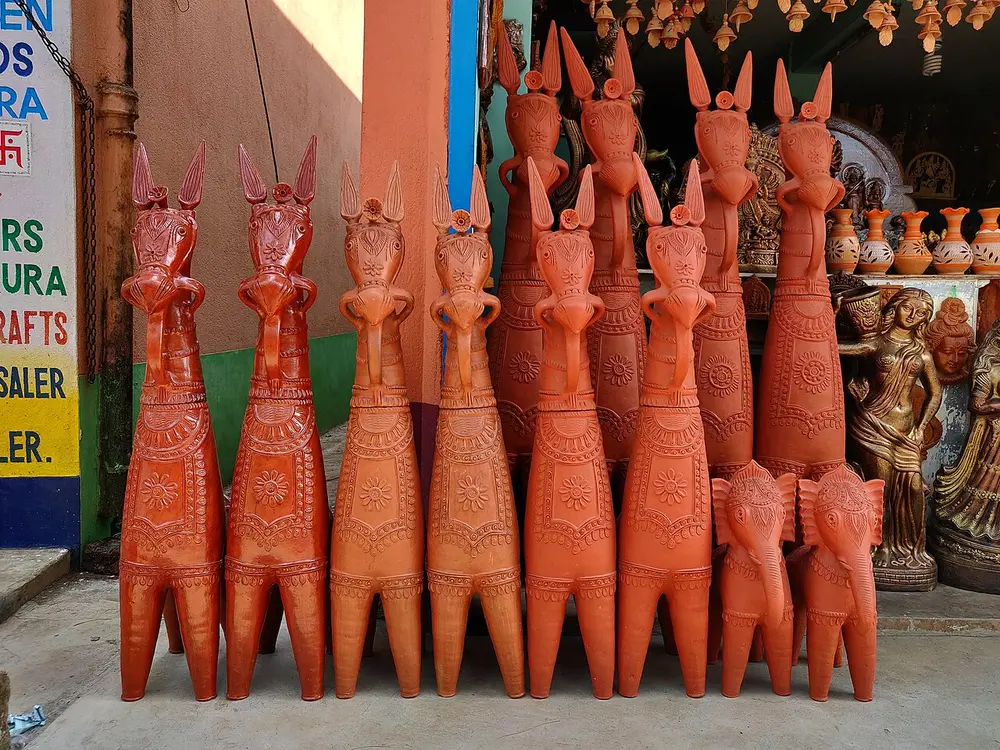
A row of tall, orange-red terracotta horses outside a shop, with long straight necks, upright pointed ears and small stamped patterns.
Picture: Footlooseinme. CC BY-SA 4.0.

Bankura horse

Where
Panchmura village, Bankura district, West Bengal
Made with
Terracotta (fired clay)

A stylised terracotta horse with a very long neck and tall, pointed ears. It is hollow, and its parts (the legs, the neck and the face) are thrown separately on the potter's wheel and joined. Such horses were first made as offerings left at village shrines; today they are also sold as decoration around the world. Panchmura's style is thought the finest of Bankura's terracotta centres. "Bankura Panchmura Terracotta Craft" has a GI tag.

Spot it by

A tall, thin, red-brown horse with a stiff upright neck and ears like spikes.

Remember

The Bankura horse is all neck.

Don't confuse

Molela, from Rajasthan, is also terracotta, but it is flat relief plaques of gods, not free-standing horses.

Molela clay work

Also called Molela plaques

Where
Molela village, Rajsamand district, Rajasthan, near Nathdwara
Who
Kumhar (potter) families
Made with
Clay from the banks of the Banas river, fired and painted

Molela potters make flat terracotta plaques with figures standing out in relief. Most show folk gods, above all Dev Narayan, and Nagaraja the snake god. Every year families from tribal and village communities such as the Bhil, Meena and Gujjar come to Molela with their priest to choose plaques for their shrines. Today the potters also make decorative plaques of everyday scenes. "Molela Clay Work" has a GI tag.

Spot it by

A flat clay panel, painted or plain red, with a god on horseback or a figure in raised relief.

Remember

Molela makes gods you can hang on a wall.

Metal

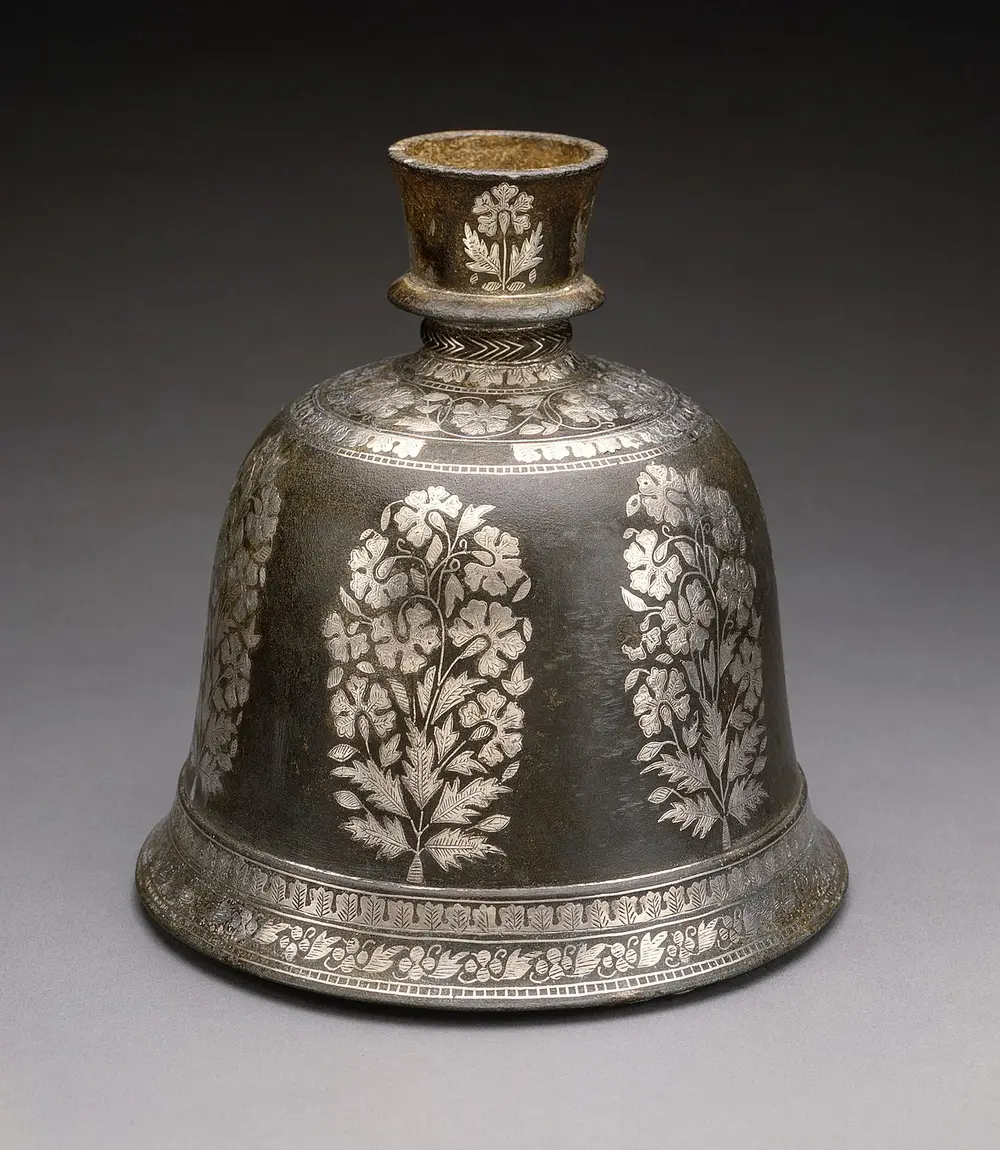
A bell-shaped black metal hookah base inlaid with large silver flowering plants and silver bands of tiny patterns.
Picture: Natasha Khaitan. CC BY-SA 4.0.

Bidriware

Where
Bidar, Karnataka; also Hyderabad
When
From the 14th to 15th century, under the Bahmani sultans
Made with
A cast alloy of zinc with a little copper, inlaid with silver

The object is cast in an alloy that is mostly zinc, the design is cut into it, and thin silver wire and sheet are hammered into the grooves. Then comes the trick: the piece is rubbed with a paste of soil from Bidar fort and ammonium chloride. The alloy turns deep black, but the silver doesn't, so the pattern shines out. The art grew up under the Bahmani sultans, with Persian influence. The hookah base in the picture was made between 1750 and 1800. "Bidriware" has a GI tag.

Spot it by

Matt black metal with bright silver flowers, vines or geometric patterns.

Remember

Bidri is black and silver, from Bidar.

Don't confuse

Dhokra is a golden-brown cast figure with no inlay. The Thanjavur art plate is shiny brass, copper and silver.
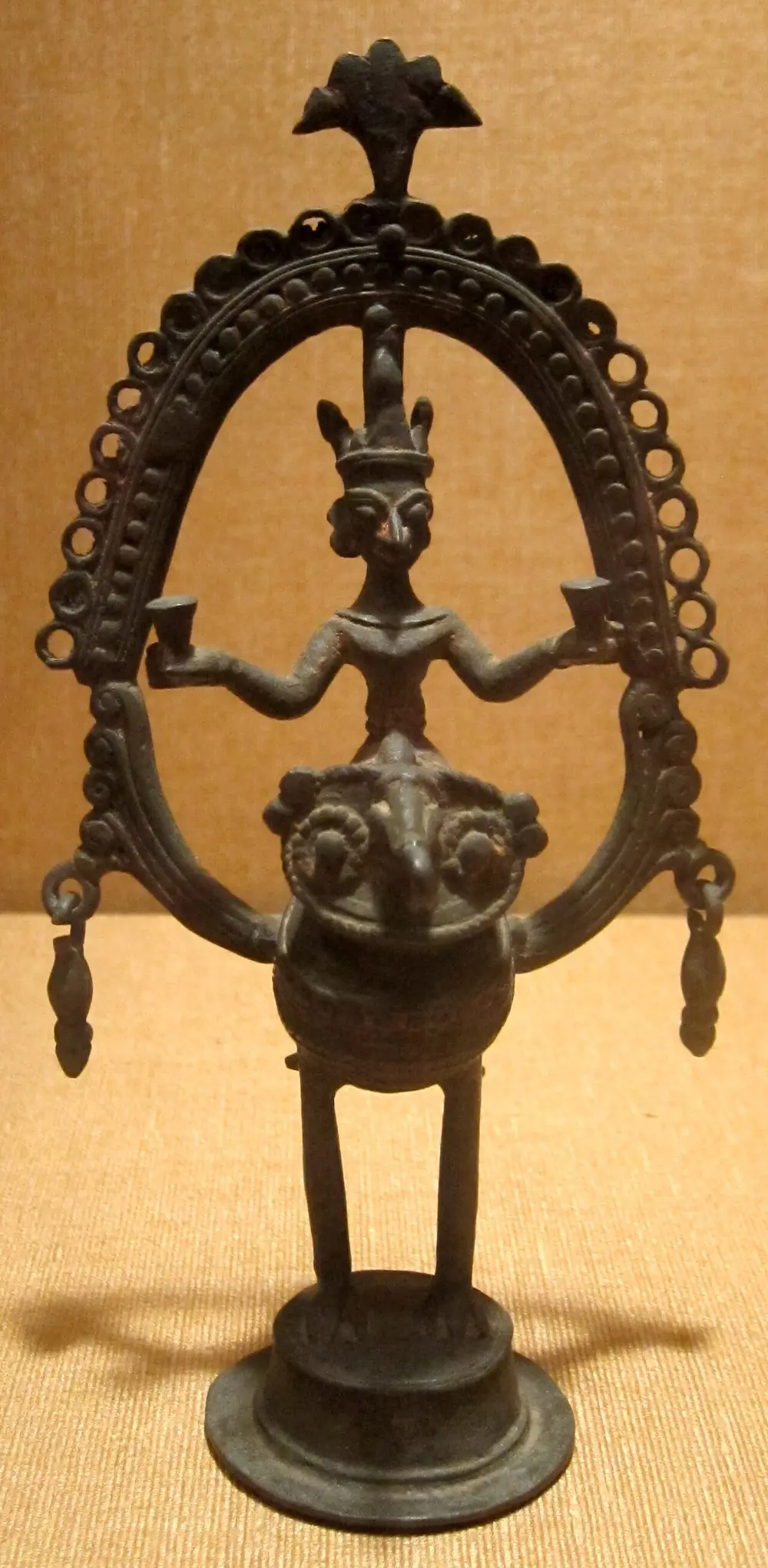
A dark brass figure of a god standing on an owl, framed by a tall arch of fine twisted metal threads with a leaf-shaped top.
Picture: Hiart. CC0.

Dhokra

Also called Dokra

Where
Bastar (Chhattisgarh), Bankura and Bardhaman (West Bengal), Odisha, Jharkhand, and Adilabad (Telangana)
Who
Dhokra Damar and other metalsmith communities
Made with
Brass or bell metal, beeswax and clay

Dhokra figures are cast by the lost-wax method (also called cire perdue). Each piece needs its own mould, so no two are alike. Animals, gods, lamps and tribal figures are typical, with surfaces covered in fine coiled threads. The method is ancient: the bronze Dancing Girl of Mohenjo-daro was cast this way more than 4,000 years ago. The piece in the picture was made in Bankura in the 19th century. GI tags: "Bastar Dhokra", "Bengal Dokra", "Adilabad Dokra" and "Jharkhand Dokra Craft".

Spot it by

A golden-brown or dark metal figure with a rough, handmade look and patterns of fine raised threads and spirals.

Remember

In Dhokra the wax is lost so the metal can take its place.

Don't confuse

Bidriware is black with silver inlay. Thewa (Rajasthan) is gold on glass and filigree is twisted wire, so neither is cast.

How lost-wax casting works:

  1. A rough core is shaped from clay and dried.
  2. The core is covered in wax, and the details are added with thin wax threads and coils.
  3. The wax model is covered in layers of clay, leaving a small channel, and dried into a mould.
  4. The mould is heated. The wax melts and runs out: it is "lost".
  5. Molten brass is poured into the space the wax left.
  6. When it cools, the clay is broken off, so each mould is used only once.

Because the metal flows through every wax thread, parts that touched in the wax model end up joined in metal. CEED 2021 showed a Dhokra animal whose tail is fused to its hind leg and asked why; the answer was the casting process, not welding.

Pembarthi metal craft

Where
Pembarthi village, Jangaon district, Telangana
Made with
Brass and copper sheet

Pembarthi craftsmen shape sheet metal by hand. The design is drawn on a brass or copper sheet, which is set on a bed of lac (a natural resin) to hold it, and then hammered and chased from the back and front with small hammers and punches until the figures stand out in relief. The craft is linked to the Kakatiya kings, who used it for temple doors, chariots and images of gods. Today it makes plaques, vases, lamps and decorative pieces. "Pembarthi Metal Craft" has a GI tag.

Spot it by

Shiny brass sheets with raised, hammered figures and borders.

Remember

Pembarthi beats metal into pictures.

Don't confuse

Dhokra is cast in a mould; Pembarthi is hammered from flat sheet.
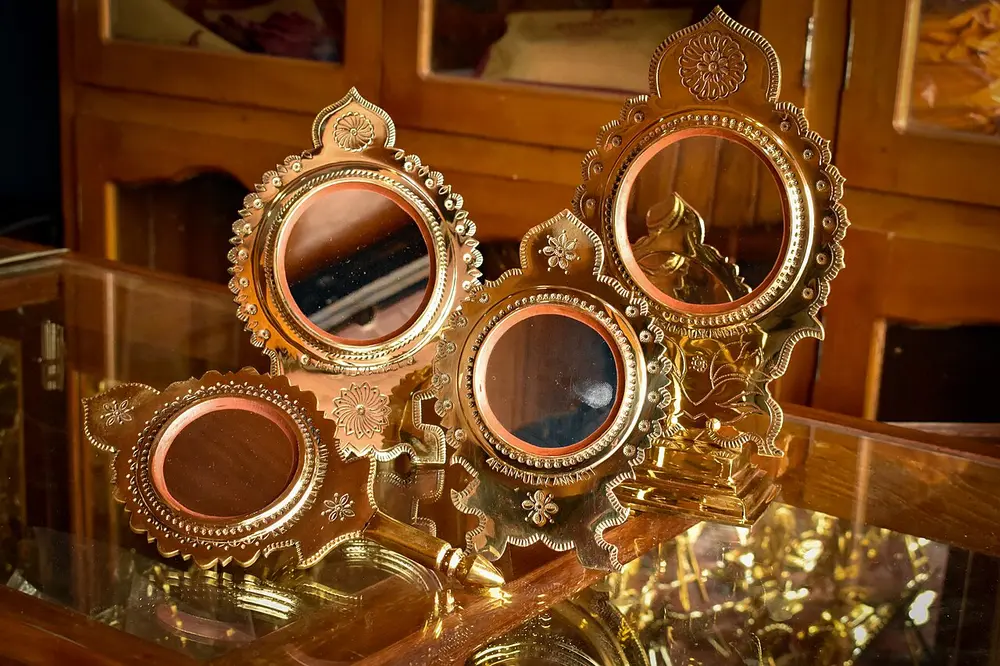
Several round, polished metal mirrors in ornate golden brass frames with leaf-shaped tops, standing on a glass shelf.
Picture: Prasanth Prakash. CC BY-SA 4.0.

Aranmula kannadi

Also called Aranmula mirror

Where
Aranmula, Pathanamthitta district, Keralam
Made with
A secret alloy based on copper and tin, polished for days

A mirror with no glass. Its face is a disc of metal alloy, mainly copper and tin, polished by hand for days until it reflects. Because the reflection comes from the front surface, not from silver behind glass, there is no faint second image. A few families keep the exact recipe secret. The craft is linked to the Parthasarathy temple at Aranmula, and the mirror is one of the eight auspicious items used to welcome a bride in Keralam. "Aranmula Kannadi" was among the first crafts in India to get a GI tag.

Spot it by

A small round mirror in a decorative brass frame, often with a leaf-shaped top.

Remember

Aranmula's mirror is all metal: kannadi means mirror.
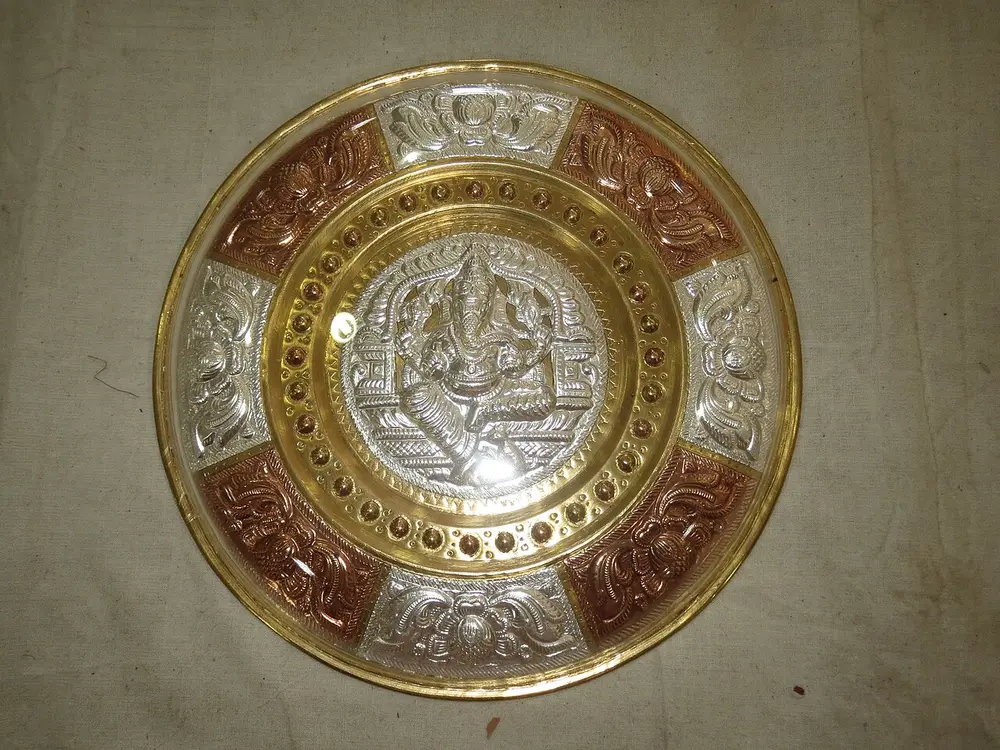
A round brass plate with a raised silver figure of a god at the centre, surrounded by rings and panels of embossed silver and copper.
Picture: Booradleyp1. CC BY-SA 4.0.

Thanjavur art plate

Also called Tanjore plate

Where
Thanjavur, Tamil Nadu
When
Introduced under the Maratha ruler Serfoji II (1777 to 1832)
Who
Vishwakarma metalsmiths
Made with
A brass plate with embossed copper and silver

A round brass plate decorated with figures beaten out of copper and silver sheet and fixed onto it. The centre usually holds a god, such as Ganesha or Krishna, or a peacock, ringed by panels of flowers and animals. The three metals give three colours: yellow brass, red copper and white silver. It began as a royal gift item at the court of Serfoji II. "Thanjavur Art Plate" has a GI tag.

Spot it by

A shiny round plate with gold, copper-red and silver rings and a raised figure in the middle.

Remember

Thanjavur plate: three metals, three colours.

Don't confuse

Tanjore painting, from the same town, is a painting on wood with gold foil and glass stones. It is in the note on folk painting.

Wood and paper

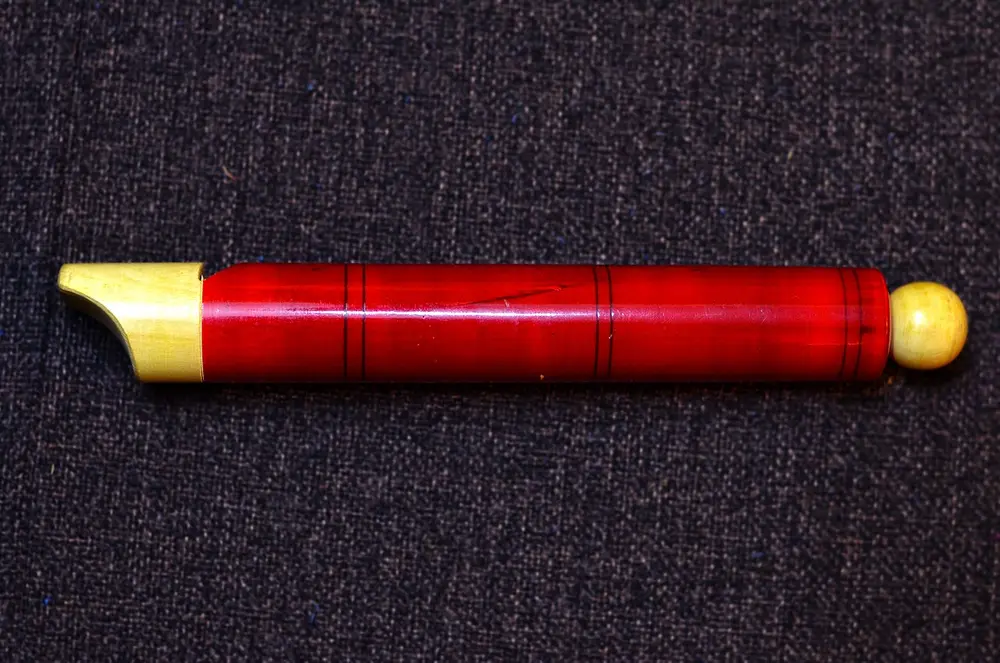
A red toy flute made of turned wood, glossy with lacquer, with a pale mouthpiece and a round knob at the end.
Picture: Subhashish Panigrahi. CC BY-SA 4.0.

Channapatna toys

Where
Channapatna, between Bengaluru and Mysuru, Karnataka
Made with
Ivory wood (aale mara, Wrightia tinctoria), turned on a lathe and coated with coloured lacquer

Channapatna is called Gombegala Ooru, "toy town". Soft, pale ivory wood is spun on a lathe and shaped with tools, then coloured lacquer is pressed against the spinning wood, so the toy comes out smooth, round and glossy. Rattles, tops, dolls, beads and rolling toys are typical. The craft is linked to the patronage of Tipu Sultan, and in the 20th century Bavas Miyan brought in new methods to improve it. "Channapatna Toys & Dolls" has a GI tag.

Spot it by

Smooth, rounded wooden toys in shiny bright reds, yellows and greens.

Remember

Channapatna toys spin to life on a lathe.

Don't confuse

Etikoppaka toys are made the same way from the same kind of wood, but in Andhra Pradesh.
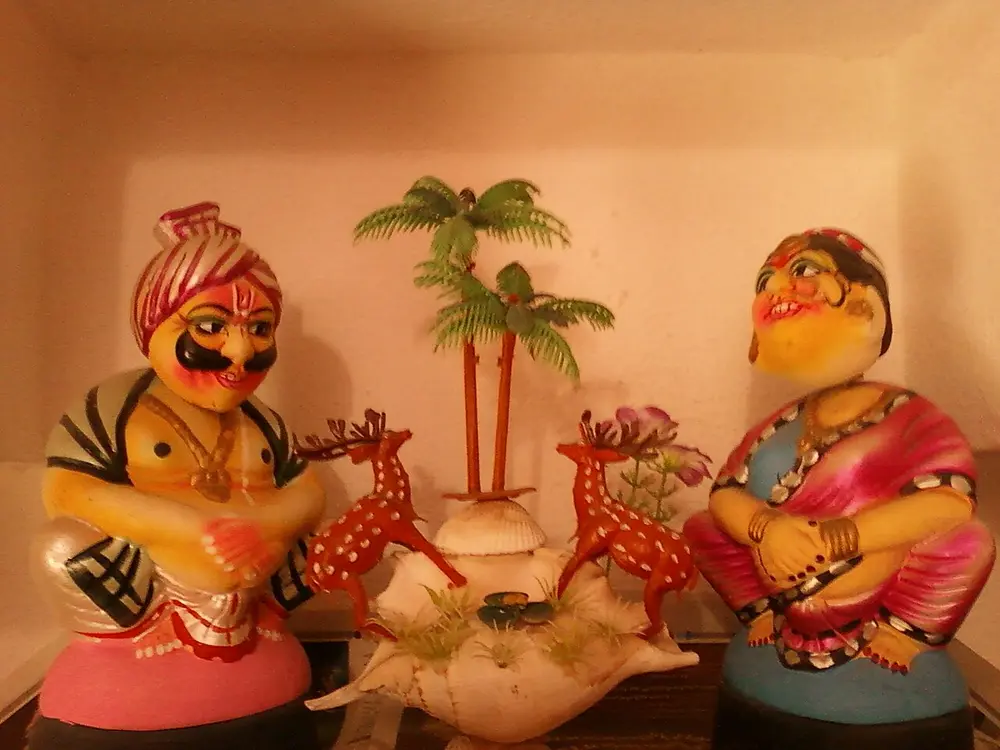
Two painted wooden figures, a man in a turban and a woman in a sari, sitting on either side of small palm trees and spotted deer.
Picture: Adityamadhav83. CC BY-SA 3.0.

Kondapalli and Etikoppaka toys

Where
Kondapalli, near Vijayawada, and Etikoppaka, on the Varaha river in Anakapalli district, both in Andhra Pradesh
Made with
Kondapalli: light local wood, carved and painted. Etikoppaka: ankudu wood, turned and lacquered

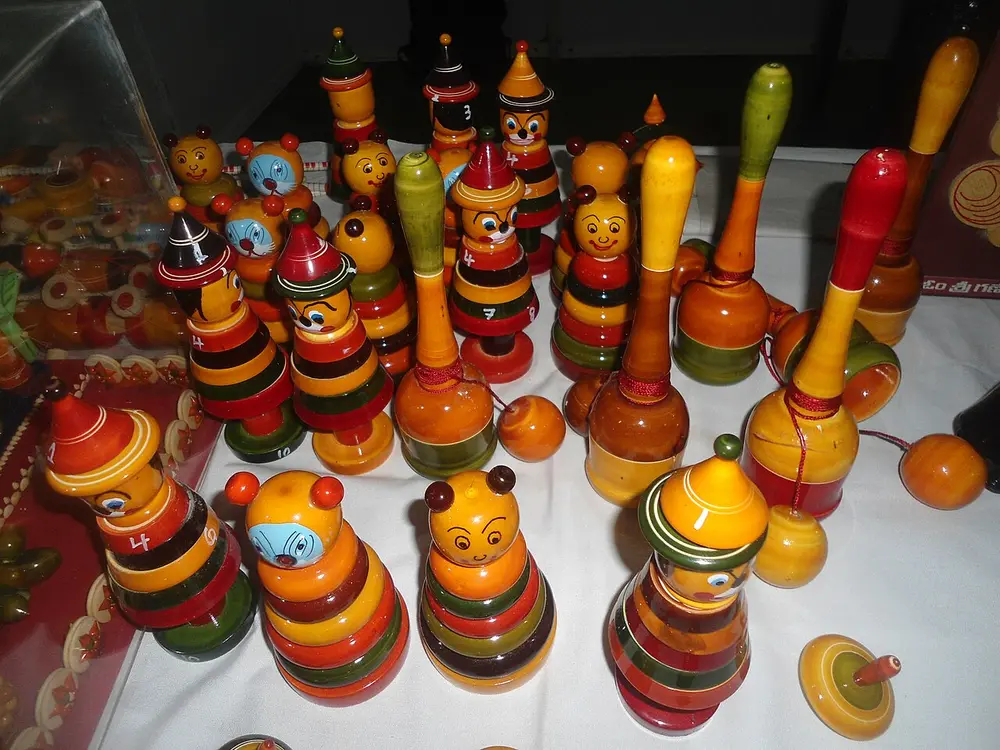
Andhra Pradesh has two famous toy villages. Kondapalli toys are carved from soft, light wood, the parts glued together, and painted: village people at work, gods, animals and the Dashavatara. They are set out in the Bommala Koluvu, the display of dolls at Sankranti and Navratri. Their makers say their families came from Rajasthan in the 16th century. Etikoppaka toys are turned on a lathe and coloured with lac and natural dyes, like Channapatna's. "Kondapalli Bommallu" and "Etikoppaka Toys" both have GI tags.

Spot it by

Kondapalli: painted carved figures and scenes, like the couple in the picture. Etikoppaka: round, glossy lacquered toys.

Remember

Kondapalli is carved and painted; Etikoppaka is turned and lacquered.

Don't confuse

Channapatna (Karnataka) and Etikoppaka (Andhra Pradesh) look almost the same. Learn their states.
A table of glossy turned wooden toys in red, yellow, green and orange, including stacking dolls, tops and rattles.

Etikoppaka toys at an exhibition in Visakhapatnam: turned on a lathe and coated with coloured lac.

Picture: Adityamadhav83. CC BY-SA 4.0.
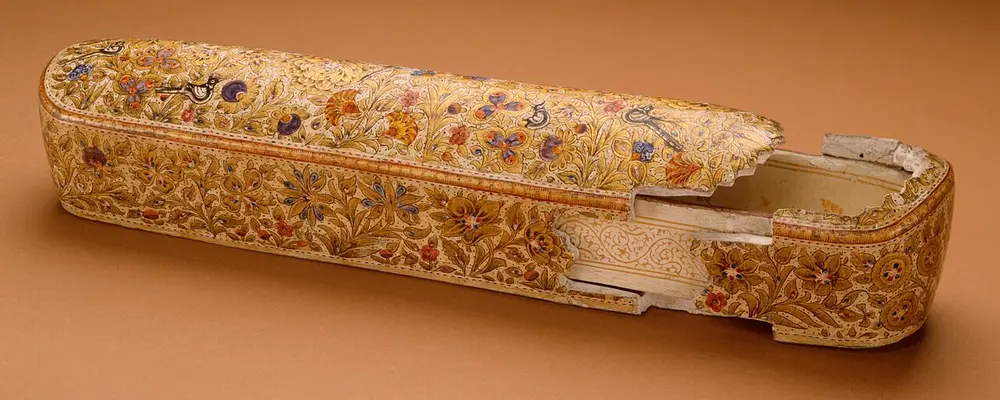
A long, narrow box with a sliding inner tray, its cream surface painted all over with tiny flowers in red, blue and gold.
Picture: Los Angeles County Museum of Art. Public domain.

Kashmiri papier-mâché

Where
Srinagar and the Kashmir valley
Made with
Paper pulp or layered paper, paint, gold and varnish

Papier-mâché means "chewed paper" in French. Paper is soaked to a pulp or pasted in layers over a mould and dried into a light, hard shape: this stage is sakhtsazi. Then a painter covers it with fine flowers, leaves, chinar leaves and birds, often with gold: this stage is naqashi. Finally it is varnished. The craft came to Kashmir from Persia. Pen boxes like the one in the picture, from Srinagar in about 1800 to 1850, were once so common that the work was called the art of the pen case. "Kashmir Paper Machie" has a GI tag.

Spot it by

Light boxes, bowls and ornaments painted all over with tiny bright flowers and gold.

Remember

Kashmir paints its paper with gardens.
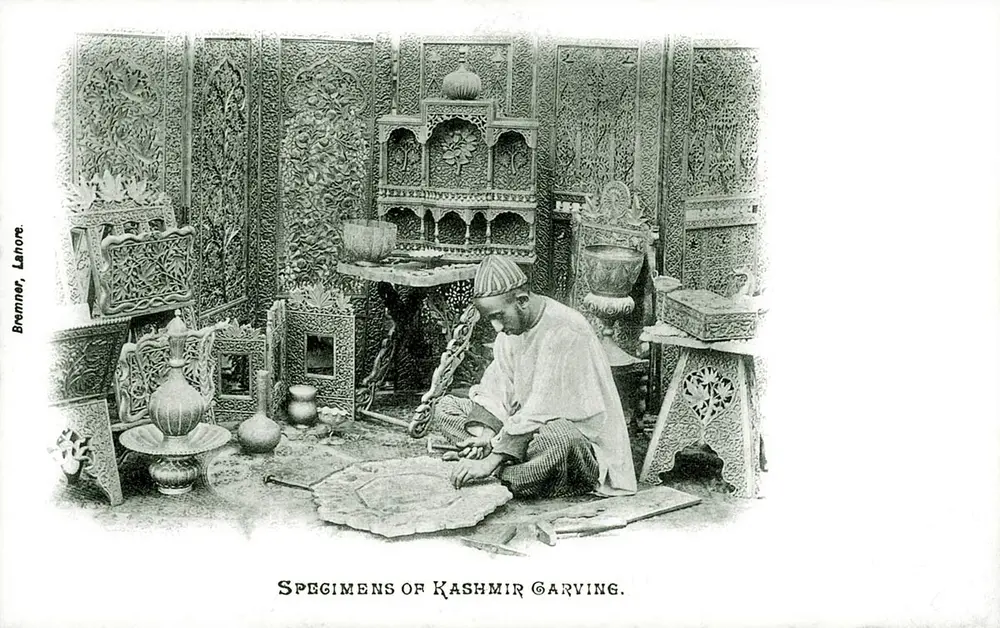
An old black and white postcard of a seated carver at work, surrounded by heavily carved screens, cabinets, tables and boxes.
Picture: Fred Bremner. CC BY 4.0.

Kashmir walnut wood carving

Where
Srinagar and the Kashmir valley
Made with
Wood of the walnut tree

Walnut trees grow in the Kashmir valley, and their dense, dark wood takes very fine carving. Kashmiri carvers make screens, tables, chests and boxes covered in chinar leaves, vines, grapes, lotuses and flowers. Some work is in low relief, some cut deep, and some carved right through as an open lattice. The postcard was sold by the photographer Fred Bremner around 1903. "Kashmir Walnut Wood Carving" has a GI tag.

Spot it by

Dark brown wood crowded with deeply carved leaves and flowers.

Remember

Walnut from the valley, carved with the valley's chinar leaves.

Fibre and puppets

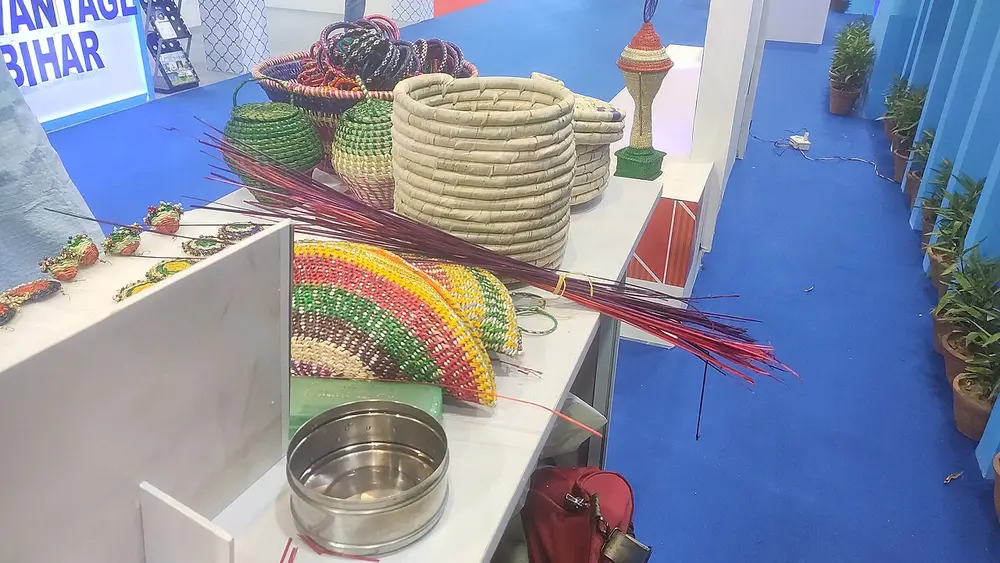
A craft fair stall with coiled grass baskets and boxes in natural gold, and bundles of grass dyed bright red and green.
Picture: Goutam1962. CC BY-SA 4.0.

Sikki grass craft

Where
The Mithila region of north Bihar
Who
Mostly women
Made with
Sikki, a golden wild grass, often dyed

Sikki is a grass that grows wild in the wet land of north Bihar. Its stems dry to a shiny gold. Women coil and stitch it with a needle into boxes, baskets, toys and figures, and dye some of it red, green or purple for patterns. Small round boxes called pauti are given by parents to a daughter at her wedding, to hold sindoor and jewellery. "Sikki Grass Products of Bihar" has a GI tag.

Spot it by

Golden, coiled grass boxes and figures with bright dyed patterns.

Remember

Sikki is golden grass from the same Mithila region as Madhubani painting.
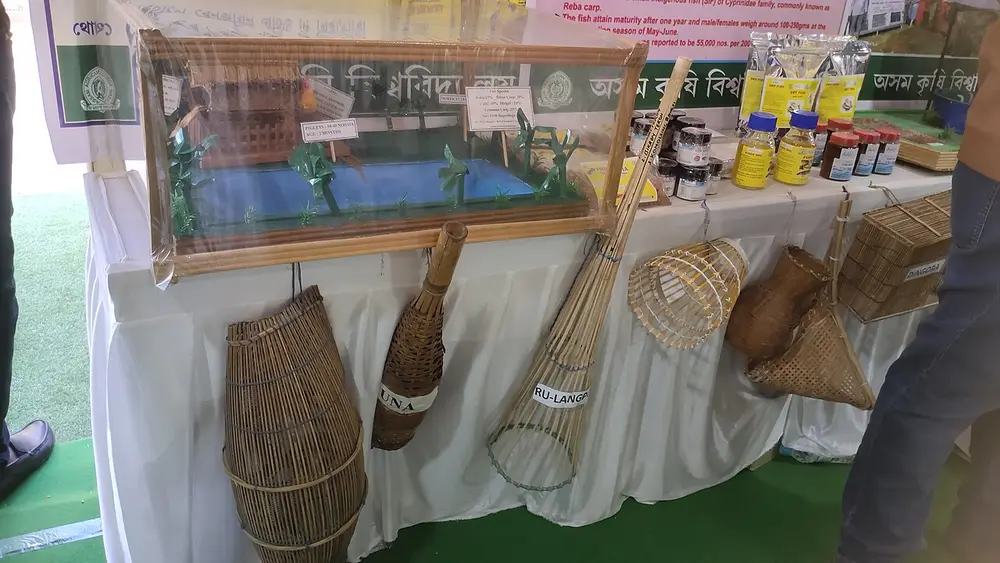
A display of handmade bamboo objects: tall cone-shaped baskets and traps for catching fish, a scoop net and other baskets.
Picture: Medhi jyoti. CC BY 4.0.

Cane and bamboo of Assam and Tripura

Where
Assam, Tripura and the other north-eastern states
Made with
Bamboo and cane (rattan), split, shaped and woven

In the North-East, bamboo and cane are used for almost everything: houses, furniture, mats, baskets, hats and tools. Assam's japi is a wide sunshade hat of bamboo and palm leaf, given to honour guests. Fish traps such as the ones in the picture are set in shallow water in streams and paddy fields. Tripura is especially known for fine cane furniture and mats. "Assam Jaapi" has a GI tag, and "Assam Ba Shilp (Bamboo Craft)" got one in June 2026; Tripura's cane and bamboo work does not have one in the registry as of October 2026.

Spot it by

Woven bamboo baskets, cones and traps, and cane furniture.

Remember

In the North-East, bamboo is the plastic of the past.

Don't confuse

UCEED 2018 showed a man carrying a bamboo basket trap like these and asked what it was for: catching fish in shallow water.
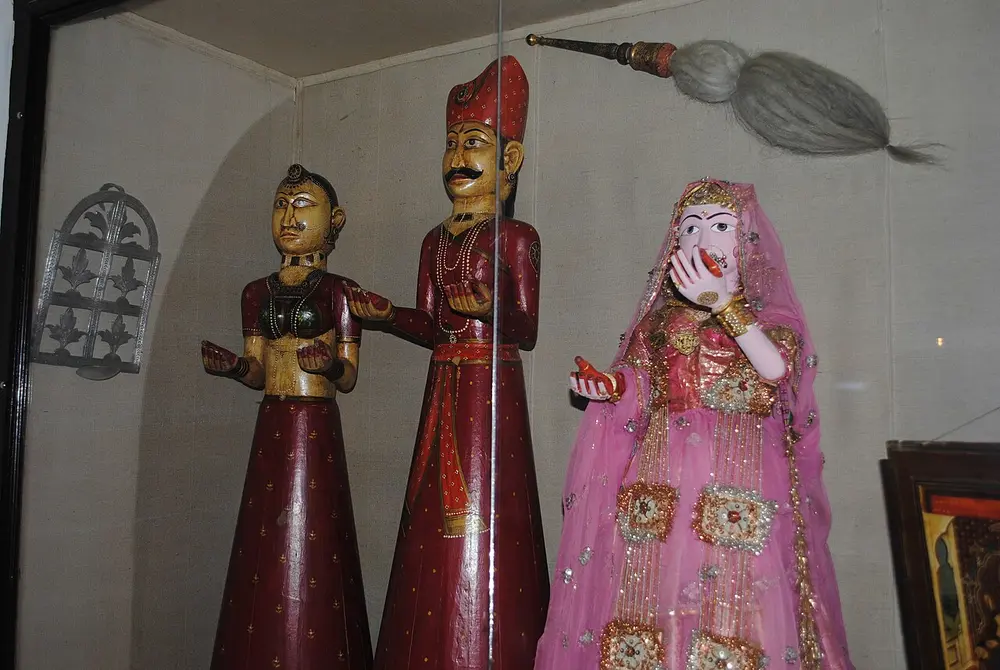
Three wooden string puppets in a museum: a woman in a red skirt, a man with a turban and moustache holding up a fly whisk, and a woman in a pink veil.
Picture: Schwiki. CC BY-SA 3.0.

Kathputli

Where
Rajasthan
Who
The Bhat community of puppeteers
Made with
Carved and painted wooden heads, cloth costumes and strings

Kath means wood and putli means doll. A Kathputli is a string puppet: a carved and painted wooden head and body in a bright cloth costume, worked from above with strings. The puppets usually have no legs; long skirts hide that. Bhat puppeteers travel to tell stories of kings, battles and lovers with music and song. The puppets in the picture are in the museum at Junagarh Fort, Bikaner. "Kathputlis of Rajasthan" has a GI tag.

Spot it by

Wooden puppets with big eyes, painted faces and moustaches, in red and gold costumes and turbans.

Remember

Kathputli: kath is wood, putli is doll.

Which state is it from?

Craft State GI name
Blue pottery Rajasthan Blue Pottery of Jaipur
Longpi pottery Manipur Applied for in 2025, not yet registered
Khurja pottery Uttar Pradesh Khurja Pottery
Bankura horse West Bengal Bankura Panchmura Terracotta Craft
Molela plaques Rajasthan Molela Clay Work
Bidriware Karnataka Bidriware
Dhokra Chhattisgarh, West Bengal, Telangana, Jharkhand, Odisha Bastar Dhokra; Bengal Dokra; Adilabad Dokra; Jharkhand Dokra Craft
Pembarthi metal craft Telangana Pembarthi Metal Craft
Aranmula kannadi Keralam Aranmula Kannadi
Thanjavur art plate Tamil Nadu Thanjavur Art Plate
Channapatna toys Karnataka Channapatna Toys & Dolls
Kondapalli toys Andhra Pradesh Kondapalli Bommallu
Etikoppaka toys Andhra Pradesh Etikoppaka Toys
Papier-mâché Jammu and Kashmir Kashmir Paper Machie
Walnut wood carving Jammu and Kashmir Kashmir Walnut Wood Carving
Sikki grass Bihar Sikki Grass Products of Bihar
Cane and bamboo Assam, Tripura Assam Jaapi; Assam Ba Shilp (Bamboo Craft)
Kathputli Rajasthan Kathputlis of Rajasthan

GI status is as of October 2026, from the GI Registry's list.

CEED 2019 showed four objects, a black clay mug with a cane-wrapped handle, a willow wicker basket, a turned wooden toy hammer and a brass crocodile cast in Dhokra style, and asked for their states, given in random order. The four states in its answer key were Nagaland, Jammu and Kashmir, Chhattisgarh and Andhra Pradesh. CEED 2026 showed a carved wooden peacock with a pierced tail and asked which operations made it: drilling, chiselling, sanding and finishing, all done with hand tools.

Don't confuse

These two How to tell them apart
Bidriware and Dhokra Bidri is black metal with silver inlay, from Bidar. Dhokra is cast brass made by the lost-wax method.
Dhokra and Pembarthi Dhokra is cast in a clay mould; Pembarthi is hammered from sheet metal.
Blue pottery and Khurja Jaipur blue pottery has no clay (quartz and glass). Khurja is clay-based glazed ceramic from Uttar Pradesh.
Bankura horse and Molela Both terracotta. Bankura is a free-standing horse from West Bengal; Molela is flat plaques of gods from Rajasthan.
Channapatna and Etikoppaka Both turned and lacquered wood. Channapatna is in Karnataka; Etikoppaka is in Andhra Pradesh.
Kondapalli and Etikoppaka Both Andhra Pradesh. Kondapalli is carved and painted; Etikoppaka is turned and lacquered.
Thanjavur art plate and Tanjore painting The plate is brass, copper and silver metalwork. The painting is on wood with gold foil.
Longpi and Nagaland Longpi is made by Tangkhul Naga potters, but in Manipur.

Test yourself

Question 1 of 8

Which of these is Bidriware?

Question 2 of 8

This figure was cast in brass by the lost-wax method. What is the craft called?

Question 3 of 8

Which of these is Longpi pottery?

Question 4 of 8

These terracotta horses with long necks come from which state?

Question 5 of 8

This painted box from Srinagar is made mainly of what?

Question 6 of 8

Which of these are Kondapalli toys?

Question 7 of 8

What is the Aranmula kannadi?

Question 8 of 8

Jaipur blue pottery is made mainly from

From past papers

Real exam questions on this topic, each with a full solution.

Finished this note?

Mark it as studied to track your progress through the course.

Was this note useful?

Each picture is credited underneath it. Pictures of works still in copyright are shown small, for teaching only. If you hold the rights to a picture and want it removed, tell us through the contact page and we will take it down.