India's earliest sculpture, from the Indus Valley's Dancing Girl, Priest-King and seals to the polished Mauryan Lion Capital and yakshis, and the carved railings of Bharhut and Sanchi.
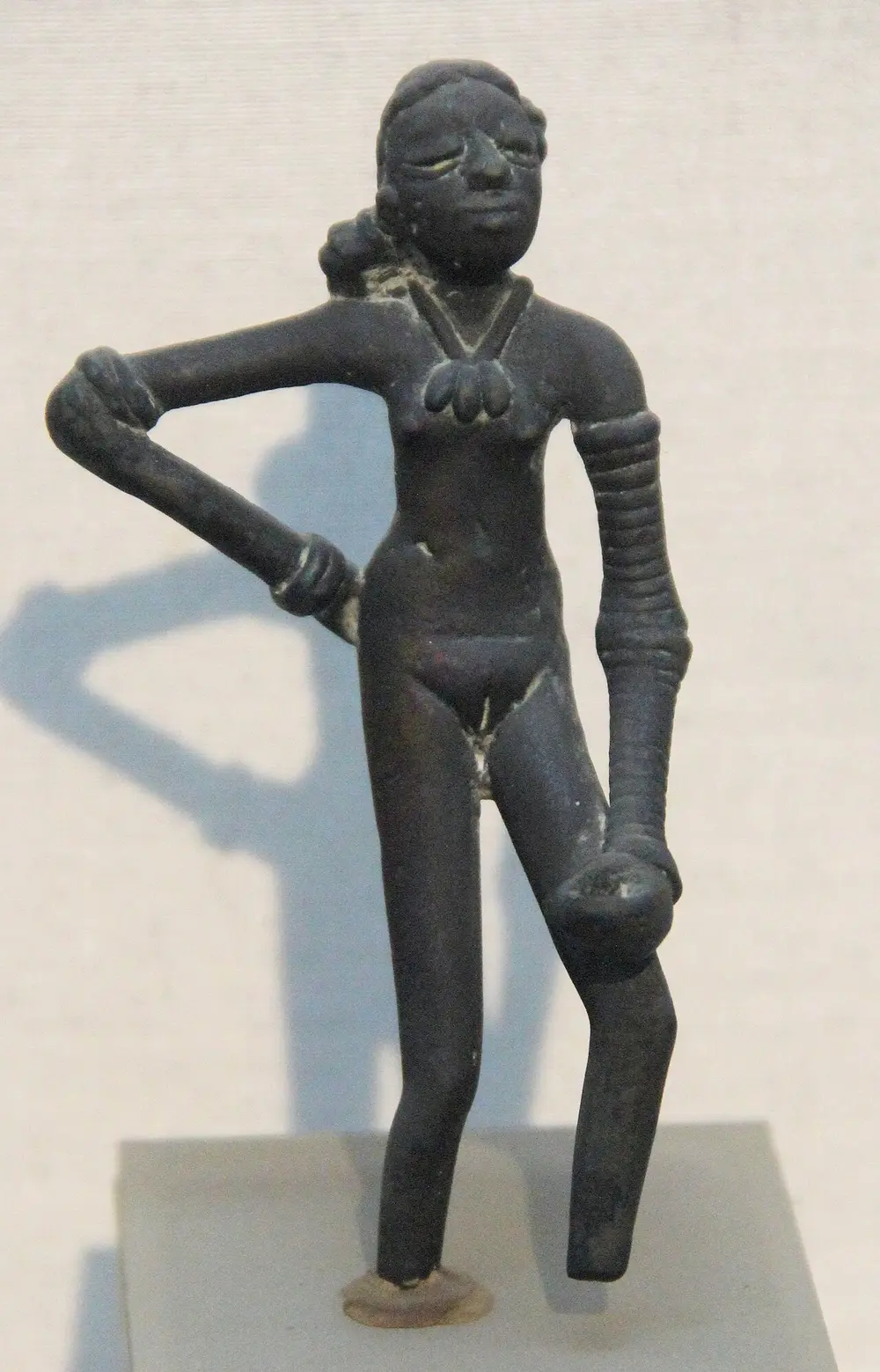
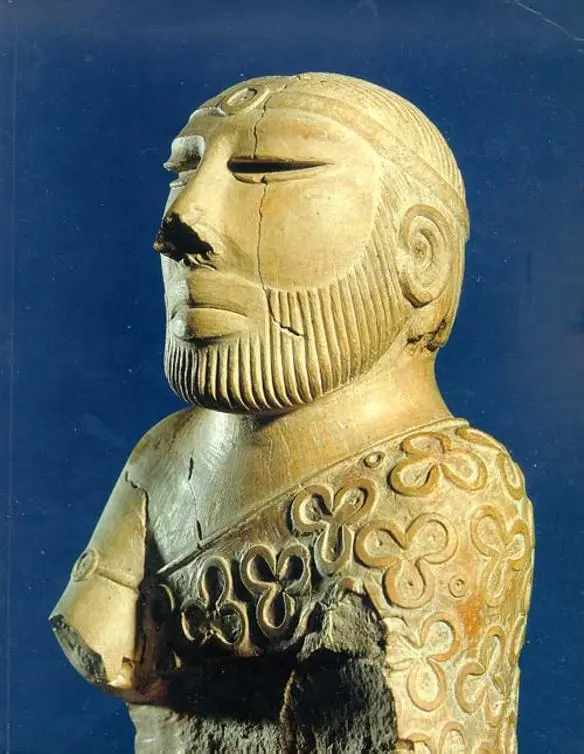
1The Indus cities (about 2500 to 1900 BCE) left small but skilful sculpture: the bronze Dancing Girl, the steatite Priest-King, clay mother goddesses and thousands of carved seals.
2The Dancing Girl was cast by the lost-wax method, the same process Dokra metalworkers still use today.
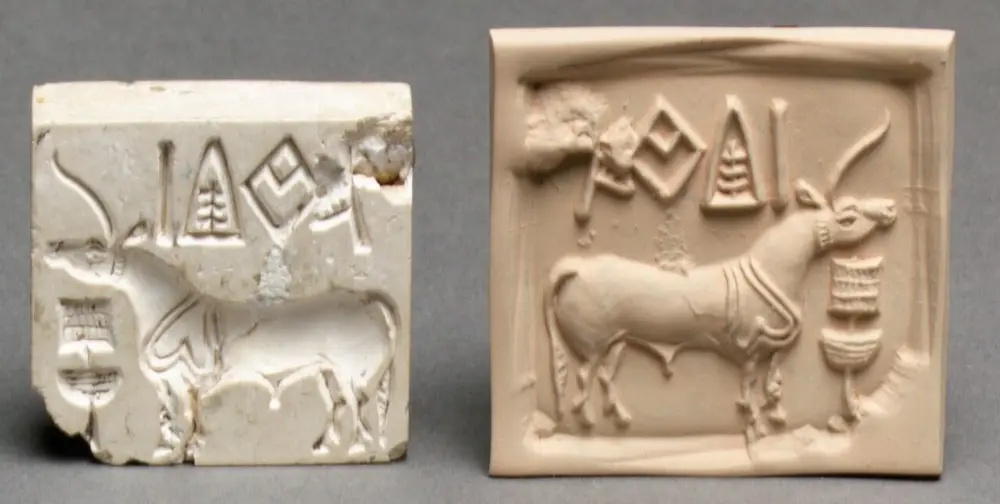
3Most Indus seals are small squares of steatite (soapstone) carved with an animal, such as the "unicorn", and a line of a script nobody can read yet.
4Large stone sculpture returns under the Mauryas (322 to 185 BCE), rubbed to a glassy shine called the Mauryan polish.
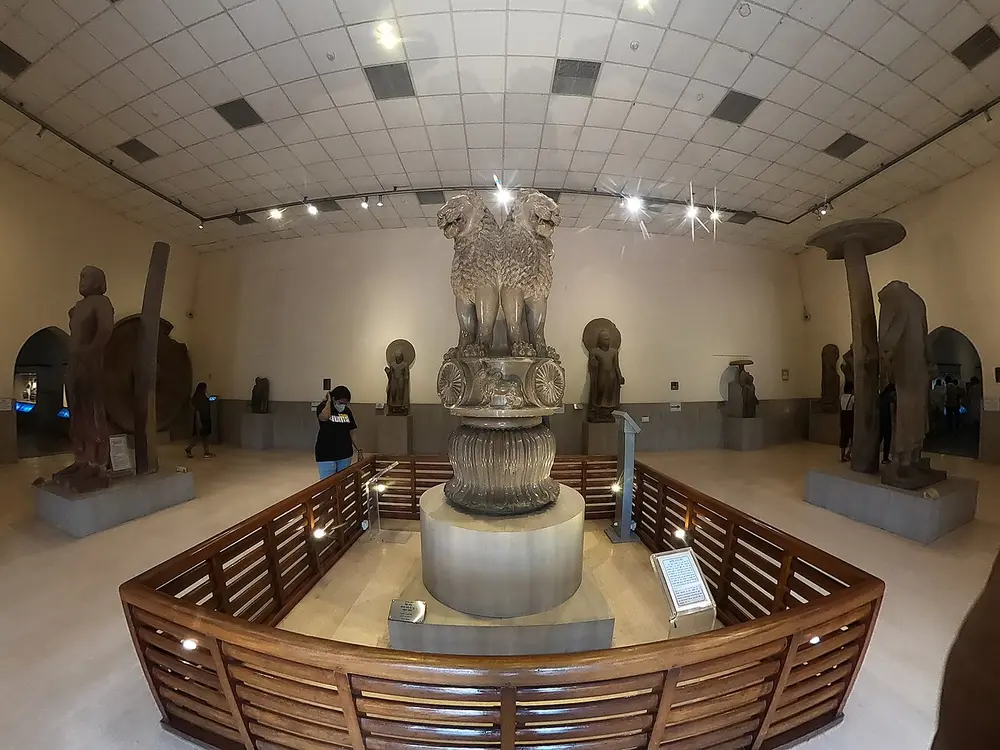
5The Sarnath Lion Capital (about 250 BCE) is one block of polished Chunar sandstone, not granite. It is in the Sarnath Museum, and the State Emblem of India is based on it.
6After the Mauryas, sculptors carved stories and yakshis on the railings of Bharhut (2nd century BCE) and the gateways of Sanchi (1st century BCE).
The Indus cities, about 2500 to 1900 BCE
The Indus Valley (or Harappan) Civilisation built planned cities such as Harappa and Mohenjo-daro, now in Pakistan, and Lothal, Dholavira, Kalibangan and Rakhigarhi, now in India. Its sculptures are few and small, but finely made. They come in four materials worth remembering: bronze, cast in moulds; steatite, a soft stone also called soapstone; terracotta, which means baked clay; and harder stones such as red sandstone.
Found at Mohenjo-daro; now in the National Museum, New Delhi
When
About 2300 to 1750 BCE; found in 1926
Who
Unknown Harappan metalworker
Made with
Bronze, cast by the lost-wax method
This tiny figure, only about 10.5 cm tall, was found by the archaeologist Ernest Mackay in 1926. It was made by lost-wax casting: the shape is modelled in wax and coated in clay, then heated so the wax melts and drains out, and molten metal is poured into the hollow mould. Once the metal cools, the clay is broken away. The girl stands with her right hand on her hip, her long arms thin, her left arm covered in bangles and her hair in a heavy bun. Nobody knows if she is really a dancer, but her relaxed, confident pose is unlike anything else from the Indus cities.
Spot it by
A tiny, thin, dark metal figure, nude, one hand on the hip, bangles all the way up the left arm.
Remember
Bronze girl, lost wax: the wax goes, the metal stays.
Don't confuse
Dokra figures are also lost-wax castings, but Dokra is a living craft of central and eastern India, not a 4,000-year-old find.
Found at Mohenjo-daro; now in the National Museum of Pakistan, Karachi
When
Mature Harappan period, late in the life of Mohenjo-daro
Who
Unknown Harappan sculptor
Made with
Steatite (soapstone)
This bust is the most famous stone sculpture of the Indus Valley, though it is only 17.5 cm tall. A neatly bearded man wears a band (a fillet) round his head, an armband, and a shawl over his left shoulder and under his right arm, patterned with trefoils, three-lobed shapes that still show traces of red. His eyes are half-closed, as if he is thinking. The name "Priest-King" is only the excavators' guess: no clear evidence of kings or priests has been found in the Indus cities.
Spot it by
A bearded man in a trefoil-patterned shawl, half-closed eyes, a headband, and a figure broken off at the chest.
Remember
Priest-King: soapstone, shawl of trefoils, and a title that is only a guess.
Don't confuse
The Dancing Girl is bronze and went to India at Partition; the Priest-King is soapstone and is in Pakistan.
Found at Harappa; now in the National Museum, New Delhi
When
Usually dated to the Harappan period
Who
Unknown Harappan sculptor
Made with
A red stone, called red sandstone in the NCERT textbook and red jasper by the museum
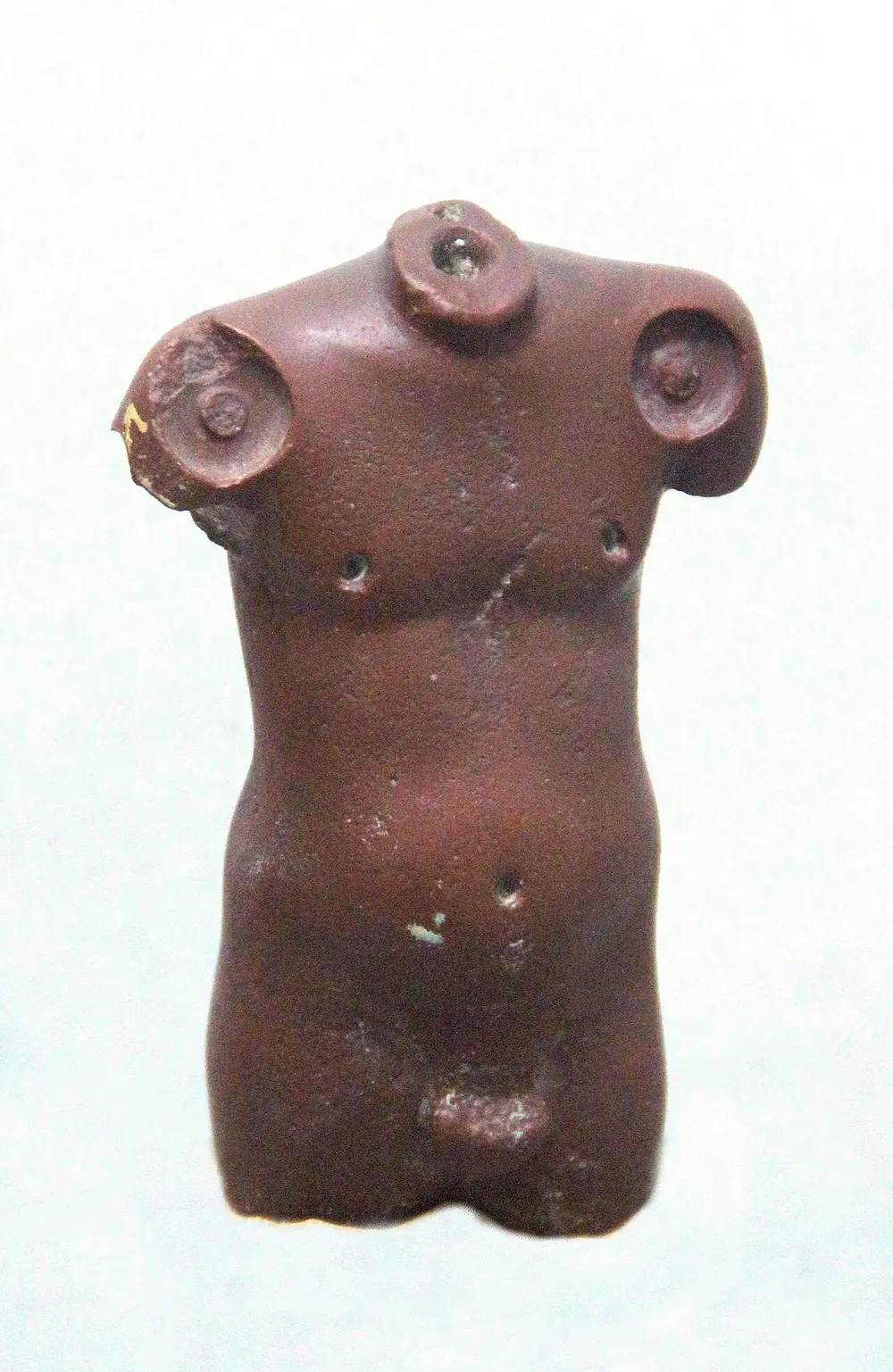
This male torso is about 9.2 cm tall, yet it is modelled with a softness and life that is rare in Indus art. The head and arms were carved separately and fixed into the socket holes at the neck and shoulders, so the figure was once complete. It faces straight ahead, with firm shoulders and a slightly full belly. It is so natural that some scholars have doubted it is really Harappan.
Spot it by
A tiny reddish stone body, no head or arms, with round holes where they used to fit.
Remember
The Harappa torso is a red stone body with holes for its missing parts.
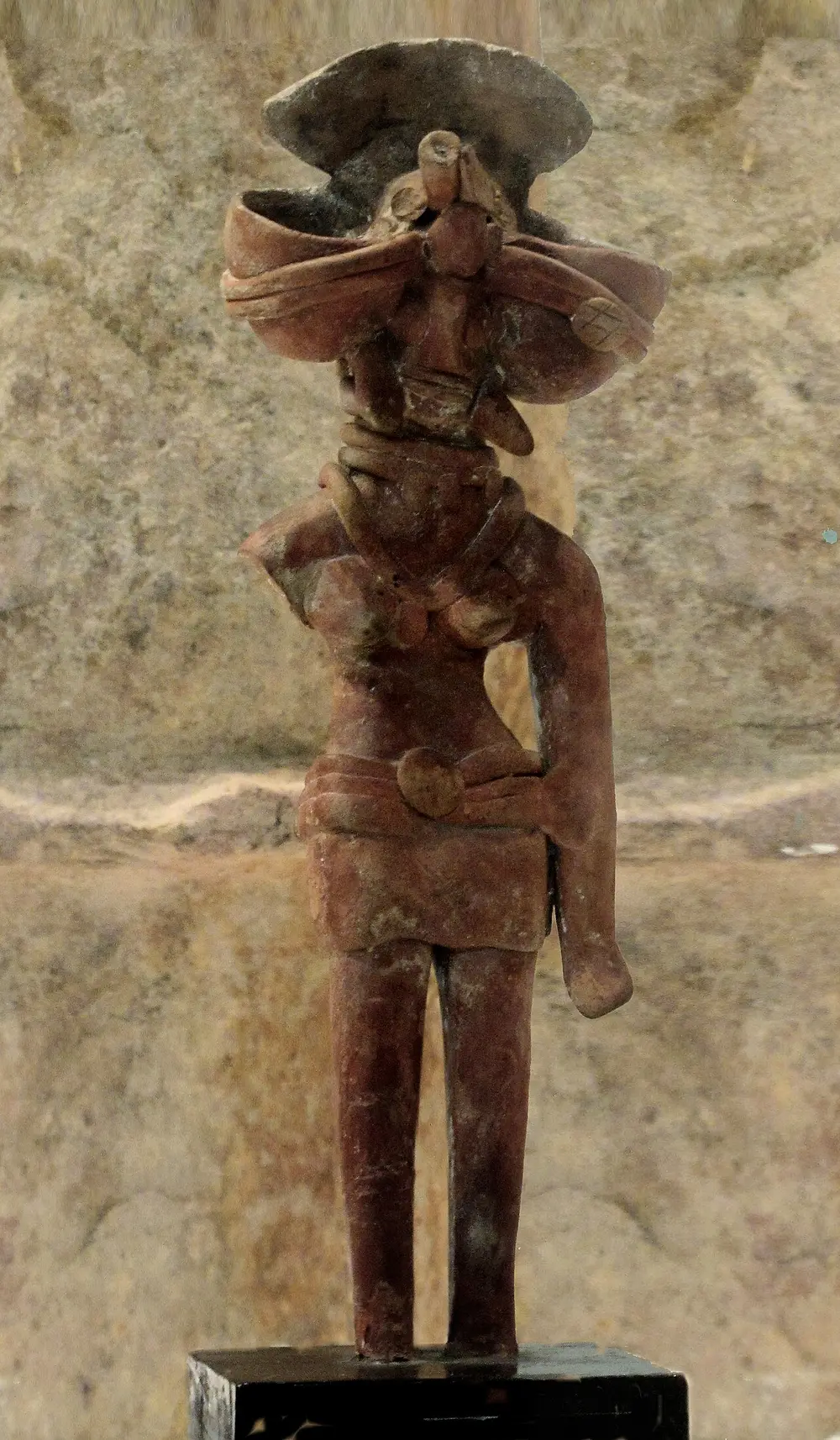
Clay figures of women are the most important Indus terracottas, and archaeologists call them mother goddesses, a modern label for what may have been figures of worship. They are much cruder than the bronzes: pellets of clay for eyes, a pinched nose and a slit for a mouth. What gives them away is the jewellery: stacks of necklaces, a girdle or short skirt, and a fan-shaped headdress with a cup-like bump on each side. Clay was also used for toy carts with wheels, whistles, rattles and animals.
Spot it by
Rough baked clay, a fan-shaped headdress, pellet eyes and lots of necklaces.
Remember
Fan on the head, beads on the chest: an Indus mother goddess.
Indus seals
Thousands of seals have been found, mostly cut from steatite, though a few are of agate, copper, faience or terracotta. A seal is carved in intaglio, which means the design is cut into the surface, so that pressing it into soft clay leaves a raised picture. Each carries a short line of the Indus script, which has not yet been deciphered. The seals were probably used in trade, to mark goods and their owners, and perhaps also worn as charms.
This one is at the Metropolitan Museum of Art, New York, shown with a modern clay impression
When
About 2600 to 1900 BCE
Who
Unknown Harappan seal cutters
Made with
Steatite
The best-known Indus seal design is a "unicorn": an animal like a bull with a single horn curving forward. Nobody knows whether it was a real animal or an imaginary one. In front of it stands an object that the museum thinks may be an incense burner, and above it runs a line of script. Other seals show a humped bull, an elephant, a tiger, a rhinoceros or a buffalo, carved with real skill on a square only a few centimetres wide. The picture on the left is the seal itself; the one on the right is the raised impression it makes in clay.
Spot it by
A small square with one animal in profile and a line of signs along the top.
Remember
Steatite square, one animal, one line of script nobody can read.
Found at Mohenjo-daro; now in the National Museum, New Delhi
When
About 2500 to 1900 BCE; found in 1928 or 1929
Made with
Steatite
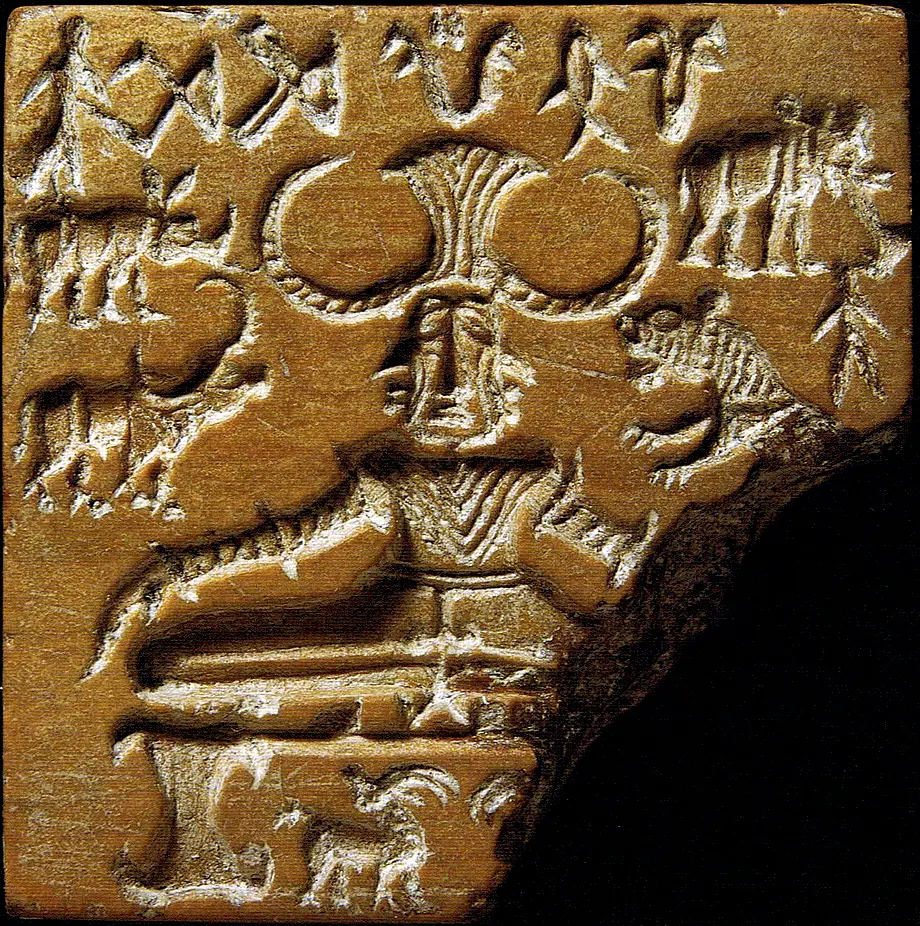
Unusually for an Indus seal, the main figure is a person, not an animal. A figure with a big horned headdress sits with legs folded, as if in a yoga posture. An elephant and a tiger are on one side, a rhinoceros and a buffalo on the other, and two antelopes sit below the seat. Some scholars saw him as an early form of Shiva as Pashupati, "lord of the animals"; others think the figure may be a different god, or even a goddess. Treat the name as a guess, not a fact.
Spot it by
A seated figure with a huge horned headdress in the middle, animals all around.
Remember
Pashupati means lord of animals, so look for the animals round the sitting figure.
Don't confuse
The unicorn seal shows one animal and no person.
The Mauryas and their polish
After the Indus cities faded, about 1,600 years pass with almost no stone sculpture surviving. Carvers probably worked in wood and clay, which have perished. Then, under the Mauryan Empire (322 to 185 BCE), and above all under the emperor Ashoka in the 3rd century BCE, large stone sculpture suddenly appears.
Mauryan carvers mostly used a fine, buff-coloured sandstone from Chunar, near Varanasi, and some spotted red sandstone from the Mathura region. They rubbed the surface until it shone like glass. This shine is called the Mauryan polish, and exactly how they achieved it is still debated. It is a useful clue, but not proof of date: some later sculptors could polish stone too.
Ashoka set up tall stone pillars across the Ganga plains, many carved with his edicts, messages about dhamma (right conduct). Each shaft is a single piece of stone. On top is the capital, the carved head of the pillar: an animal standing on a round or square slab called the abacus, above an upside-down, bell-shaped lotus.
One block of polished Chunar sandstone, about 2.1 metres tall
Ashoka set this up at Sarnath, where the Buddha gave his first sermon. Four lions sit back to back, so that from any side you see a calm, powerful face with sharp, curling manes. Below them, the abacus carries an elephant, a horse, a bull and a lion, separated by four wheels with 24 spokes each, and at the bottom is an upside-down lotus bell. A large stone wheel, the dharmachakra or "wheel of the law", once sat on the lions' heads; only fragments survive. Without its lotus, the capital is the model for the State Emblem of India, and since July 2026 Sarnath has been a UNESCO World Heritage Site (see World Heritage Sites in India).
Spot it by
Four lions back to back, a drum carved with four animals and wheels, a lotus bell below, and a glassy polish.
Remember
Four lions, four animals, four wheels, one block of sandstone.
Don't confuse
UCEED 2015 asked if it is granite. It is not: it is polished sandstone. The emblem on coins and documents is a drawing based on it, not the sculpture itself.
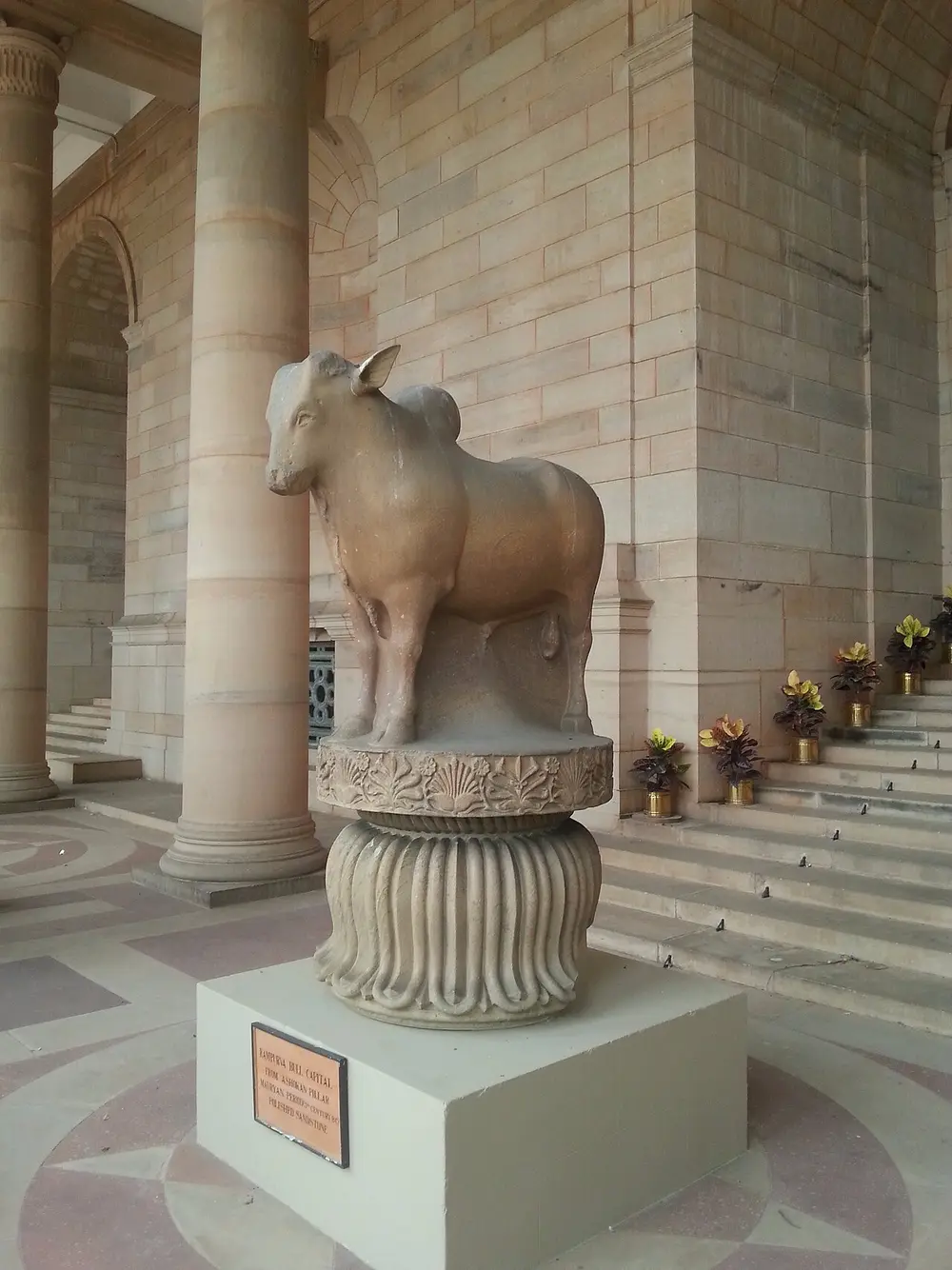
Found at Rampurva, West Champaran, Bihar; now at the entrance of Rashtrapati Bhavan, New Delhi
When
3rd century BCE
Made with
Sandstone
Rampurva had a pair of Ashokan pillars: one was crowned by a lion, now in the Indian Museum, Kolkata, and the other by this zebu, the humped Indian bull. The bull stands alone, strong and lifelike, rather than in a group like the Sarnath lions. The abacus below is carved with honeysuckle flowers and palmettes, a palm-leaf pattern, borrowed from Greek and West Asian art.
Spot it by
A single humped bull standing on a decorated slab and a lotus bell.
Remember
Rampurva gave India a bull for the President's house.
Yakshas, yakshis and an elephant
Beside the royal pillars there is a more popular sculpture, probably made for local patrons rather than the emperor. Its favourite subjects are yakshas and yakshis (also called yakshinis), nature spirits of trees, water and wealth, worshipped long before Buddhism and Jainism, which later took them in as guardians. They are among the earliest large stone figures in Indian art.
Found at Didarganj, Patna, Bihar; now in the Bihar Museum, Patna
When
Debated, from the 3rd century BCE to as late as the 1st or 2nd century CE; found in 1917
Made with
Chunar sandstone with a mirror-like polish
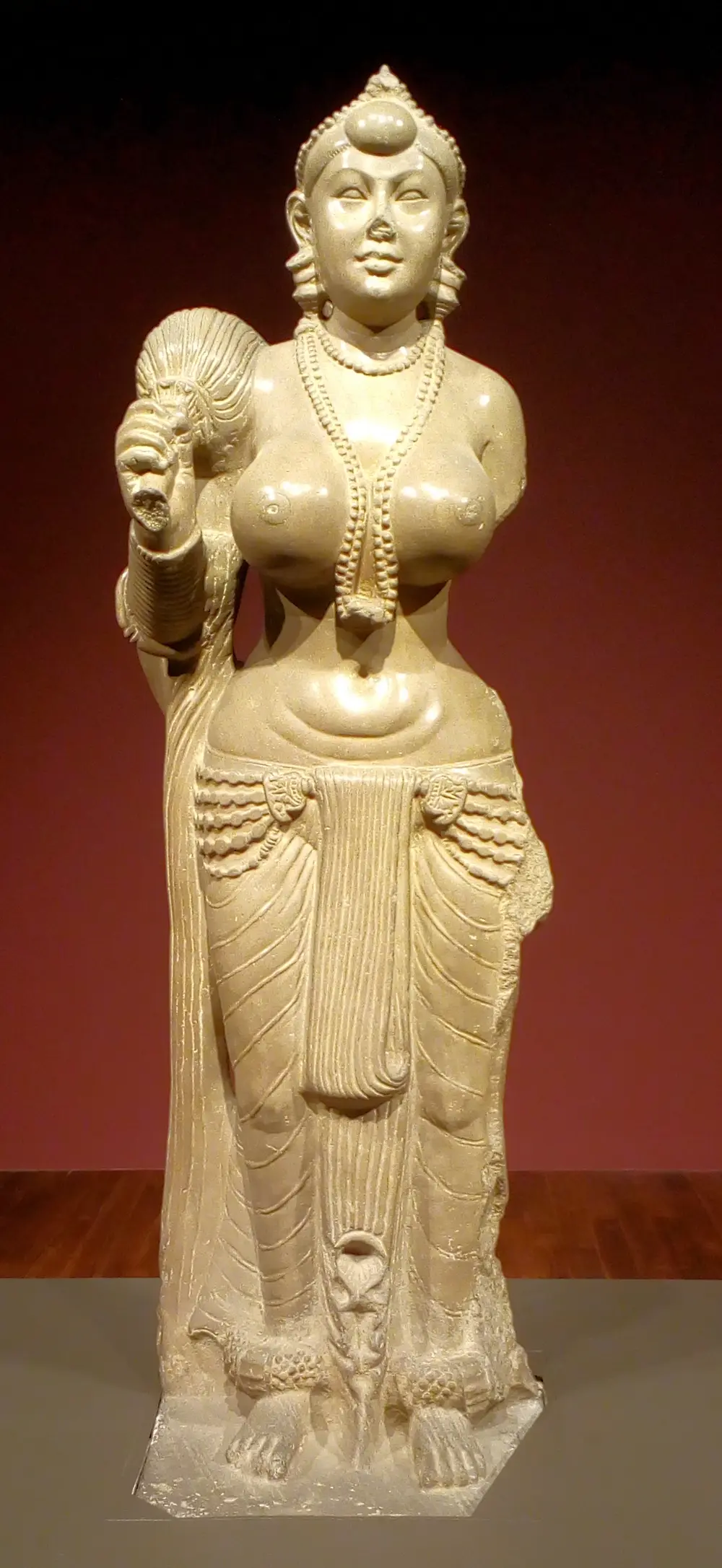
This yakshi, about 1.6 metres tall, was found in 1917 on the bank of the Ganga at Didarganj, close to ancient Pataliputra, the Mauryan capital. She holds a chauri, a fly-whisk, in her right hand; her left arm is broken. The carver gave her round, full forms, a heavy necklace falling to her waist, a beaded belt and a lower garment whose fine pleats cling to her legs. Her shine made scholars call her Mauryan, but many now date her later, so she is the classic example of why polish alone cannot date a sculpture.
Spot it by
A tall, standing woman with a fly-whisk, a glassy polish, heavy beads and a pleated skirt.
Remember
Didarganj: the polished lady with the fly-whisk, from Patna.
Don't confuse
The Bharhut and Sanchi yakshis are carved on railings and gateways, not free-standing, and they hold a tree instead of a whisk.
Found at Parkham, near Mathura; now in the Government Museum, Mathura
When
About the 2nd century BCE; older books call it Mauryan
Made with
Stone
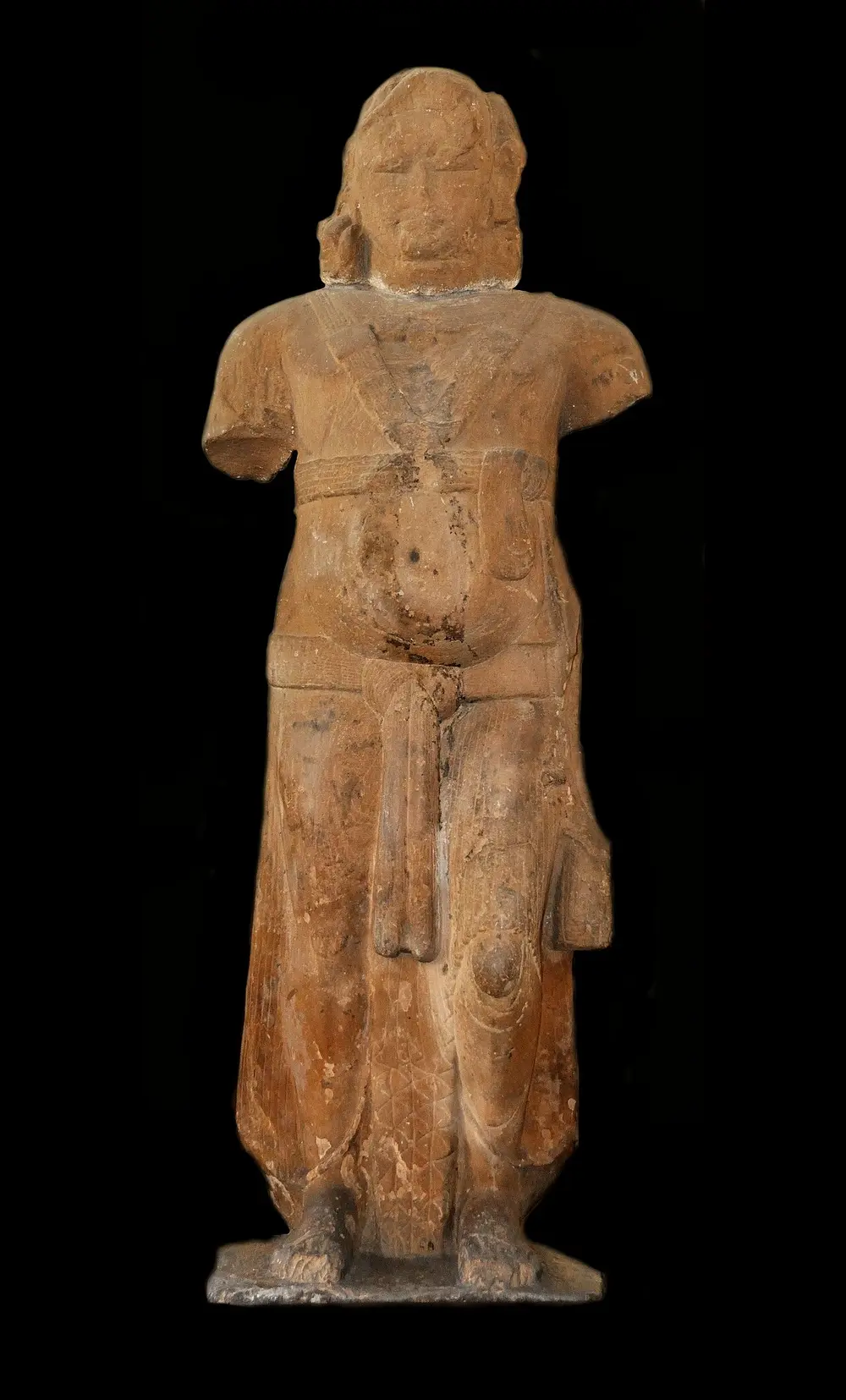
This giant yaksha stands about 2.6 metres tall with its base. An inscription on the base names him Manibhadra, a yaksha popular in ancient India. He is massive and stiff, with a big belly, broad shoulders and a heavy garment, and he is meant to be seen from the front.
Spot it by
A huge, frontal, heavy-bodied standing man with a round belly, his arms broken off.
Dhauli hill, on the Daya river near Bhubaneswar, Odisha
When
3rd century BCE
Made with
Carved from the living rock
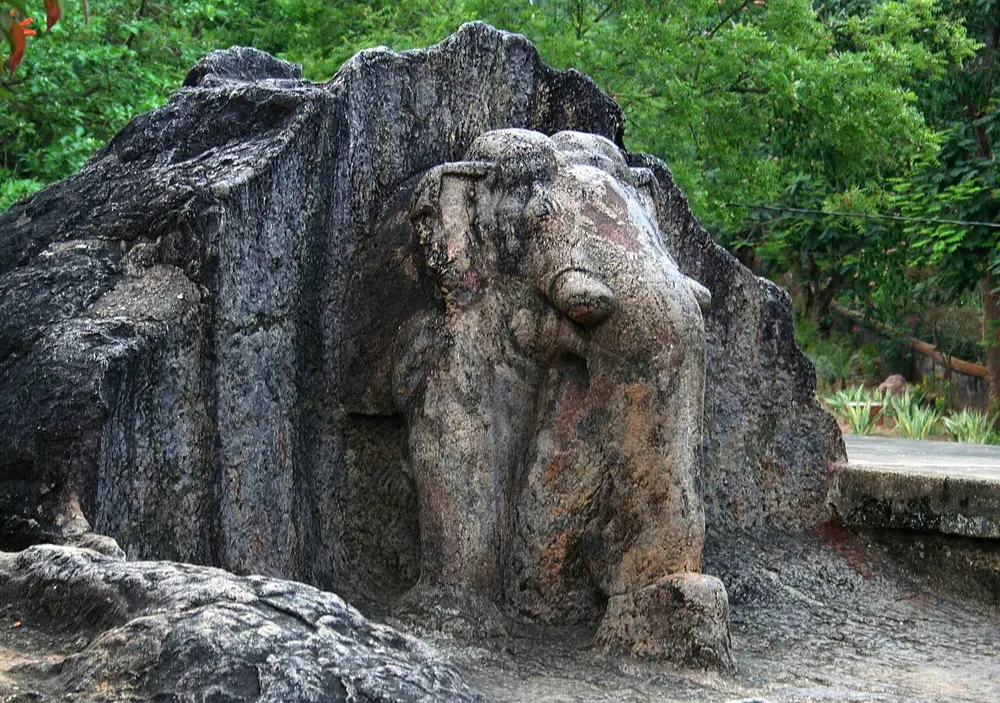
At Dhauli, about 8 km south of Bhubaneswar, the front half of an elephant seems to walk out of a boulder. It is carved in the round (finished on all visible sides, not just as a flat relief), on a terrace above a rock face carved with Ashoka's edicts, including two separate edicts for Kalinga, the land Ashoka conquered in a bloody war. The elephant was probably meant to draw people's eyes to the inscription.
Spot it by
Only the head, trunk and front legs of an elephant, coming out of a rock.
Remember
At Dhauli, Ashoka's words come with an elephant.
After the Mauryas: Bharhut and Sanchi
In the 2nd and 1st centuries BCE, Buddhist stupas, round domes over relics, were given stone railings (vedikas) and gateways (toranas). Sculptors covered them with stories of the Buddha's life and his past lives, the Jataka tales, and with yakshis. In this early art the Buddha himself is never shown as a person, only as a sign: footprints, an empty throne, a tree or a wheel. The buildings themselves are covered in the Buddhist and rock-cut architecture note; here we look at the carving.
From the stupa at Bharhut, Satna district, Madhya Pradesh; now in the Indian Museum, Kolkata
When
About the 2nd century BCE
Made with
Red sandstone
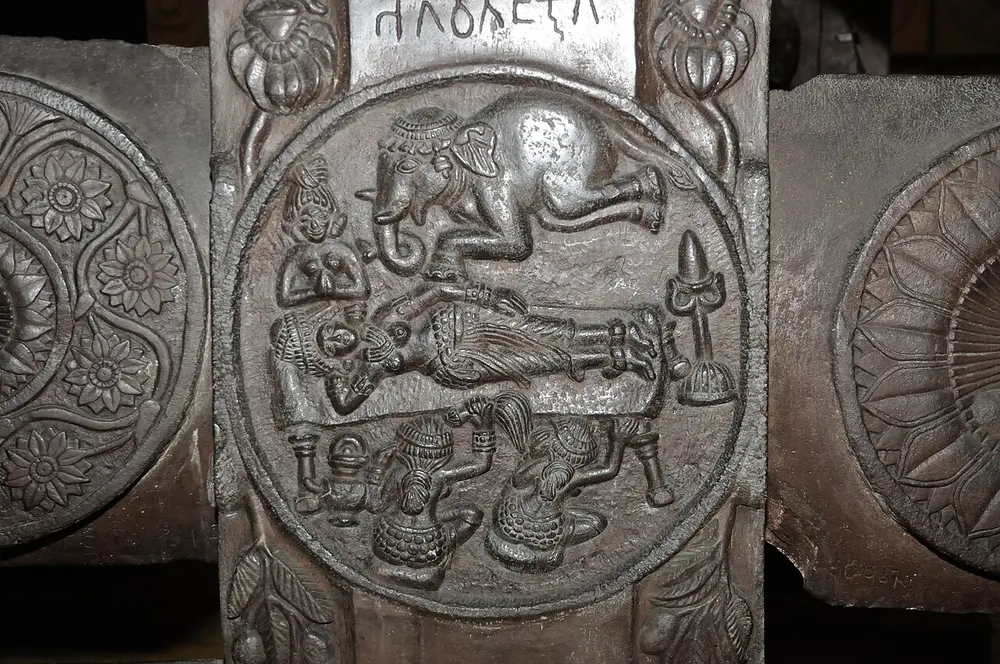
The Bharhut stupa has almost vanished, but Alexander Cunningham visited the site in 1873 and dug it up the next year, and much of it was taken to Kolkata, where its railing and a gateway fill a gallery of the Indian Museum. Its posts carry round medallions. This one shows Queen Maya asleep while a small elephant comes down to her: the dream that announced the Buddha's birth. Bharhut's reliefs are shallow, with few figures, and many are labelled in Brahmi script, saying which story they tell.
Spot it by
A round medallion on a railing post, a shallow carving, a few clear figures and a label in Brahmi above.
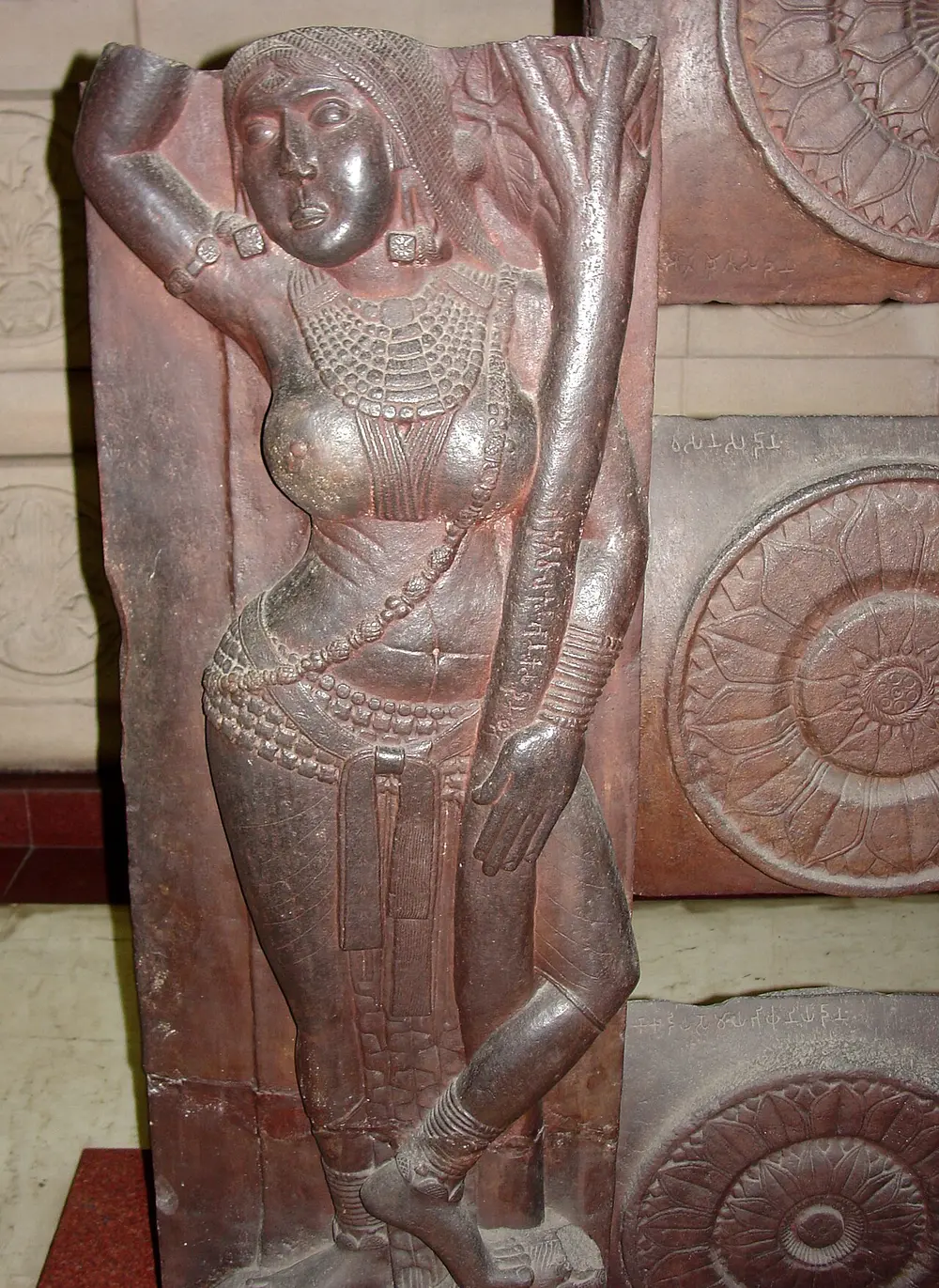
Bharhut's corner posts carry tall yakshis and yakshas. This yakshi holds a branch of a flowering tree and twines a leg round its trunk, a pose called shalabhanjika, a woman with a tree. It links her with fertility and with Queen Maya, who held a tree branch when the Buddha was born. Like most Bharhut figures, she is carved in low relief and stays close to the flat surface of the post, a little stiff, with her feet turned awkwardly to the side.
Spot it by
A tall, flat figure on a railing post, grasping a tree, carved in shallow relief.
Remember
Bharhut figures stay flat on the stone; Sanchi figures lean out of it.
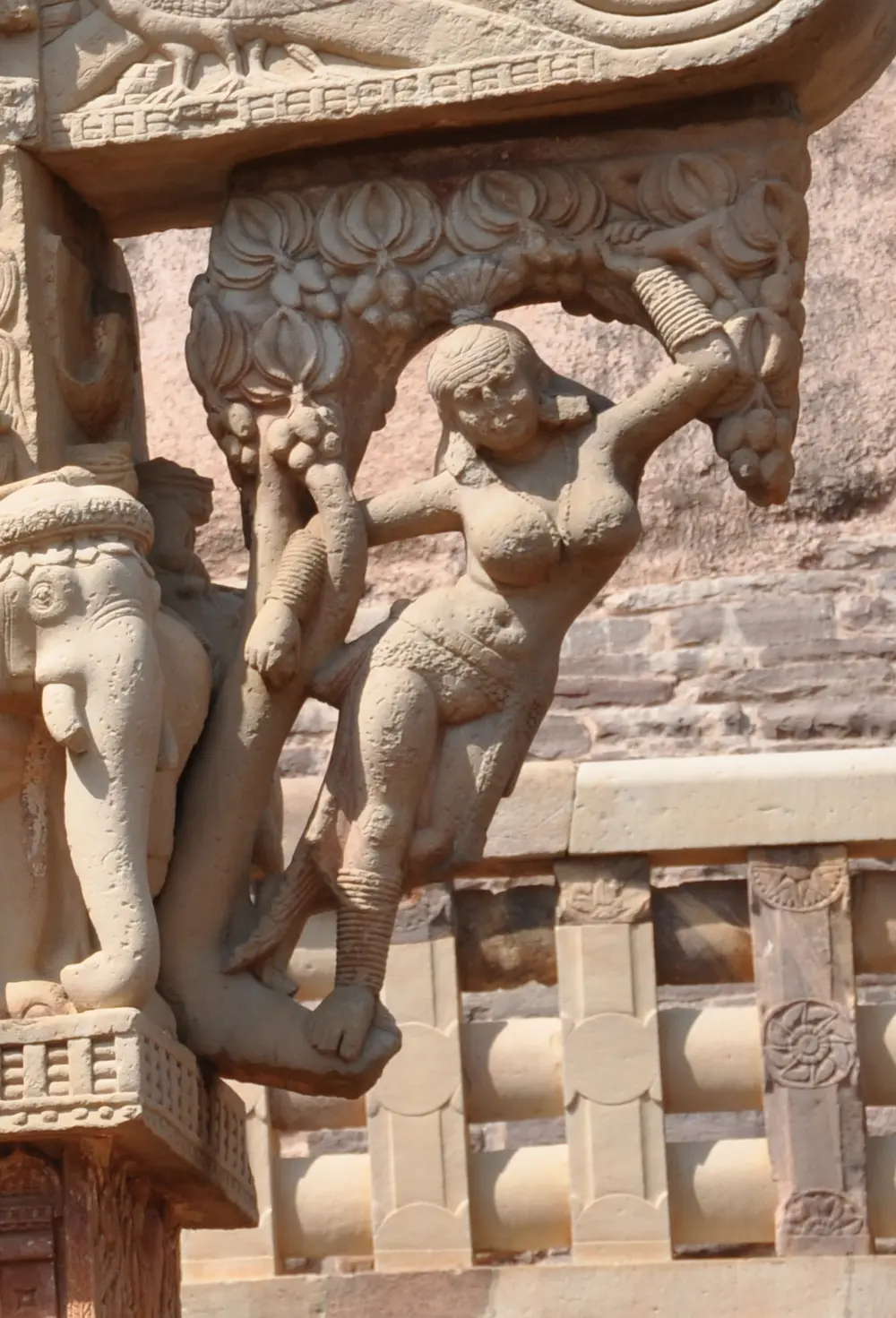
East gateway of the Great Stupa, Sanchi, Madhya Pradesh
When
1st century BCE
Who
Carvers working under the Satavahana kings
Made with
Sandstone
The four gateways of Sanchi's Great Stupa were carved from the 1st century BCE. Where the post meets the lowest crossbeam, a yakshi is set as a bracket, a support that sticks out from the wall. She hangs from a tree branch, her hips swung out and her body curving free in the air. Compared with Bharhut, the carving at Sanchi is deeper, the figures are rounder and fuller, and the poses are relaxed and natural. An inscription on the south gateway says ivory carvers from nearby Vidisha did some of the work.
Spot it by
A curving female figure swinging out from a gateway post, holding a branch, carved almost in the round.
Remember
The Sanchi yakshi swings out from the gate.
Don't confuse
The Bharhut yakshi is flat against its post; the Sanchi one leans out into space.
Telling them apart
Work
Material
Date
Now in
Dancing Girl
Bronze, lost-wax cast
About 2300 to 1750 BCE
National Museum, New Delhi
Priest-King
Steatite (soapstone)
Mature Harappan
National Museum of Pakistan, Karachi
Unicorn and Pashupati seals
Mostly steatite
About 2500 to 1900 BCE
Many museums; Pashupati seal in New Delhi
Mother goddess
Terracotta (baked clay)
Mature Harappan
Many museums
Harappa torso
Red stone (sandstone or jasper)
Harappan
National Museum, New Delhi
Lion Capital
Polished Chunar sandstone
About 250 BCE
Sarnath Museum
Rampurva bull
Sandstone
3rd century BCE
Rashtrapati Bhavan, New Delhi
Didarganj Yakshi
Polished Chunar sandstone
Debated, 3rd century BCE to 2nd century CE
Bihar Museum, Patna
Dhauli elephant
The living rock
3rd century BCE
Dhauli, Odisha
Bharhut reliefs and yakshis
Red sandstone
About 2nd century BCE
Indian Museum, Kolkata
Sanchi gateway yakshi
Sandstone
1st century BCE
Sanchi, Madhya Pradesh
From the Indus to Sanchi
About 2500 BCE
The Indus cities are at their height; seals, bronzes and clay figures are made
About 2300 to 1750 BCE
The Dancing Girl is cast at Mohenjo-daro
About 1900 BCE
The great Indus cities begin to decline
322 BCE
The Mauryan Empire begins under Chandragupta Maurya
About 250 BCE
Ashoka sets up the pillar at Sarnath with its Lion Capital
3rd century BCE
The Dhauli elephant is carved above Ashoka's edicts in Odisha
185 BCE
The Mauryan Empire ends
2nd century BCE
The Parkham Yaksha and the Bharhut railing are carved
1st century BCE
The gateways of the Great Stupa at Sanchi are carved
Test yourself
Question 1 of 8
Which of these is the Dancing Girl of Mohenjo-daro?
Question 2 of 8
What is this Indus figure carved from?
Question 3 of 8
The Dancing Girl was made using the lost-wax process. What is that process used for?
Question 4 of 8
This capital in the Sarnath Museum is carved from which stone?
Question 5 of 8
Why is the Indus bust called the "Priest-King" only a guess?
Question 6 of 8
Where is this rock-cut elephant, carved above Ashoka's edicts?
Question 7 of 8
Which of these yakshis swings out from a gateway of the Great Stupa at Sanchi?
Question 8 of 8
This bull capital, now at Rashtrapati Bhavan, came from which site?
From past papers
Real exam questions on this topic, each with a full solution.
Mark it as studied to track your progress through the course.
Was this note useful?
Each picture is credited underneath it. Pictures of works still in copyright are shown small, for teaching only. If you hold the rights to a picture and want it removed, tell us through the contact page and we will take it down.