Skip to content

Chapter 1: Painting in India

Painted caves and rock shelters

India's oldest paintings, from the Stone Age rock shelters of Bhimbetka to Ajanta, Bagh, Ellora, Badami, Sittanavasal, Lepakshi and the Kerala murals, with how each was painted and how to tell them apart.

In one minute

6 facts to know

  1. Bhimbetka, 45 km south of Bhopal in Madhya Pradesh, has India's oldest known paintings: Stone Age hunters, dancers and huge animals, mostly in red and white.
  2. Ajanta in Maharashtra holds the finest ancient Indian wall paintings: Buddhist stories (the Jatakas) and the Bodhisattva Padmapani in Cave 1, mostly painted in the 5th century CE.
  3. Most Indian "frescoes" are really fresco secco: the colours were put on dry lime plaster with a glue binder, not into wet plaster as in a true fresco.
  4. Bagh (Madhya Pradesh) is Buddhist like Ajanta; Ellora's paintings are on the ceilings of the Kailasa temple and the Jain caves; Badami (Karnataka) has early Hindu paintings of the Chalukyas.
  5. Sittanavasal in Tamil Nadu is a Jain cave whose ceiling shows a lotus pond; the Veerabhadra temple at Lepakshi has 16th-century Vijayanagara ceiling paintings.
  6. Kerala murals, such as the Ramayana scenes in Mattancherry Palace (the Dutch Palace) in Kochi, use five colours and very rounded, richly dressed figures.

The pictures in this note are on walls, ceilings and rocks, not on paper or cloth. The caves themselves, and their architecture and sculpture, are in the notes on Buddhist and rock-cut architecture and on India's World Heritage Sites. Here we look only at the paint.

How cave paintings were made

Fresco means painting on fresh, wet lime plaster. The colour soaks in, and when the plaster dries the picture becomes part of the wall. Painting on plaster that has already dried is called fresco secco (secco is Italian for dry), or tempera. The colour then needs a binder, a sticky substance such as glue, to hold it to the wall. Almost all old Indian wall paintings were made the second way, even though books often call them frescoes.

Feature True fresco Fresco secco (tempera)
Plaster Wet when painted Dry when painted
What holds the colour The plaster itself as it sets A binder such as glue or gum
Where you see it Italian Renaissance walls Ajanta, Bagh, Sittanavasal, Lepakshi

The painters of Ajanta and Bagh first covered the rough rock with a thick layer of mud or clay mixed with plant fibre, then a thin coat of lime, and painted on that. They drew outlines first, usually in red, then filled in the colours.

The colours came mostly from the earth:

Colour Where it came from
Red and yellow Red and yellow ochre, coloured earths; red also from haematite, called geru
White Lime, or white stone such as limestone
Black Soot from oil lamps, or charcoal
Green A green earth (terre verte); at Bhimbetka, a green stone called chalcedony
Blue Lapis lazuli, a costly blue stone brought from Afghanistan

Bhimbetka: the Stone Age

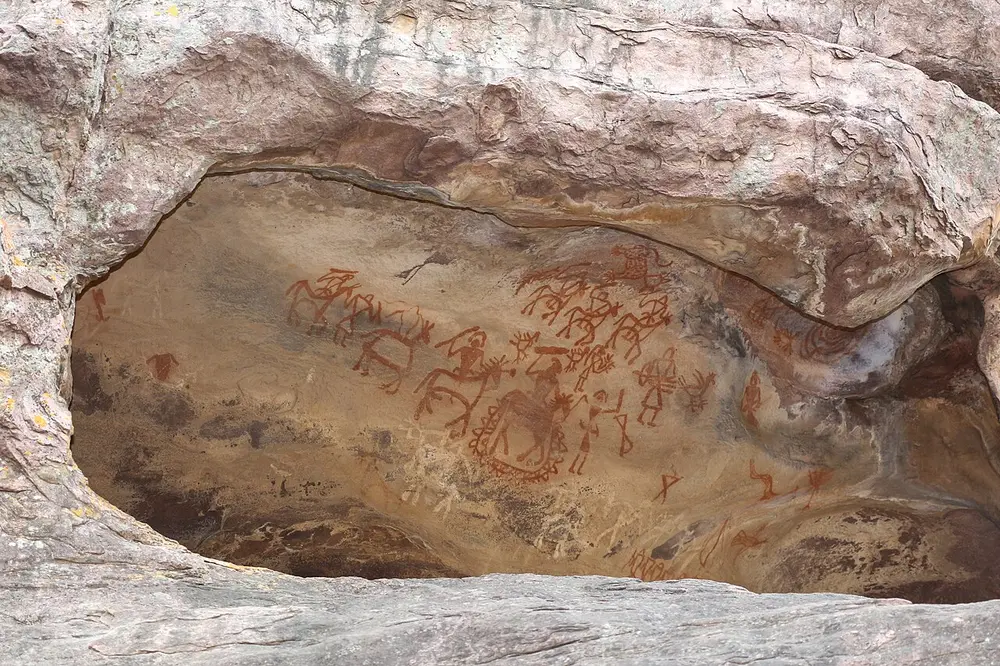
A low overhanging rock shelter whose inner wall is covered with small red figures of men on horses, animals and stick figures, with a large patterned animal near the middle.
Picture: Bernard Gagnon. CC BY-SA 3.0.

Bhimbetka rock shelters

Where
Raisen district, about 45 km south of Bhopal, Madhya Pradesh
When
From the Upper Palaeolithic (late Old Stone Age) to medieval times
Who
Stone Age hunter-gatherers, then later peoples who used the same shelters
Made with
Ground minerals mixed with water and perhaps animal fat, gum or resin, put on with plant-fibre brushes

Bhimbetka is a group of hills in the Vindhya range with hundreds of natural rock shelters, about 500 of them painted. The archaeologist V. S. Wakankar found their prehistoric paintings in 1957 and spent years surveying them. Scholars sort the pictures into seven periods, from the late Old Stone Age to medieval times, and in some places there are 20 layers of paint, one over another. The site became a UNESCO World Heritage Site in 2003.

Spot it by

Stick-like people and big animals on a bare rock wall, mainly in red and white, with hunters, dancers and later horse and elephant riders.

Remember

Bhimbetka means "Bhima's seat", and it holds the oldest paintings in India.

Don't confuse

Ajanta and Bagh are caves cut by people and painted on smooth plaster; Bhimbetka's are natural rock shelters painted straight onto the rock.
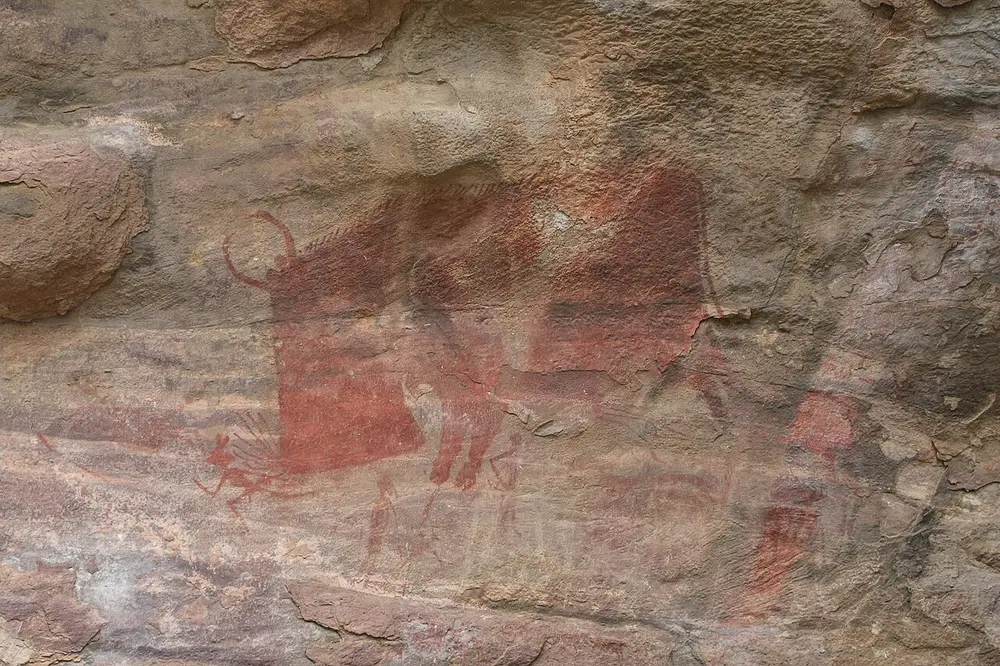
A huge red animal with horns and a spiky back fills a rock wall, while a tiny red stick figure of a man runs in front of it.
Picture: Bernard Gagnon. CC BY-SA 3.0.

Hunting scenes at Bhimbetka

Where
Rock Shelter 15, Bhimbetka
When
Prehistoric (the Middle Stone Age is the period with the most paintings)
Style
Prehistoric rock painting

Most of Bhimbetka's paintings come from the Mesolithic, or Middle Stone Age. They are full of hunting: groups of people with barbed spears, bows and arrows chase deer, bison and boars, and sometimes the animal chases the hunter. This painting, usually called the boar, shows a giant horned beast towering over a running man. Animals are drawn quite naturally, while people are reduced to simple stick figures, and there are also scenes of dancing in a ring, collecting honey and family life.

Spot it by

A giant animal and a tiny person, flat red paint filled with lines or patterns, and no ground line or background.

Remember

At Bhimbetka the animals are big and the people are small.
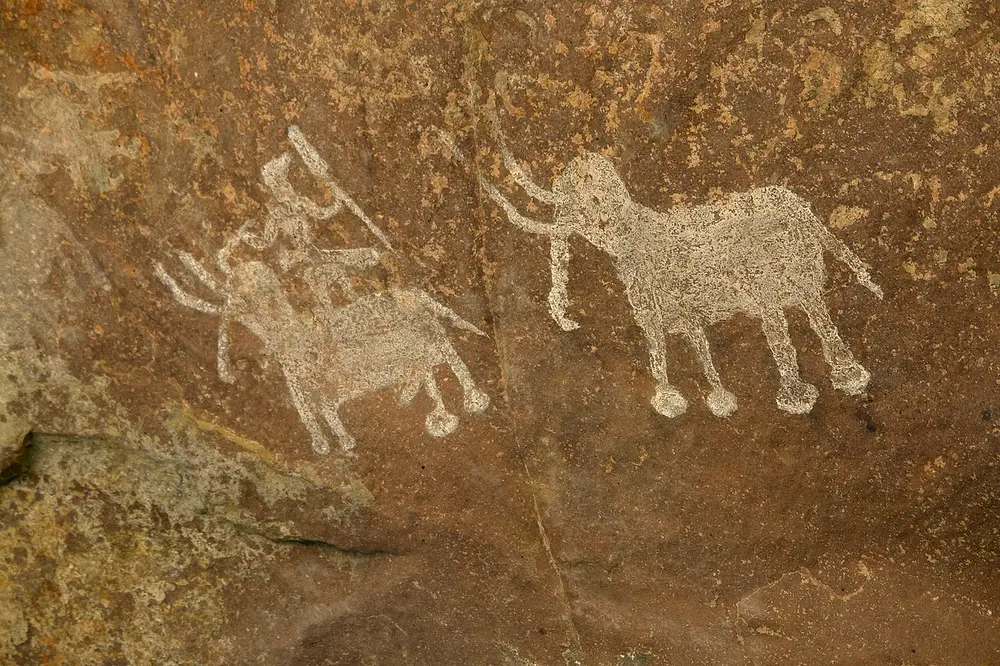
Two white elephants painted on a brown rock, one carrying a rider holding a long spear or goad.

Later painters at Bhimbetka added riders on horses and elephants, often in white. These come from historic times, long after the Stone Age hunting scenes.

Picture: Yann (talk). CC BY-SA 4.0.

Buddhist caves: Ajanta and Bagh

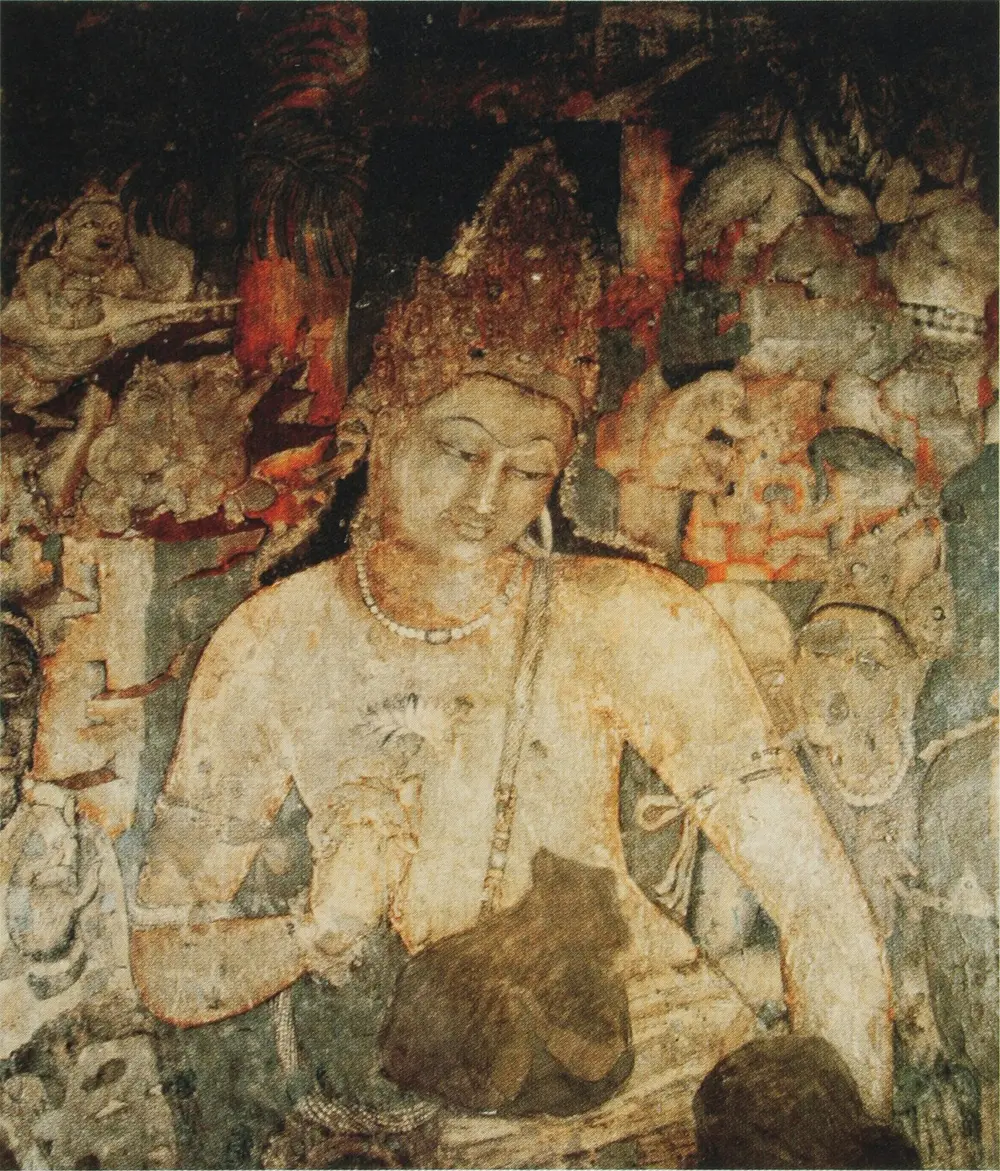
A wall painting of a calm young man with a tall jewelled crown, lowered eyes, a pearl necklace and a slightly bent head, surrounded by smaller faded figures.
Picture: Unknown author. Public domain.

Bodhisattva Padmapani, Ajanta

Also called Padmapani, "the one holding a lotus"

Where
Cave 1, Ajanta, near Chhatrapati Sambhajinagar (Aurangabad), Maharashtra
When
Late 5th century CE
Who
Painted for the Vakataka king Harishena's court
Style
Ajanta, Buddhist mural
Made with
Mineral colours with a binder on mud and lime plaster

A Bodhisattva is a being who has reached enlightenment but stays in the world to help others. Padmapani is painted larger than life beside the doorway of the shrine in Cave 1, holding a lotus flower, with Vajrapani, who holds a thunderbolt, on the other side. His lowered eyes, gently bent head and soft shading make him look lost in thought, and he is one of the most famous paintings in India.

Spot it by

Heavy-lidded downcast eyes, a tall crown, a body that bends gently, soft shading that makes the figure look round, and crowds of figures around him.

Remember

Padma means lotus: Padmapani is the lotus-holder of Cave 1.

Don't confuse

Ajanta's figures are soft, rounded and shaded. Later wall paintings, such as those at Ellora and Lepakshi, have sharper outlines and flatter figures.
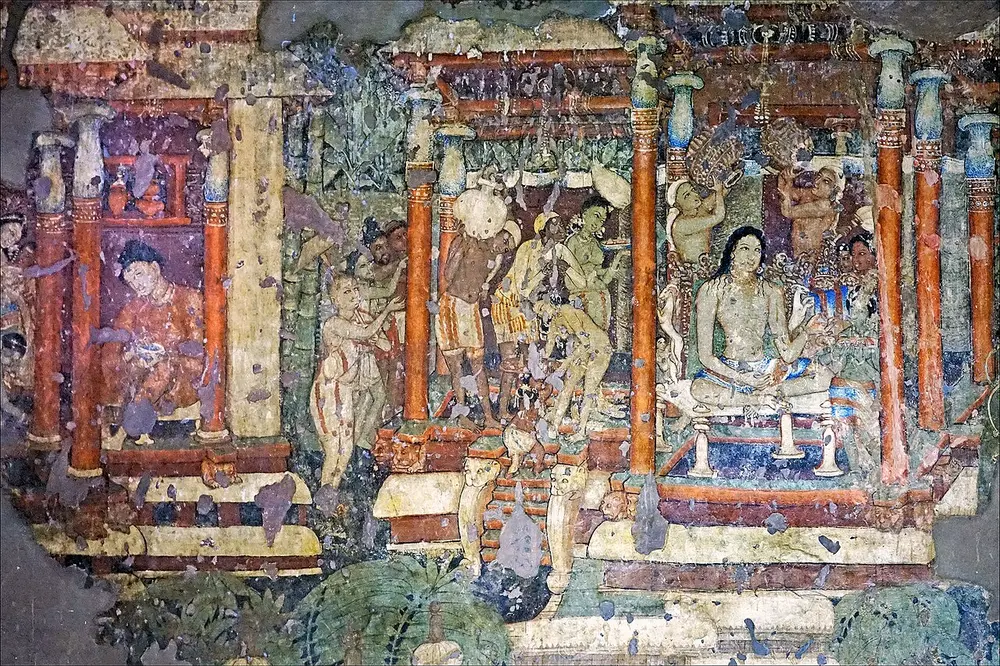
A crowded wall painting of a palace with red pillars, where a long-haired prince sits on a stool while servants carrying pots pour water over him and others watch.
Picture: Jean-Pierre Dalbéra. CC BY 2.0.

Jataka scenes at Ajanta

Also called Mahajanaka Jataka

Where
Cave 1, Ajanta (Jataka scenes also fill Caves 2, 16 and 17)
When
5th century CE; a few older fragments survive in Caves 9 and 10
Style
Ajanta, narrative mural

The Jatakas are stories of the Buddha's earlier lives, when he was born as a prince, a merchant or an animal and showed kindness, courage or generosity. Ajanta's walls are covered with them. This scene is from the Mahajanaka Jataka, about a prince who gives up his kingdom to become a monk; here he is bathed in his palace. The Ajanta painters did not split a wall into neat rows: a story spreads across the wall, with one scene running into the next.

Spot it by

Busy palace and street scenes, many people of different skin tones, elegant hands and poses, and one story flowing across a whole wall.

Remember

A Jataka is a "birth story": the Buddha's past lives, told on Ajanta's walls like a giant comic without borders.
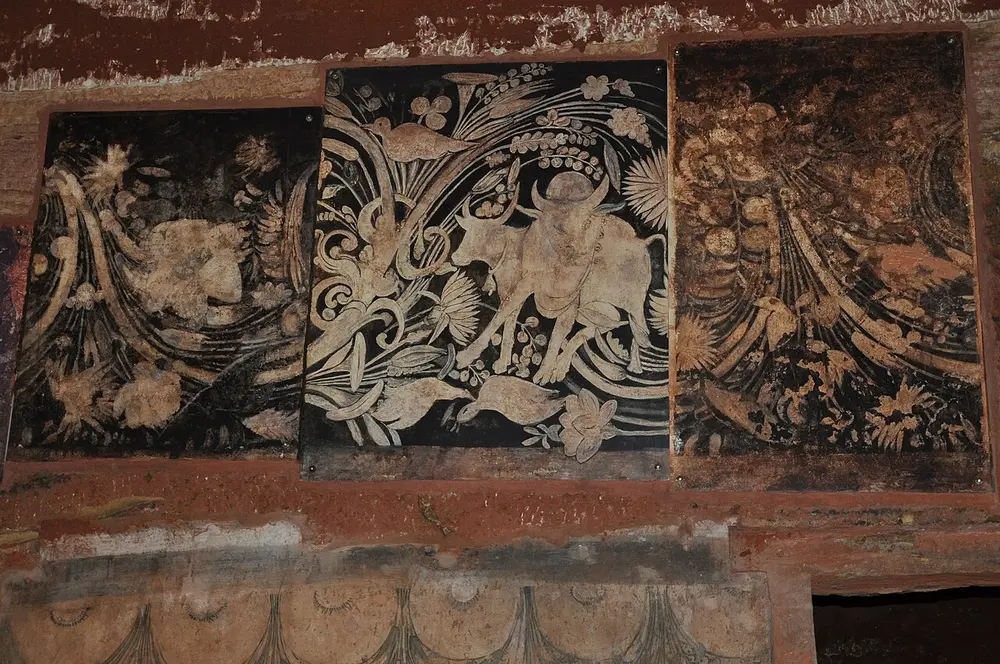
Three dark painted panels set on a red cave wall, the middle one showing a pale bull among curling leaves, flowers and birds.
Picture: Prof Ranga Sai. CC BY-SA 4.0.

Bagh caves

Where
Bagh, Dhar district, Madhya Pradesh
When
Late 5th to 7th century CE
Style
Buddhist mural, close to Ajanta
Made with
Tempera on a reddish mud plaster with a lime coat

The Bagh caves are Buddhist monasteries cut into a sandstone hill, and their paintings are close cousins of Ajanta's. The best were in Cave 4, called the Rang Mahal (palace of colours), whose long porch showed a group of women musicians around a dancer and grand processions of elephants and horsemen. The paintings were badly damaged by water and a fallen porch; artists from Santiniketan, including Nandalal Bose, copied them in the early 1920s, and in the 1980s many panels were taken off the walls and moved to the museum at Gwalior.

Spot it by

Ajanta-like figures, but with scenes of everyday court life: music, dance and processions rather than mostly Buddhist stories.

Remember

Bagh's Rang Mahal is the palace of colours, and its best paintings now live in Gwalior.

Don't confuse

Ajanta is in Maharashtra and mostly tells Jataka stories; Bagh is in Madhya Pradesh and is best known for its dance and procession scenes.

Hindu and Jain caves of the Deccan

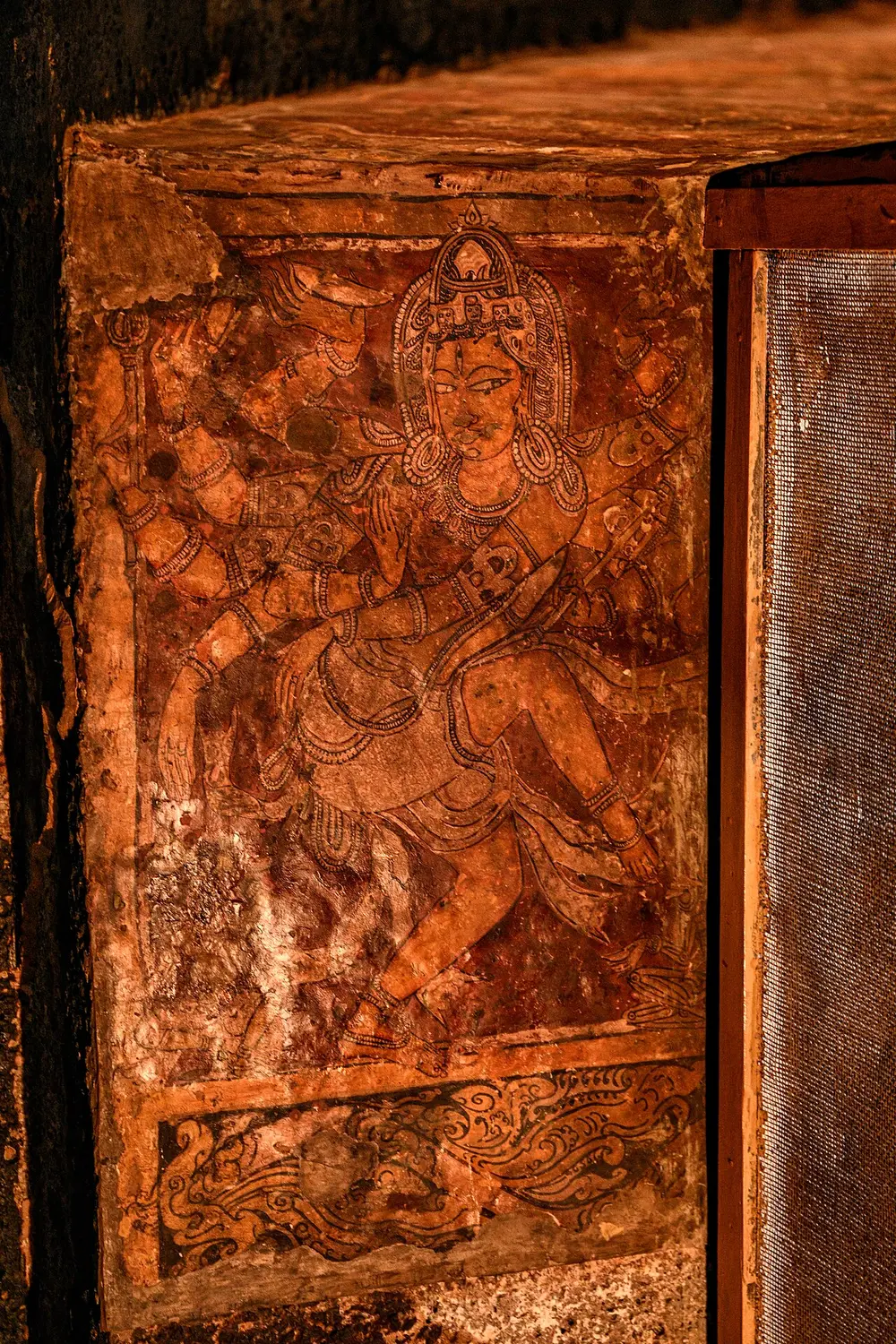
A faded red-brown wall painting of a many-armed god dancing with one leg raised, wearing a tall crown, drawn with fine dark outlines, above a band of curling waves.
Picture: Anjan Kumar Kundu. CC BY 4.0.

Ellora's paintings

Where
Kailasa temple (Cave 16) and the Jain caves such as the Indra Sabha (Cave 32), Ellora, Maharashtra
When
About the 8th to 10th centuries CE
Who
Mostly the Rashtrakuta kings
Style
Hindu and Jain wall painting
Made with
Paint on a thin coat of lime plaster

Ellora is famous for carving, but much of it was once plastered and painted, and patches of paint survive on the ceilings and walls of the Kailasa temple and the Jain caves. The pictures show gods, dancing figures and flying celestial beings among clouds. Compared with Ajanta, the lines are sharper, the figures more angular, and the eye on the far side of a face often juts out beyond its outline, a habit that later spread through Deccan and southern painting.

Spot it by

Many-armed dancing gods and flying figures in red, brown and black, with sharp noses, pointed features and a far eye sticking out of the face.

Remember

Ajanta is soft and Buddhist; Ellora's paint is sharper, and it is Hindu and Jain too.

Don't confuse

The big Ellora attraction is the rock-cut Kailasa temple itself. For paintings, look up at its ceilings.

Badami cave paintings

Where
Vishnu cave (usually called Cave 3; NCERT numbers it Cave 4), Badami, Karnataka
When
The cave is dated by an inscription to 578 to 579 CE
Who
The early Chalukya king Mangalesha
Style
Early Hindu wall painting

Badami was the capital of the early Chalukyas, and the cave Mangalesha dedicated to Vishnu has the oldest surviving Hindu cave paintings in the Deccan. Only fragments remain on the vaulted ceiling of the front hall. One shows a palace scene with Kirtivarman, Mangalesha's elder brother, seated with his queen and nobles watching a dance; others show gods such as Brahma on his swan and the wedding of Shiva and Parvati. The smooth lines and half-closed eyes show that the Ajanta way of painting had travelled south.

Spot it by

Faint fragments on a ceiling of red sandstone, with graceful faces in the Ajanta manner.

Remember

Badami brings Ajanta's style to a Hindu cave in Karnataka, in 578 CE.

Tamil Nadu and Andhra Pradesh

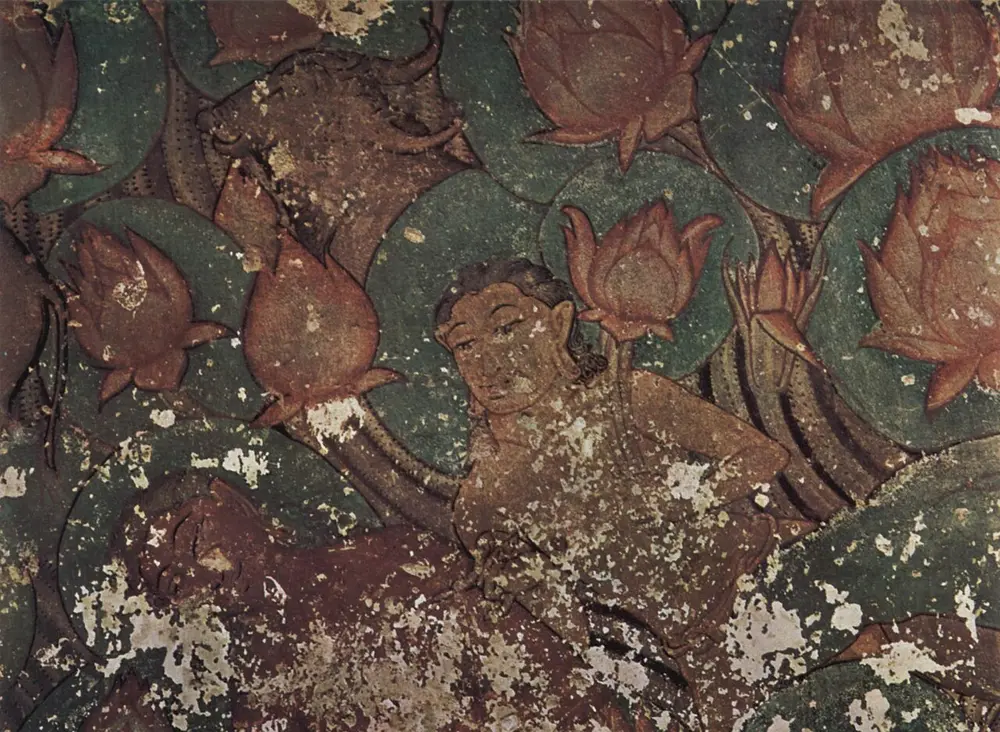
A faded ceiling painting of a lotus pond with large pink lotus buds on round green leaves, and a man with a lotus in his hand standing among them.
Picture: Unknown Pandya-period painter. Public domain.

Sittanavasal

Also called Arivar Kovil

Where
Pudukkottai district, Tamil Nadu
When
The paintings are usually dated to the 9th century CE, under the Pandya kings
Who
Jain monks; an inscription names the Jain teacher Ilan Gautaman
Style
Jain wall painting
Made with
Mineral colours on lime plaster

Sittanavasal is a small Jain cave temple cut into a hill. Its ceiling shows a lotus pond full of flowers, fish, geese, buffaloes and elephants, with men gathering lotuses. For Jains the pond stands for the heavenly gathering where a Tirthankara preaches. Dancing celestial women are painted on the pillars of the porch.

Spot it by

A ceiling pond of big pink lotuses on green leaves, with fish, elephants and people gathering flowers.

Remember

Sittanavasal is the Jain lotus pond on the ceiling.

Don't confuse

Ajanta is Buddhist and shows crowded stories; Sittanavasal is Jain and shows a calm lotus pond.
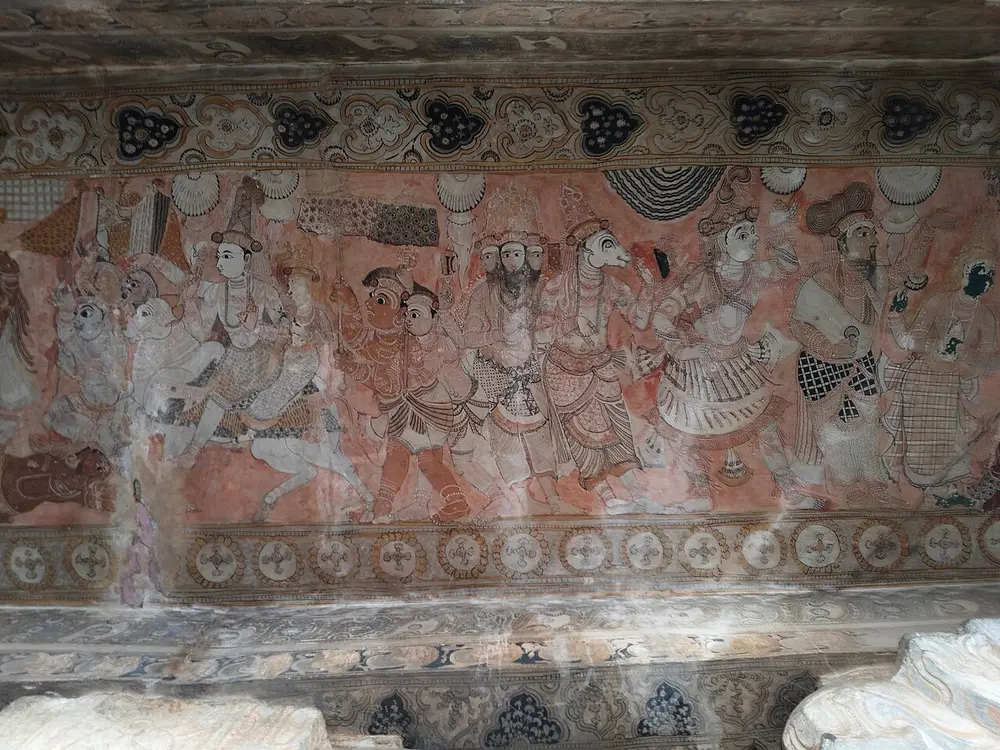
A long ceiling painting on a red ground showing a row of gods and attendants in patterned clothes, with faces in profile and large eyes, between bands of flower patterns.
Picture: NithishKWiki. CC BY-SA 4.0.

Lepakshi ceiling paintings

Where
Veerabhadra temple, Lepakshi, near Hindupur, Andhra Pradesh
When
16th century, about 1530 to 1540
Who
Built by the brothers Virupanna and Viranna, governors under the Vijayanagara king Achyuta Deva Raya
Style
Vijayanagara painting
Made with
Earth and plant colours mixed with lime water on lime plaster, usually on a red background

The ceilings of this temple to Veerabhadra, a fierce form of Shiva, are covered with paintings of the gods, the epics and Shiva's many forms, and include one of the largest old ceiling paintings in India. Vijayanagara painters showed faces in profile, kept figures flat like cut-outs, and arranged scenes in long rectangular bands. The costumes are drawn in great detail, so the paintings also show what textiles of the time looked like.

Spot it by

A red background, figures in profile with a large eye, flat bodies, patterned clothes, and scenes lined up in long strips on a ceiling.

Remember

Lepakshi is a Vijayanagara ceiling in Andhra Pradesh, painted in long red strips.

Don't confuse

Kerala murals are much rounder and crowded, mostly in deep orange, yellow and green; Lepakshi's figures are flat and in profile on red.

Kerala murals

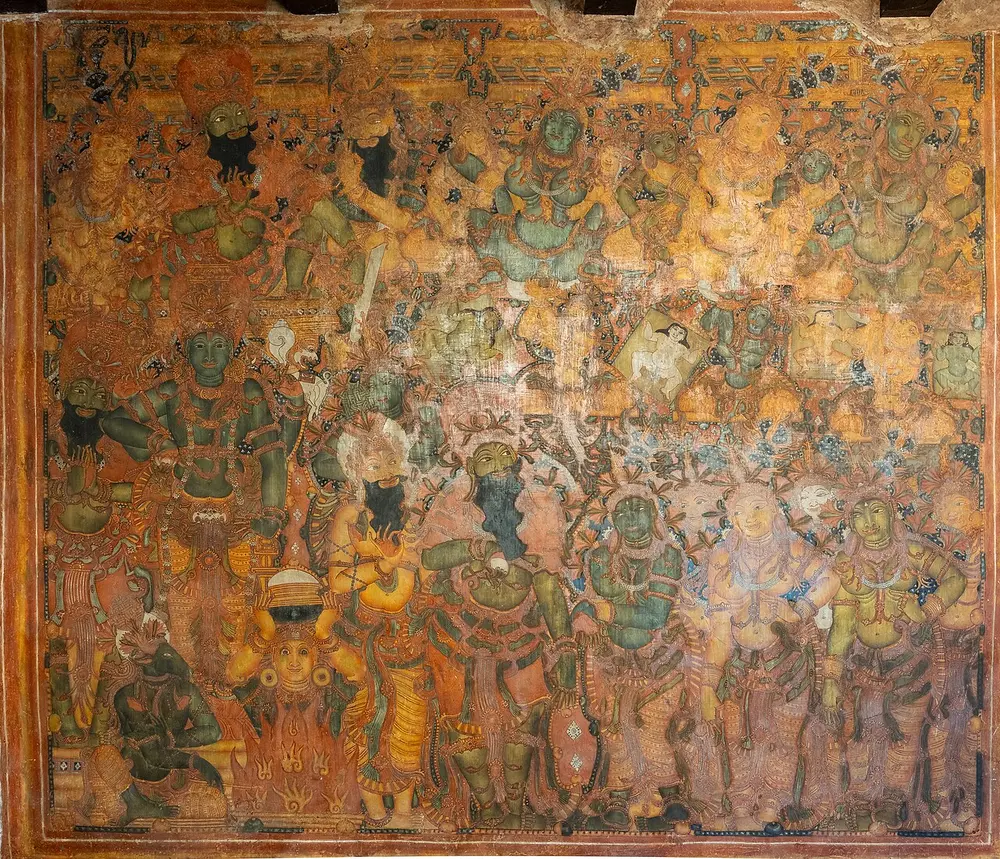
A crowded wall painting in deep orange, yellow and green, packed with richly dressed and crowned figures, some with green faces and black beards, around a fire.
Picture: Rainer Halama. CC BY-SA 4.0.

Mattancherry Palace murals

Also called Dutch Palace, Kochi

Where
Mattancherry, Kochi, Keralam (Kerala until 2026)
When
Palace built in the mid-16th century; the Ramayana murals from the 16th century, with more added later
Who
Painted for the Rajas of Kochi
Style
Kerala mural
Made with
Natural colours on lime plaster

The Portuguese built this palace for the Raja of Kochi in the 16th century; it is called the Dutch Palace because the Dutch repaired it after they took over Kochi in 1663. The Raja's bedchamber is covered with the story of the Ramayana. Kerala murals were painted on the walls of temples and palaces from about the 16th to the 18th century, with others at Padmanabhapuram Palace and temples such as Ettumanoor. They use a few strong colours, traditionally five (panchavarna), and their round, heavily ornamented figures recall the costumes and make-up of Kathakali dancers.

Spot it by

No empty space, deep orange and yellow with green, big rounded bodies, huge crowns and jewellery, and wide staring eyes.

Remember

Kochi's Dutch Palace was built by the Portuguese and painted with the Ramayana.

Don't confuse

Lepakshi's Vijayanagara figures are flat and in profile on a red ground; Kerala mural figures are rounded and fill every corner.

Which site is it?

Site State Religion and date One clue
Bhimbetka Madhya Pradesh Prehistoric Red and white hunters on bare rock
Ajanta Maharashtra Buddhist, mostly 5th century CE Padmapani, Jataka stories
Bagh Madhya Pradesh Buddhist, late 5th to 7th century Rang Mahal dance and processions
Ellora Maharashtra Hindu and Jain, 8th to 10th century Sharp lines, far eye sticking out
Badami Karnataka Hindu, 578 CE Chalukya palace scene
Sittanavasal Tamil Nadu Jain, about 9th century Lotus pond on the ceiling
Lepakshi Andhra Pradesh Hindu, 16th century Vijayanagara figures in profile on red
Mattancherry Keralam Hindu, 16th century on Ramayana in deep orange and green
  1. Upper Palaeolithic and Mesolithic

    The first paintings at Bhimbetka: animals, hunters and dancers

  2. 2nd to 1st century BCE

    The oldest painted fragments at Ajanta, in Caves 9 and 10

  3. 5th century CE

    The great Ajanta paintings under the Vakatakas, in Caves 1, 2, 16 and 17

  4. 578 CE

    Mangalesha dedicates the Vishnu cave at Badami

  5. Late 5th to 7th century CE

    The Bagh caves are painted

  6. 8th to 10th century CE

    Paintings on Ellora's Kailasa temple and Jain caves

  7. 9th century CE

    The Sittanavasal lotus pond, under the Pandyas

  8. 11th century CE

    Chola paintings in the Brihadeeswara temple at Thanjavur

  9. About 1530 to 1540

    The Veerabhadra temple at Lepakshi is built and painted

  10. 16th to 18th century

    Kerala murals, including Mattancherry Palace

  11. 1819

    A British officer, John Smith, comes across the Ajanta caves while hunting a tiger

  12. 1957

    V. S. Wakankar finds the prehistoric paintings at Bhimbetka

Test yourself

Question 1 of 8

Which of these paintings is from the Bhimbetka rock shelters?

Question 2 of 8

This famous painting of a Bodhisattva holding a lotus is in Cave 1 of which site?

Question 3 of 8

This ceiling painting of a lotus pond is in a Jain cave in Tamil Nadu. Which site is it?

Question 4 of 8

Which of these is a painting from Ellora?

Question 5 of 8

Flat figures in profile on a red ground, in long strips on a temple ceiling, point to which tradition?

Question 6 of 8

What does fresco secco mean?

Question 7 of 8

The prehistoric painters of Bhimbetka got their red colour from which material?

Question 8 of 8

The Ramayana murals of the Mattancherry Palace, also called the Dutch Palace, are in which city?

From past papers

Real exam questions on this topic, each with a full solution.

Finished this note?

Mark it as studied to track your progress through the course.

Was this note useful?

Each picture is credited underneath it. Pictures of works still in copyright are shown small, for teaching only. If you hold the rights to a picture and want it removed, tell us through the contact page and we will take it down.