Skip to content

Chapter 3: Art of the world

The Impressionists and after

How a group of Paris painters chased light and modern life from the 1870s, and how Seurat, Cézanne, Van Gogh, Gauguin and Toulouse-Lautrec pushed their ideas further, with Japanese prints in the background.

In one minute

6 facts to know

  1. Impressionism takes its name from Monet's Impression, Sunrise (1872). A critic used the word to mock the group's first exhibition in Paris in April 1874.
  2. The Impressionists painted light, weather and everyday modern life with quick, broken strokes of bright colour: Monet, Renoir, Degas, Pissarro, Morisot and Cassatt.
  3. Manet is the forerunner. His Le Déjeuner sur l'herbe and Olympia shocked Paris in the 1860s.
  4. The Post-Impressionists kept the bright colour but added something: Seurat's dots (pointillism), Cézanne's solid shapes, Van Gogh's swirling emotion, Gauguin's flat colour and symbols.
  5. Seurat's A Sunday Afternoon on the Island of La Grande Jatte is the classic pointillist painting; Van Gogh's The Starry Night is in MoMA, New York.
  6. Japanese woodblock prints taught them flat colour, bold outlines and unusual viewpoints.

What Impressionism was

In the 1860s, the main way for a French painter to succeed was the Salon, a huge official exhibition in Paris whose jury liked smooth, polished paintings of history, myth and religion. A group of younger artists wanted to paint something else: the world around them, as it looked at one moment, in a particular light.

So they worked fast, often outdoors (in French, en plein air), with short, separate strokes of pure colour that stay visible on the canvas. Up close the paintings look rough and unfinished; from a distance they shimmer. In 1874 they stopped waiting for the Salon and held their own exhibition. There were eight of these shows, from 1874 to 1886.

After 1886 a new generation, now called the Post-Impressionists, took Impressionist colour in different directions. They were never one group with one style; the label just means "after the Impressionists".

The forerunner: Manet

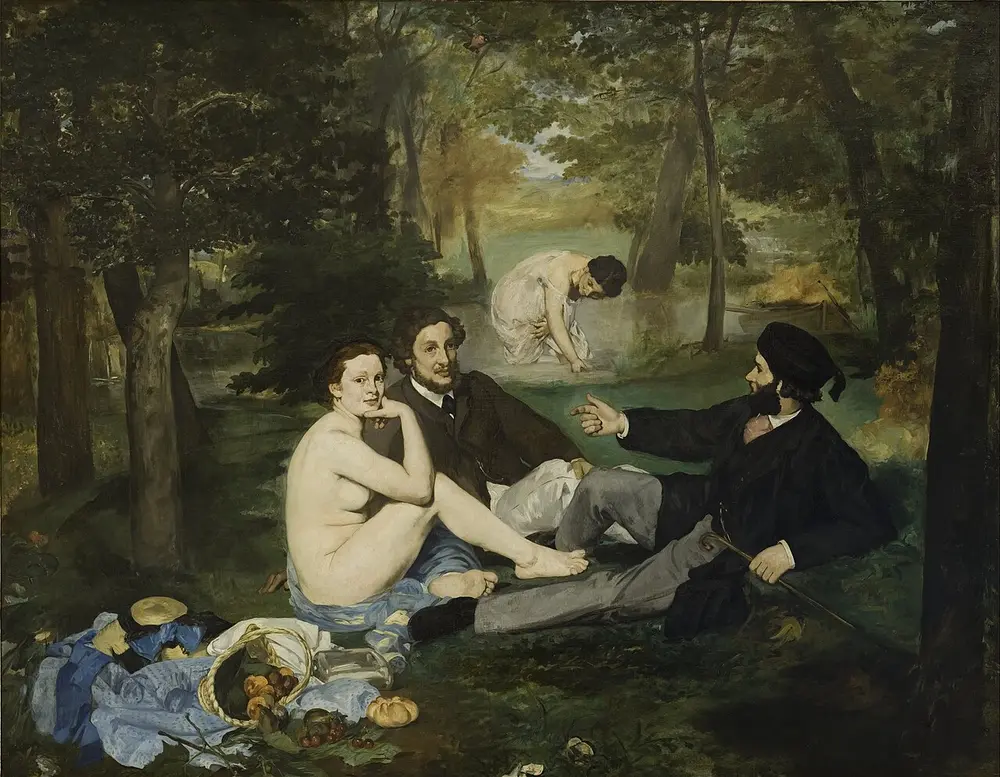
A picnic in a wood: two men in dark modern suits sit on the grass beside a nude woman who looks straight out at the viewer, while another woman bathes in a stream behind them.
Picture: Édouard Manet. Public domain.

Le Déjeuner sur l'herbe

Also called The Luncheon on the Grass

Where
Musée d'Orsay, Paris
When
1863
Who
Édouard Manet
Style
Forerunner of Impressionism (Realism)
Made with
Oil on canvas
Key works
Le Déjeuner sur l'herbe (1863); Olympia (1863, shown 1865), also in the Musée d'Orsay

The Salon jury turned this painting down in 1863, so Manet showed it at the Salon des Refusés, an exhibition of rejected works, where it caused a scandal. People were used to nudes as goddesses in old myths; here a real Paris woman sits with men in modern clothes and stares back at us. His Olympia, a nude based on Titian's Venus of Urbino, caused a second scandal at the 1865 Salon. Manet did not take part in the 1874 Impressionist show, but the younger painters saw him as their leader.

Spot it by

Dark modern suits next to bare skin, a woman looking straight at you, flat patches of colour, a picnic basket and fruit spilled in the corner.

Remember

Manet with an A came first; Monet with an O came next.

Don't confuse

Manet and Monet are different people. Manet is the forerunner who painted people and scandals; Monet is the Impressionist who painted light, water and water lilies.
The Impressionists

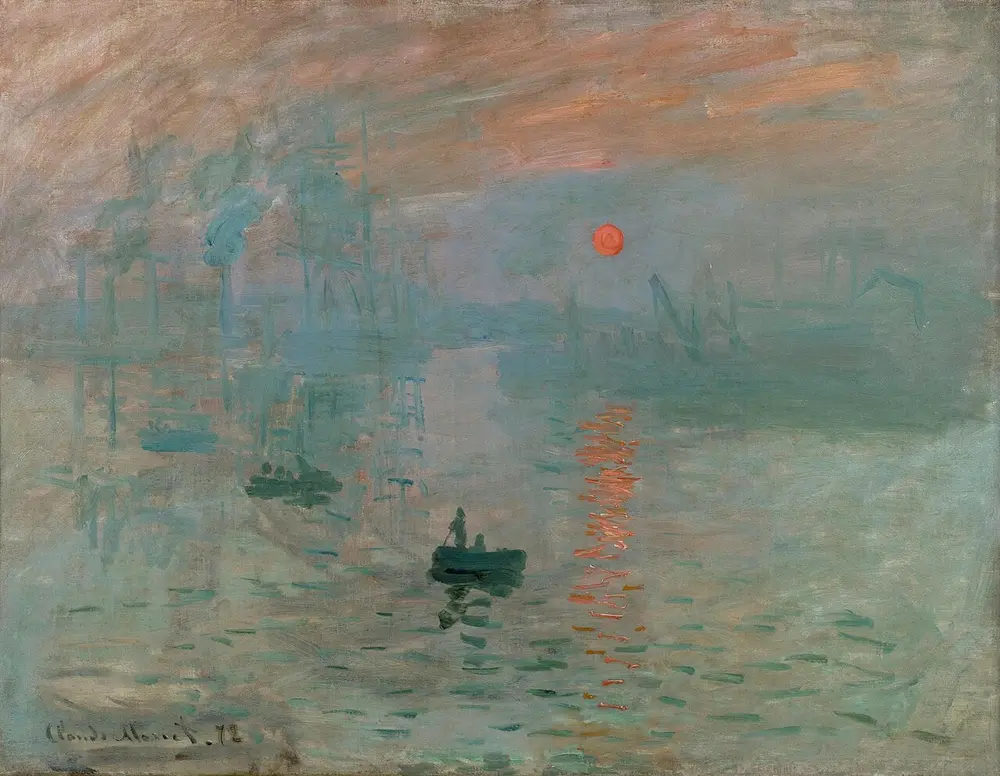
A misty harbour at dawn painted in quick blue-grey strokes, with an orange sun and its reflection on the water and two small dark rowing boats.
Picture: Claude Monet. Public domain.

Impression, Sunrise

Also called Impression, soleil levant

Where
Musée Marmottan Monet, Paris
When
1872
Who
Claude Monet
Style
Impressionism
Made with
Oil on canvas

Monet painted the port of Le Havre, his home town, early one morning from his room. He showed it at the group's first exhibition, which opened on 15 April 1874 in the old studio of the photographer Nadar in Paris. The critic Louis Leroy picked on the word Impression in the title and called them all "Impressionists" in a mocking review. The artists later took the name for themselves.

Spot it by

Blue-grey mist, a small bright orange sun, a streak of orange reflection, a dark rowing boat, very loose brushwork.

Remember

A sunrise named the movement in 1874.
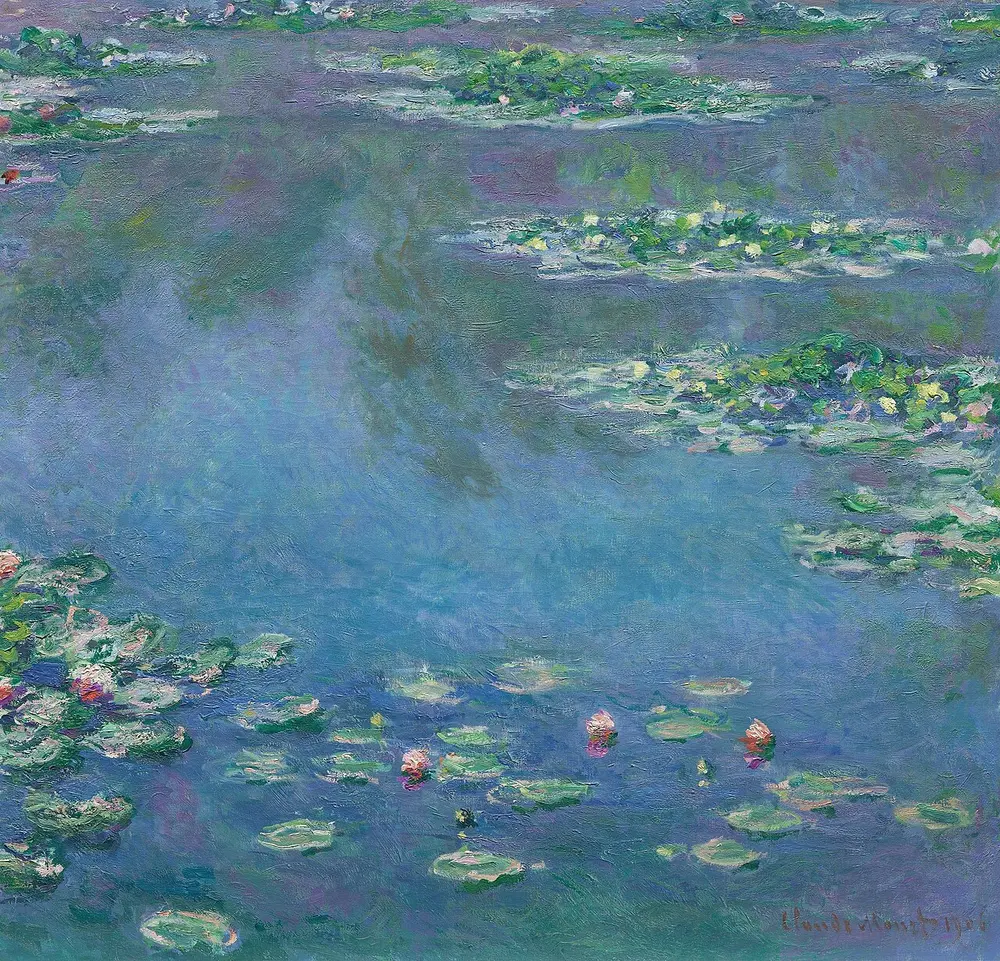
A close view of a pond surface in soft blues and violets, with floating green lily pads and small pink and white water lily flowers and the reflection of the sky.
Picture: Claude Monet. Public domain.

Monet's Water Lilies

Also called Nymphéas

Where
This one: Art Institute of Chicago. The largest set: Musée de l'Orangerie, Paris
When
This one 1906; the series from the late 1890s to 1926
Who
Claude Monet
Style
Impressionism
Made with
Oil on canvas
Key works
Water Lilies (about 250 paintings); Haystacks (1890 to 1891)

Monet built a garden with a lily pond at his home in Giverny, north-west of Paris, and painted it about 250 times in the last 30 years of his life. Eight enormous Water Lilies panels now fill two oval rooms at the Musée de l'Orangerie in Paris. Earlier, in his Haystacks series of 1890 to 1891, he painted the same stacks of wheat again and again to show how light and weather change at different times of day and through the seasons.

Spot it by

No horizon or sky, just the surface of water, floating lily pads, reflections of clouds and trees, soft blues, greens and pinks.

Remember

Monet painted one pond, hundreds of times.

Don't confuse

Monet often painted series of one subject, such as haystacks or his lily pond. If you see the same view in many lights, think Monet.
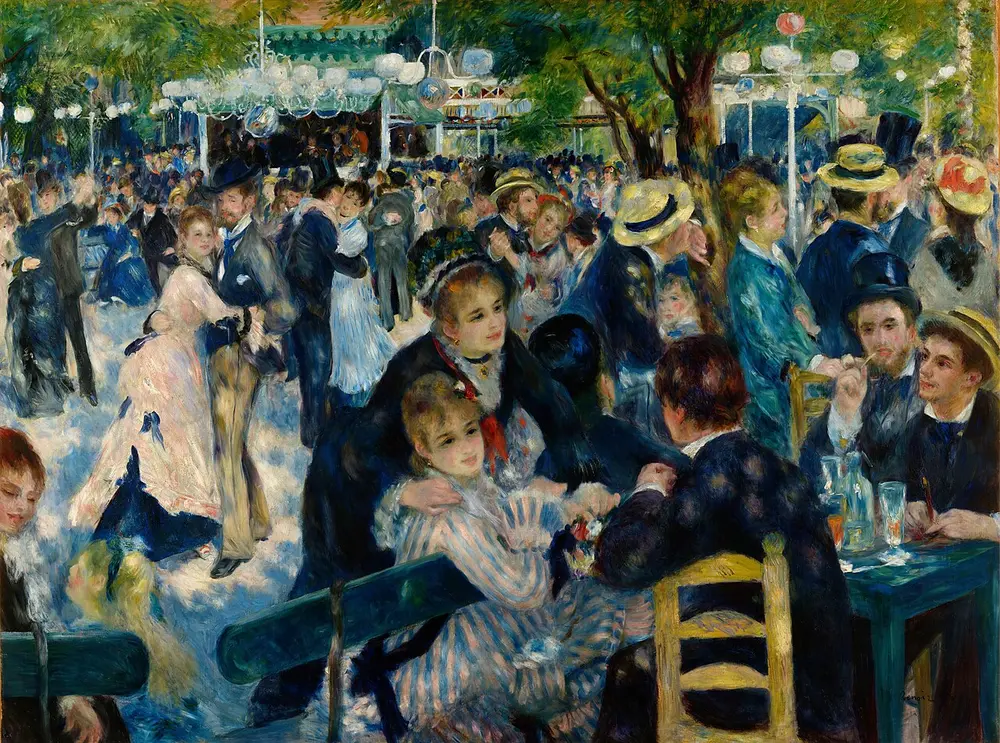
A crowded open-air dance in Paris on a sunny afternoon, with couples dancing and young people chatting at tables under trees, spots of sunlight falling on their clothes.
Picture: Pierre-Auguste Renoir. Public domain.

Bal du moulin de la Galette

Also called Dance at the Moulin de la Galette

Where
Musée d'Orsay, Paris
When
1876
Who
Pierre-Auguste Renoir
Style
Impressionism
Made with
Oil on canvas

Every Sunday afternoon, ordinary Parisians dressed up and went to dance at the Moulin de la Galette, an outdoor dance hall in Montmartre. Renoir painted the happy crowd with soft, feathery strokes and no hard outlines. The patches of sunlight coming through the leaves are the real subject. It was shown at the third Impressionist exhibition in 1877.

Spot it by

A big cheerful crowd, straw boater hats, striped dresses, round lamps, dabs of sunlight on clothes and faces.

Remember

Renoir painted happiness: dancing, sunshine and friends.
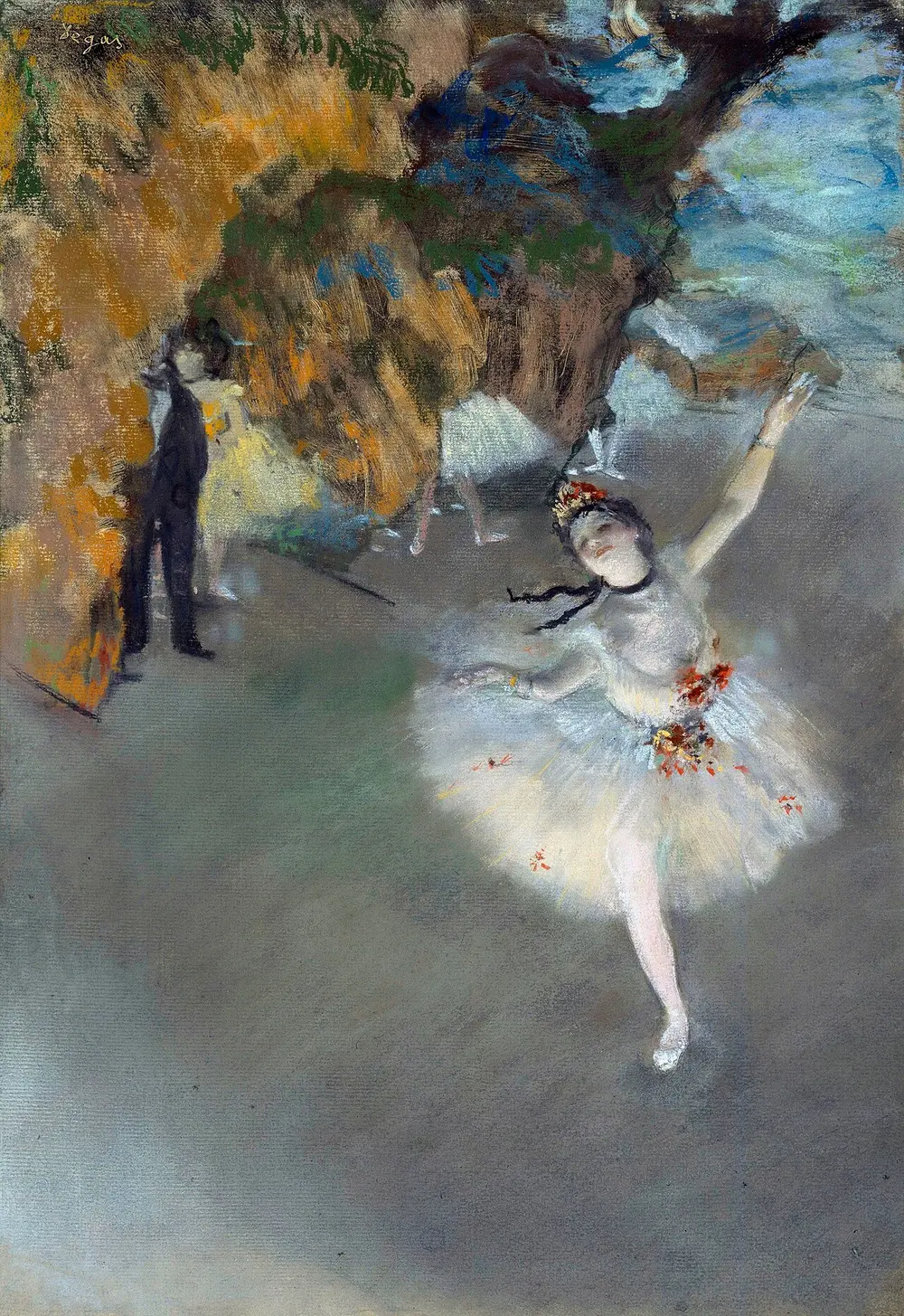
A ballet dancer in a white tutu poses on one leg on a stage, seen from above, while other dancers and a man in a black suit wait behind the painted scenery.
Picture: Edgar Degas. Public domain.

Ballet (The Star)

Also called L'Étoile, Dancer on the Stage

Where
Musée d'Orsay, Paris
When
About 1876 to 1877
Who
Edgar Degas
Style
Impressionism
Made with
Pastel over a monotype (a one-off print)

Degas is the painter of dancers: he showed them again and again, on stage, rehearsing or resting. He worked a lot in pastel, sticks of pure powdered colour that let him draw and colour at the same time. Here we look down on the star dancer, as if from a high seat at the opera, with the stage floor filling the picture and figures cut off at the edges, like a snapshot.

Spot it by

Ballet dancers in tutus, views from above or from the side, figures cut off by the edge, chalky pastel texture.

Remember

Degas means dancers, drawn in pastel.

Don't confuse

Renoir painted dancing couples at a party; Degas drew professional ballet dancers at work.
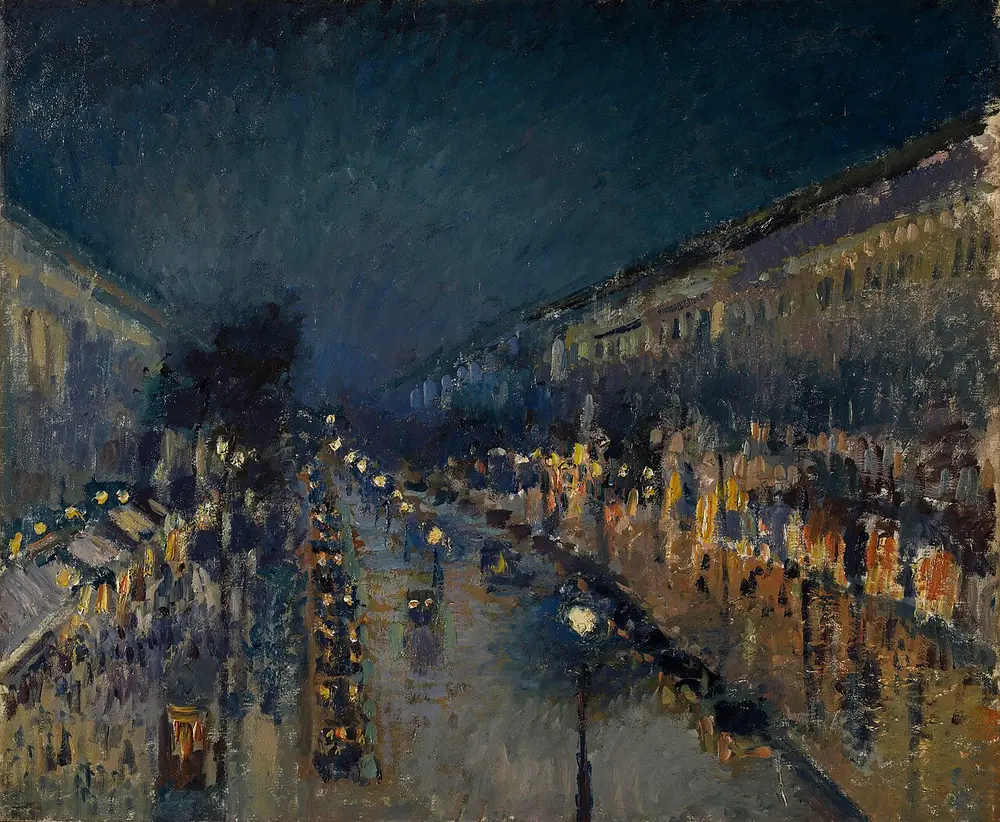
A wide Paris boulevard at night seen from above, wet with rain, lit by rows of yellow shop windows and white street lamps under a dark blue sky.
Picture: Camille Pissarro. Public domain.

The Boulevard Montmartre at Night

Where
National Gallery, London
When
1897
Who
Camille Pissarro
Style
Impressionism
Made with
Oil on canvas

Pissarro was the oldest of the group and held it together. He is the only artist who showed work at all eight Impressionist exhibitions, from 1874 to 1886. In 1897 he took a hotel room above a busy Paris boulevard and painted the street over and over in different weather and light. This is the night view after rain.

Spot it by

A city street seen from high above, rows of lights, wet reflections, quick dabs of paint.

Remember

Pissarro, the father figure, never missed a show: eight out of eight.
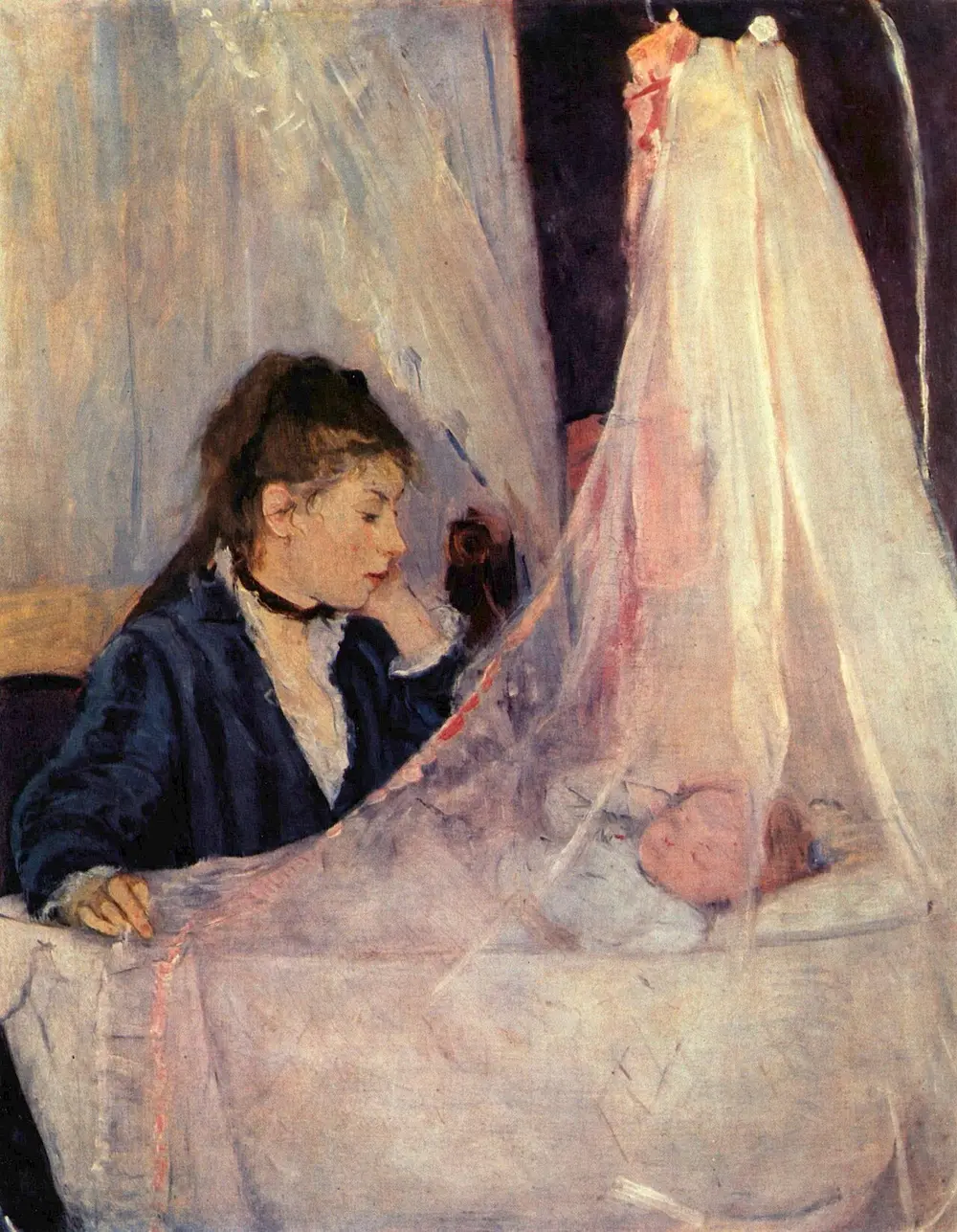
A young mother in a dark dress rests her chin on her hand and watches a baby sleeping in a cradle behind a soft, see-through pink-white curtain.
Picture: Berthe Morisot. Public domain.

The Cradle

Where
Musée d'Orsay, Paris
When
1872
Who
Berthe Morisot
Style
Impressionism
Made with
Oil on canvas

Berthe Morisot was one of the founding Impressionists and showed at their first exhibition in 1874. She mostly painted the private world of home, women and children. Her light, quick brushwork, seen here in the transparent curtain, is as daring as Monet's.

Spot it by

A quiet home scene, a mother and baby, white and pale pink, feathery strokes, a see-through veil.

Remember

Morisot painted the cradle; Cassatt painted the bath.
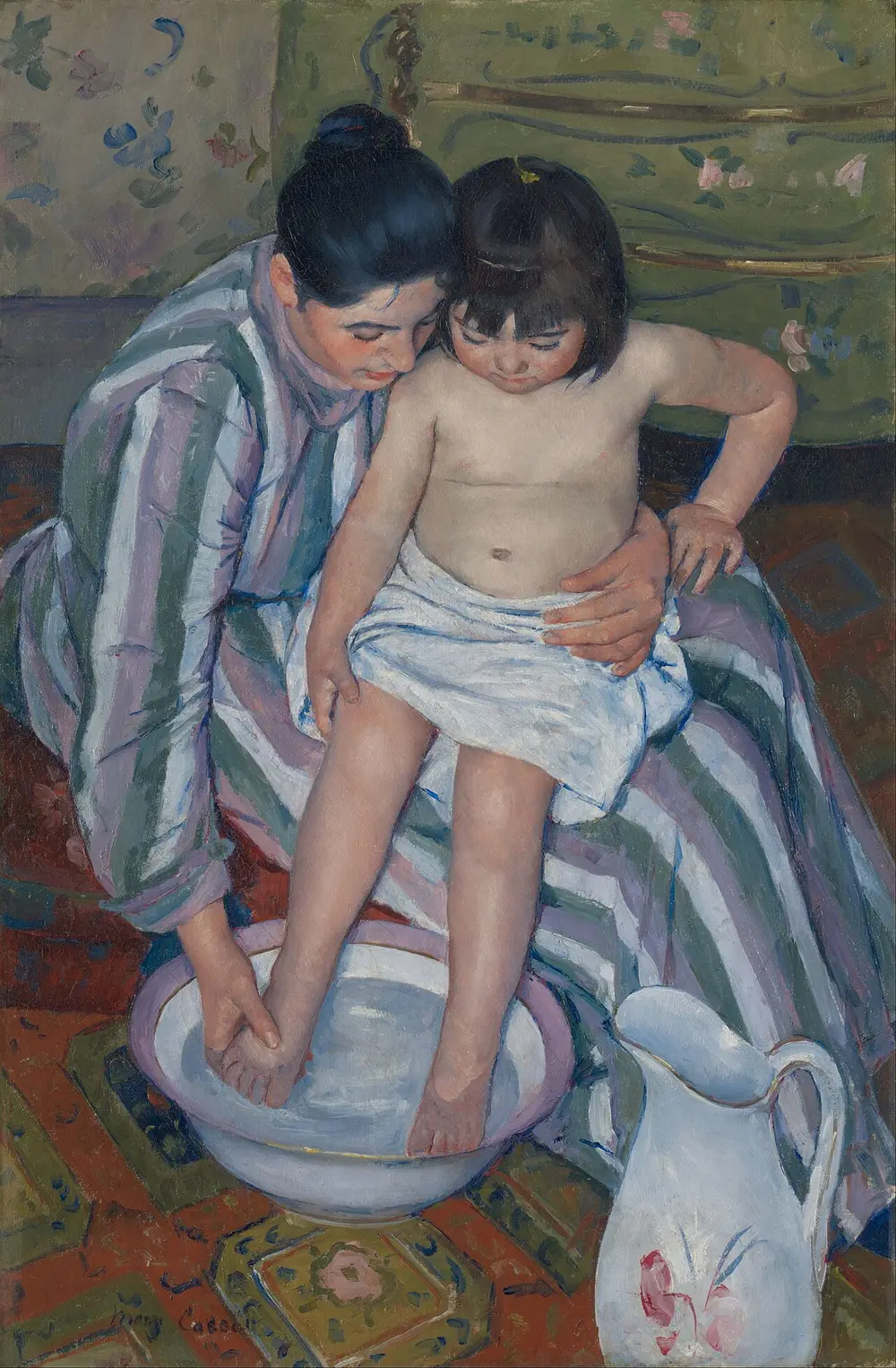
Seen from above, a woman in a striped dress holds a small child on her lap and washes the child's feet in a white basin, with a flowered jug on the patterned rug.
Picture: Mary Cassatt. Public domain.

The Child's Bath

Where
Art Institute of Chicago
When
1893
Who
Mary Cassatt
Style
Impressionism
Made with
Oil on canvas

Mary Cassatt was an American who lived in France, became a friend of Degas and exhibited with the Impressionists. Mothers and children were her great subject. The high viewpoint and the flat, patterned stripes and rug come from Japanese woodblock prints, which she saw at a big exhibition in Paris in 1890.

Spot it by

A mother and child, an unusual view looking down, strong stripes and patterns, a basin and jug.

Remember

The American Impressionist painted mothers and children.

The Post-Impressionists

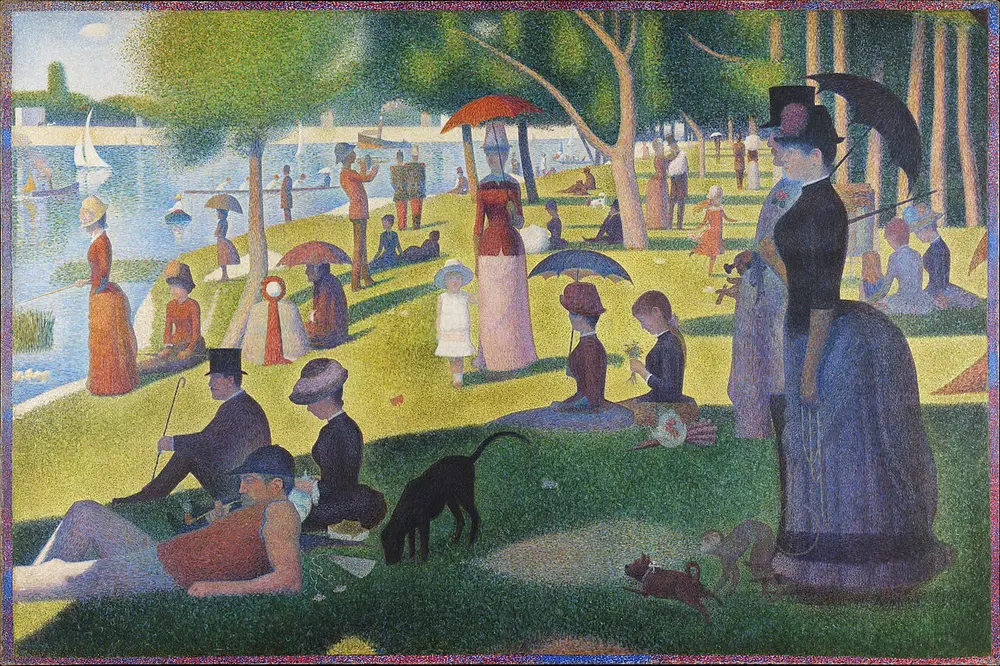
Parisians relax in a sunny park on an island in the River Seine, with parasols, top hats, a monkey on a lead and boats on the water, all painted in tiny dots of colour.
Picture: Georges Seurat. Public domain.

A Sunday Afternoon on the Island of La Grande Jatte

Where
Art Institute of Chicago
When
1884 to 1886
Who
Georges Seurat
Style
Pointillism (Neo-Impressionism)
Made with
Oil on canvas, in tiny dots; the painted border was added later

Seurat wanted to make Impressionism more scientific. Instead of mixing colours on his palette, he put small dots of pure colour side by side and let them blend in the viewer's eye. This method is called pointillism, and the movement it started is Neo-Impressionism. He spent two years on this huge canvas and showed it at the eighth and last Impressionist exhibition in 1886. His friend Paul Signac carried on the method; he is best known for harbours and seascapes.

Spot it by

Countless tiny dots, stiff figures in profile like cut-outs, parasols and top hats, a calm, frozen feeling.

Remember

Seurat: dot, dot, dot, and the eye does the mixing.

Don't confuse

UCEED 2018 showed another Seurat, Bathers at Asnières, and asked for its movement: pointillism. Seurat is counted as a Post-Impressionist, even though he showed at the last Impressionist exhibition.
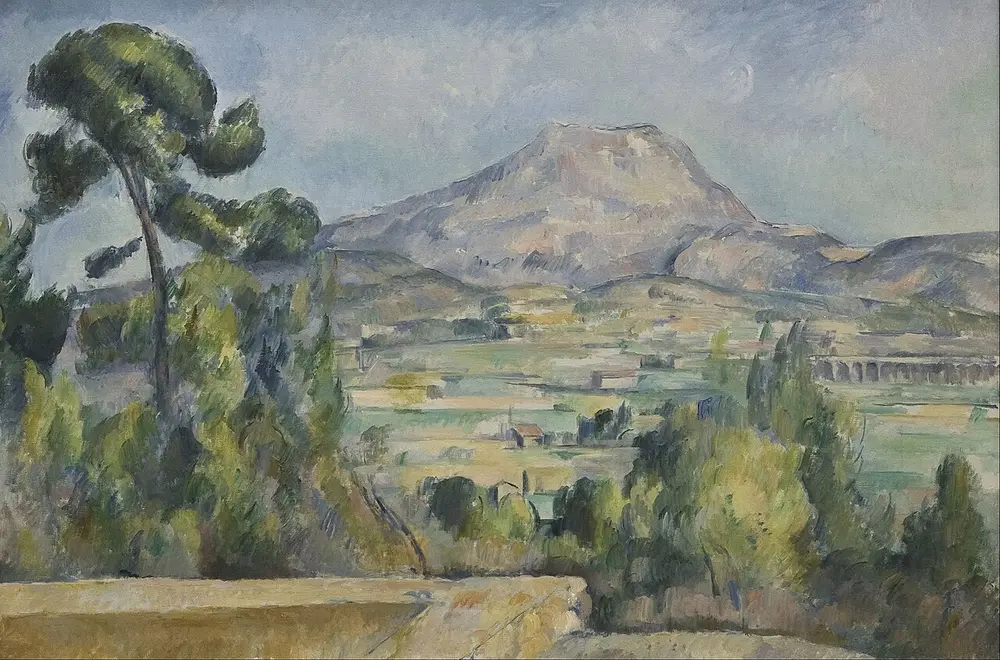
A broad Provence landscape of fields, houses and trees in greens and ochres, with a tall pine on the left, a viaduct on the right and a pale grey-pink mountain in the distance.
Picture: Paul Cézanne. Public domain.

Mont Sainte-Victoire

Where
This version: Musée d'Orsay, Paris
When
This version about 1890; he painted the mountain from the 1880s until he died in 1906
Who
Paul Cézanne
Style
Post-Impressionism
Made with
Oil on canvas
Key works
Mont Sainte-Victoire (a series); The Card Players (five versions, early 1890s)

Cézanne came from Aix-en-Provence in the south of France and painted the mountain near his home many times. He wanted Impressionism to feel solid and lasting, so he built landscapes, still lifes and people out of small blocks of colour and simple shapes. In The Card Players, a series of five paintings, quiet farm workers sit at a table as still as the mountain. Because he broke nature into shapes, he is seen as the bridge from Impressionism to Cubism.

Spot it by

Patches of colour laid like tiles, flattened shapes, a mountain in the distance, apples and jugs that look like solid blocks.

Remember

Cézanne turned nature into building blocks, and the Cubists built on them.
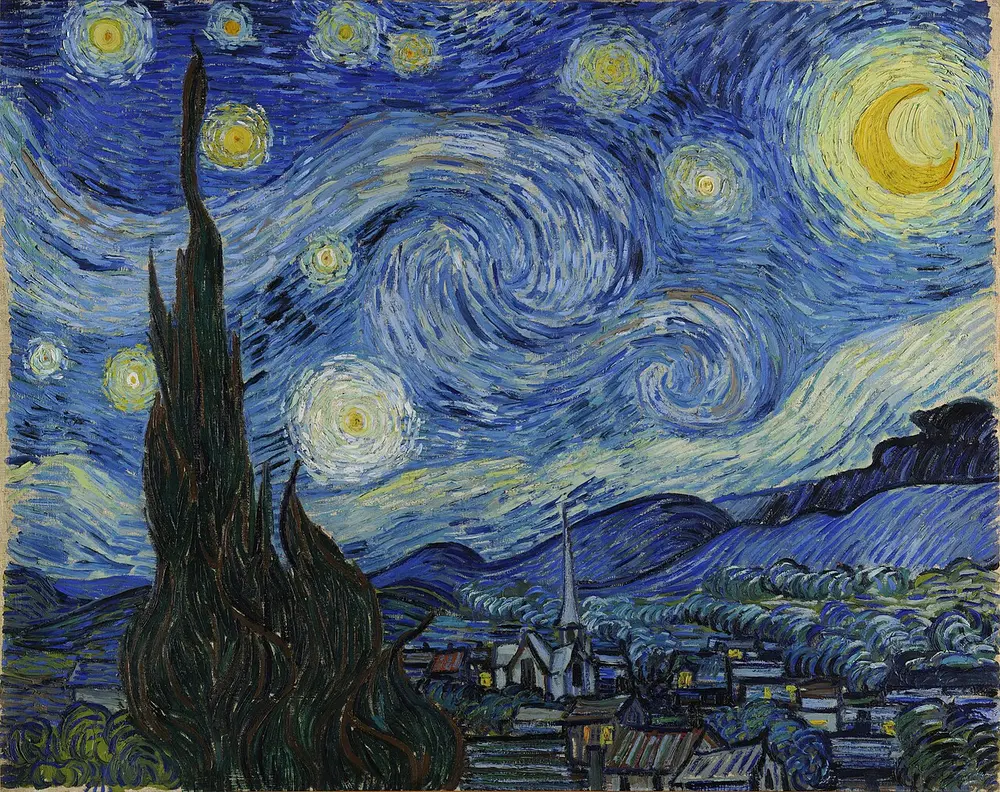
A night sky full of swirling blue and white winds, glowing yellow stars and a crescent moon above a small sleeping village with a church spire, with a dark flame-like cypress tree in front.
Picture: Vincent van Gogh. Public domain.

The Starry Night

Where
Museum of Modern Art (MoMA), New York
When
June 1889
Who
Vincent van Gogh (1853 to 1890)
Style
Post-Impressionism
Made with
Oil on canvas, with thick paint

The Dutch painter Vincent van Gogh painted this while staying at an asylum in Saint-Rémy, in the south of France, after a mental breakdown. He started from the view from his window before sunrise, then added a village and changed the sky from memory and imagination. The swirling, thickly painted brushstrokes show feeling, not just what he saw. That is the big step beyond Impressionism.

Spot it by

Swirls in the sky, big glowing stars, a crescent moon, a black cypress like a flame, a church spire, short thick strokes.

Remember

Van Gogh painted the night sky as if it were alive.
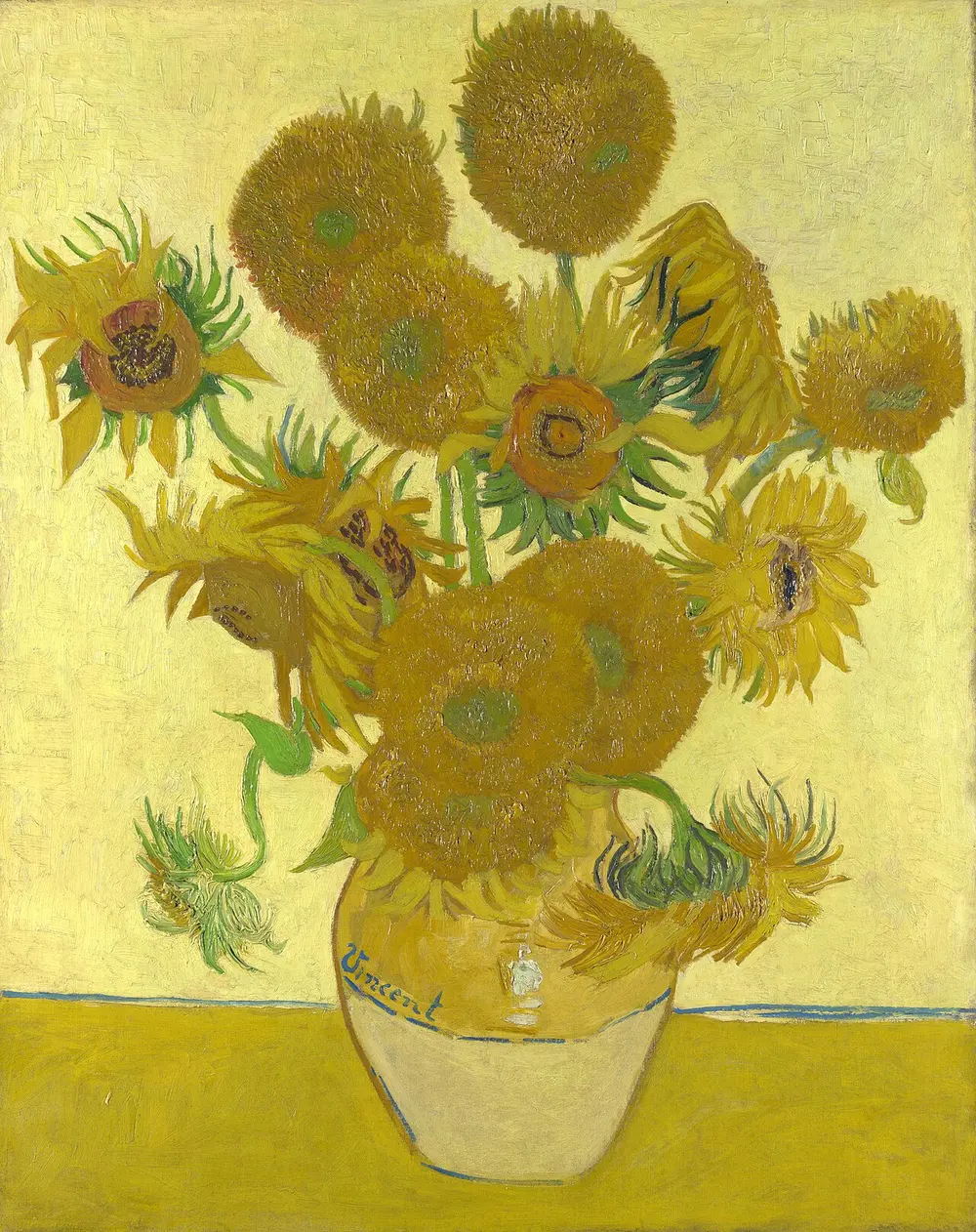
A vase of sunflowers, some fresh and some wilting, painted in many shades of yellow against a pale yellow wall, with the name Vincent written on the vase.
Picture: Vincent van Gogh. Public domain.

Sunflowers

Where
This version: National Gallery, London
When
August 1888
Who
Vincent van Gogh
Style
Post-Impressionism
Made with
Oil on canvas

Van Gogh painted his sunflowers in Arles, in the south of France, to decorate the Yellow House, where he hoped his friend Paul Gauguin would come to live and work. He made several versions. This one is almost all yellow, yellow on yellow, and he signed it simply "Vincent" on the vase.

Spot it by

Yellow flowers in a vase, a yellow background, some flowers drooping, thick textured paint, "Vincent" on the vase.

Remember

Yellow on yellow, signed Vincent.
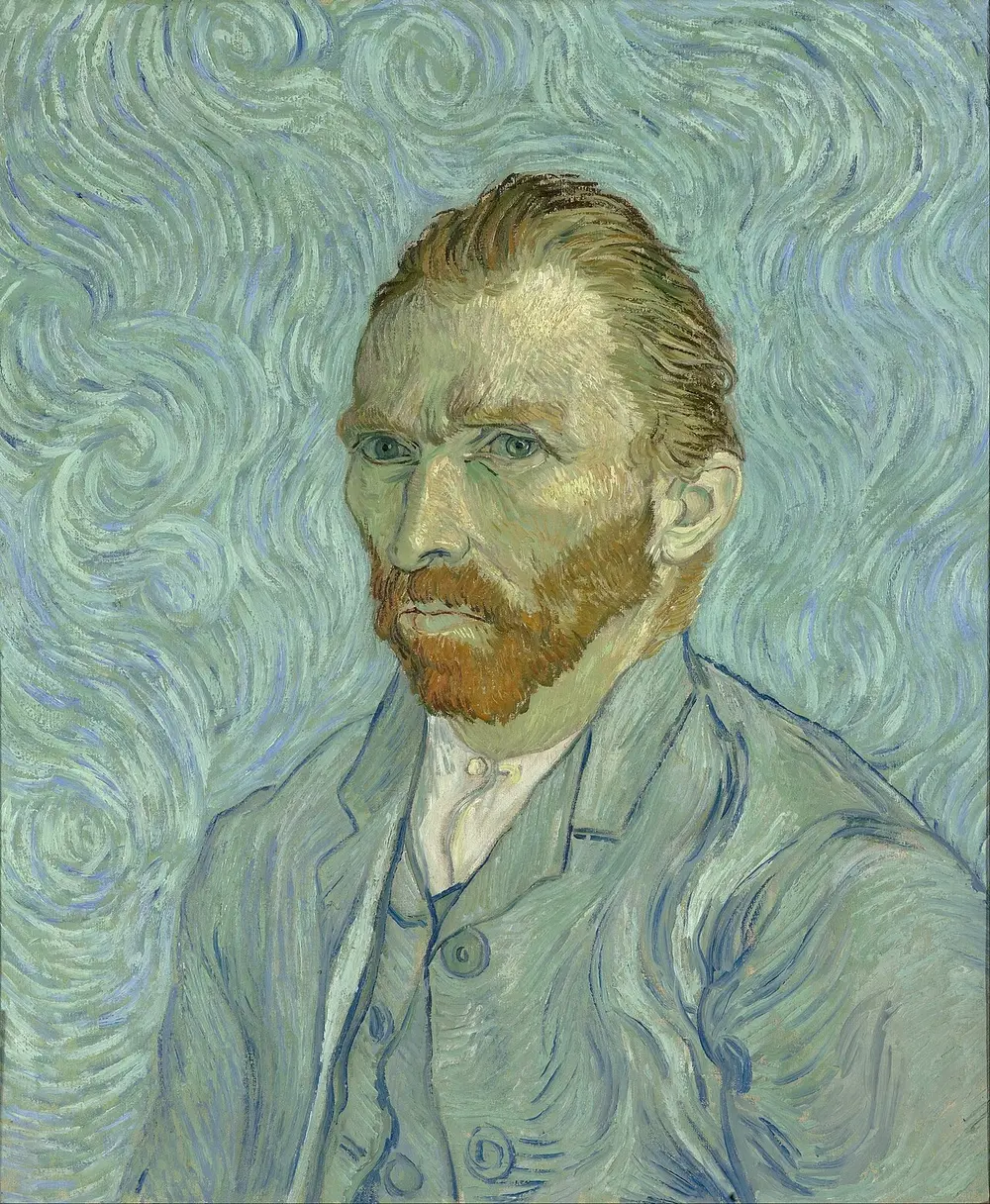
Van Gogh paints himself with red-orange hair and beard and a blue-grey suit, staring sideways, against a pale blue background full of swirling lines.
Picture: Vincent van Gogh. Public domain.

Van Gogh's Self-Portrait of 1889

Where
Musée d'Orsay, Paris
When
1889
Who
Vincent van Gogh
Style
Post-Impressionism
Made with
Oil on canvas
Key works
Many self-portraits; The Bedroom (1888), three versions, in Amsterdam, Chicago and Paris

Van Gogh painted himself many times. In this late one, the waves in his hair and beard spill out into the whole background, so the picture seems to vibrate. He also painted his small bedroom in the Yellow House in Arles, The Bedroom, in bright flat colours with tilted perspective; he made three versions, now in the Van Gogh Museum in Amsterdam, the Art Institute of Chicago and the Musée d'Orsay.

Spot it by

Red beard, blue-green tones, swirling lines filling the background, an intense sideways look.

Remember

The background swirls like his Starry Night.

Don't confuse

UCEED 2015 showed a cartoon remake of this portrait, with the same swirling blue background. Gauguin's portraits use flat colour with outlines, not swirls.
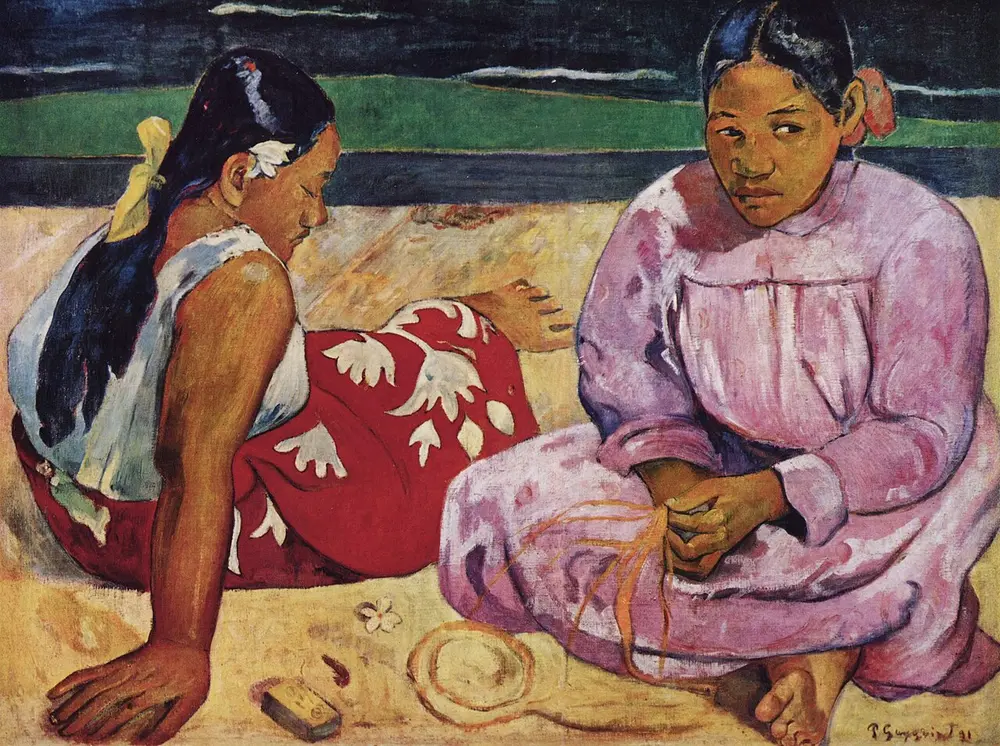
Two Tahitian women sit on yellow sand: one in a red and white wrap turns away, the other in a pink dress looks to the side, with flat bands of green and dark blue sea behind them.
Picture: Paul Gauguin. Public domain.

Tahitian Women on the Beach

Also called Femmes de Tahiti

Where
Musée d'Orsay, Paris
When
1891
Who
Paul Gauguin
Style
Post-Impressionism (Synthetism)
Made with
Oil on canvas

Gauguin left Paris for Tahiti, a French colony in the Pacific Ocean, in April 1891, looking for a simpler life far from Europe. This was painted in his first months there. He used large flat areas of strong colour with outlines, and he cared more about mood and meaning than about real-looking light. He spent most of his later years in the South Pacific.

Spot it by

Tahitian people, flat areas of bold colour, clear outlines, bands of colour for sand, sea and sky, little depth.

Remember

Gauguin went to Tahiti and painted it flat and bright.

Don't confuse

Gauguin stayed with Van Gogh in Arles in 1888. Van Gogh's paint is thick and swirling; Gauguin's is flat and smooth.
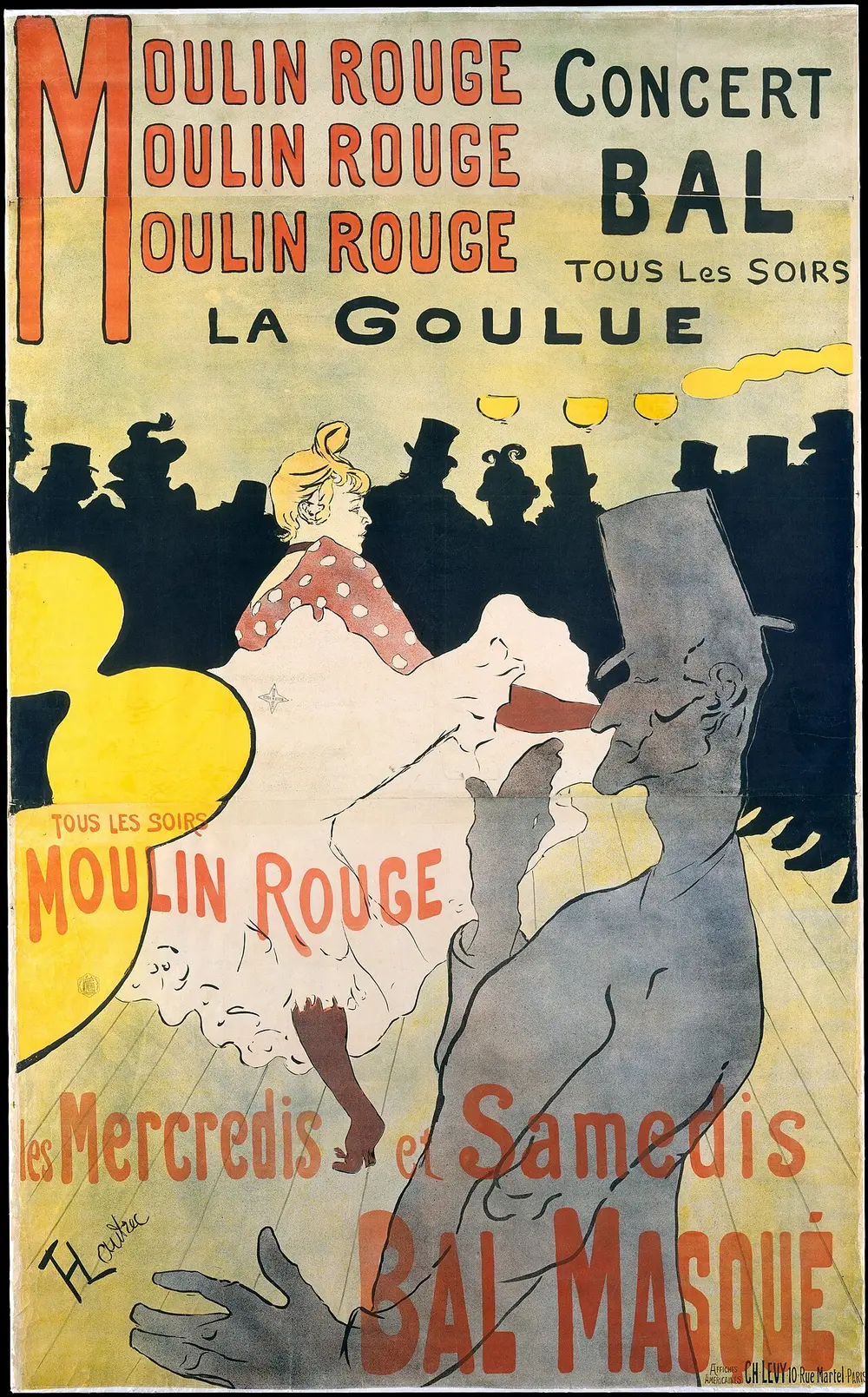
A tall poster with the words Moulin Rouge repeated in red at the top; a cancan dancer in a white petticoat kicks in the centre, with a grey silhouetted man in a top hat in front and a black crowd of silhouettes behind.
Picture: Henri de Toulouse-Lautrec. Public domain.

Moulin Rouge: La Goulue

Where
Copies in many museums, including the Metropolitan Museum of Art and MoMA, New York
When
1891
Who
Henri de Toulouse-Lautrec
Style
Post-Impressionism; poster art
Made with
Colour lithograph, printed on three sheets because it was so big

Toulouse-Lautrec painted the nightlife of Montmartre, its dance halls, cabarets and performers. This was his first poster, made to advertise the Moulin Rouge dance hall and its star cancan dancer, La Goulue ("the glutton"), whose real name was Louise Weber. With flat colour, black silhouettes and big lettering, it helped turn the street poster into an art form.

Spot it by

Bold lettering, flat colour, black silhouettes, a kicking dancer, a figure cut off in the foreground.

Remember

Lautrec made posters for the Moulin Rouge.

Don't confuse

Renoir's Moulin de la Galette is a different dance hall, painted 15 years earlier as an oil painting. Lautrec's is a printed poster.

Japanese prints and the West

From the 1860s, Japanese woodblock prints, called ukiyo-e, became popular in Paris. They were cheap prints sold in Japan, but European painters had never seen anything like them: flat areas of colour, strong outlines, no shadows, figures cut off at the edge, and views from high up or close in. The craze for Japanese art is called Japonisme. You can see it in Degas's cut-off dancers, Cassatt's patterned bath scene, Lautrec's flat posters and Van Gogh's bright colours.

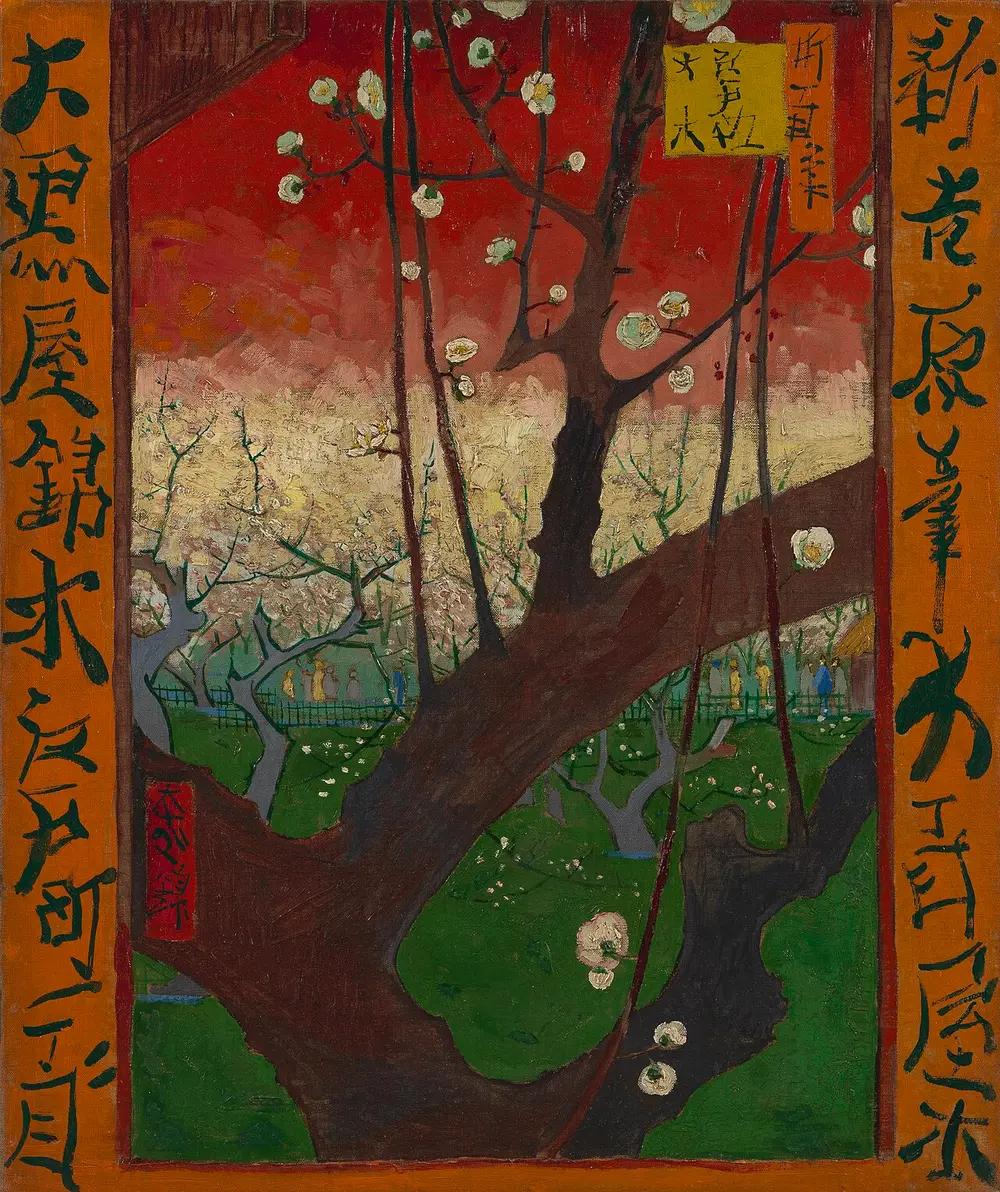
Van Gogh's oil copy of a Japanese print: a dark plum tree trunk crosses the picture in front of white blossom against a red sky, framed by orange borders with Japanese characters.
Picture: Vincent van Gogh. Public domain.

Flowering Plum Orchard (after Hiroshige)

Where
Van Gogh Museum, Amsterdam
When
1887
Who
Vincent van Gogh, copying Utagawa Hiroshige
Style
Japonisme
Made with
Oil on canvas

Van Gogh copied a print of a plum garden at Kameido, in Edo (now Tokyo), from Hiroshige's series One Hundred Famous Views of Edo. He painted it in oil and added borders of Japanese characters. Copying prints like this helped him learn flat colour, strong outlines and bold, close-up compositions, which you can see in his later work.

Spot it by

A dark tree cutting across the front, flat bright colours, a red sky, Japanese lettering in the borders.

Remember

Van Gogh learned from Japan by copying a Japanese print.

Impressionism and Post-Impressionism compared

Impressionism Post-Impressionism
When 1870s and 1880s; eight group shows, 1874 to 1886 Roughly 1886 to 1905
Aim Catch a passing moment of light and weather, as the eye sees it Go beyond what the eye sees: add structure, feeling or meaning
Brushwork Short, quick, broken strokes; soft edges; often painted outdoors Different for each artist: Seurat's dots, Cézanne's blocks, Van Gogh's swirls, Gauguin's flat areas with outlines
Colour Light, bright colours; coloured shadows instead of black Bold colour, often unnatural, used for feeling or symbol
Subjects Modern Paris, dances, gardens, rivers, the same view in different light Mountains and still lifes, the artist's own feelings, faraway places
Key artists Monet, Renoir, Degas, Pissarro, Morisot, Cassatt Seurat, Signac, Cézanne, Van Gogh, Gauguin, Toulouse-Lautrec

Timeline

  1. 1863

    Manet shows Le Déjeuner sur l'herbe at the Salon des Refusés

  2. 1865

    Manet's Olympia causes a scandal at the Paris Salon

  3. 1872

    Monet paints Impression, Sunrise at Le Havre

  4. 1874

    The first Impressionist exhibition opens in Paris on 15 April; a mocking review by Louis Leroy gives the group its name

  5. 1876

    Renoir paints Bal du moulin de la Galette

  6. 1884

    Seurat begins A Sunday Afternoon on the Island of La Grande Jatte (finished 1886)

  7. 1886

    The eighth and last Impressionist exhibition, where Seurat shows La Grande Jatte

  8. 1887

    Van Gogh copies Hiroshige's plum garden print in oil paint

  9. 1888

    Van Gogh paints Sunflowers and The Bedroom in Arles

  10. 1889

    Van Gogh paints The Starry Night at Saint-Rémy

  11. 1890

    Van Gogh dies; Monet begins his Haystacks series

  12. 1891

    Gauguin sails for Tahiti; Toulouse-Lautrec makes his first poster, Moulin Rouge: La Goulue

  13. 1893

    Mary Cassatt paints The Child's Bath

  14. 1906

    Cézanne dies

  15. 1910

    Roger Fry's London exhibition Manet and the Post-Impressionists makes the name Post-Impressionism famous

  16. 1926

    Monet dies, still working on his Water Lilies

Test yourself

Question 1 of 8

Which of these is by Seurat?

Question 2 of 8

Which painting gave the Impressionist movement its name?

Question 3 of 8

Which of these is by Van Gogh?

Question 4 of 8

Who made this pastel of a ballet dancer?

Question 5 of 8

Who designed this poster?

Question 6 of 8

In which year did the first Impressionist exhibition open in Paris?

Question 7 of 8

Which artist left France for Tahiti in 1891?

Question 8 of 8

Which mountain did Cézanne paint again and again?

From past papers

Real exam questions on this topic, each with a full solution.

Finished this note?

Mark it as studied to track your progress through the course.

Was this note useful?

Each picture is credited underneath it. Pictures of works still in copyright are shown small, for teaching only. If you hold the rights to a picture and want it removed, tell us through the contact page and we will take it down.