Skip to content

Chapter 7: Textiles, crafts and motifs

Stitched by hand

India's embroidery traditions, from Phulkari, Chikankari and Kantha to Kasuti, Toda and Pipli appliqué, with the stitches behind them, where each comes from and how to tell look-alikes apart.

In one minute

6 facts to know

  1. Embroidery is decoration stitched onto cloth after it is woven. Batik, bandhani and ikat are dyeing, not embroidery.
  2. The pairs exams ask most: Phulkari (Punjab), Chikankari (Lucknow, Uttar Pradesh), Kantha (West Bengal), Kasuti (Karnataka), Kashida (Kashmir), Chamba rumal (Himachal Pradesh), Gota (Rajasthan).
  3. Phulkari means "flower work". When the whole cloth is covered so none of the base shows, it is called a bagh, a "garden".
  4. Kantha (Bengal) and Sujni (Bihar) are both quilts of old cloth held together by running stitch.
  5. Zardozi is embroidery with gold and silver metal thread. Aari work is chain stitch made with a hooked needle.
  6. Mirror work belongs to Kutch in Gujarat and to the Lambani of Karnataka; Pipli in Odisha is appliqué, cut cloth sewn onto cloth.

Stitches to know

Most Indian embroideries are built from a handful of stitches. Knowing them makes the traditions easy to sort.

Stitch What it looks like Where you see it
Running stitch A dashed line, the needle going in and out Kantha, Sujni
Darning stitch Rows of long and short stitches laid side by side by counting threads Phulkari, Toda
Satin stitch Stitches packed close to fill a shape smoothly Chamba rumal, which uses a double satin stitch
Chain stitch Loops linked like a chain Sujni outlines, Kutch, aari work
Cross stitch Rows of tiny crosses Kasuti, where it is called menthi
Mirror work Small mirrors held down by a ring of stitches Kutch, Rabari, Lambani
Appliqué Cut shapes of cloth stitched onto a base Pipli, Gota
Metal thread Gold or silver wire sewn onto the surface Zardozi, Kashmiri tilla

Aari is the hooked needle, like a fine crochet hook, used to make chain stitch quickly. Aari work is done in Kashmir and in Gujarat, among other places.

The north

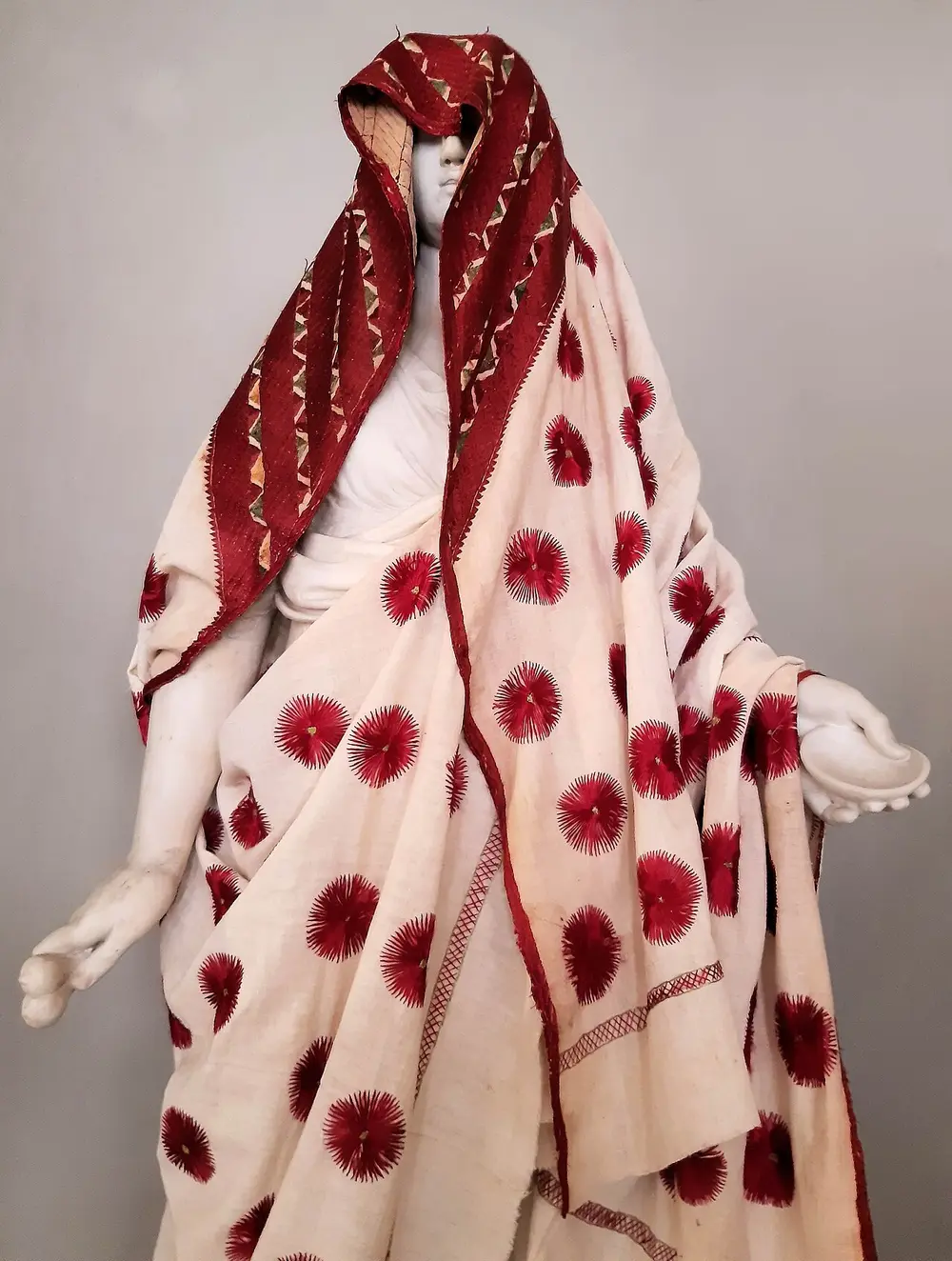
An off-white cotton shawl on a museum figure, scattered with deep red flower motifs embroidered in silk, with a red embroidered border over the head.
Picture: Chiswick Chap. CC BY-SA 4.0.

Phulkari

Also called "Flower work"

Where
Punjab (the GI is shared with Haryana and Rajasthan)
Who
Women of rural Punjab, for weddings and family occasions
Made with
Untwisted silk floss (pat) on coarse handspun cotton (khaddar)

Punjab's folk embroidery, done by women on shawls and head-covers. It uses long and short darning stitches worked from the back of the cloth by counting threads, with no traced design. The glossy silk catches the light, so the motifs look almost woven. In a phulkari the base cloth still shows between the motifs.

Spot it by

Bright silk geometric flowers in red, orange, yellow or magenta on a plain cotton ground, with a soft sheen.

Remember

Phul means flower; Phulkari is flower work from Punjab.

Don't confuse

Kasuti is also counted geometric work, but it is made of fine lines and crosses, not filled blocks of glossy colour.
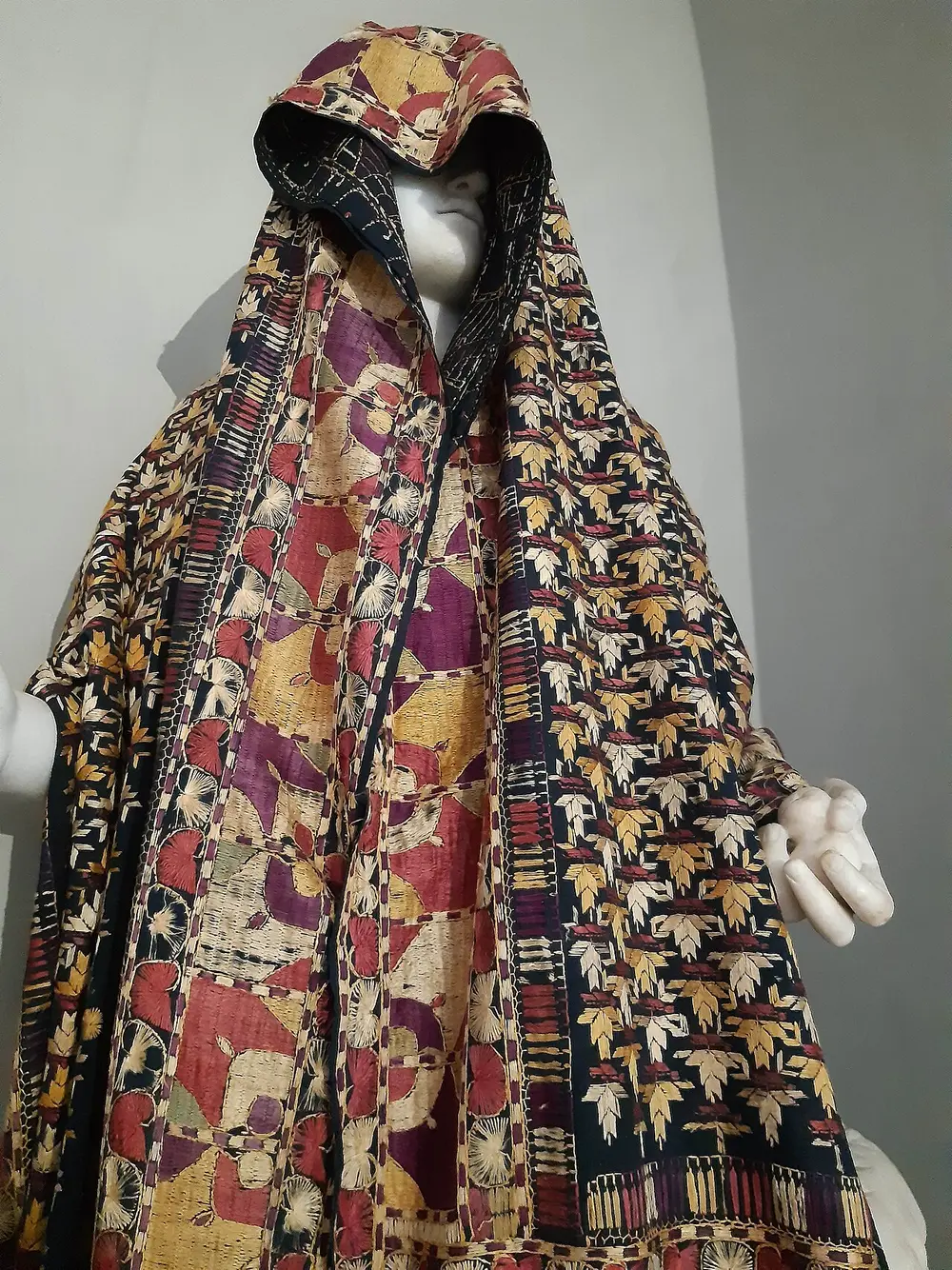
A shawl on a museum figure so densely embroidered in gold, cream, red and purple silk that the dark base cloth barely shows.
Picture: Chiswick Chap. CC BY-SA 4.0.

Bagh

Also called Bagh phulkari

Where
Punjab
Made with
Silk floss darning on cotton

A bagh is a phulkari embroidered so thickly that the whole cloth is covered and the base hardly shows. Bagh means garden, and the surface becomes one dense field of geometric pattern. A bagh was a treasured wedding piece, often made over many months.

Spot it by

Every part of the shawl filled with silk embroidery, in geometric patterns.

Remember

A phulkari has flowers; a bagh is the whole garden.

Don't confuse

In a phulkari you can still see the plain base cloth.
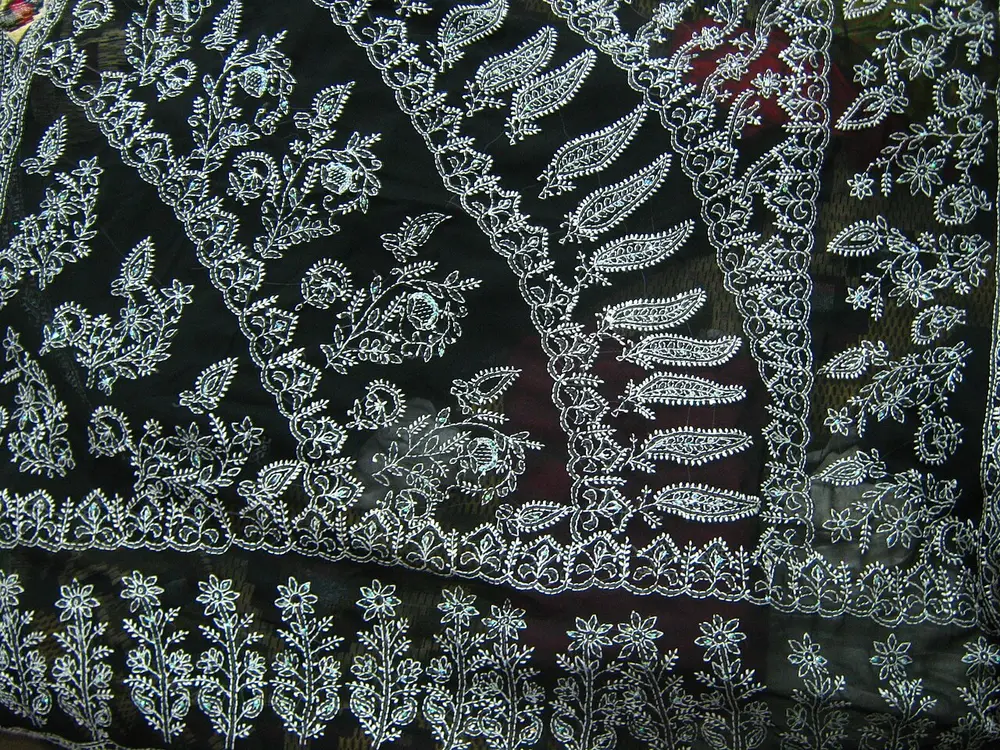
A dark sheer sari pallu embroidered in fine white thread with paisleys, flowering stems and a border of little plants.
Picture: आशीष भटनागर at hi.wikipedia. Public domain.

Chikankari

Also called Chikan work, Lucknawi chikan

Where
Lucknow, Uttar Pradesh
Made with
White cotton thread on fine, sheer cloth such as muslin

Lucknow's delicate whitework. It began as white thread on white muslin, and is still mostly pale thread on light, sheer cloth. The design is first printed on the fabric with wooden blocks; once the stitching is done the cloth is washed and the print disappears. On sheer cloth, stitches on the back show through as a soft shadow work. Its GI name is "Lucknow Chikan Craft".

Spot it by

Fine white floral and paisley embroidery on thin, see-through cloth, often with a shadowy look.

Remember

Chikan is chic and white, from Lucknow.

Don't confuse

Jamdani also has white motifs on fine cotton, but they are woven in, not stitched.
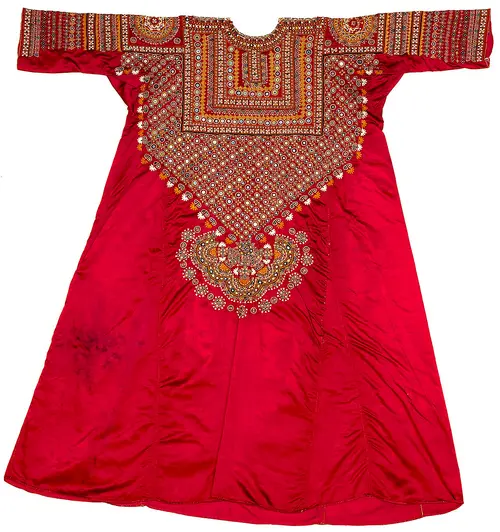
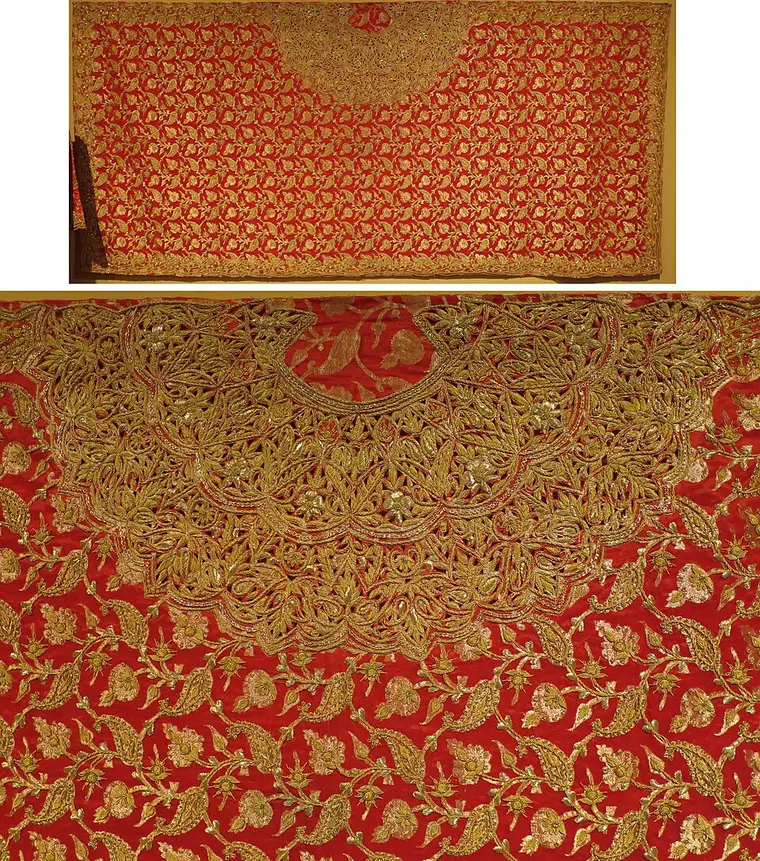
A red silk bridal garment in a museum covered with gold metal-thread flowers and leaves, with a dense golden yoke at the neck.
Picture: Hiart. CC0.

Zardozi

Where
Lucknow and Varanasi (Uttar Pradesh), and other old courtly cities
Made with
Gold and silver wire, sequins and beads on silk, satin or velvet

The heavy metal-thread embroidery of royal courts. The name comes from Persian zar (gold) and dozi (sewing). Coiled and twisted wires, sequins and beads are sewn onto rich fabric. Real gold and silver were once used; today it is usually copper wire with a gold or silver coating. "Lucknow Zardozi" and "Banaras Zardozi" both have GI tags.

Spot it by

Raised, glittering gold or silver patterns on deep red, maroon or velvet cloth.

Remember

Zar is gold: Zardozi is gold sewing.

Don't confuse

Zari is the metal thread itself, woven into saris such as Banarasi. Zardozi is the embroidery done with it.
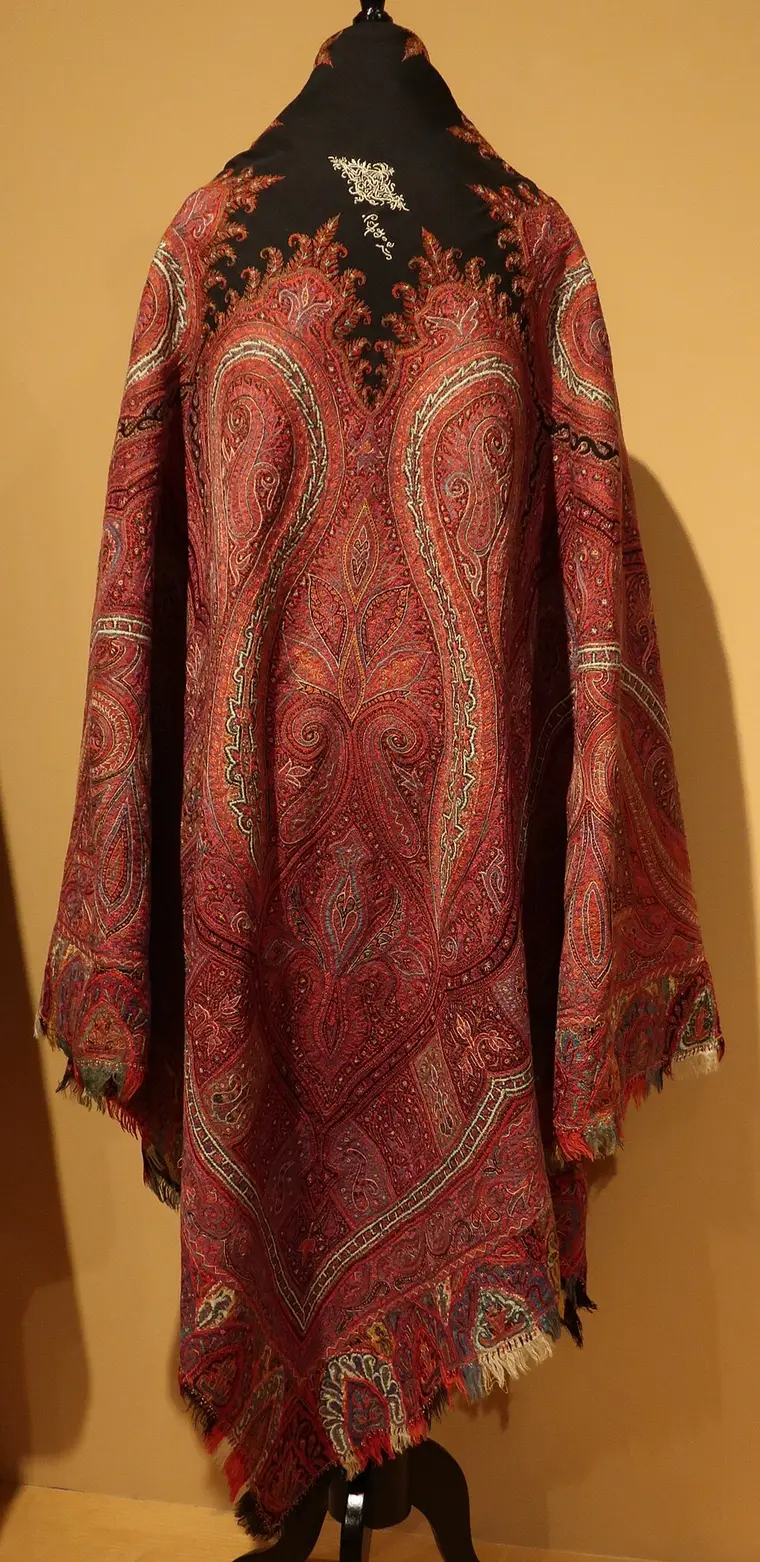
A large red Kashmir shawl on a stand, covered with closely embroidered paisleys and leaves, with a black centre.
Picture: Hiart. CC0.

Kashida and Sozni

Also called Kashmiri embroidery

Where
Kashmir valley
Who
Traditionally men, with skills passed from father to son
Made with
Silk or wool thread on pashmina and wool

Kashida is the umbrella name for Kashmir's embroidery. Its main kinds are sozni, very fine needlework on pashmina shawls (the best is the same on both sides); aari, chain stitch made with a hook, often in wool on rugs and coats; and tilla, done with gold or silver thread. Motifs come from the valley: chinar leaves, lotuses, paisleys and birds. The shawl in the picture is an embroidered one, called amlikar. "Kashmir Sozani Craft" has a GI tag.

Spot it by

Paisleys, chinar leaves and flowering vines in fine stitches on a soft wool shawl.

Remember

Kashida, Kashmir: both start with "Kash".

Don't confuse

Kasuti sounds similar but is from Karnataka, with geometric counted stitches.
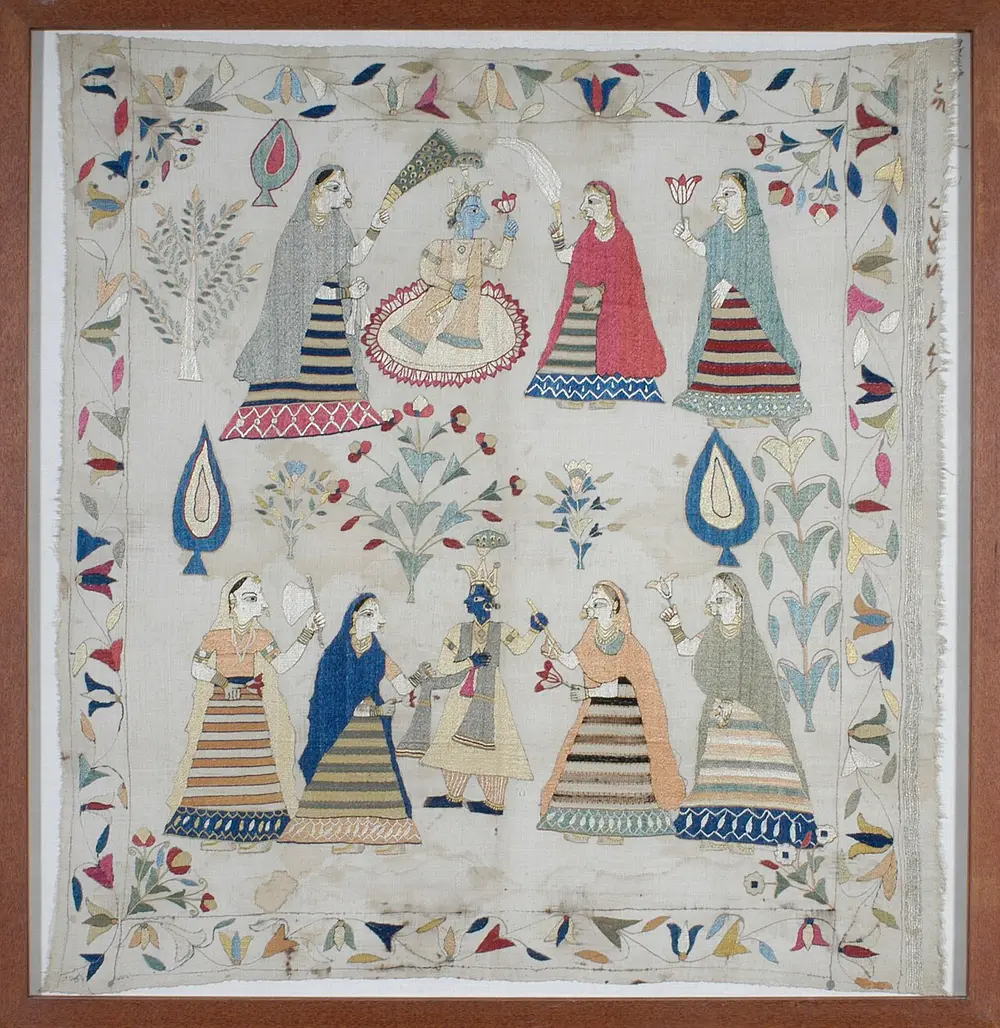
A square embroidered cloth showing Krishna, blue-skinned, with women in striped skirts, between flowering trees and a border of flowers.
Picture: Los Angeles County Museum of Art. Public domain.

Chamba rumal

Where
Chamba, Himachal Pradesh
When
Flourished in the 18th and 19th centuries
Made with
Untwisted silk thread on fine cotton or muslin

A square cloth (rumal) embroidered with scenes and given as a gift at weddings. Painters of the Pahari miniature tradition drew the outlines, and women filled them in with a double satin stitch (dohara tanka) that looks the same on both sides. Favourite themes are Krishna with the gopis, scenes from the epics, and weddings. It has a GI tag.

Spot it by

A square picture of figures, often Krishna, in soft silk colours on a pale ground, like a miniature painting in thread.

Remember

A Chamba rumal is a Pahari painting you can turn over.

Don't confuse

Kantha also shows figures, but it is a running-stitch quilt from Bengal, and its back looks different.

The east

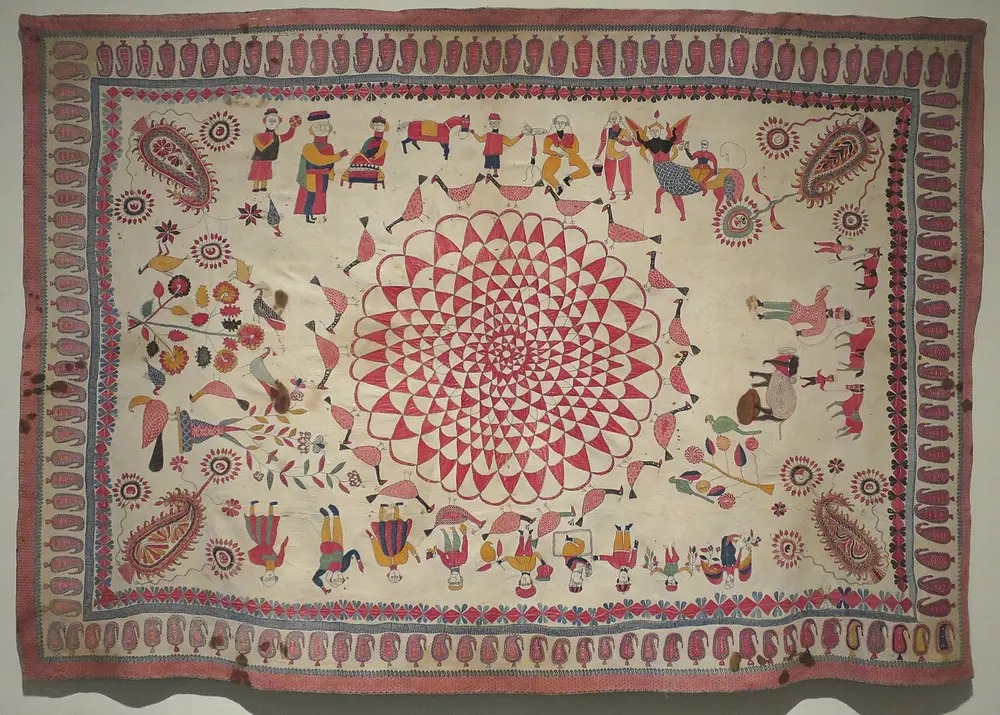
A white quilted bedcover embroidered with a big red lotus in the centre, surrounded by birds, horses, people and paisleys, with a paisley border.
Picture: Hiart. CC0.

Kantha

Also called Nakshi kantha

Where
West Bengal, and Bangladesh; also Odisha and Tripura
Who
Women at home
Made with
Layers of old saris and dhotis, stitched together

Bengal's way of turning worn-out cloth into something new. Several layers of old saris and dhotis are stacked and quilted together with running stitch, then decorated with motifs. The many rows of running stitch give the cloth a gently rippled look. A patterned one is called a nakshi kantha, and "Nakshi Kantha" from West Bengal has a GI tag.

Spot it by

A pale quilt covered in rows of tiny running stitches, often with a lotus in the centre and animals, people, fish and paisleys around it.

Remember

Kantha is a quilt of old saris, held together by running stitch.

Don't confuse

Sujni from Bihar is also a running-stitch quilt; it tells stories with dark chain-stitch outlines.

Sujni

Also called Sujani

Where
Bhusra and nearby villages, Muzaffarpur district, Bihar
Who
Women, for newborn babies
Made with
Layers of old cloth, running stitch and chain stitch

A quilt first made in Bihar as a soft wrap for a newborn baby. Old saris and dhotis are layered and quilted with running stitch, and pictures are outlined in chain stitch in a dark colour, so each quilt tells a story. Its GI name is "Sujini Embroidery Work of Bihar".

Spot it by

Bold outlined figures and scenes on a running-stitched quilt, like a drawing in thread.

Remember

Sujni is Kantha's cousin in Bihar.

Don't confuse

Kantha (Bengal) is more often filled with small motifs such as lotuses, fish and paisleys.
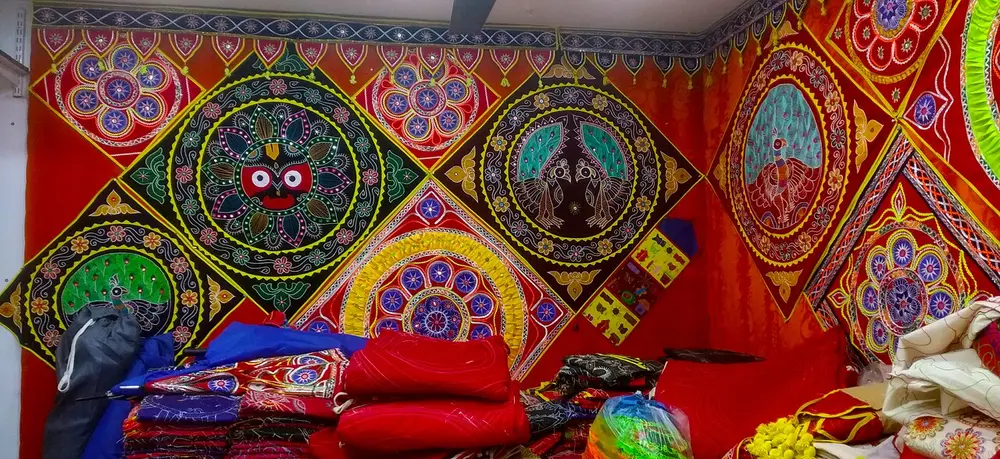
A shop wall in Pipli covered with bright appliqué hangings, made of cut red, yellow, green and black cloth, with the round-eyed face of Jagannath and peacocks.
Picture: Rahul Mukherjee. CC BY-SA 4.0.

Pipli appliqué

Also called Chandua

Where
Pipli, Puri district, Odisha
Made with
Cut pieces of coloured cloth stitched onto a base, with some embroidery and mirrors

In appliqué, shapes are cut from coloured cloth and sewn onto a base cloth. Pipli's craft grew in the service of the Jagannath temple at Puri: its artisans make the canopies, umbrellas (chhati) and fan-like tarasa carried during the Rath Yatra. Today they also make wall hangings, lamps and bags. Its GI name is "Pipli Applique Work".

Spot it by

Flat, bright shapes of red, yellow, green and black cloth, with elephants, peacocks, flowers and the face of Jagannath.

Remember

Pipli is near Puri, and dresses Jagannath's chariots.

Don't confuse

Kutch work is embroidery with mirrors; Pipli is mostly cut cloth sewn on.

The west

A red silk bride's shirt from Kutch, its chest and sleeves densely embroidered with tiny mirrors and coloured geometric patterns.
Picture: Indianapolis Museum of Art. Copyrighted free use.

Kutch and Rabari work

Also called Mirror work, abhla

Where
Kutch district, Gujarat
Who
Women of many communities, including the Rabari herders
Made with
Cotton or silk thread on cotton or silk, with small mirrors (abhla)

Kutch is one of India's richest embroidery regions, and each community has its own style, such as Rabari, Mutva, Jat, Suf and Paako. Stitches include chain, buttonhole, darning, running and satin. The sparkle comes from little mirrors, called abhla, held in place by rings of stitches. The Rabari, a herding community, are known for bold work crowded with mirrors on blouses, skirts and shawls. "Kutch Embroidery" has a GI tag.

Spot it by

Many small round mirrors, framed by bright thread, in dense geometric patterns.

Remember

Kutch catches the sun with its mirrors.

Don't confuse

Lambani work from Karnataka also has mirrors, but adds coins, cowrie shells and patchwork.
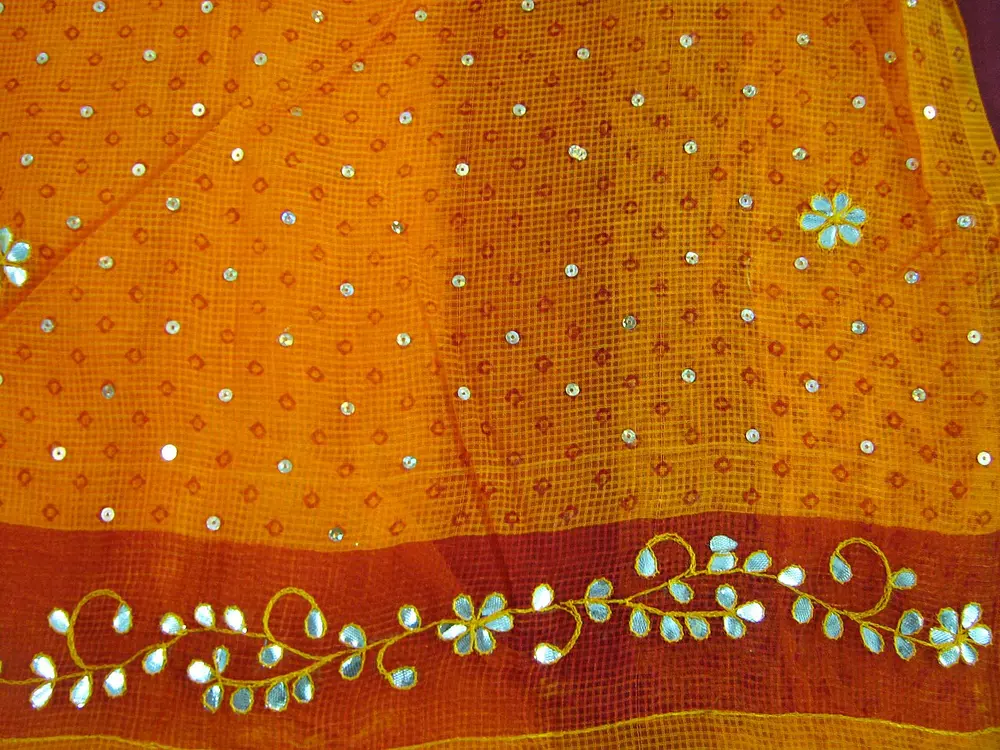
An orange sari with a border of small leaf and flower shapes cut from shiny silver ribbon and stitched on along a curling stem.
Picture: आशीष भटनागर. Public domain.

Gota

Also called Gota patti

Where
Rajasthan
Made with
Gold or silver ribbon, cut and sewn onto cloth

Gota is a narrow gold or silver ribbon. In gota work, pieces of it are cut into leaves, flowers and other shapes and stitched onto the cloth, so it is a kind of appliqué. It brightens Rajasthani wedding and festival clothes, often on bandhani or Kota cloth. The ribbon was once real metal; today it is usually metal-coated plastic.

Spot it by

Flat, shiny cut-out leaves and flowers in gold or silver, sewn on in borders.

Remember

Gota is gold ribbon from Rajasthan.

Don't confuse

Zardozi uses metal wire and thread for raised work; gota uses flat ribbon.

The south

Kasuti

Where
Karnataka
Who
Women, as part of a bride's trousseau
Made with
Cotton or silk thread, counted on the cloth

Karnataka's counted-thread embroidery, traditionally worked on Ilkal saris and blouses. Nothing is traced: the embroiderer counts the threads of the cloth and works without knots. It has four stitches: gavanti (double running), murgi (zigzag), negi (running) and menthi (cross stitch, named after fenugreek seeds). Gavanti and murgi look the same on both sides. Motifs include temple towers, chariots, palanquins, lamps and conches. It has a GI tag.

Spot it by

Small, neat geometric motifs made of fine lines and crosses, often in one or two colours on a dark sari.

Remember

Kasuti, Karnataka, counting.

Don't confuse

Kashida (Kashmir) has a similar name but flowing floral designs. Phulkari is counted too, but in glossy filled blocks.

Lambani embroidery

Also called Banjara work, Sandur Lambani embroidery

Where
Sandur, Ballari district, Karnataka, and Banjara communities across the Deccan
Who
Women of the Lambani (Banjara) community
Made with
Thread, mirrors, coins, cowrie shells, beads and patchwork

The Lambani, also called Banjara, are a community with a nomadic past. Their women decorate skirts, blouses and bags with bold, mostly geometric embroidery, patchwork and appliqué, sewing on mirrors, coins, cowrie shells and beads. The Sandur Kushala Kala Kendra has helped keep the craft going, and "Sandur Lambani Embroidery" has a GI tag.

Spot it by

Thick, heavy work in strong colours, with mirrors plus coins and cowries.

Remember

Lambani adds loose change: coins and cowries.

Don't confuse

Kutch mirror work is finer and usually has no coins or shells.

Toda embroidery

Also called Pukhoor

Where
Nilgiri Hills, Tamil Nadu
Who
Women of the Toda, a buffalo-herding people
Made with
Red and black wool thread on white cotton

The Toda embroider their cloaks, called poothkuli, in bands of red and black on white cloth. The stitches are darned in by counting the warp and weft, without a frame, so the finished pattern looks almost woven, and both sides can be used. Motifs come from their world: buffaloes, the sun, moon and stars, and peacock-feather eyes. It has a GI tag.

Spot it by

White cloth with bands of tiny red and black geometric patterns.

Remember

The Toda live high in the Nilgiris, and their shawls are red and black on white.

Don't confuse

Kasuti is also geometric and counted, but it comes from Karnataka and isn't made in red and black bands.

Embroidery by state

Embroidery State or region
Phulkari and bagh Punjab (GI shared with Haryana and Rajasthan)
Chikankari Lucknow, Uttar Pradesh
Zardozi Lucknow and Varanasi, Uttar Pradesh
Kashida, sozni, aari Kashmir
Chamba rumal Himachal Pradesh
Kantha West Bengal (and Bangladesh)
Sujni Bihar
Pipli appliqué Odisha
Kutch and Rabari mirror work Gujarat
Gota Rajasthan
Kasuti Karnataka
Lambani Karnataka
Toda Nilgiris, Tamil Nadu

Don't confuse

These two How to tell them apart
Kantha and Sujni Both running-stitch quilts made from layers of old cloth. Kantha is Bengal, filled with lotuses, fish and paisleys. Sujni is Bihar, with dark chain-stitch outlines that tell stories.
Phulkari and Kasuti Both counted geometric work. Phulkari (Punjab) is glossy silk darning in filled blocks on coarse cotton. Kasuti (Karnataka) is fine lines and crosses.
Kasuti and Kashida Names sound alike. Kasuti is Karnataka; Kashida is Kashmir.
Phulkari and bagh A phulkari shows its base cloth; a bagh covers it completely.
Zari and Zardozi Zari is the metal thread, woven into saris like Banarasi. Zardozi is embroidery made with it.
Chamba rumal and Kantha Both show figures. Chamba rumal is double satin stitch, the same on both sides, from Himachal. Kantha is a running-stitch quilt from Bengal.
Pipli and Kutch Pipli is appliqué, cut cloth sewn on. Kutch is embroidery with mirrors.
Chikankari and Jamdani Chikankari is stitched on after weaving. Jamdani motifs are woven in.
Embroidery and dyeing Batik (wax resist), bandhani (tie-dye) and ikat such as Patola are made with dye, not a needle.

Test yourself

Question 1 of 8

Which of these is Phulkari?

Question 2 of 8

Which of these is a Kantha?

Question 3 of 8

This square cloth shows Krishna with the gopis, embroidered so it looks the same on both sides. What is it?

Question 4 of 8

These bright appliqué hangings with the face of Jagannath come from which place?

Question 5 of 8

Which of these is NOT an embroidery tradition?

Question 6 of 8

Kasuti embroidery comes from which state?

Question 7 of 8

What is embroidery with gold and silver metal thread called?

Question 8 of 8

Sujni, a running-stitch quilt, comes from which state?

From past papers

Real exam questions on this topic, each with a full solution.

Finished this note?

Mark it as studied to track your progress through the course.

Was this note useful?

Each picture is credited underneath it. Pictures of works still in copyright are shown small, for teaching only. If you hold the rights to a picture and want it removed, tell us through the contact page and we will take it down.