Skip to content

Chapter 3: Art of the world

Name that movement

A picture guide to naming an art movement from a single image, from the Renaissance to Pop and Op, with the clues to look for and the six pairs exams mix up.

In one minute

6 facts to know

  1. In time order: Renaissance (1400s and 1500s), Baroque (1600s), Realism (mid-1800s), Impressionism (from 1874), Post-Impressionism (about 1886 to 1905), then the early 20th-century movements, and Pop and Op in the 1950s and 1960s.
  2. Impressionism catches a moment of light in quick dabs; Post-Impressionism adds dots (Seurat), solid shapes (Cézanne) or strong feeling (Van Gogh).
  3. Art Nouveau (about 1890 to 1910) flows like a plant; Art Deco (1920s and 1930s) turns the same plant into a neat geometric fan.
  4. Fauvism paints cheerful scenes in wild, unreal colour; Expressionism twists faces and places to show fear or pain.
  5. Cubism breaks a still subject into flat facets seen from several sides; Futurism repeats lines to show speed. Dada mocks art itself; Surrealism paints dreams with great care.
  6. Pop art copies comics, adverts and film stars, often with printed-looking dots; Op art uses abstract patterns that seem to move or bulge.

Exams often show four to six small pictures and ask you to name the movement of each. You don't need to know every painting. You need a few clues for each movement, and you need to know the pairs that look alike. Each card below gives one example and its "spot it by" clues. The examples are different from the ones in the longer notes, such as The Impressionists and after, Modern art breaks the rules, 1900 to 1945 and Design movements, so you see each style twice.

Old masters: Renaissance, Baroque and Realism

These three come before modern art, and all of them look "real". To tell them apart, look at the light and the mood: calm and even, dark and dramatic, or plain and everyday.

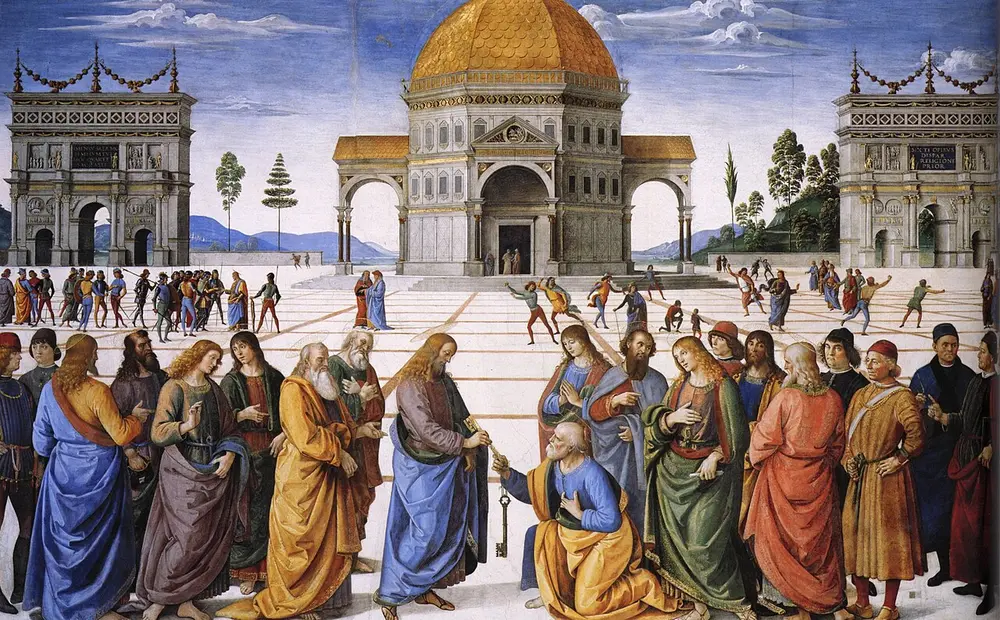
A wide fresco of a huge, sunny paved square, its lines leading to an eight-sided domed temple in the centre, with a triumphal arch on each side and a row of robed figures in front, where Christ hands a pair of keys to the kneeling Saint Peter.
Picture: Pietro Perugino. Public domain.

The Delivery of the Keys

Also called Christ Giving the Keys to Saint Peter

Where
Sistine Chapel, Vatican City
When
1481 to 1482
Who
Pietro Perugino, Italy
Style
Renaissance
Made with
Fresco (paint on wet plaster)

Pope Sixtus IV had the walls of his new Sistine Chapel painted by leading artists of the day, and Perugino's scene shows Christ giving Saint Peter the keys of heaven. The lines of the paving all run towards one point, the doorway of the temple in the middle. This trick, called one-point perspective, makes a flat wall look deep. Everything is calm and balanced: the figures stand in a neat row, the buildings are symmetrical and the daylight is clear and even.

Spot it by

Deep space with lines meeting at one point, classical buildings with columns, arches and domes, balanced groups of calm figures, and clear, even daylight.

Remember

Renaissance means order: one vanishing point and everyone calm.

Don't confuse

Baroque paintings also look real, but they are full of motion, deep shadow and a single spotlight.
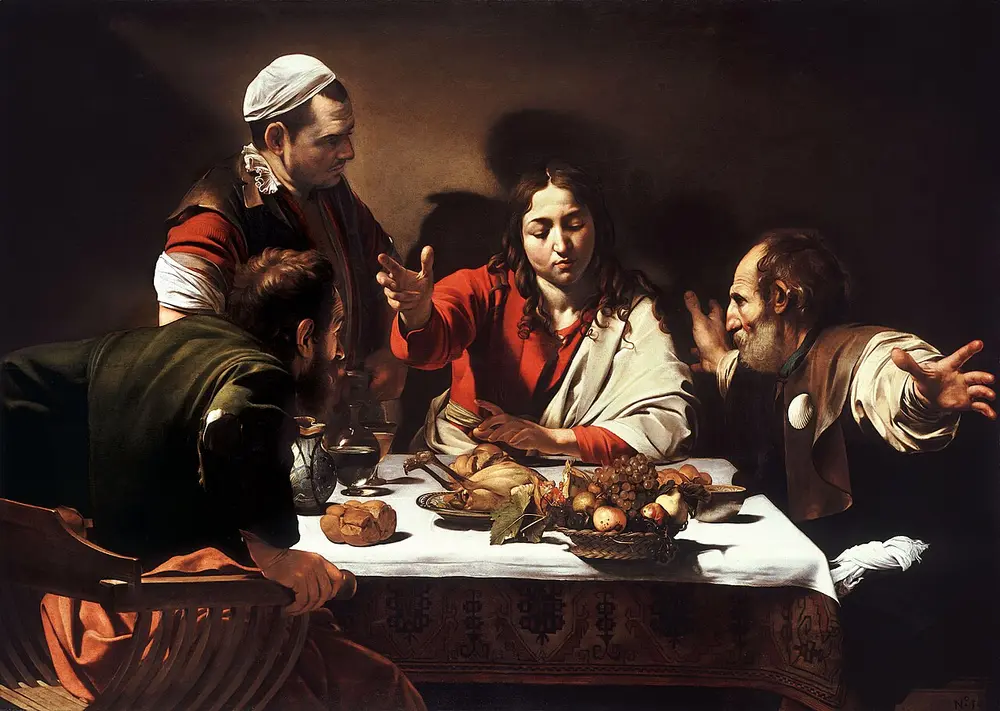
Four men around a table in a dark room. A young, beardless Christ in a red robe raises his hand in blessing, one man flings his arms wide, another grips his chair, and a basket of fruit sits on the very edge of the white tablecloth.
Picture: Caravaggio. Public domain.

The Supper at Emmaus

Where
National Gallery, London
When
1601
Who
Caravaggio, Italy
Style
Baroque
Made with
Oil on canvas

In the Gospel story, two followers of Jesus share a meal with a stranger after his death and suddenly realise who he is. Caravaggio paints that exact second: one man pushes back his chair, the other throws out his arms, and the basket of fruit tips over the edge of the table towards us. A strong light falls from one side while the background sinks into darkness. This sharp contrast of light and dark, called chiaroscuro (Italian for "light-dark"), and the choice of the most dramatic moment, are what make it Baroque.

Spot it by

Deep black shadows with a spotlight on faces and hands, figures caught in the middle of a gesture, rich deep colours and a feeling of theatre.

Remember

Baroque switches on a spotlight in a dark room.

Don't confuse

CEED 2026 showed Vermeer's Girl with a Pearl Earring as its Baroque example. It is quieter than Caravaggio, but the dark background and single light are the same clue.
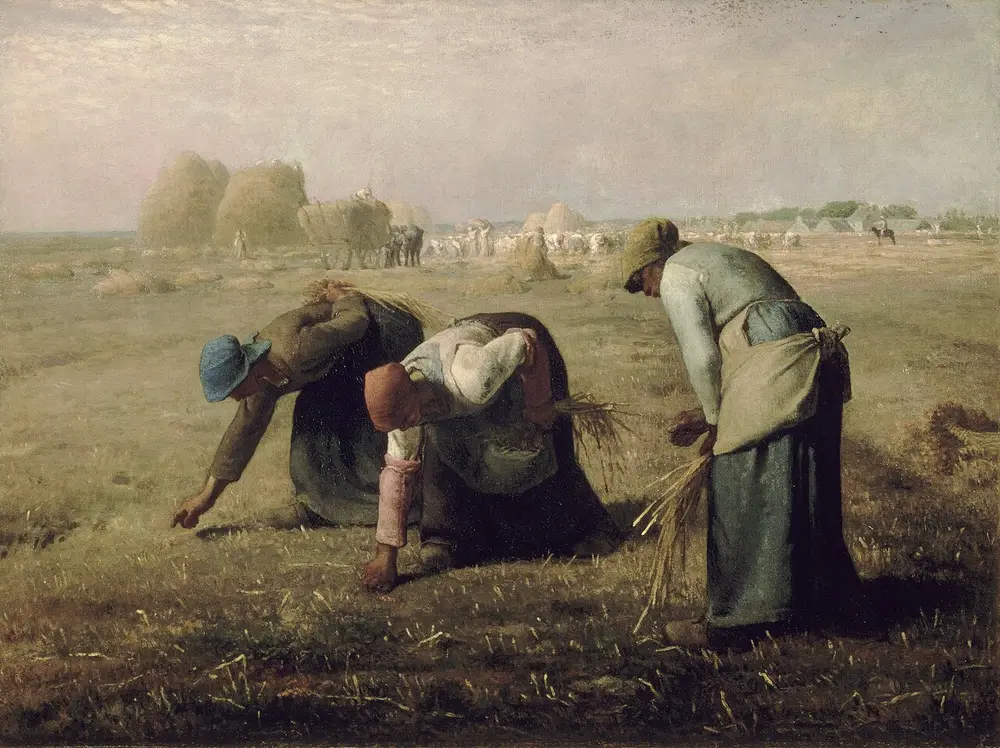
Three peasant women in a flat golden field bend low to pick up leftover stalks of wheat, while far behind them stand huge haystacks, a cart and harvest workers in the hazy light.
Picture: Jean-François Millet. Public domain.

The Gleaners

Where
Musée d'Orsay, Paris
When
1857
Who
Jean-François Millet, France
Style
Realism
Made with
Oil on canvas

Gleaners were among the poorest people in the French countryside: they were allowed to pick up the stray stalks of wheat left behind after a harvest. Millet painted three of them bent double in the front of the picture, with the rich harvest piled up far behind them. When it was shown at the Paris Salon of 1857, many wealthy critics disliked it: it showed the poorest workers with so much sympathy that it looked to them like a political warning. Realism, led by Gustave Courbet, turned away from the drama of Romanticism to paint ordinary people as they really were.

Spot it by

Ordinary people at hard work, earthy browns, greens and golds, no gods, kings or drama, and a plain, true-to-life look.

Remember

Realism paints the field worker, not the king.

Don't confuse

UCEED 2018 showed a portrait by Courbet for Realism. Impressionism came next and also shows everyday life, but with quick, broken brushstrokes and bright outdoor light.

Impressionism or Post-Impressionism?

Both are French, both use bright colour and visible brushstrokes, and many of the painters knew each other. The Impressionists tried to paint exactly what the eye sees in one moment. The painters who came after kept the bright colour but each added something of their own. The critic Roger Fry gave them the name Post-Impressionists for an exhibition he organised in London in 1910.

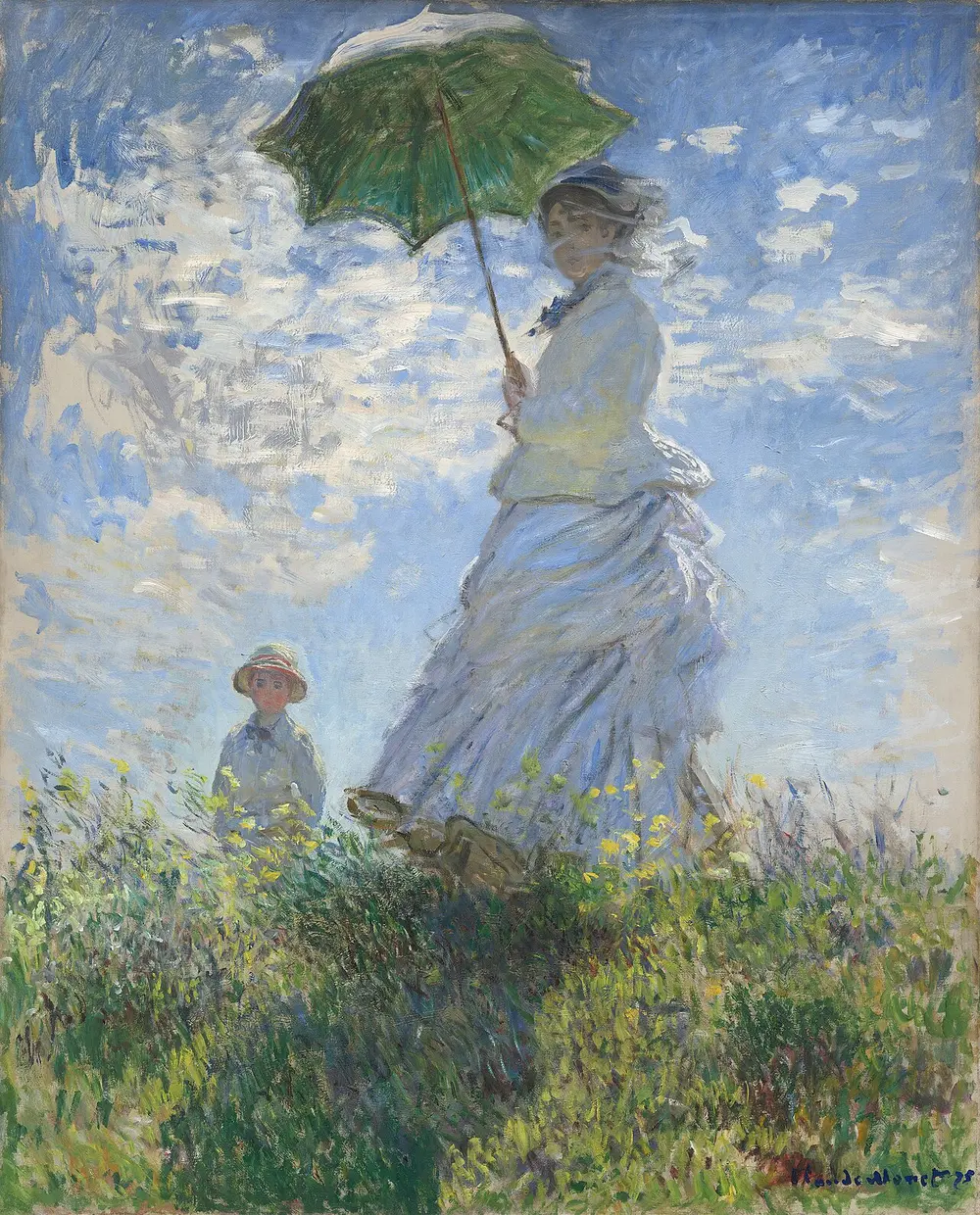
Seen from below, a woman in a white dress holding a green parasol stands on a grassy hill against a bright blue sky with white clouds, her veil blowing in the wind, while a small boy stands behind her in the grass.
Picture: Claude Monet. CC0.

Woman with a Parasol

Also called Madame Monet and Her Son

Where
National Gallery of Art, Washington, DC
When
1875
Who
Claude Monet, France
Style
Impressionism
Made with
Oil on canvas

Monet painted his wife Camille and their son Jean on a windy summer day at Argenteuil, near Paris, where the family lived. Quick dabs of paint make the grass seem to sway and the dress seem to flutter, and the veil and clouds are only a few strokes. It looks like a snapshot of a single moment. The movement took its name from Monet's painting Impression, Sunrise, which a critic mocked after the group's first exhibition in 1874.

Spot it by

Quick, visible dabs of paint, bright outdoor light, soft edges, colourful shadows and an everyday moment, as if seen in a glance.

Remember

Impressionism paints a moment of light.

Don't confuse

Post-Impressionists also use bright colour, but they add something: dots, firm outlines, solid shapes or strong feeling.
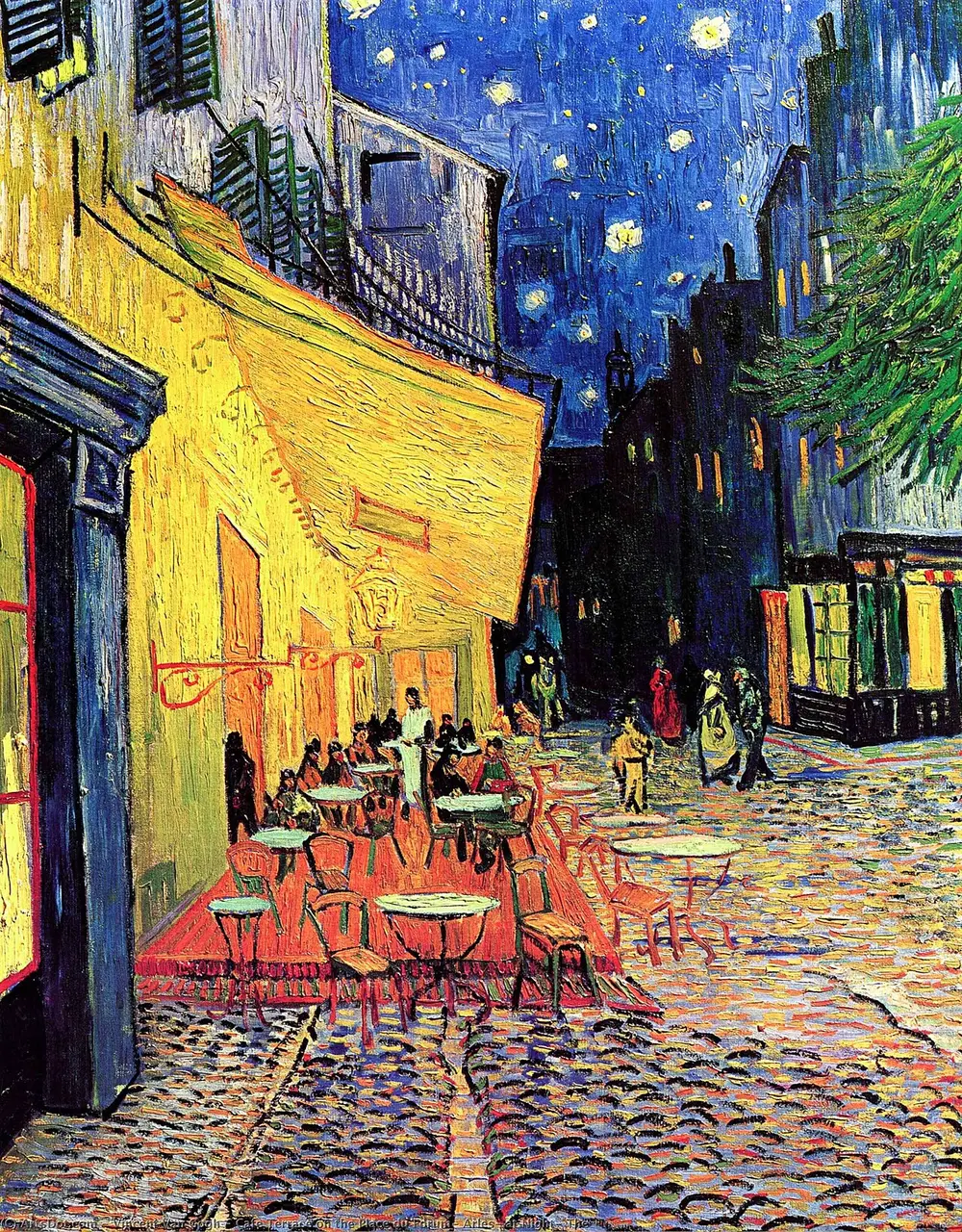
A café terrace under a glowing yellow awning at night, with tables and people on a cobbled street that leads off into the dark, beneath a deep blue sky full of large stars.
Picture: Vincent van Gogh. CC0.

Café Terrace at Night

Where
Kröller-Müller Museum, Otterlo, Netherlands
When
September 1888
Who
Vincent van Gogh, Netherlands, working in Arles, France
Style
Post-Impressionism
Made with
Oil on canvas

Van Gogh set up his easel in a square in Arles, in the south of France, and painted this café at night under its gas lamps. Instead of soft, broken light he used bold blocks of yellow against blue, thick strokes of paint and firm dark outlines, and he chose colours for feeling as much as for truth. Post-Impressionism is an umbrella name for painters who went different ways after Impressionism: Van Gogh towards emotion, Paul Cézanne towards solid shapes, Paul Gauguin towards flat colour and symbols, and Georges Seurat towards a system of dots.

Spot it by

Thick, dashed or swirling brushstrokes, strong outlines, bold yellows against deep blues, and colour used for feeling rather than accuracy.

Remember

Impressionism catches the light; Post-Impressionism adds a feeling or a system.

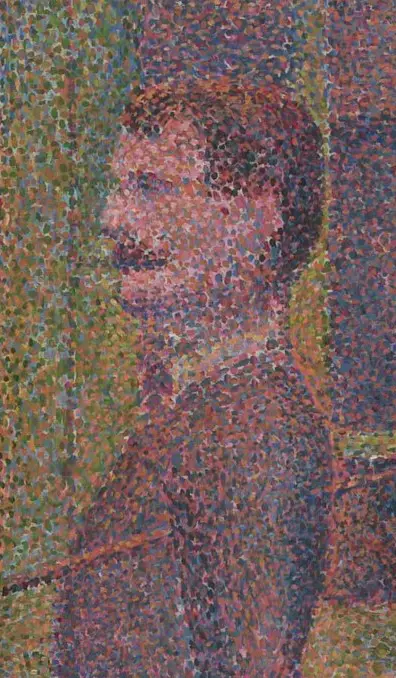
Pointillism was Seurat's system. With Paul Signac he worked it out from 1886: instead of mixing colours on the palette, he placed small dots of pure colour side by side and let them mix in the viewer's eye. It is also called Neo-Impressionism, and UCEED 2018 called it Pointillism.

A close-up of a painted man in profile, made entirely of tiny separate dots of violet, orange, blue and green paint.

Pointillism up close. In this detail from Seurat's Circus Sideshow (1887 to 1888, Metropolitan Museum of Art, New York), the whole figure is built from dots.

Picture: Georges Seurat. Public domain.

Art Nouveau or Art Deco?

Both are decorative styles that you find on posters, buildings, jewellery and furniture, and both borrow from nature. Art Nouveau ("new art", about 1890 to 1910) lets nature flow in long, loose curves. Art Deco (1920s and 1930s) tidies nature into geometry: fans, sunbursts, zigzags and steps, in glamorous materials. Art Deco's name comes from a big exhibition of decorative arts held in Paris in 1925.

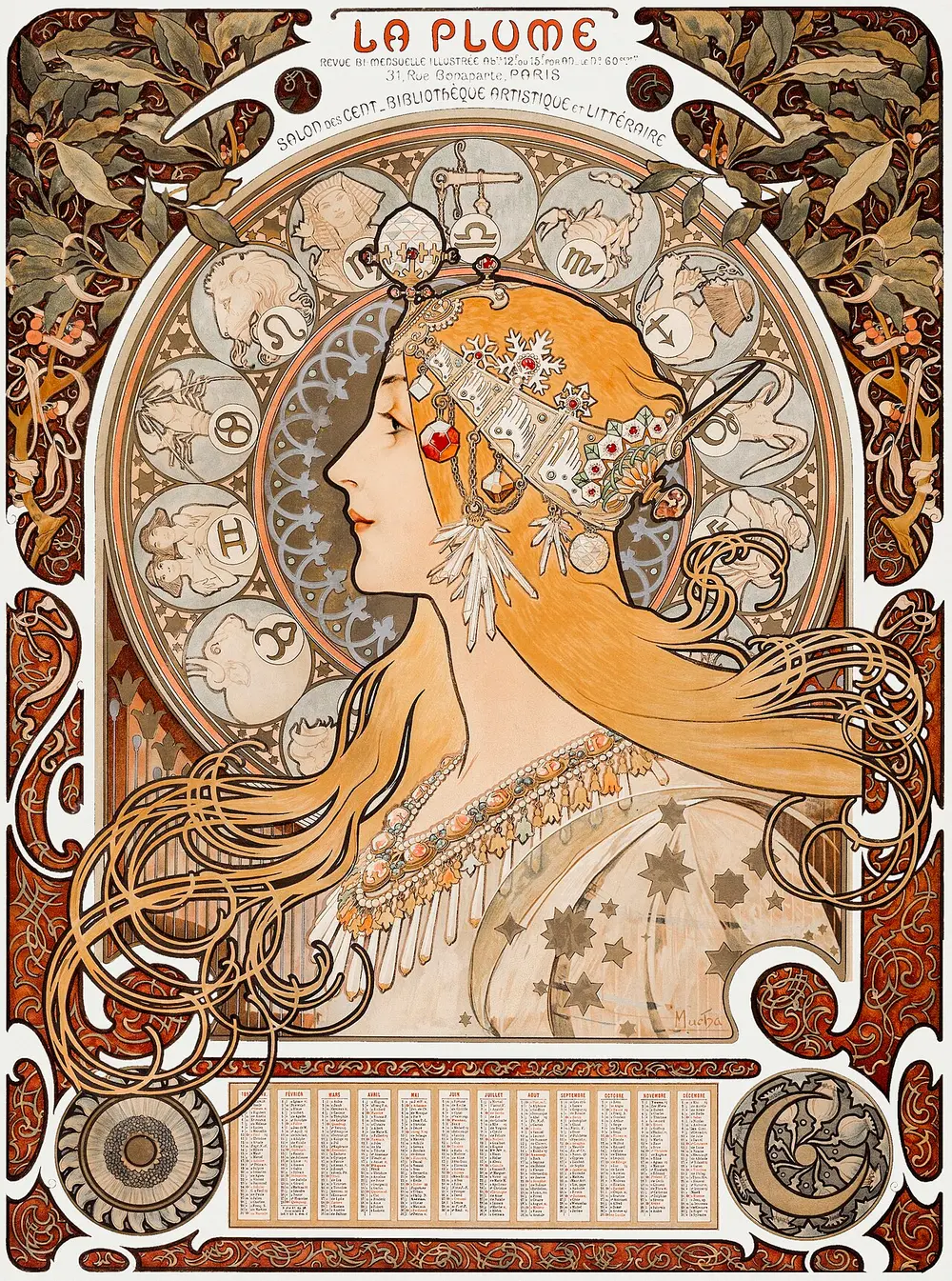
A poster of a woman in profile with long golden hair flowing in curls, wearing a jewelled headdress, in front of a large halo-like disc carrying the twelve signs of the zodiac, inside a frame of plant shapes with the words La Plume at the top.
Picture: Alphonse Mucha. Public domain.

Zodiac

Where
Printed in Paris
When
1896
Who
Alphonse Mucha, Czech, working in Paris
Style
Art Nouveau
Made with
Colour lithograph (a printed poster)

Mucha first designed this image as a calendar for his printer, Champenois. The editor of the art magazine La Plume then bought the rights and used it as the magazine's calendar for 1897. The woman's profile sits in front of a large disc carrying the twelve signs of the zodiac, and her hair spills out in long loose curls. Art Nouveau took its shapes from nature, from stems, flowers and insects to these whip-like curves.

Spot it by

A graceful woman with long flowing hair, a halo-like circle behind her head, flowers and curling plant lines, soft colours and decorative hand-drawn lettering.

Remember

Nouveau flows like hair; Deco snaps into a fan.

Don't confuse

CEED 2026 showed a cover of the German magazine Jugend as its Art Nouveau example. Jugendstil, "youth style", is the German name for the same movement.
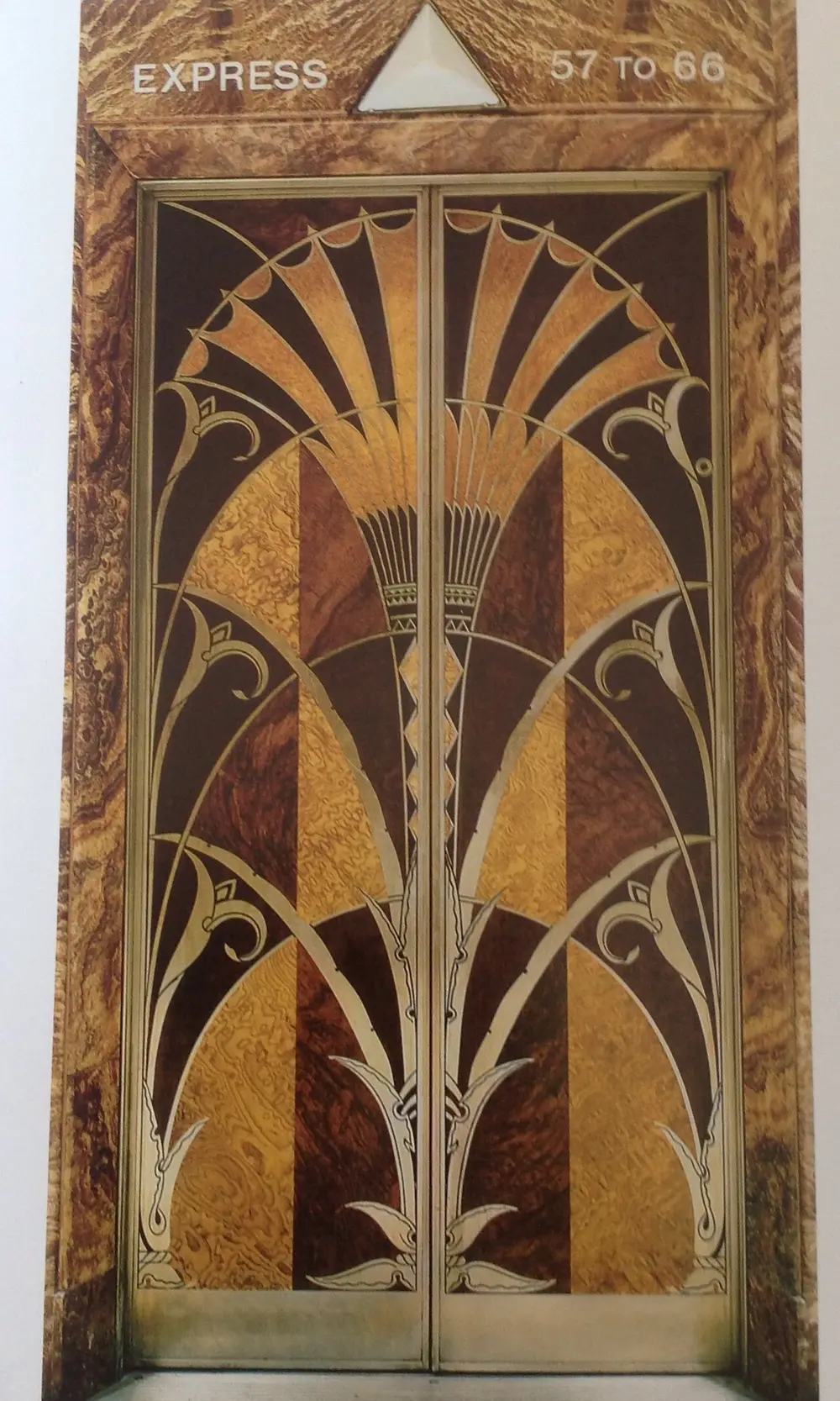
A pair of tall elevator doors covered in inlaid woods of several colours, forming a symmetrical fan of thin, pointed, plant-like shapes that rise from the bottom, inside a metal frame with a triangle above.
Picture: SiefkinDR. CC BY-SA 4.0.

Chrysler Building elevator doors

Where
Chrysler Building lobby, New York
When
Building finished in 1930
Who
Building by William Van Alen; doors made by the Tyler Company
Style
Art Deco
Made with
Inlaid wood veneers and metal

The lobby of the Chrysler Building is one of the most famous Art Deco interiors in the world. Its elevator doors are covered in different woods cut into a stylised plant, described as a lotus or a papyrus, which echoes the ancient Egyptian art that Art Deco loved to borrow from. Notice that the plant is no longer a loose curve, as it would be in Art Nouveau: it has become a strict, symmetrical fan of straight, pointed shapes.

Spot it by

Symmetry, fans and sunbursts, zigzags and chevrons, stepped shapes like a staircase, and shiny, costly materials such as chrome, lacquer, marble and inlaid wood.

Remember

Art Nouveau grows; Art Deco is built.

Don't confuse

Art Nouveau also uses plants, but its lines wander freely and are never strictly symmetrical.

Fauvism or Expressionism?

Both began in 1905 and both use strong, unnatural colour, which is why exams mix them up. Fauvism was French and short-lived, and it was mostly about the joy of pure colour. Expressionism was strongest in Germany and Austria, and it used colour and distortion to show inner feelings such as fear, loneliness and anger. Its two big German groups were Die Brücke ("The Bridge"), formed in Dresden in 1905, and Der Blaue Reiter ("The Blue Rider"), formed in Munich in 1911.

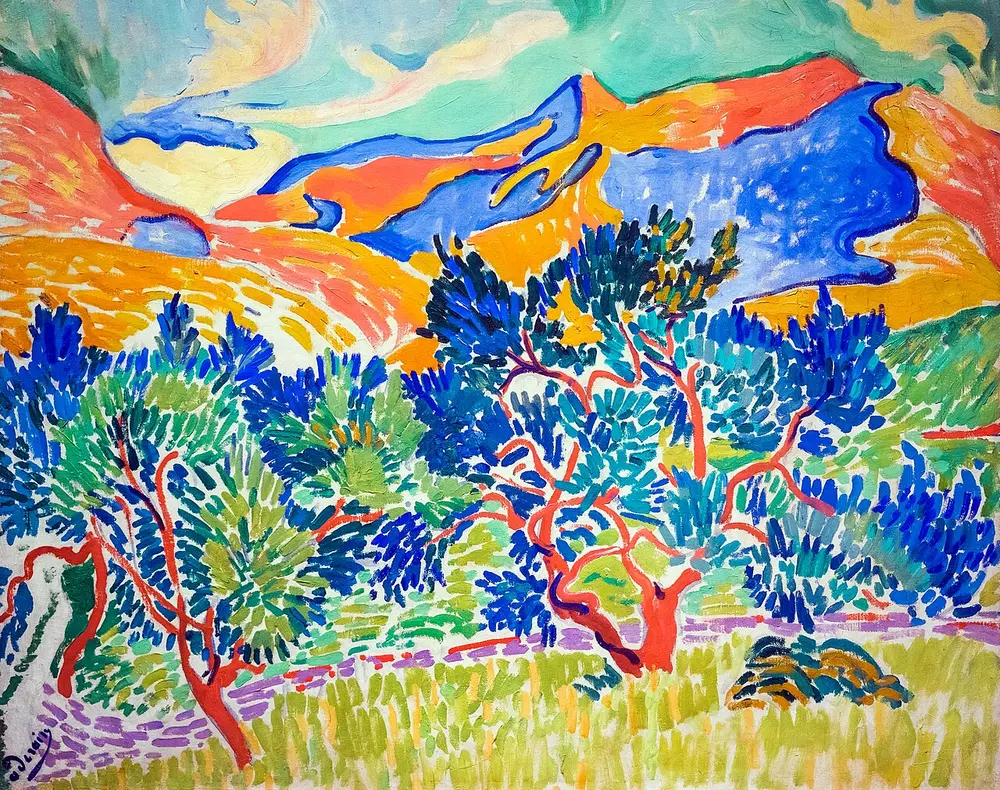
A landscape of trees with red trunks and blue and green leaves in front of orange, pink and blue mountains, painted in short strokes and flat patches of pure, bright colour.
Picture: André Derain. Public domain.

Mountains at Collioure

Where
National Gallery of Art, Washington, DC
When
1905
Who
André Derain, France
Style
Fauvism
Made with
Oil on canvas

In the summer of 1905 Derain worked alongside Henri Matisse in Collioure, a fishing village on the Mediterranean coast of France. Here the trees have red trunks and blue leaves, and the mountains are flat patches of coral, orange and cobalt blue. Colour no longer has to match nature: it is there for its own brightness. When Matisse, Derain and their friends showed such paintings at the Salon d'Automne in Paris that autumn, the critic Louis Vauxcelles called them les fauves, "the wild beasts".

Spot it by

Pure, bright colour straight from the tube, colours that don't match reality (red trees, green faces), flat patches and loose strokes, and cheerful subjects such as landscapes, harbours, rooms and portraits.

Remember

The Fauves are wild about colour, not worried about life.

Don't confuse

Expressionism also uses unreal colour, but its faces and streets are twisted and its mood is tense or sad.
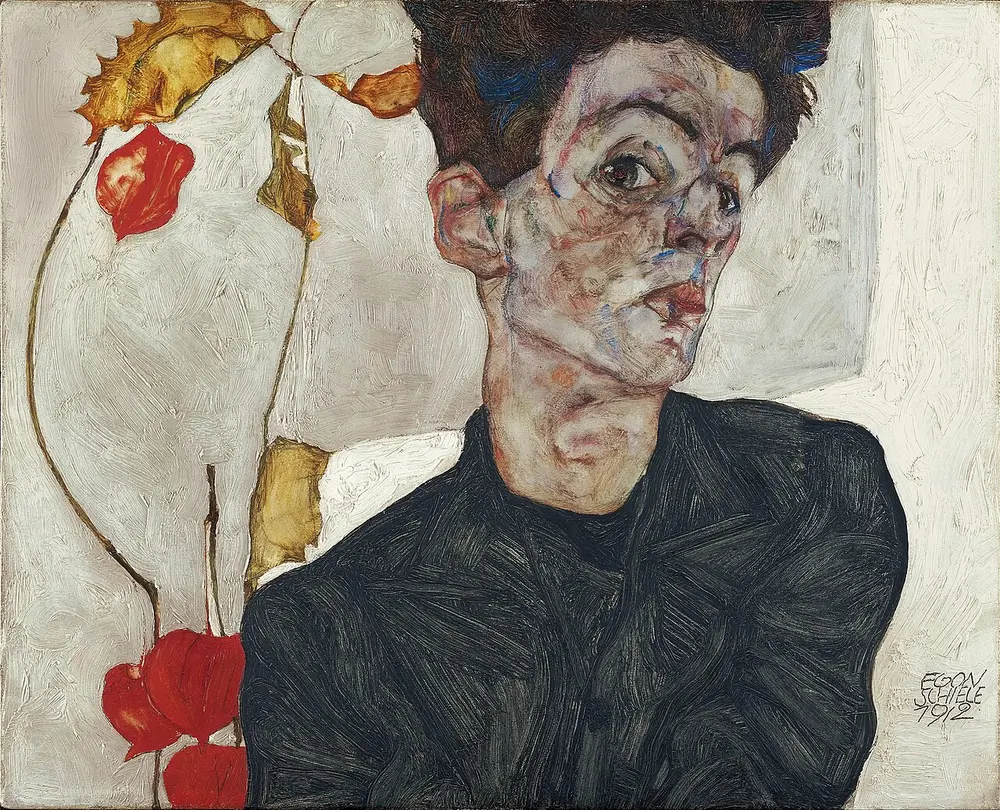
A pale young man with wild dark hair turns his head sharply and stares out, his thin face drawn with nervous, scratchy lines and patches of green and red, beside a stem of orange-red lantern-shaped seed pods on a white background.
Picture: Egon Schiele. Public domain.

Self-Portrait with Physalis

Also called Self-Portrait with Chinese Lantern Plant

Where
Leopold Museum, Vienna
When
1912
Who
Egon Schiele, Austria
Style
Expressionism
Made with
Oil and opaque paint on wood

Schiele painted himself again and again, often thin, twisted and uneasy. Here his head tilts at an awkward angle, his skin is patched with greens and reds, and the outlines are jagged and tense. Expressionist artists cared less about how things look than about how they feel, so they bent faces, bodies and cities out of shape. Edvard Munch's The Scream (1893) is the famous picture that led the way.

Spot it by

Stretched, twisted or bony figures, harsh outlines, sickly or clashing colours, and an anxious, lonely or angry mood.

Remember

Fauvism is a holiday; Expressionism is a nightmare.

Don't confuse

UCEED 2018 used The Scream for Expressionism. If the colours are wild but the mood is happy, think Fauvism instead.

Cubism or Futurism?

Both break things into sharp, angled pieces. Cubism began in Paris around 1907 with Pablo Picasso and Georges Braque, and it looks at a still subject from several sides at once. Futurism began in Italy in 1909. It loved speed, machines and cities, and it repeats shapes to show movement.

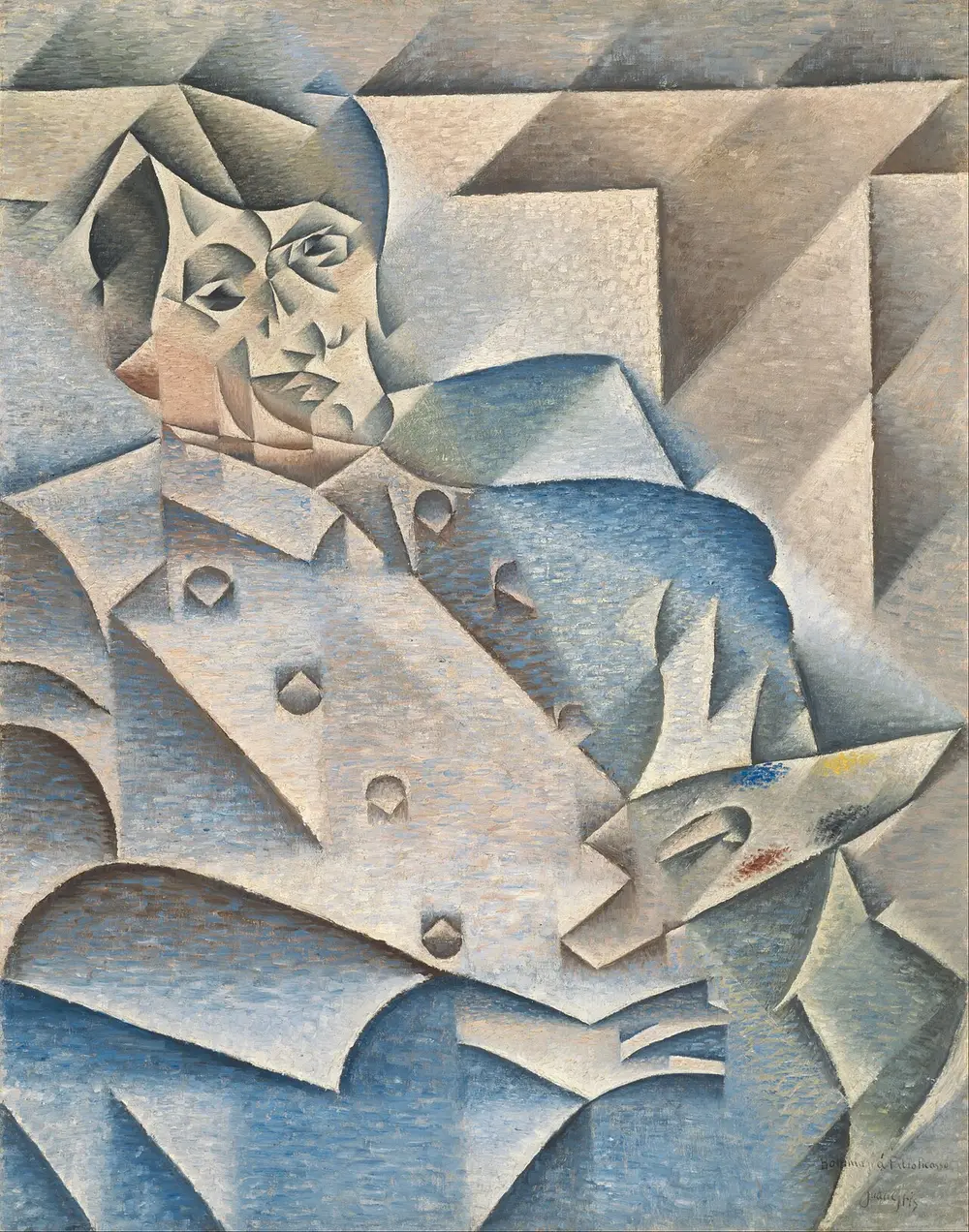
A portrait of a man holding a painter's palette, broken into many flat, angled planes of blue, grey and brown, so that his face, collar and jacket look like folded and overlapping pieces.
Picture: Juan Gris. Public domain.

Portrait of Pablo Picasso

Where
Art Institute of Chicago
When
1912
Who
Juan Gris, Spain, working in Paris
Style
Cubism
Made with
Oil on canvas

Gris painted this tribute to Picasso, one of the inventors of Cubism, and wrote "Hommage à Pablo Picasso" in the lower right corner. Picasso's head, neck and body are split into flat planes and simple shapes on a strong diagonal grid, in a few quiet blues, browns and greys. Showing it at the Salon des Indépendants in Paris in spring 1912 helped make Gris's own name. Cubist painters wanted to show a subject from several viewpoints at once, so it looks like a reflection in a broken mirror.

Spot it by

A still subject (a face, a guitar, a bottle) broken into flat, angled facets, several viewpoints at once, quiet browns, greys and blues, and very little depth.

Remember

Cubism sits still and is seen from all sides.

Don't confuse

Futurism also uses broken shapes, but everything in it rushes, with repeated lines and swirling motion.
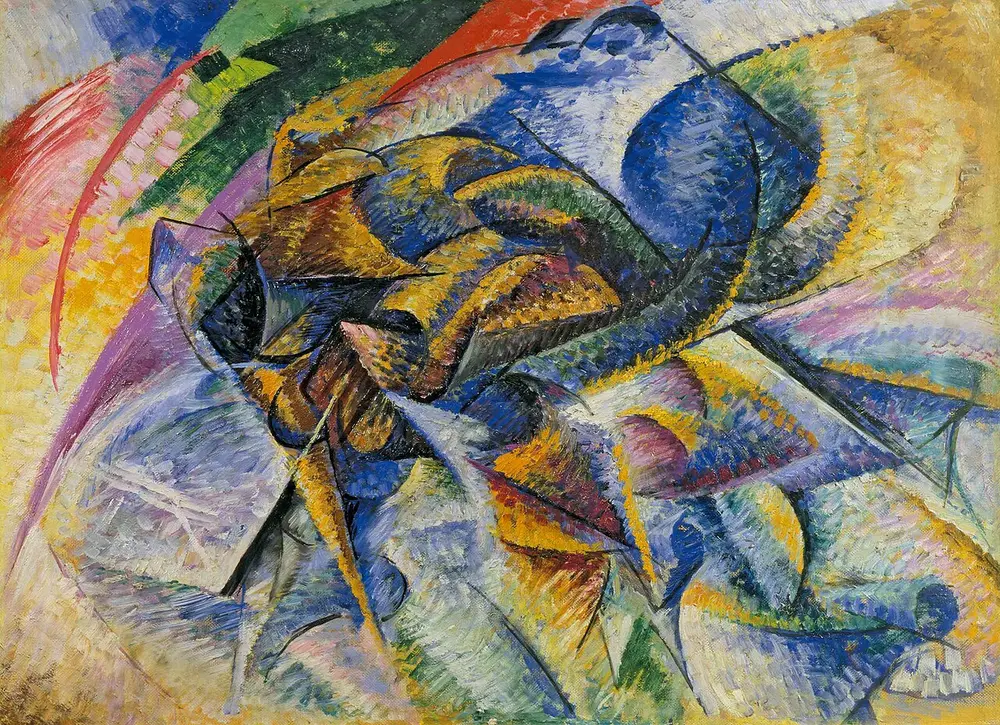
A painting of curving and angled shapes in blue, yellow, orange and red that rush from left to right, suggesting a cyclist bent low over his bicycle at speed.
Picture: Umberto Boccioni. Public domain.

Dynamism of a Cyclist

When
1913
Who
Umberto Boccioni, Italy
Style
Futurism
Made with
Oil on canvas

The poet Filippo Tommaso Marinetti launched Futurism with a manifesto on the front page of the Paris newspaper Le Figaro on 20 February 1909. He praised "the beauty of speed" and wanted to free Italy from its museums and its past. Painters such as Boccioni, Giacomo Balla and Gino Severini then tried to paint movement itself. Here a cyclist and his bicycle dissolve into sweeping curves and bursts of colour, with lines of force driving forward across the canvas.

Spot it by

Movement and speed, outlines repeated like a blurred photograph, lines of force, bright clashing colour, and modern subjects such as cars, trains, cyclists, crowds and cities.

Remember

Cubism walks around a still thing; Futurism chases a fast one.

Straight lines only: De Stijl

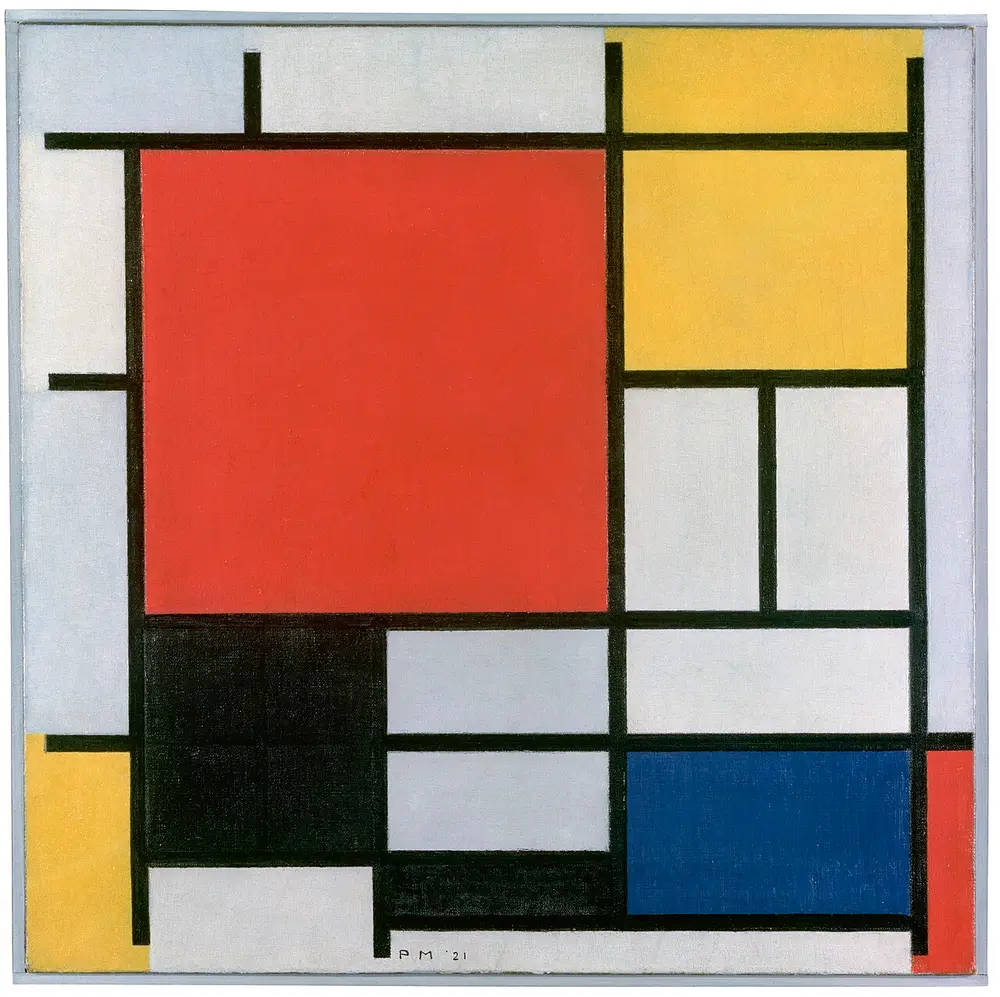
A square painting divided by thick black lines into rectangles, with a large red square at the top left, yellow at the top right, blue and black blocks at the bottom, and the rest pale grey and white.
Picture: Piet Mondrian. Public domain.

Composition with Large Red Plane, Yellow, Black, Grey and Blue

Where
Kunstmuseum Den Haag, The Hague
When
1921
Who
Piet Mondrian, Netherlands
Style
De Stijl
Made with
Oil on canvas

The Dutch group De Stijl ("The Style") formed in 1917 around Theo van Doesburg and Mondrian. Mondrian cut painting down to the simplest parts he could find: straight black lines meeting at right angles, the three primary colours, and white, grey and black. This 1921 picture is one of the first in his fully worked-out style. The same rules shaped furniture and buildings, such as Gerrit Rietveld's Red Blue Chair.

Spot it by

Only straight horizontal and vertical lines, rectangles of red, yellow and blue with black, white and grey, and no curves, diagonals or subjects.

Remember

Mondrian allowed lines, right angles and primary colours, and nothing else.

Don't confuse

Op art is also pure geometry, but it is designed to make your eyes see movement. De Stijl is calm and still.

Dada or Surrealism?

Dada began in Zurich in 1916, in the middle of the First World War, at a small arts club called the Cabaret Voltaire. Disgusted by the war, its artists attacked art itself with jokes, nonsense, found objects and collage. Surrealism grew partly out of Dada in Paris, and André Breton's Surrealist Manifesto of 1924 asked artists to set free the dreaming, unconscious mind. A quick test: Dada is usually a prank or an idea, while Surrealism is usually a dream, painted carefully.

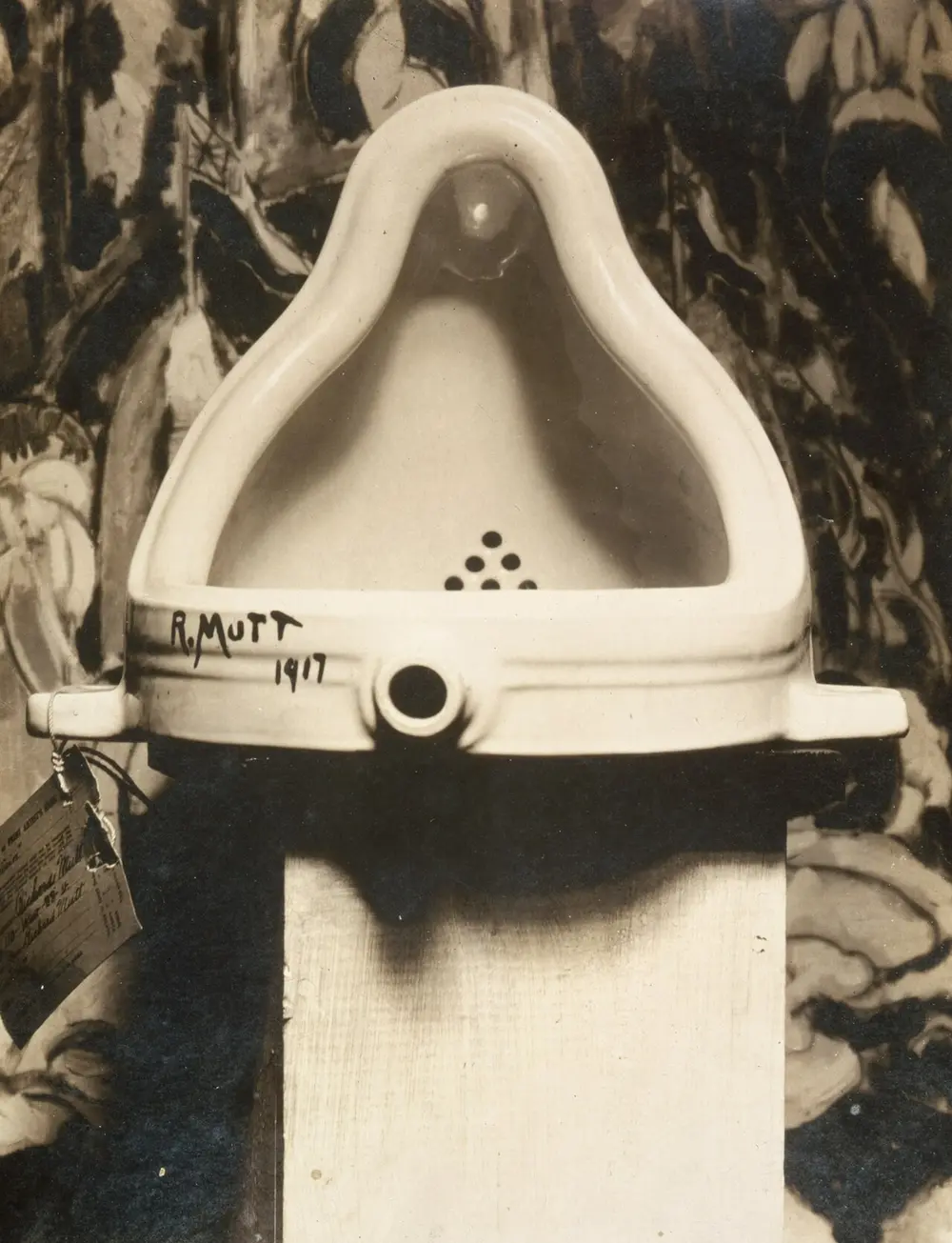
A black-and-white photograph of a white porcelain urinal turned onto its back on a plinth, signed "R. Mutt 1917" in black paint, in front of a dark painting.
Picture: Marcel Duchamp / Alfred Stieglitz. Public domain.

Fountain

Where
The original is lost; replicas from the 1950s and 1960s are in museums such as Tate Modern, London
When
1917
Who
Marcel Duchamp, France, working in New York; photograph by Alfred Stieglitz
Style
Dada
Made with
A shop-bought porcelain urinal, a "readymade"

Duchamp bought an ordinary urinal, turned it on its back, signed it "R. Mutt 1917" and entered it for an exhibition of the Society of Independent Artists in New York, which had promised to show the work of anyone who paid the fee. It was kept out of the show, and the original was soon lost, so this photograph by Stieglitz is how we know it. Duchamp called such objects readymades: everyday things that become art because an artist chooses them. In 1919 he drew a moustache and beard on a postcard of the Mona Lisa and called it L.H.O.O.Q., the joke UCEED 2025 asked about.

Spot it by

Ordinary objects shown as art, nonsense and jokes, collage and photomontage, cut-up words and letters, and anything meant to shock or mock serious art.

Remember

Dada asks "is this art?"; Surrealism asks "is this real?"

Don't confuse

A moustache on a famous painting, or a urinal in a gallery, is Dada, not Surrealism or Pop.
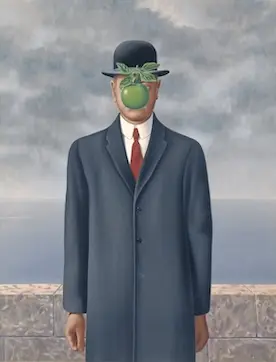
A man in a dark overcoat, red tie and bowler hat stands in front of a low wall by the sea under a cloudy sky, his face hidden by a floating green apple.
Picture: René Magritte. Copyright Estate of René Magritte, shown for teaching.

The Son of Man

Where
Private collection
When
1964
Who
René Magritte, Belgium
Style
Surrealism
Made with
Oil on canvas

Magritte painted this as a self-portrait, but he hid his face behind a green apple hanging in the air, so that only his eyes peep over its edge. Everything is painted smoothly and clearly, like an advert, which makes the impossible apple even stranger. That is one of the two main paths of Surrealism: dream scenes painted with photographic care, as Magritte and Salvador Dalí did. The other path let the hand draw freely, without planning, to reach the unconscious mind, as Joan Miró did.

Spot it by

Ordinary things in impossible places or sizes, melting or floating objects, empty dream-like landscapes, and a smooth, careful, realistic painting style.

Remember

Surrealism paints a dream as if it were a photograph.

Don't confuse

UCEED 2018 used a Max Ernst painting for Surrealism. A careful painting of something impossible is Surrealism; a prank, a found object or a collage of cut-up newspapers is Dada.

Pop or Op?

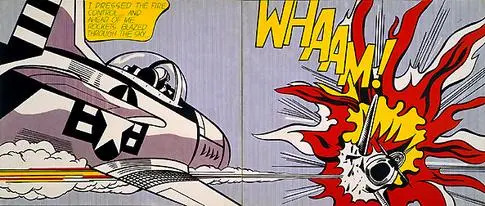
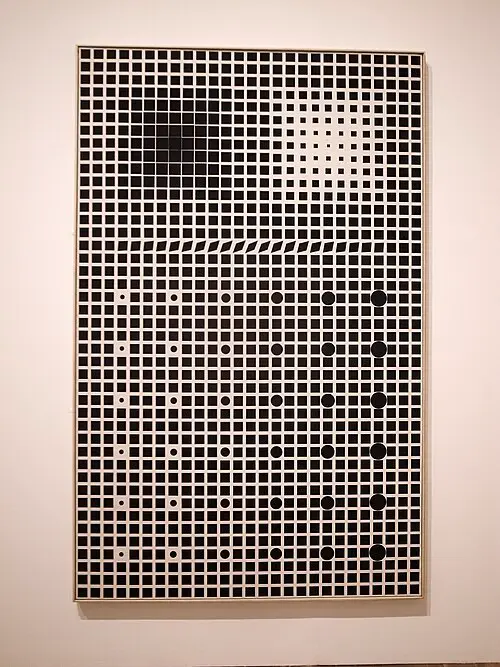
The names differ by one letter, and both belong to the 1960s. Pop art began in Britain and the USA in the 1950s. It took pictures from popular culture, such as comics, adverts, packaging and film stars, and treated them as fine art. Op art, short for "optical art", is abstract: black-and-white or brightly coloured patterns that seem to flicker, swell or move. Its name dates from 1964, and an exhibition called The Responsive Eye at the Museum of Modern Art in New York made it famous in 1965.

A wide painting in two panels in comic-book style. On the left a fighter plane fires a rocket; on the right another plane explodes in red and yellow flames under the word "Whaam!", with a speech box at the top left.
Picture: Roy Lichtenstein. Copyright Estate of Roy Lichtenstein, shown for teaching.

Whaam!

Where
Tate Modern, London
When
1963
Who
Roy Lichtenstein, USA
Style
Pop art
Made with
Acrylic and oil paint on canvas, in two panels

Lichtenstein took this scene from a panel in a 1962 war comic, All-American Men of War, and blew it up into a huge painting across two canvases. He painted the dots through a metal screen to copy Ben-Day dots, the cheap printing dots used in comics, so it looks machine-printed rather than hand-painted. Tate bought it in 1966, and it is one of the best-known Pop paintings.

Spot it by

Comic-strip images with thick black outlines, printed-looking dots, speech bubbles and sound words, flat bright colours, and celebrities, brands or everyday products, often repeated.

Remember

Pop art comes from popular culture: comics, adverts and stars.

Don't confuse

Op art also uses dots and bold patterns, but it shows nothing you can recognise. Its only subject is the effect on your eyes.
A tall black-and-white painting hanging on a gallery wall, made of a grid of small squares and circles that grow, shrink and fade in places, so that the grid seems to bulge and flicker.
Picture: Victor Vasarely; photo by Mramoeba. Copyright Estate of Victor Vasarely, shown for teaching; photo CC BY-SA 4.0.

Supernovae

Where
Tate, London
When
1959 to 1961
Who
Victor Vasarely, Hungary and France
Style
Op art

Vasarely, who was born in Hungary and worked in France, was one of the founders of Op art. Here a strict grid of black and white squares and circles changes size and tone from place to place, so the flat canvas seems to bulge, sink and shimmer as you look at it. Op artists such as Vasarely and Bridget Riley painted no story and no subject: the work happens in the viewer's eyes.

Spot it by

Abstract black-and-white or bright patterns of stripes, checks, circles or waves that seem to move, vibrate, bulge or twist, with no recognisable subject.

Remember

Op is optical: the picture plays tricks on your eyes.

Don't confuse

UCEED 2018 showed a pattern of wavy red lines as its Op art example. If you can see a face, a product or a comic, it's Pop.

The six pairs in one look

Pair The first one The second one
Impressionism or Post-Impressionism Soft dabs catching a moment of light Dots, firm outlines, solid shapes or strong feeling
Art Nouveau or Art Deco Long, loose curves of plants and hair Fans, zigzags and steps, symmetrical and shiny
Fauvism or Expressionism Wild colour, happy mood Twisted shapes, anxious mood
Cubism or Futurism A still subject seen from many sides A moving subject, repeated lines of speed
Dada or Surrealism A prank, a found object or a collage A dream, painted carefully
Pop or Op Comics, adverts and stars Abstract patterns that seem to move

Spot it by: the clue table

Movement When Spot it by Names to know
Renaissance 1400s and 1500s One-point perspective, calm balance, classical buildings, even light Leonardo, Michelangelo, Raphael, Perugino
Baroque 1600s Spotlight in deep darkness, drama, motion Caravaggio, Rembrandt, Vermeer, Rubens
Romanticism about 1800 to 1850 Storms, wild nature, heroes, strong emotion Goya, Delacroix, Turner, Friedrich
Realism mid-1800s Ordinary workers, earthy colours, no drama Courbet, Millet
Impressionism from 1874 Quick dabs, outdoor light, everyday moments Monet, Renoir, Degas, Morisot
Post-Impressionism about 1886 to 1905 Thick strokes, outlines, solid shapes, symbols Van Gogh, Cézanne, Gauguin
Pointillism from 1886 Tiny dots of pure colour Seurat, Signac
Art Nouveau about 1890 to 1910 Whip-like curves, plants, flowing hair Mucha, Guimard, Klimt
Fauvism from 1905, for a few years Wild, unreal, joyful colour Matisse, Derain
Expressionism from 1905 Distortion, harsh colour, fear and loneliness Munch, Kirchner, Schiele, Marc
Cubism from about 1907 Flat facets, many viewpoints, browns and greys Picasso, Braque, Gris
Futurism from 1909 Speed, machines, repeated lines Boccioni, Balla, Severini
Dada from 1916 Readymades, nonsense, collage, mockery Duchamp, Höch, Arp
De Stijl from 1917 Straight lines, right angles, primary colours Mondrian, Van Doesburg, Rietveld
Art Deco 1920s and 1930s Fans, sunbursts, zigzags, steps, chrome Chrysler Building, Cassandre
Surrealism from 1924 Dreams, impossible objects, careful realism Dalí, Magritte, Miró, Ernst
Abstract Expressionism 1940s and 1950s Huge drips or fields of colour, no subject Pollock, Rothko
Pop art 1950s and 1960s Comics, ads, stars, printed dots, repetition Warhol, Lichtenstein, Hamilton
Op art 1960s Patterns that seem to move or bulge Vasarely, Riley

Test yourself

Question 1 of 8

Which movement is this painting?

Question 2 of 8

Which movement is this painting?

Question 3 of 8

Which movement is this painting?

Question 4 of 8

Which of these is Art Deco?

Question 5 of 8

Which movement does this work belong to?

Question 6 of 8

Which movement is this painting?

Question 7 of 8

This close-up shows a painting built entirely from tiny dots of colour. What is this way of painting called?

Question 8 of 8

A painting shows only black and white stripes that seem to ripple and move as you look at them. Which movement is it most likely to be?

From past papers

Real exam questions on this topic, each with a full solution.

Finished this note?

Mark it as studied to track your progress through the course.

Was this note useful?

Each picture is credited underneath it. Pictures of works still in copyright are shown small, for teaching only. If you hold the rights to a picture and want it removed, tell us through the contact page and we will take it down.