Skip to content

Chapter 5: Architecture

Iconic buildings of the world

Fifteen world-famous buildings, from the Pyramids and the Parthenon to Fallingwater, the Sydney Opera House and the Burj Khalifa, with who built them, when, and how to recognise each one.

In one minute

6 facts to know

  1. The Great Pyramid of Khufu at Giza (about 2560 BCE) was the tallest structure humans had built for about 3,800 years.
  2. The Greeks built with columns (the Parthenon, 5th century BCE), the Romans with arches and concrete (the Colosseum, 80 CE), and the Byzantines raised a giant dome over Hagia Sophia (537 CE).
  3. Gothic Notre-Dame in Paris (begun 1163) has flying buttresses and rose windows. It reopened in December 2024 after the 2019 fire.
  4. The Eiffel Tower (1889) is wrought iron. Gaudí's Sagrada Família, begun in 1882, became the tallest church in the world in October 2025.
  5. Modern masters: Wright's Fallingwater, Le Corbusier's Villa Savoye, Utzon's Sydney Opera House, Gehry's Guggenheim Bilbao and Pei's Louvre Pyramid.
  6. The Burj Khalifa in Dubai (828 metres, opened 2010) is the tallest building in the world as of October 2026.

The ancient world

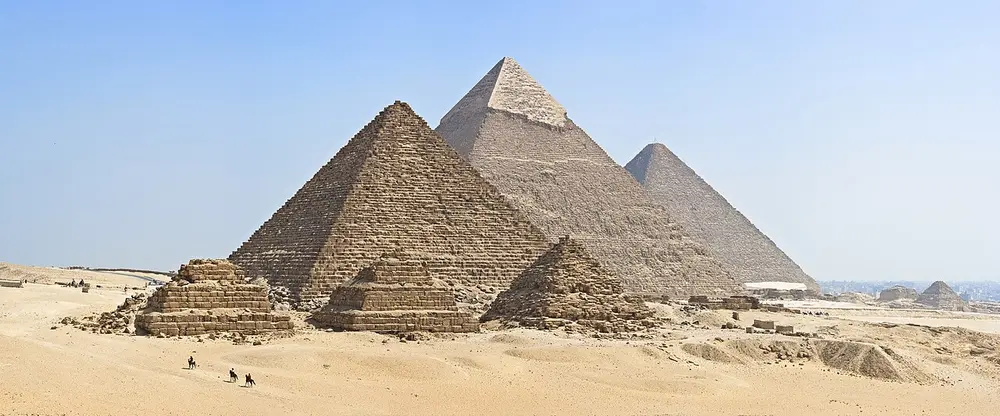
Three huge stone pyramids rising from a sandy desert under a pale blue sky, with three much smaller pyramids in front and a few people on camels.
Picture: KennyOMG. CC BY-SA 4.0.

Pyramids of Giza

Where
Giza, on the edge of Cairo, Egypt
When
The Great Pyramid about 2560 BCE
Who
Built for the pharaohs Khufu (Cheops), Khafre and Menkaure
Made with
Millions of limestone blocks, once faced with smooth white limestone

The three big pyramids are tombs for three kings of Egypt's Fourth Dynasty. The largest, the Great Pyramid of Khufu, was about 146.6 metres tall when finished, and it stayed the tallest structure built by humans for about 3,800 years, until the spire of Lincoln Cathedral in England passed it in 1311. Its smooth white outer casing was later taken away for building stone, so it is now about 138.5 metres. It is the oldest of the Seven Wonders of the Ancient World and the only one still standing.

Spot it by

Smooth triangular faces of stepped stone blocks rising to a point, in a sandy desert.

Remember

Khufu's pyramid held the height record for 38 centuries.
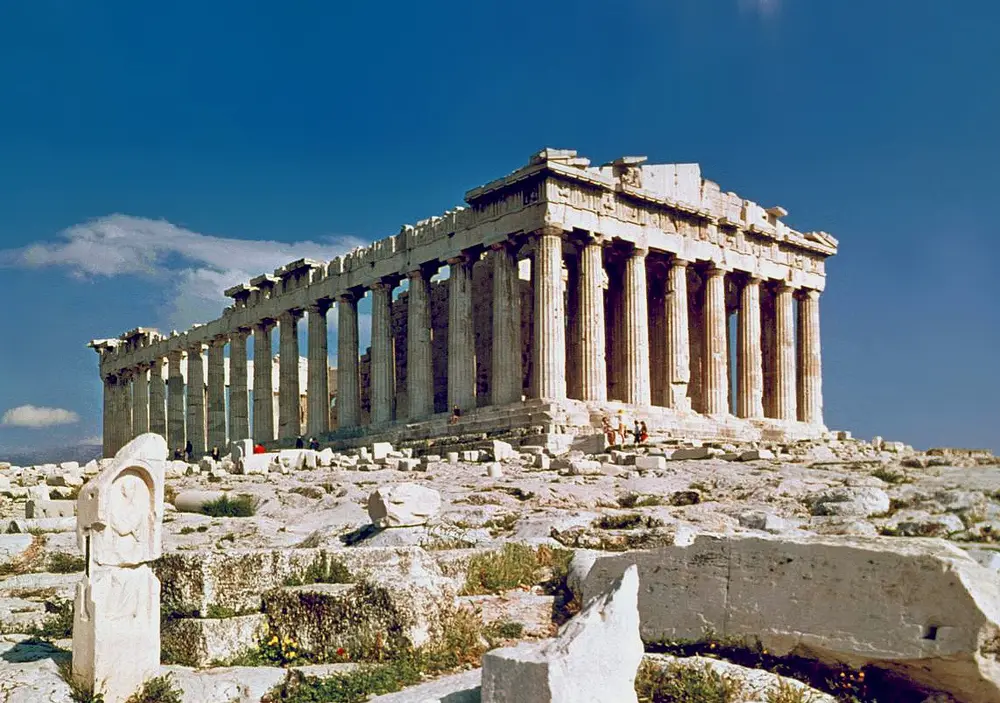
The ruined marble Parthenon on a rocky hill, a long rectangular temple surrounded by rows of thick fluted columns, with part of its roof and triangular end missing, under a deep blue sky.
Picture: Steve Swayne. CC BY 2.0.

Parthenon

Where
The Acropolis, Athens, Greece
When
447 to 432 BCE
Who
Architects Ictinus and Callicrates, with the sculptor Phidias in charge of the carvings
Style
Classical Greek, Doric order
Made with
White marble

A temple to the goddess Athena, built when Athens was at the height of its power. It is the finest example of the Doric order, the plainest of the three Greek column styles. Later it became a church, then a mosque, and in 1687 gunpowder stored inside exploded and blew out its middle. Many of its carvings were taken to Britain in the early 1800s and are now in the British Museum, where they are called the Elgin Marbles.

Spot it by

A rectangle of thick, fluted columns with plain round tops, holding up a band of carvings and a low triangular gable.

Remember

Doric is plain, Ionic has scrolls, Corinthian has leaves.
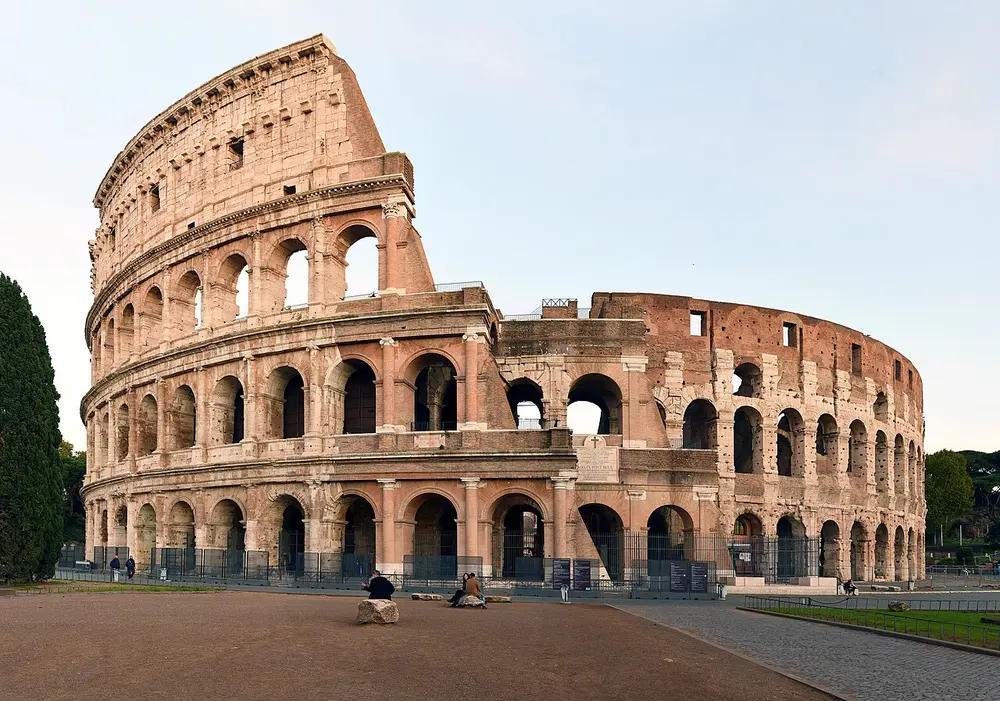
The Colosseum in Rome, a huge oval stone arena with three rows of arches and a solid top storey, part of its outer wall broken away to show inner rings of arches.
Picture: FeaturedPics. CC BY-SA 4.0.

Colosseum

Also called Flavian Amphitheatre

Where
Rome, Italy
When
Begun about 72 CE; opened 80 CE
Who
The emperors Vespasian and his son Titus
Style
Ancient Roman
Made with
Travertine stone, volcanic tuff, brick and Roman concrete

The largest amphitheatre the Romans ever built. It held an estimated 50,000 to 80,000 people, who came to watch gladiators fight, animal hunts and public shows. The Romans' great inventions, the round arch and concrete, let them build huge, many-storeyed buildings like this. Earthquakes and people taking its stone for other buildings ruined part of it, but its oval of stacked arches is still the symbol of ancient Rome.

Spot it by

A giant oval of three rows of round arches, with part of the outer wall missing.

Remember

Greeks built with columns; Romans built with arches.
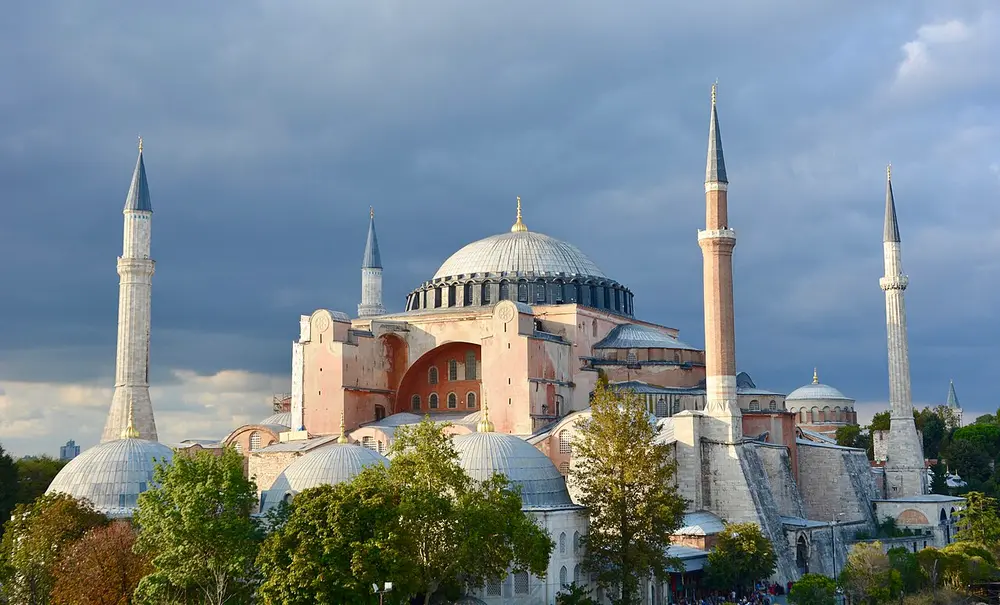
Hagia Sophia in Istanbul, a massive pink and cream building with a huge, shallow central dome ringed with small windows, smaller domes and half-domes around it, and four tall thin minarets.
Picture: Adli Wahid. CC BY-SA 3.0.

Hagia Sophia

Where
Istanbul (once Constantinople), Turkey
When
532 to 537 CE
Who
Emperor Justinian I; designed by Anthemius of Tralles and Isidore of Miletus
Style
Byzantine
Made with
Brick and stone, with marble and gold mosaics inside

Built as the great church of the Byzantine Empire, it had the largest interior space in the world when it was finished. Its huge dome sits on pendentives: four curved triangles that let a round dome rest on a square of four arches. After the Ottomans took the city in 1453 it became a mosque, and minarets were added. It became a museum in 1935 and a mosque again in 2020.

Spot it by

One vast shallow dome with a ring of windows at its base, half-domes stepping down around it, and four slim minarets at the corners.

Remember

Hagia Sophia has been a church, a mosque, a museum and a mosque again.
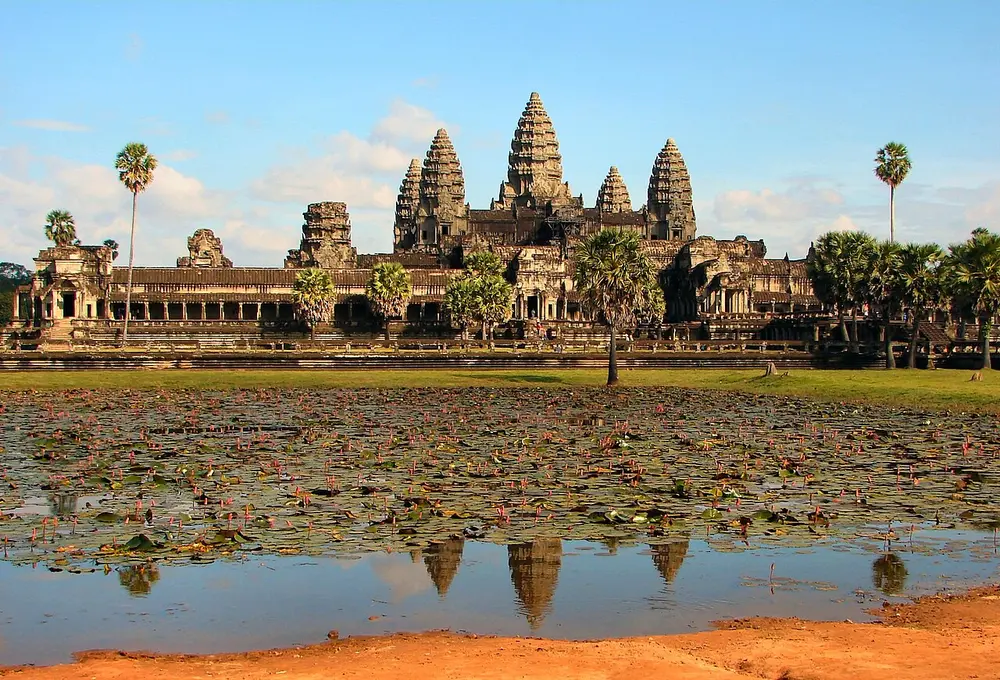
Angkor Wat, a grey stone temple with five tall towers shaped like lotus buds, behind long galleries and palm trees, reflected in a pond with water lilies in front.
Picture: Bjørn Christian Tørrissen. CC BY-SA 4.0.

Angkor Wat

Where
Siem Reap, Cambodia
When
About 1113 to 1150 CE
Who
The Khmer king Suryavarman II
Style
Khmer
Made with
Sandstone, carved all over with reliefs

The largest religious monument in the world. It was built as a Hindu temple for the god Vishnu and slowly became a Buddhist temple from the late 13th century. Its five central towers stand for the peaks of Mount Meru, the mountain at the centre of the universe in Hindu and Buddhist belief, and the wide moat around it stands for the ocean. It appears on the national flag of Cambodia.

Spot it by

Five towers shaped like lotus buds (one tall in the middle, four around it), long carved galleries and a moat.

Remember

Angkor Wat is a Hindu temple to Vishnu in Cambodia, and it is on the country's flag.

Cathedrals and palaces

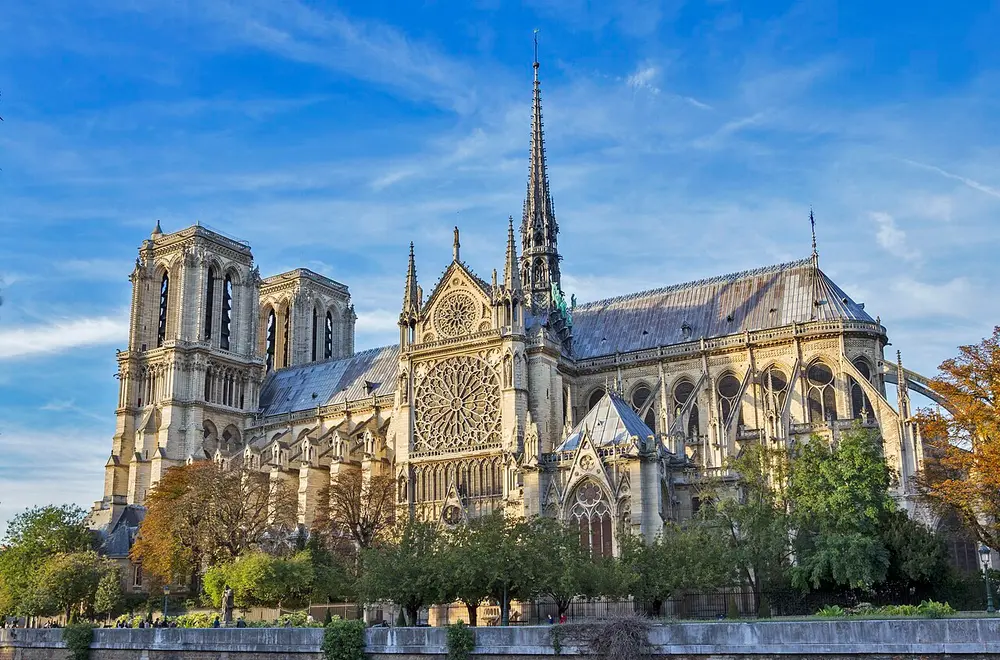
Notre-Dame cathedral in Paris in autumn sunlight, with two square towers on the left, a huge round rose window on its side, a tall thin spire, and stone arms of flying buttresses along the right.
Picture: Ali Sabbagh. CC0.

Notre-Dame de Paris

Where
Île de la Cité, an island in the river Seine, Paris, France
When
Begun 1163; largely finished by 1260
Style
Gothic
Made with
Limestone, with stained glass and a wooden roof covered in lead

Notre-Dame is one of the great Gothic cathedrals. Gothic builders used pointed arches, rib vaults and flying buttresses, stone arms on the outside that push in against the walls, so the walls could be thinner and filled with huge stained-glass windows such as its round rose windows. On 15 April 2019 a fire destroyed its wooden roof and its 19th-century spire, which you can see in this 2017 photo. After more than five years of repair, it reopened on 7 December 2024.

Spot it by

Two square towers on the front, round rose windows, a thin spire and flying buttresses along the sides.

Remember

Gothic means pointed arches, flying buttresses and lots of glass.
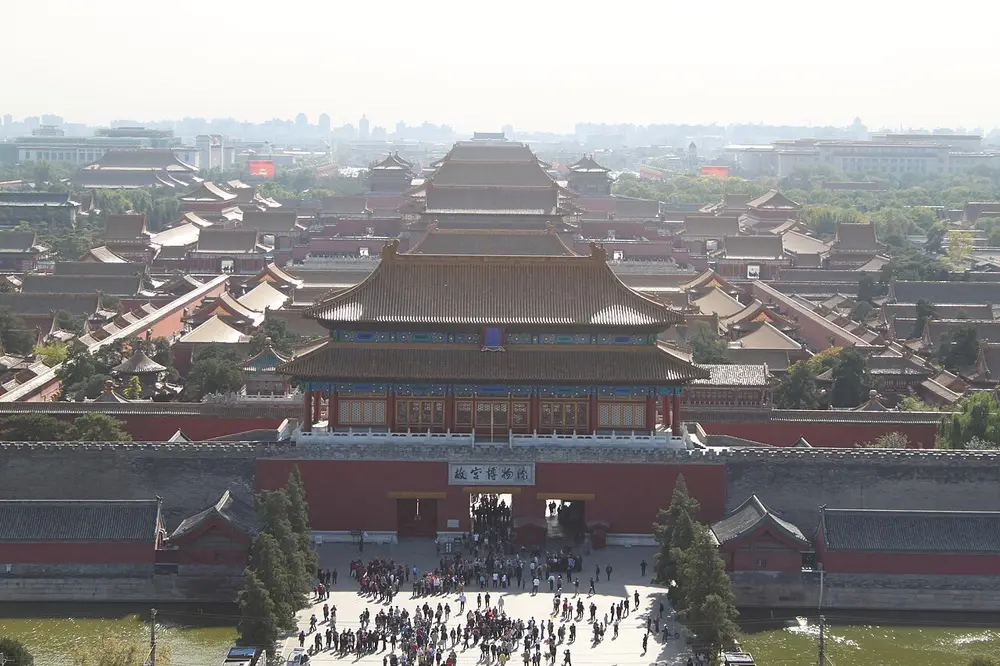
The Forbidden City in Beijing seen from a hill to the north: a two-roofed gate tower above a long red wall and a moat, with crowds at the gate and rows of palace halls with golden-yellow tiled roofs stretching away behind.
Picture: Gary Todd from Xinzheng, China. CC0.

Forbidden City

Where
Beijing, China
When
Built 1406 to 1420
Who
The Yongle Emperor of the Ming dynasty
Style
Traditional Chinese palace architecture
Made with
Wood, with glazed yellow roof tiles, on stone platforms inside red walls

The imperial palace of China for about 500 years, home to 24 emperors of the Ming and Qing dynasties. Ordinary people could not enter without permission, which is where its name comes from. It is the largest old palace complex still standing in the world, surrounded by a moat and high walls. Since 1925 it has been the Palace Museum, and it became a UNESCO World Heritage Site in 1987.

Spot it by

Rows of halls with curved, golden-yellow tiled roofs (yellow was the emperor's colour), red walls and huge courtyards.

Remember

Yellow roofs belong to the emperor.

Iron, stone and Gaudí

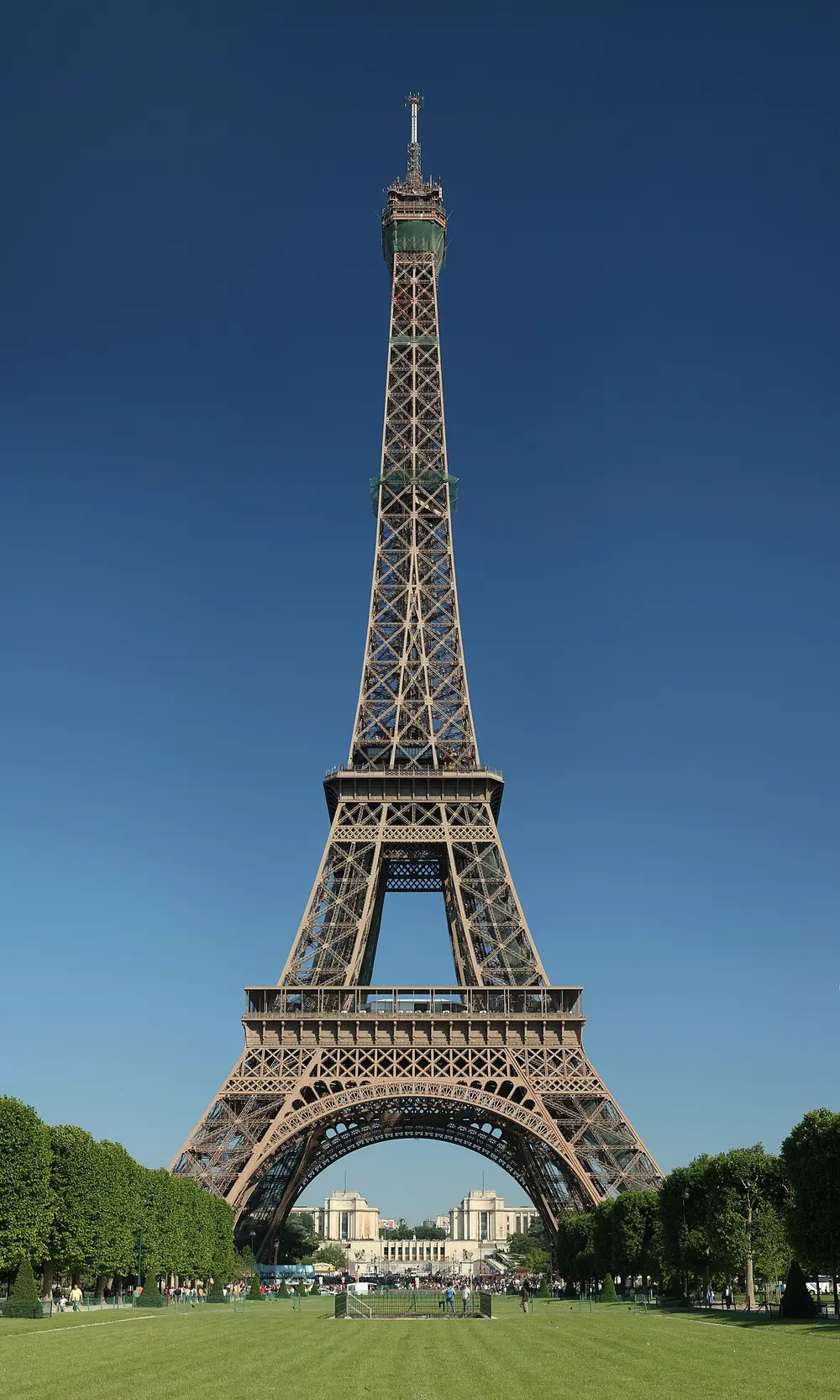
The Eiffel Tower in daylight against a deep blue sky, a tall tapering lattice of brown iron with a wide arch between its four legs, standing on a long green lawn.
Picture: Benh Lieu Song. Public domain.

Eiffel Tower

Where
Champ de Mars, Paris, France
When
1887 to 1889
Who
Gustave Eiffel's company; engineers Maurice Koechlin and Émile Nouguier, architect Stephen Sauvestre
Made with
Wrought iron, about 18,000 parts joined by 2.5 million rivets

Built as the centrepiece of the 1889 World's Fair in Paris, a hundred years after the French Revolution. Some of France's leading artists attacked it at first, but it became the symbol of Paris. It was 300 metres tall, the tallest structure in the world until the Chrysler Building in New York passed it in 1930. Aerials added since make it about 330 metres today.

Spot it by

A lattice of iron like lace, four curved legs joined by an arch, tapering to one thin top.

Remember

The Iron Lady: Paris, 1889.
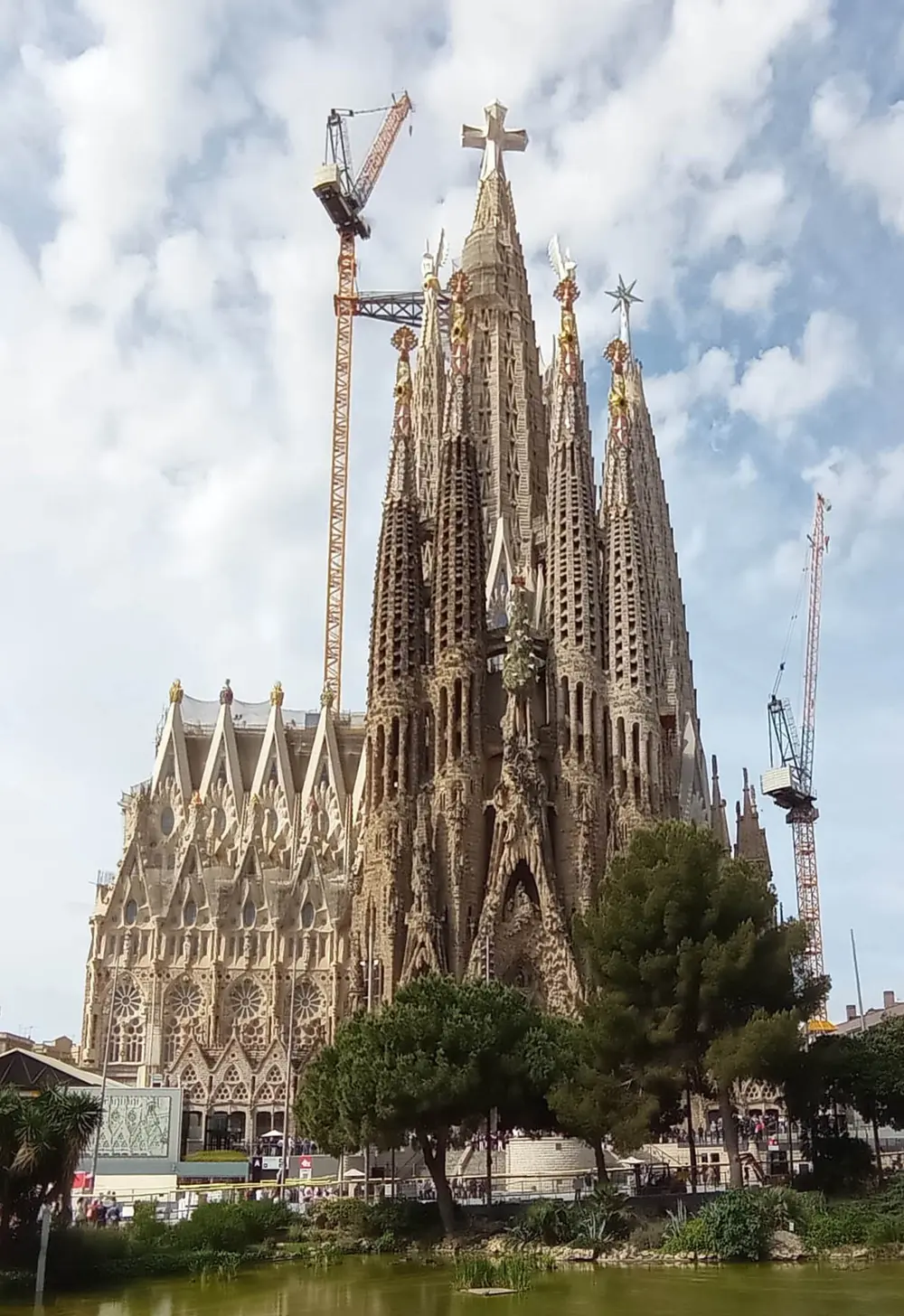
The Sagrada Família basilica in Barcelona, a group of very tall, thin, honeycombed stone spires topped with crosses and coloured finials, with tall cranes beside it.
Picture: Canaan. CC BY-SA 4.0.

Sagrada Família

Where
Barcelona, Spain
When
Begun 1882; still being finished (as of October 2026)
Who
Antoni Gaudí, from 1883 until his death in 1926
Style
Catalan Modernisme (the Catalan form of Art Nouveau)

Gaudí took over this church a year after it was begun and spent the rest of his life on it; he is buried in its crypt. When he died, less than a quarter of it was built. It has been built slowly ever since, paid for by donations and helped in recent years by computer design. In 2010 the Pope consecrated it as a basilica. On 30 October 2025 the first part of the cross went up on its central Tower of Jesus Christ, and the church passed Ulm Minster in Germany to become the tallest in the world. The cross was finished in February 2026, and the tower now stands 172.5 metres tall. Gaudí's Nativity façade and crypt are part of a UNESCO World Heritage Site (2005).

Spot it by

Clusters of tall, thin spires full of holes like honeycomb or dripping sandcastles, with surfaces that look grown rather than built, and usually cranes.

Remember

Gaudí's church has been under construction since 1882.

Modern masters

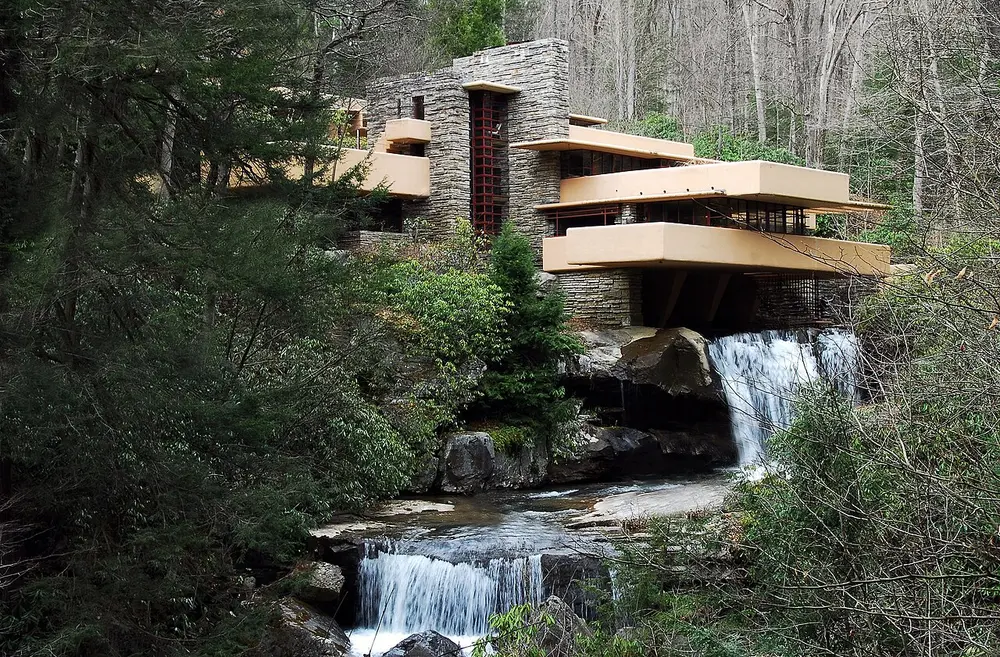
Fallingwater, a house of cream concrete terraces and stone walls jutting out over a waterfall in a forest.
Picture: lachrimae72. CC0.

Fallingwater

Where
Mill Run, Pennsylvania, United States
When
Designed 1935; built 1936 to 1939
Who
Frank Lloyd Wright, for the Kaufmann family
Style
Organic architecture
Made with
Local stone, reinforced concrete, steel and glass

The Kaufmann family hired Wright to design a weekend house on their land at Bear Run, a forest stream. He built it partly over a waterfall. Its concrete terraces are cantilevered: they stick out into the air, held only at one end, from a stone core. Wright called his approach organic architecture, meaning buildings that grow out of their site. In 2019 Fallingwater became part of a UNESCO World Heritage Site with seven other Wright buildings, including the spiral Guggenheim Museum in New York (1959). UCEED 2017 showed Fallingwater in a set of famous buildings and furniture.

Spot it by

Flat terraces stacked over a waterfall, stone walls and a forest all around.

Remember

Fallingwater falls over water.
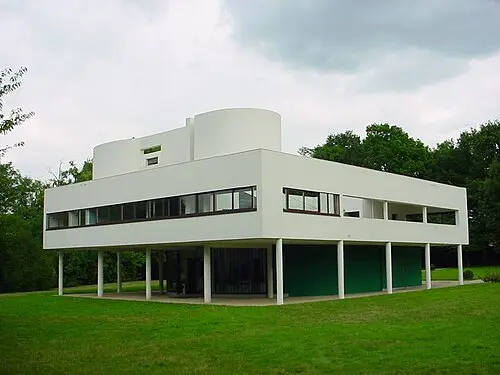
Villa Savoye, a white box-shaped house raised on thin round columns above a green lawn, with a long strip of windows across its upper floor and curved white walls on the roof.
Picture: Valueyou. CC BY-SA 3.0.

Villa Savoye

Where
Poissy, near Paris, France
When
1928 to 1931
Who
Le Corbusier, with his cousin Pierre Jeanneret
Style
Modernism (International Style)
Made with
Reinforced concrete, painted white

A country house that shows all of Le Corbusier's five points of a new architecture: (1) pilotis, thin columns that lift the house off the ground; (2) a free plan, since the columns carry the weight and walls can go anywhere; (3) a free façade, for the same reason; (4) long horizontal ribbon windows; and (5) a roof garden. It is one of the 17 works in UNESCO's Le Corbusier World Heritage Site (2016), together with the Capitol Complex in Chandigarh.

Spot it by

A white box on thin stilts with a long strip window, and curved walls on the roof.

Remember

Five points: stilts, free plan, free façade, strip windows, roof garden.
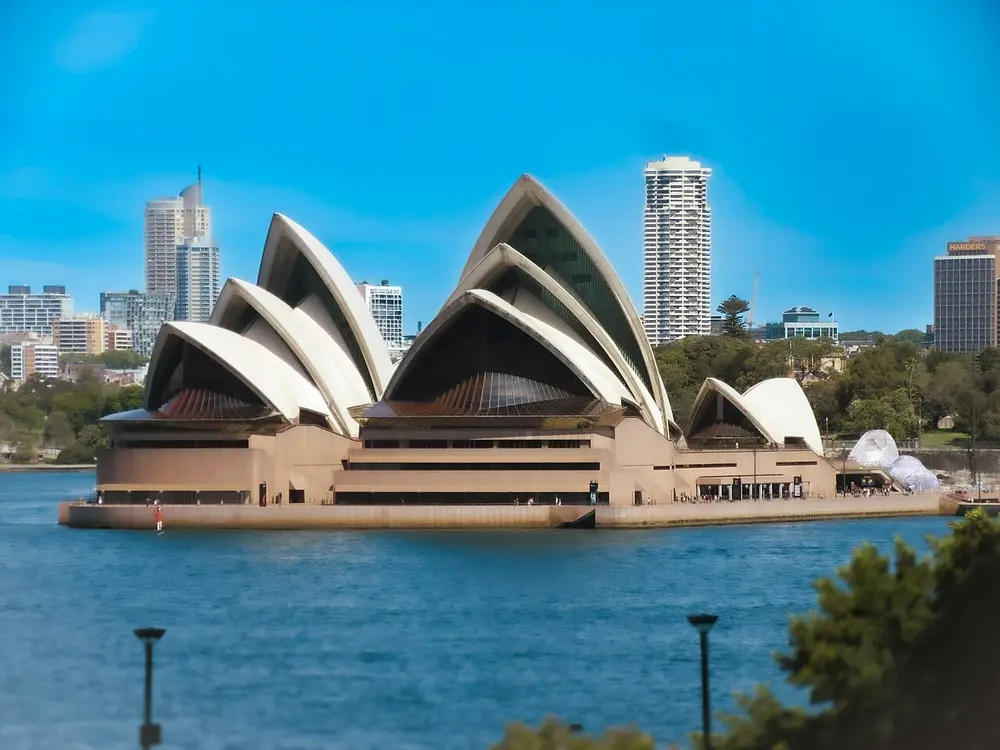
The Sydney Opera House on the harbour, a group of white curved shell roofs like sails or segments of an orange, on a broad base, with city towers behind and blue water in front.
Picture: BAVhah. CC BY-SA 4.0.

Sydney Opera House

Where
Bennelong Point, Sydney Harbour, Australia
When
Design chosen 1957; opened 1973
Who
Jørn Utzon, Denmark; finished by an Australian team led by Peter Hall
Style
Expressionism (modern)
Made with
Precast concrete shells covered in white and cream tiles

Utzon, then little known, won an international competition in 1957. Working out how to build his shells took years: in the end every shell was made from pieces of the same sphere, so the parts could be cast in a factory. After rows over cost he resigned in 1966 and never saw the finished building. Queen Elizabeth II opened it on 20 October 1973. It became a UNESCO World Heritage Site in 2007, while Utzon was still alive, and he won the Pritzker Prize in 2003.

Spot it by

White shell-shaped roofs like sails, on a platform by the water.

Remember

Utzon's sails are all cut from one sphere.

Don't confuse

The Lotus Temple in Delhi also has white curved shells, but its petals rise in rings around one centre like a flower.
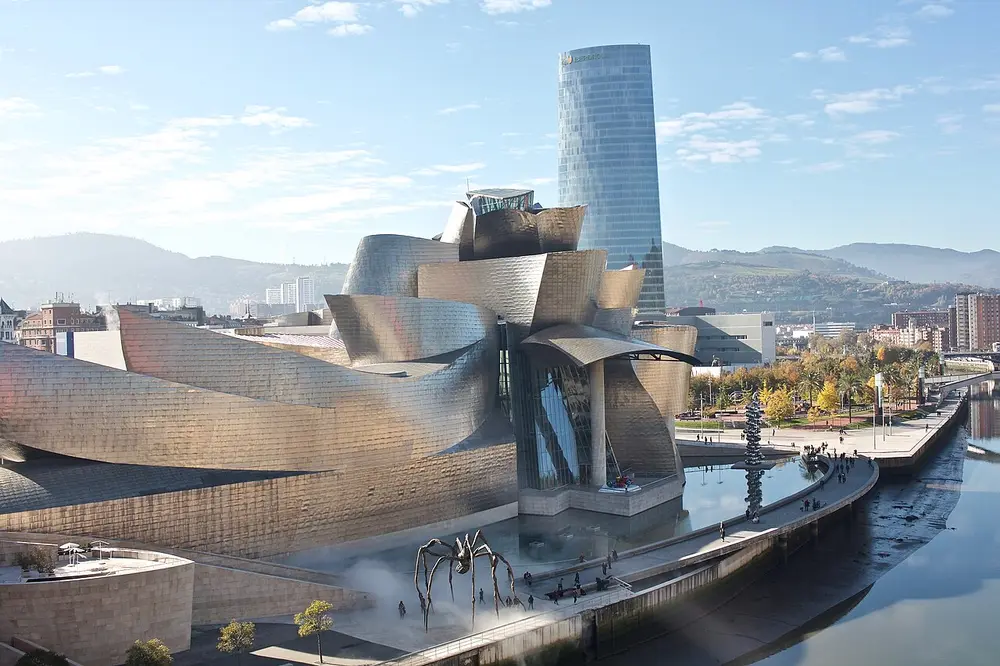
The Guggenheim Museum in Bilbao, a cluster of swooping, curved silver metal forms and glass beside a river, with a giant spider sculpture on the riverside walkway and a glass tower behind.
Picture: Naotake Murayama. CC BY 2.0.

Guggenheim Museum Bilbao

Where
Bilbao, Spain, beside the river Nervión
When
Opened October 1997
Who
Frank Gehry (1929 to 2025), Canadian-American
Style
Deconstructivism
Made with
Titanium sheets, limestone and glass

A museum of modern art whose silvery titanium curves seem to twist and flow like a ship or a fish. Gehry won the Pritzker Prize in 1989. The museum brought so many visitors to a run-down industrial city that a landmark building that turns a city around is now said to have the "Bilbao effect".

Spot it by

Wild, curving shapes clad in shining metal, with no straight walls.

Remember

Gehry's Bilbao is titanium waves.

Don't confuse

The Guggenheim in New York is by Frank Lloyd Wright (1959): a smooth white spiral, with a ramp inside winding up around an open centre.
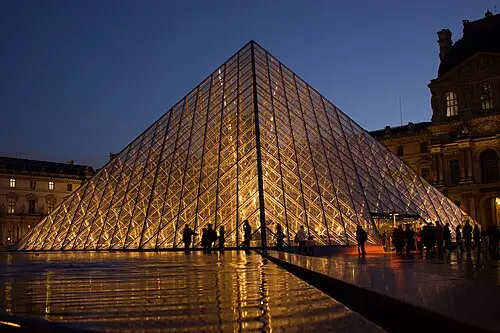
The Louvre Pyramid at dusk, a tall pyramid of glass panes held in a metal grid, glowing from inside, with the old stone palace of the Louvre behind and people walking past.
Picture: Hteink.min. CC BY-SA 3.0.

Louvre Pyramid

Where
Courtyard of the Louvre Museum, Paris, France
When
Completed 1989
Who
I.M. Pei (1917 to 2019), Chinese-American
Style
Modernism
Made with
Glass panes on a metal frame

The Louvre needed a large new entrance hall, so Pei put it underground and lit it with a glass pyramid about 21.6 metres tall, with three smaller pyramids around it. Its sides slope at nearly the same angle as the pyramids of Egypt. Many Parisians hated a modern glass pyramid in front of an old royal palace, but it soon became one of the city's landmarks. Pei won the Pritzker Prize in 1983.

Spot it by

A clear glass pyramid in a grid of metal, in front of an old stone palace.

Remember

Pei put a pyramid of glass in Paris.
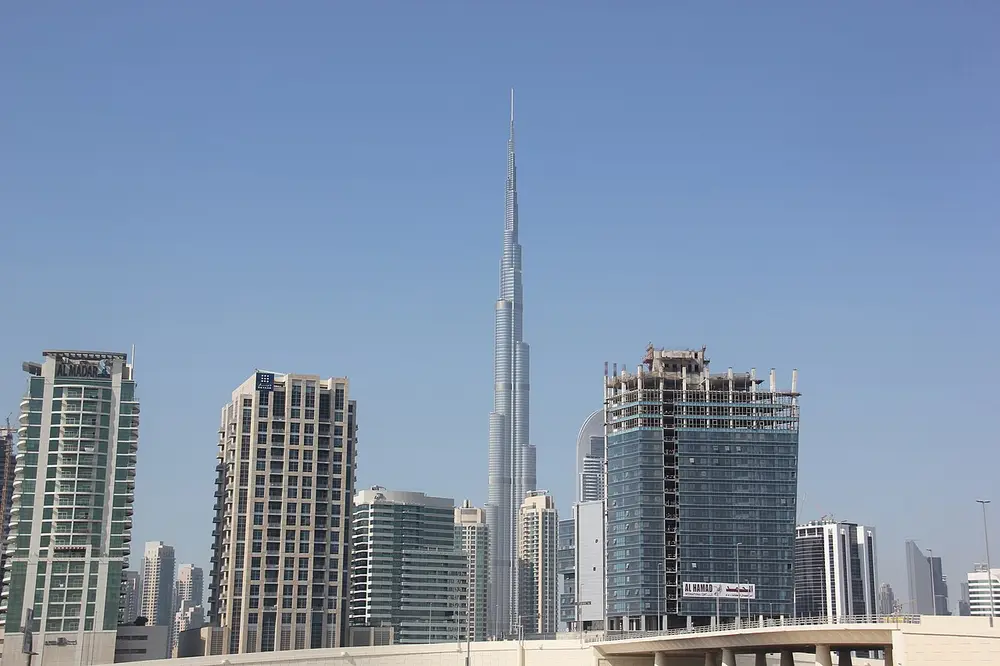
The Burj Khalifa in Dubai, a very tall, slim silver tower stepping back as it rises to a needle-like spire, more than three times as tall as the tower blocks around it, under a clear blue sky.
Picture: Laika ac. CC BY-SA 2.0.

Burj Khalifa

Where
Dubai, United Arab Emirates
When
Built 2004 to 2009; opened 2010
Who
Adrian Smith, chief architect at the firm Skidmore, Owings & Merrill (SOM)
Made with
Reinforced concrete, with a steel spire and a glass and metal skin

At 828 metres, the Burj Khalifa has been the tallest building in the world since it opened, taking the title from Taipei 101. It is still the tallest as of October 2026; the Jeddah Tower in Saudi Arabia is being built to pass it, with completion planned for about 2028. Its floor plan is shaped like a Y with three wings, and the wings step back one by one in a spiral as the tower rises, so it gets slimmer towards the top.

Spot it by

A silver needle far taller than everything around it, stepping in as it climbs.

Remember

Burj Khalifa, 828 metres, 2010.

More buildings to know

Building Architect City Year
St Peter's Basilica Bramante, Michelangelo (the dome) and Maderno; piazza by Bernini Vatican City, Rome 1506 to 1626
Barcelona Pavilion Ludwig Mies van der Rohe and Lilly Reich Barcelona 1929 (rebuilt 1986)
Guggenheim Museum Frank Lloyd Wright New York 1959
Centre Pompidou Renzo Piano and Richard Rogers, with Gianfranco Franchini Paris 1977
30 St Mary Axe (the Gherkin) Norman Foster London 2004
Beijing National Stadium (the Bird's Nest) Herzog and de Meuron, with the artist Ai Weiwei Beijing 2008
Heydar Aliyev Centre Zaha Hadid Baku, Azerbaijan 2012

The Centre Pompidou wears its pipes, lifts and escalators on the outside in bright colours, a style called high-tech. The Bird's Nest, built for the 2008 Olympics, is wrapped in a tangle of steel beams. The Heydar Aliyev Centre is one smooth white surface that flows up out of the ground with no sharp corners.

Pritzker Prize winners in this note

The Pritzker Architecture Prize, given every year since 1979, is the biggest prize in architecture. Le Corbusier, Frank Lloyd Wright and Mies van der Rohe all died before it began.

Architect Country Prize Building in this note
I.M. Pei United States 1983 Louvre Pyramid
Frank Gehry United States and Canada 1989 Guggenheim Bilbao
Renzo Piano Italy 1998 Centre Pompidou
Norman Foster United Kingdom 1999 30 St Mary Axe
Herzog and de Meuron Switzerland 2001 Beijing National Stadium
Jørn Utzon Denmark 2003 Sydney Opera House
Zaha Hadid United Kingdom (born in Iraq) 2004 Heydar Aliyev Centre
Richard Rogers United Kingdom 2007 Centre Pompidou
B.V. Doshi India 2018 See the Modern Indian architecture note

Zaha Hadid was the first woman to win the prize.

Timeline

  1. About 2560 BCE

    The Great Pyramid of Khufu is built at Giza

  2. 447 to 432 BCE

    The Parthenon is built in Athens

  3. 80 CE

    The Colosseum opens in Rome

  4. 537 CE

    Hagia Sophia is completed in Constantinople

  5. About 1113 to 1150

    Suryavarman II builds Angkor Wat

  6. 1163

    Work begins on Notre-Dame de Paris

  7. 1420

    The Forbidden City is completed in Beijing

  8. 1626

    St Peter's Basilica is completed

  9. 1882

    Work begins on the Sagrada Família; Gaudí takes over in 1883

  10. 1889

    The Eiffel Tower opens for the Paris World's Fair

  11. 1929

    Mies van der Rohe's Barcelona Pavilion

  12. 1931

    Le Corbusier's Villa Savoye is completed

  13. 1939

    Frank Lloyd Wright's Fallingwater is completed

  14. 1959

    Wright's Guggenheim Museum opens in New York

  15. 1973

    The Sydney Opera House opens

  16. 1977

    The Centre Pompidou opens in Paris

  17. 1979

    The first Pritzker Prize is awarded

  18. 1989

    I.M. Pei's Louvre Pyramid is completed

  19. 1997

    Frank Gehry's Guggenheim Bilbao opens

  20. 2010

    The Burj Khalifa opens as the world's tallest building

  21. 2019

    Fire destroys Notre-Dame's roof and spire

  22. 2024

    Notre-Dame reopens

  23. 2025

    The Sagrada Família becomes the tallest church in the world

  24. 2026

    The Sagrada Família's central tower reaches its full 172.5 metres

Test yourself

Question 1 of 8

Which of these buildings is in Cambodia?

Question 2 of 8

Who designed this house?

Question 3 of 8

Which of these buildings was designed by Frank Gehry?

Question 4 of 8

Who designed this building?

Question 5 of 8

Which building shows Le Corbusier's "five points": stilts, free plan, free façade, strip windows and a roof garden?

Question 6 of 8

Which of these is a Gothic cathedral with flying buttresses?

Question 7 of 8

Who designed the glass pyramid at the Louvre in Paris?

Question 8 of 8

As of October 2026, which is the tallest building in the world?

From past papers

Real exam questions on this topic, each with a full solution.

Finished this note?

Mark it as studied to track your progress through the course.

Was this note useful?

Each picture is credited underneath it. Pictures of works still in copyright are shown small, for teaching only. If you hold the rights to a picture and want it removed, tell us through the contact page and we will take it down.