Chapter 10: Environment, climate and sustainable design
Designing sustainably
How designers cut waste and carbon, from cradle to cradle and the circular economy to stepwells, kulhads, cork, mycelium and India's green building ratings.
1Life-cycle thinking looks at a product's whole life: raw materials, making, transport, use and what happens when it is thrown away.
2A carbon footprint is the greenhouse gas an activity or product gives off. Embodied carbon is the part released in making the materials and putting a building or product together.
3Cradle to Cradle (2002), by the American architect William McDonough and the German chemist Michael Braungart, says waste should become food for something new.
4The Ellen MacArthur Foundation, set up in 2010, promotes the circular economy: design out waste, keep things in use, regenerate nature.
5India's old answers: stepwells store water, jaalis let in air but block the sun, and kulhads, leaf plates and khadi return to the earth.
6India's green building ratings are GRIHA (by TERI, the national rating since 2007) and IGBC (by CII, formed 2001); LEED is the American one.
Think about the whole life of a thing
Every object has a life story. Materials are dug up, grown or made; they are shaped in a factory; the product travels to a shop; someone uses it; then it is thrown away, burnt, buried or used again. Looking at all of these stages together is called life-cycle thinking. The old, wasteful pattern is called cradle to grave: a product is born, used once and buried. A life-cycle assessment adds up the energy, water and pollution at every stage, so designers can see which stage does the most harm.
A carbon footprint is the total greenhouse gas released by an activity, a product or a person, usually counted as if it were all carbon dioxide. For a building there are two parts. Embodied carbon is released before anyone moves in: making the cement, steel and glass, carrying them to the site and building. Operational carbon comes from running the building every day, such as lights and air conditioning. A building can save energy every day and still carry a heavy load of embodied carbon from its concrete.
Greenwashing is the opposite of real sustainable design: advertising something as "green" or "eco-friendly" without truly changing how it is made. The word was coined in 1986 by the American environmentalist Jay Westerveld, about hotels asking guests to reuse towels "to save the environment".
The Rs, from best to last:
R
What it means
Example
Refuse
Don't take what you don't need
Say no to a plastic bag or straw
Reduce
Use less material and energy
A lighter bottle, a smaller box
Reuse
Use the same thing again
A steel tiffin instead of foil
Repair
Fix it instead of replacing it
A phone with a battery you can swap
Recycle
Turn waste into new material
Old PET bottles spun into polyester
Recycling comes last because it still uses energy, and the material often comes back weaker. The higher up the list, the less waste there is to deal with.
William McDonough, American architect (pictured), and Michael Braungart, German chemist
Key works
Cradle to Cradle, Remaking the Way We Make Things
McDonough and Braungart argued that being "less bad" is not enough. In nature there is no waste, because a fallen leaf feeds the soil. So every material should be designed to go somewhere useful after its first life. They split materials into two loops. Biological nutrients, such as cotton or wood, can safely go back to the soil. Technical nutrients, such as metals and some plastics, should go round and round in factories without losing quality. To make the point, the book itself was printed on waterproof "paper" made of plastic that can be recycled, not on paper from trees.
Spot it by
Two loops: one back to nature, one back to the factory.
Remember
Cradle to grave ends in a dump; cradle to cradle starts a new life.
Don't confuse
Cradle to cradle is the idea; the circular economy is the wider plan for a whole economy built on similar ideas.
Ellen MacArthur, British sailor (pictured), and the Ellen MacArthur Foundation
Today's economy is mostly a straight line: take, make, throw away. A circular economy keeps products and materials in use for as long as possible. In 2005 Ellen MacArthur set a world record for sailing alone around the world. On a boat she had to make every bit of food and fuel last, and she saw that the world's resources are limited in the same way. In 2010 she started a foundation to spread the circular economy. Its three principles are to design out waste and pollution, to keep products and materials in use at their highest value, and to regenerate nature.
Remember
A line ends in a dump; a circle comes back round.
India's old answers
Long before the word "sustainable", Indian builders and craftspeople used local materials, the sun, the wind and the shape of a building to keep people cool and to waste almost nothing. (The architects who carried these ideas into modern India, such as Laurie Baker, are in the modern Indian architecture note.)
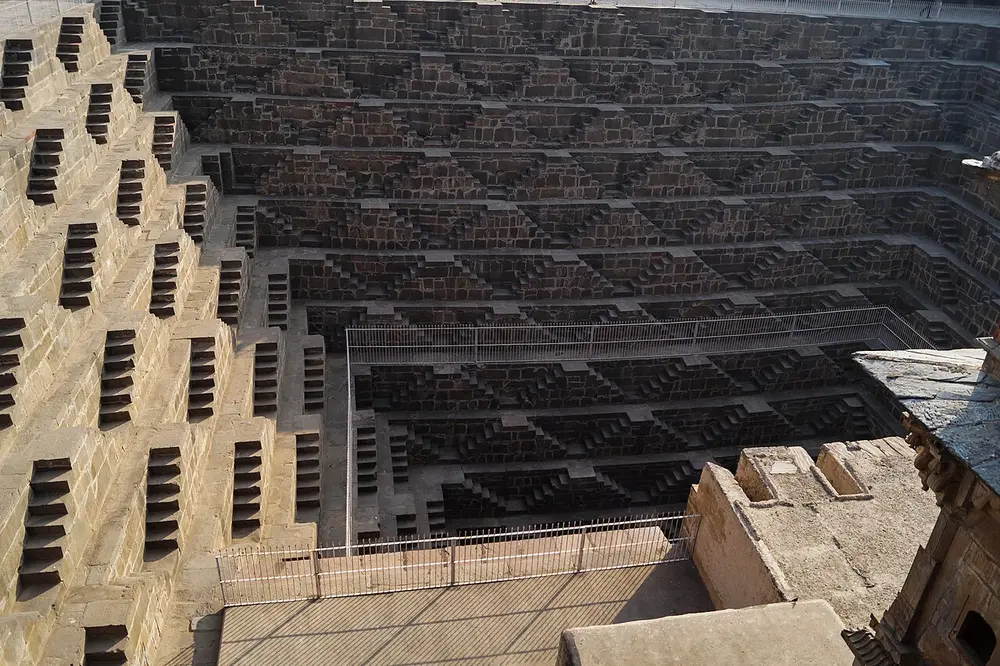
About the 8th to 9th century CE; upper parts added later
Who
Traditionally linked to Raja Chanda of the Nikumbh dynasty
Made with
Stone blocks
In dry western India, rain falls in a few months and the land is thirsty for the rest of the year. A stepwell (baori or bawdi in Hindi, vav in Gujarati) is a deep well with flights of steps going down to the water, so people could reach it however low it fell. Chand Baori has about 3,500 steps on 13 levels, arranged like an upside-down pyramid. The deep stone walls also stay cool, so stepwells were shady places to rest in the summer heat.
Spot it by
A deep pit with criss-cross flights of narrow steps on three sides.
Remember
Stepwells are steps down to water.
Don't confuse
Rani-ki-Vav in Patan, Gujarat, is a stepwell too, carved with sculptures and a World Heritage Site since 2014. Chand Baori is famous for its zigzag steps.
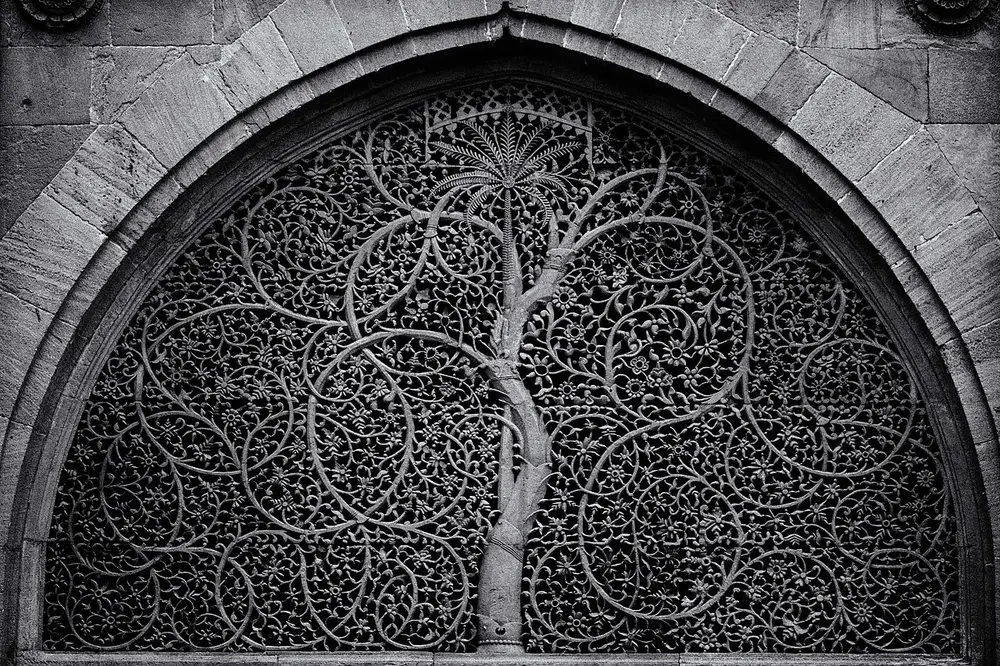
A jaali is a screen of stone, wood or brick cut with many small holes. It lets in light and breeze but keeps out the harsh sun and rain, and people inside can see out without being seen. The moving air helps to cool the room. The Sidi Saiyyed Mosque's most famous jaali (pictured) is carved as a tree with curling branches, and it inspired the logo of IIM Ahmedabad. Modern architects are using jaalis again to cut the need for air conditioning.
Spot it by
Stone carved like lace, in grids, stars, flowers or a tree.
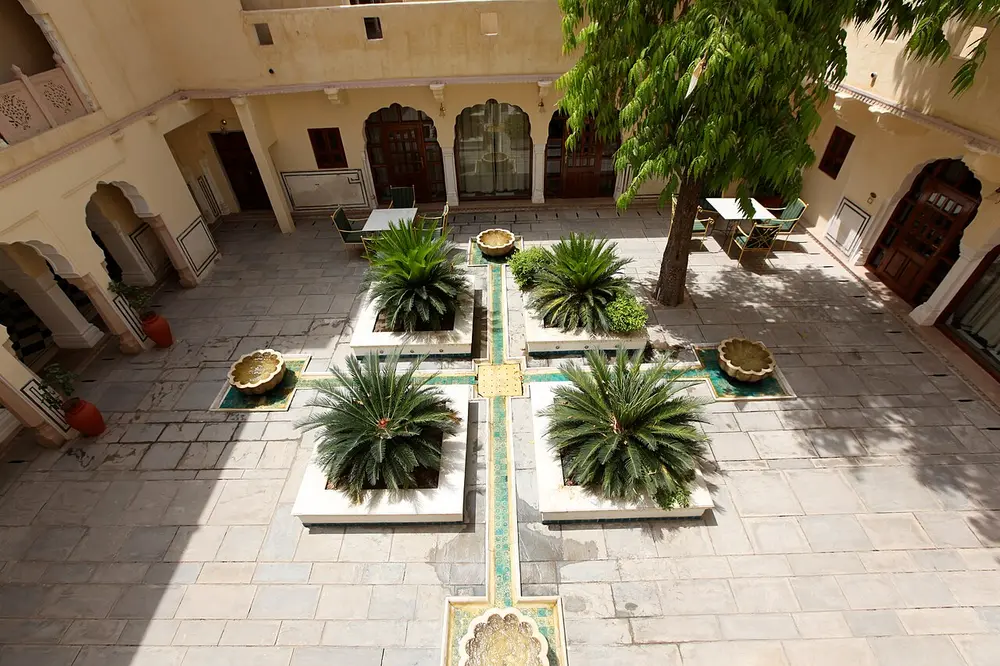
Havelis of Rajasthan and Gujarat; this one is in Jaipur
Old Indian houses, from the havelis of Rajasthan to the nalukettu houses of Keralam (Kerala until 2026), are often built around an open courtyard. The rooms open onto it for light and air. The courtyard is shaded for much of the day, and as warm air rises out of it, cooler air is drawn in through the rooms. In Iran and the Gulf, builders added wind catchers (badgirs), tall towers that catch the breeze above the rooftops and send it down into the house. Both cool a building with no machines at all.
Spot it by
Rooms around an open square, with a tree, plants or water in the middle.
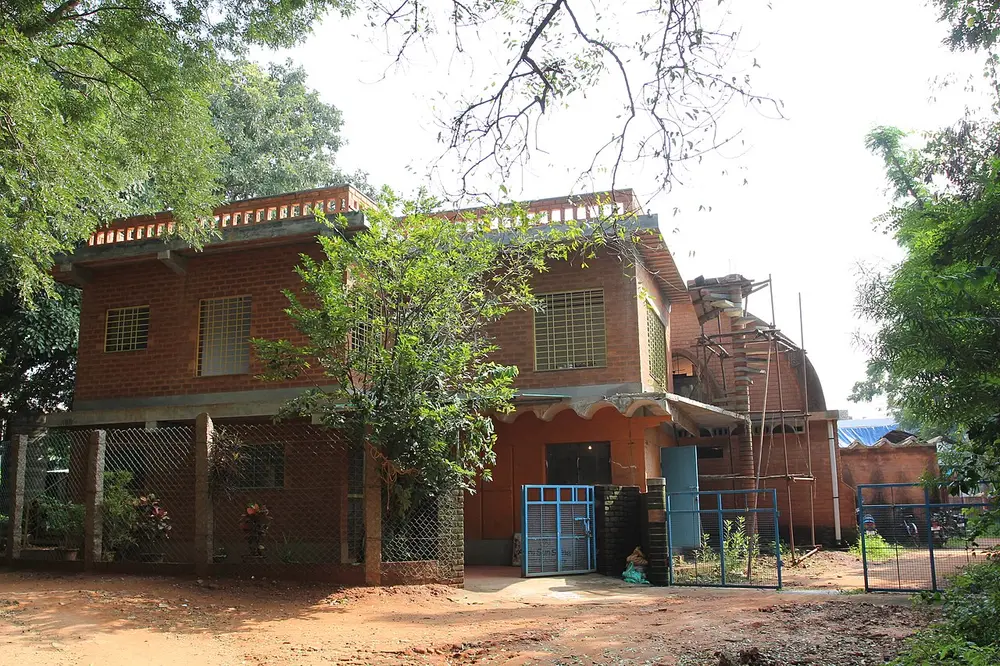
Auroville Earth Institute, Auroville, near Puducherry, Tamil Nadu (pictured)
Made with
Damp soil with a little cement or lime, pressed into blocks
Mud houses have been built in India for thousands of years. The soil is dug on the spot, so nothing travels far, and thick earth walls keep rooms cool by day and warm at night. The Auroville Earth Institute, led by Satprem Maïni, has spent decades improving the idea. Its main method is the compressed stabilised earth block: damp soil mixed with a little cement or lime and squeezed hard in a press. The blocks are dried in the sun instead of being fired in a kiln, so they use much less energy than burnt bricks. The institute builds vaults and domes with them and trains builders from many countries.
Spot it by
Neat, even earth-coloured blocks, often in vaults and domes.
Remember
Sun-dried, not kiln-fired.
Don't confuse
Rammed earth is also soil, but it is packed in layers inside a wooden frame on site, not pressed into blocks.
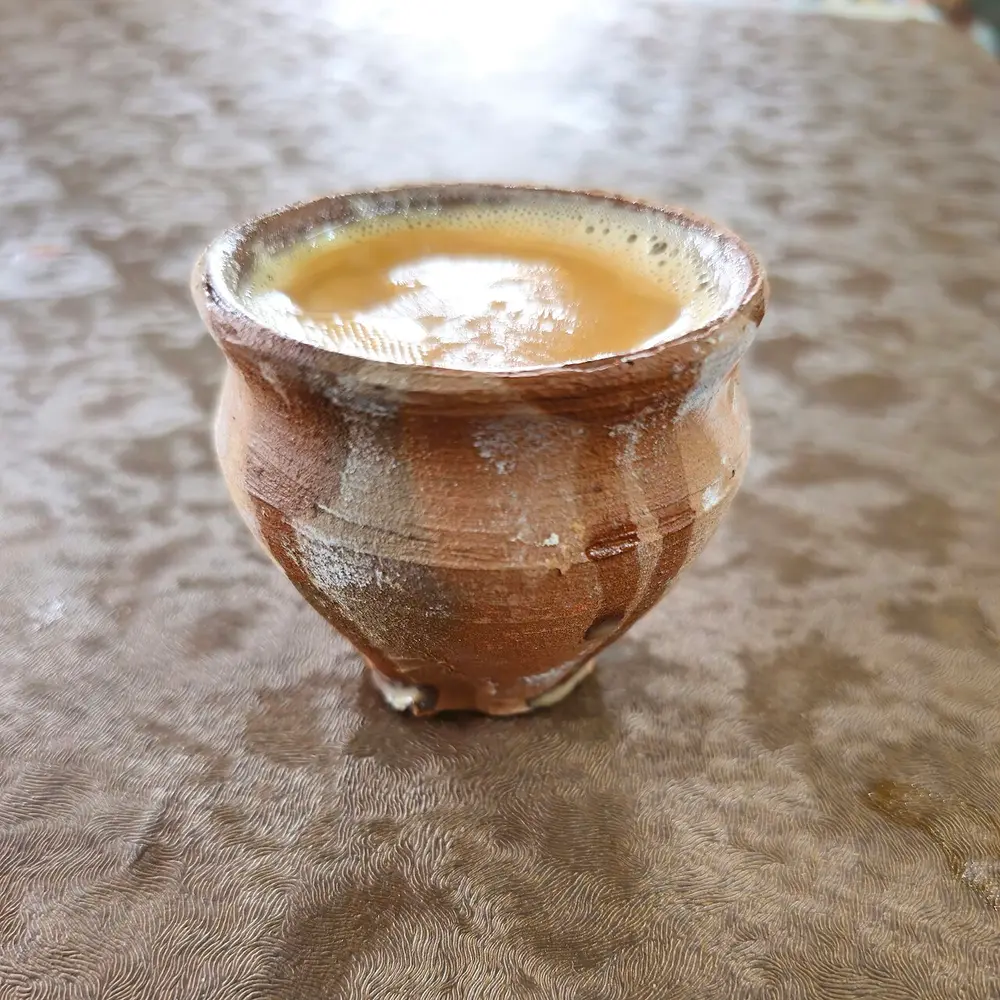
A kulhad is a small, plain clay cup with no handle and no glaze, used once for tea, lassi or milk and then thrown away. Because it is only baked clay, it breaks back into soil instead of lasting for centuries like plastic. In 2004 Indian Railways tried to bring kulhads back at stations in place of plastic cups. By 2008 the plan had largely failed, because kulhads were heavier and cost more, and critics pointed out that firing billions of cups in kilns burns a lot of fuel and uses up topsoil. So even a natural material has a cost, and designers must look at the whole life cycle.
Spot it by
A small, rough, reddish-brown clay cup, often served with chai.
All over India; areca plates especially from Karnataka
Made with
Sal leaves stitched with thin bamboo pins; or areca palm sheaths, pressed with heat
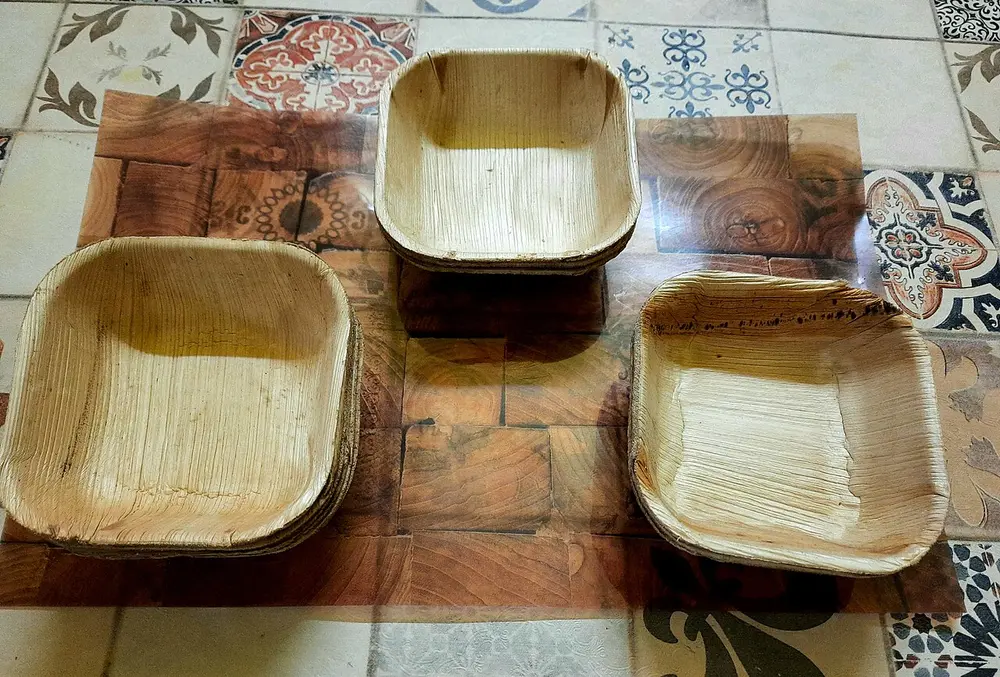
For centuries Indians have eaten festival meals off plates made of leaves. A pattal is made by stitching sal leaves together with thin slivers of bamboo, and it is still a cottage craft. Newer areca plates (pictured) are pressed from the tough sheath that falls naturally from the areca palm, so no tree is cut. Both are used once and then rot away, unlike plastic or foam plates.
Spot it by
Rough, brown, natural plates with the grain of a leaf.
First made at Gandhi's Sabarmati Ashram in 1917 to 1918
Who
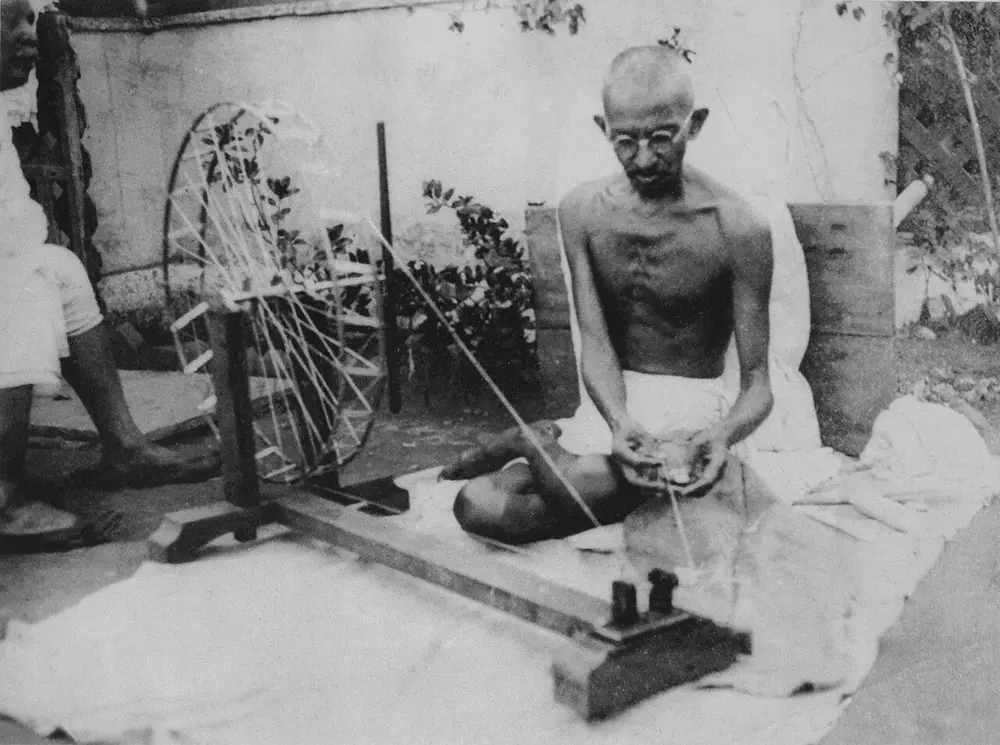
Promoted by Mahatma Gandhi (pictured)
Made with
Cotton, silk or wool, spun by hand on a charkha and woven by hand
Khadi is cloth that is both spun and woven by hand. Gandhi made it a symbol of the freedom struggle: by spinning their own thread, Indians could stop buying cloth from British mills. It also needs no factory power, gives work to spinners and weavers in villages, and uses natural fibres. Today it is promoted by the government's Khadi and Village Industries Commission.
Spot it by
Slightly uneven, textured cloth, and the charkha spinning wheel.
Remember
Khadi is hand-spun and hand-woven.
Low-impact materials
Material
What it is
Why it's low-impact
Bamboo
A giant grass
Grows back fast after cutting; very strong for its weight
Cork
Bark of the cork oak
Stripped every nine years without cutting the tree
Jute
Fibre from the stem of the jute plant
Rain-fed, needs little fertiliser, and rots away; India is the largest producer
Mycelium
The root-like threads of fungi
Grown, not mined, on farm waste; can be composted
Recycled PET
Plastic bottles melted or shredded and remade
Keeps bottles out of landfill; used for polyester fabric
Rammed earth
Damp soil packed hard in layers inside a frame
Dug on site, needs no kiln
Lime
Burnt limestone, used in plaster and mortar
Takes carbon dioxide back from the air as it hardens; lets walls breathe
Most of India's jute is grown, and most of its jute mills stand, in West Bengal. Recycled PET is everywhere now: the Indian cricket team's World Cup shirts of 2015 and 2019 were made of recycled polyester, and CEED 2023 asked students to match products such as a football boot and a cricket shirt with the waste they were made from.
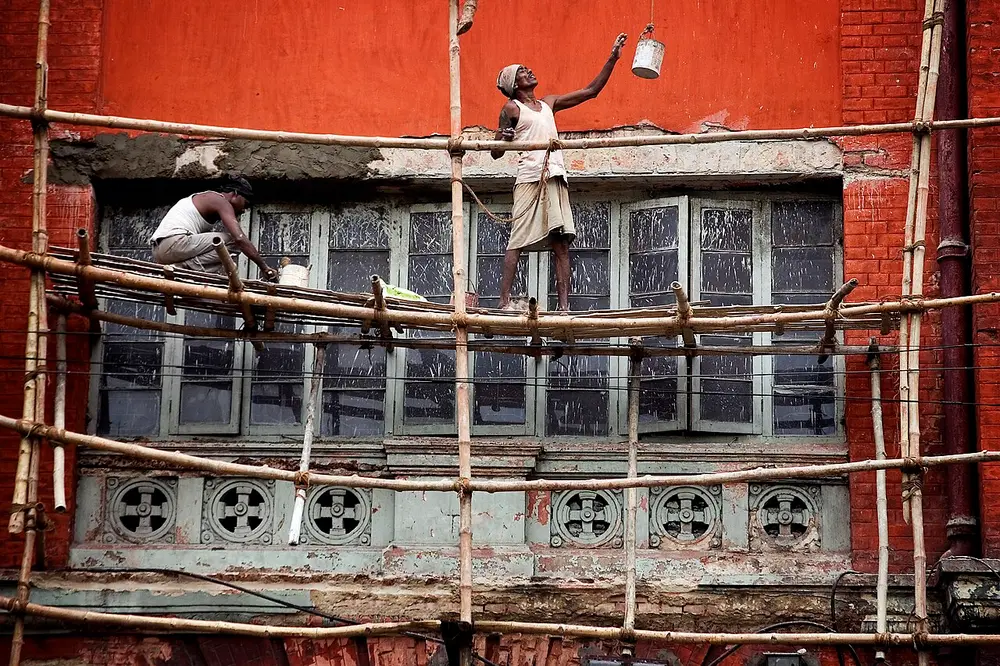
Kolkata (pictured); grown across India, especially the northeast
Made with
Hollow, jointed stems called culms
Bamboo is not a tree but a giant grass, and some kinds grow almost a metre in a single day. A clump can be cut again and again for years without being replanted. Its hollow stems are light but very strong, which is why Indian builders trust bamboo scaffolding on tall buildings. It is also used for houses, furniture, mats, baskets and even bicycles.
Spot it by
Straight, hollow poles with rings (nodes) along them.
Remember
Bamboo is the fastest-growing building material: a grass you can build with.
Around the Mediterranean; Portugal produces about half the world's cork
Made with
The bark of the cork oak (Quercus suber)
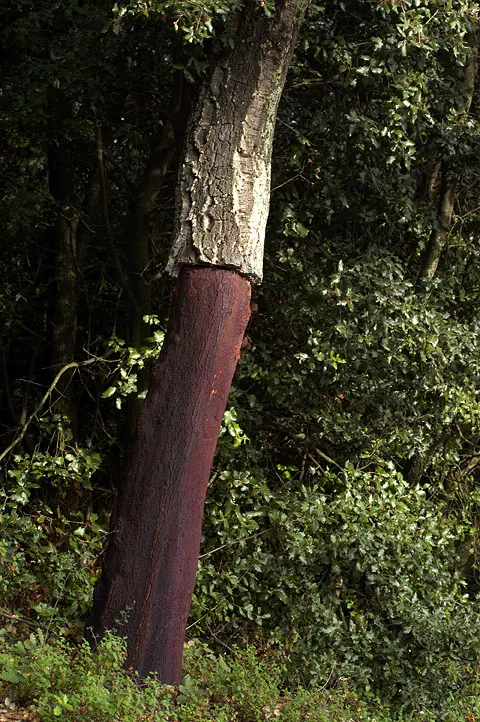
Cork is the thick outer bark of the cork oak. Workers peel it off by hand about every nine years, and the tree keeps living and growing a new layer, so no tree is cut down. Cork is light, floats, keeps out water and holds heat in, so it is used for bottle stoppers, floors, notice boards, shoe soles and even "vegan leather" bags. After use it can be ground up and made into new cork products.
Spot it by
A trunk stripped bare to a reddish-brown band, with rough grey bark above.
Ecovative Design, United States (pictured); The Living, architects
Made with
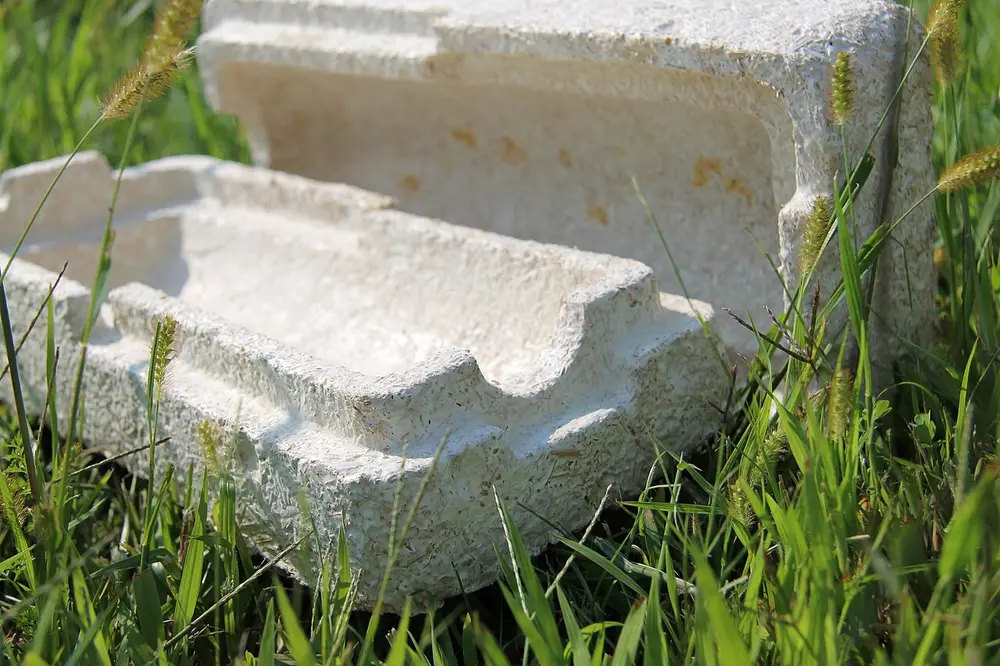
Mushroom mycelium grown on chopped farm waste
Mycelium is the network of fine white threads that a fungus grows underground; a mushroom is only its fruit. If farm waste such as corn stalks is packed into a mould with mycelium, the threads grow through it and bind it into a solid, light shape. The American company Ecovative makes packaging this way (pictured) to replace polystyrene foam. In 2014 the architects The Living built Hy-Fi, a tower of mycelium bricks, in the courtyard of the MoMA PS1 gallery in New York; when the summer ended, the bricks were composted.
Spot it by
White or cream material with a fuzzy, felt-like surface.
Remember
Mycelium is a material you grow, not one you dig or drill.
Made to come apart
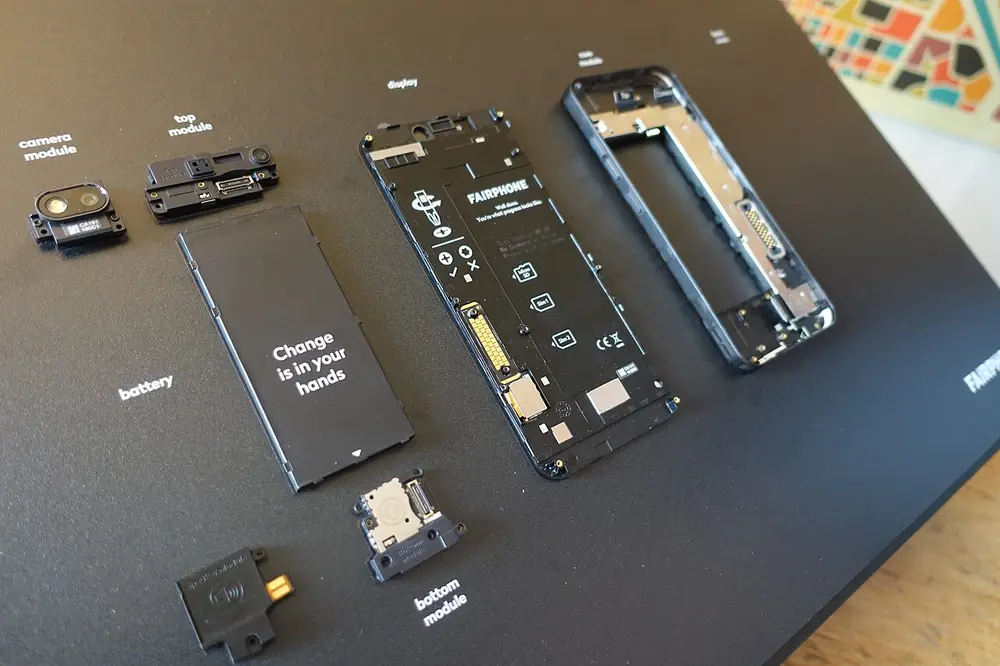
Design for disassembly means planning from the start how a product or building will be taken apart, so that its parts can be repaired, reused or recycled. Screws and clips are used instead of glue, and different materials are kept separate.
Most phones are glued shut, so a broken screen or a tired battery often means a new phone. Fairphone, a Dutch company, builds phones from a few modules held in by screws and clips: the battery, the screen, the cameras and so on (pictured, the Fairphone 3 in 2019). Owners can replace a part themselves with a small screwdriver and order spare parts. The repair website iFixit has given its phones top marks for repairability, and the company also tries to use recycled and fairly mined materials.
Spot it by
A phone shown as a set of separate, labelled parts.
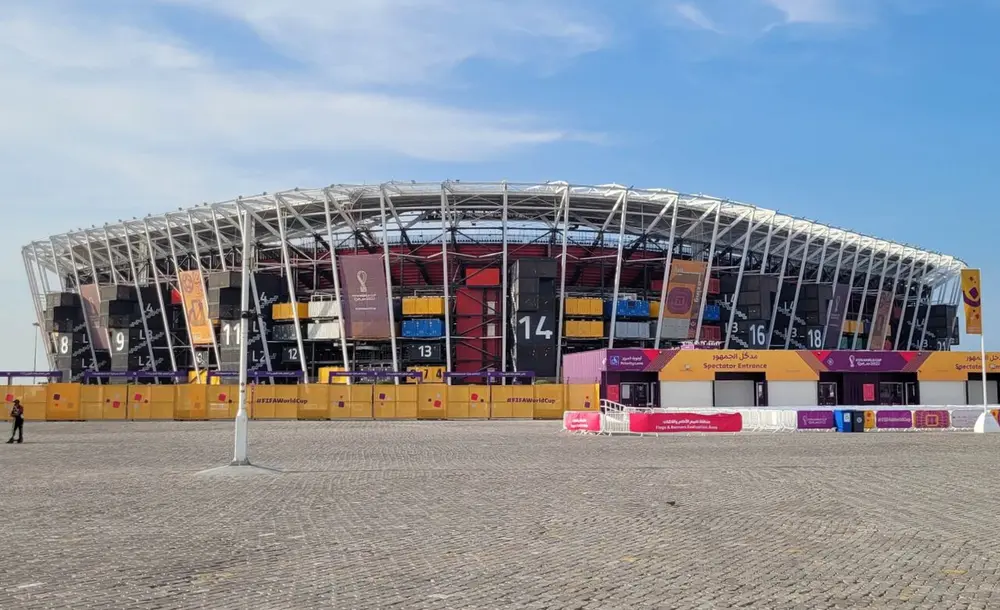
Big tournaments often leave behind huge stadiums that are hardly used again. Stadium 974 was planned as the first temporary stadium in World Cup history, built so that it could be taken apart and put up again somewhere else. Its walls are made of old shipping containers, some holding toilets, stairs and food stalls, bolted into a steel frame. The number 974 is both Qatar's telephone code and the number of containers used. CEED 2023 showed it and asked what it was made from.
Spot it by
A stadium of stacked, colourful shipping containers.
Remember
974 is both the number of containers and Qatar's telephone code.
Another favourite of exam setters: the gold, silver and bronze medals of the Tokyo 2020 Olympics were made from metal recovered from small electronics, including millions of old mobile phones, given by people across Japan.
Sorting waste
Recycling only works if waste is sorted where it is made. India's Solid Waste Management Rules of 2016 ask every household to keep three kinds of waste apart.
Bin
What goes in it
Examples
Wet (biodegradable)
Things that rot
Peels, food scraps, leaves, tea leaves
Dry (recyclable)
Things that can be remade
Paper, cardboard, plastic bottles, metal cans, glass, old clothes
Domestic hazardous
Things that are poisonous or dangerous
Batteries, medicines, paint, bulbs, chemicals
Green building ratings
A green building rating checks how well a building saves energy and water, uses healthy and low-impact materials, handles waste and treats its site. Buildings earn points and get a level, such as LEED Platinum or GRIHA five stars.
Rating
Run by
Started
Note
LEED
US Green Building Council
1998
The best known worldwide
GRIHA
TERI, with the Ministry of New and Renewable Energy
National rating since 2007
India's own national rating system
IGBC
Indian Green Building Council, part of CII
Council formed 2001
Many rating types, from homes to factories
In 2003 the CII-Sohrabji Godrej Green Business Centre in Hyderabad, now the home of IGBC, became the first building outside the United States to be rated LEED Platinum.
Timeline
8th to 9th century CE
Chand Baori stepwell is built at Abhaneri, Rajasthan
1573
The Sidi Saiyyed Mosque in Ahmedabad is completed, with its famous jaalis
1917
The first khadi is woven at Gandhi's Sabarmati Ashram
1986
Jay Westerveld coins the word greenwashing
1998
The US Green Building Council launches LEED
2001
CII forms the Indian Green Building Council
2002
McDonough and Braungart publish Cradle to Cradle
2003
The CII-Godrej Green Business Centre, Hyderabad, is the first LEED Platinum building outside the US
2004
Indian Railways tries to bring back the kulhad
2007
GRIHA becomes India's national green building rating
2010
Ellen MacArthur sets up her foundation for the circular economy
2013
Fairphone is founded in Amsterdam
2014
Hy-Fi, a tower of mycelium bricks, stands at MoMA PS1 in New York
2016
India's Solid Waste Management Rules ask homes to sort waste three ways
2021
Tokyo 2020 Olympic medals, made from old phones, are awarded; Stadium 974 opens
Test yourself
Question 1 of 8
What was this structure mainly built for?
Question 2 of 8
Who wrote Cradle to Cradle (2002)?
Question 3 of 8
Which idea does this phone show best?
Question 4 of 8
What is harvested from this tree, which keeps growing afterwards?
Question 5 of 8
Which of these was built to be taken apart and moved?
Question 6 of 8
What does this stone screen do for a building?
Question 7 of 8
Which green building rating is India's national rating system, developed by TERI?
Question 8 of 8
A company calls its product "eco-friendly" but changes nothing about how it is made. What is this called?
From past papers
Real exam questions on this topic, each with a full solution.
Mark it as studied to track your progress through the course.
Was this note useful?
Each picture is credited underneath it. Pictures of works still in copyright are shown small, for teaching only. If you hold the rights to a picture and want it removed, tell us through the contact page and we will take it down.