Skip to content

Chapter 11: Cinema, photography and media

Print, posters, comics and advertising

From Gutenberg's press to the Amul girl: how printing came to India, and the comics, cartoonists, ads and posters that design exams ask about.

In one minute

6 facts to know

  1. Gutenberg printed with movable metal type in Mainz, Germany, from the 1440s. India's first press reached Goa in 1556, and its first newspaper, Hicky's Bengal Gazette, came out in Calcutta in 1780.
  2. Anant Pai started Amar Chitra Katha in 1967 to retell Indian myths and history as comics, and the children's magazine Tinkle in 1980. Pran created Chacha Chaudhary for Lotpot.
  3. R.K. Laxman drew the silent Common Man in his daily cartoon You Said It in The Times of India from 1951. Mario Miranda drew crowded, cheerful scenes of Goa.
  4. Shankar's Weekly (1948 to 1975) was India's answer to Punch and gave cartoonists such as Laxman and Abu Abraham a start.
  5. The Amul girl has joked about the news on hoardings since 1966. Alyque Padamsee's Lintas made the Liril waterfall, Lalitaji and Hamara Bajaj, and Piyush Pandey's Ogilvy made the Fevicol and Asian Paints ads.
  6. The four families of printmaking: relief (woodcut), intaglio (etching), planographic (lithography) and stencil (screen printing, also called serigraphy).

The printing press reaches India

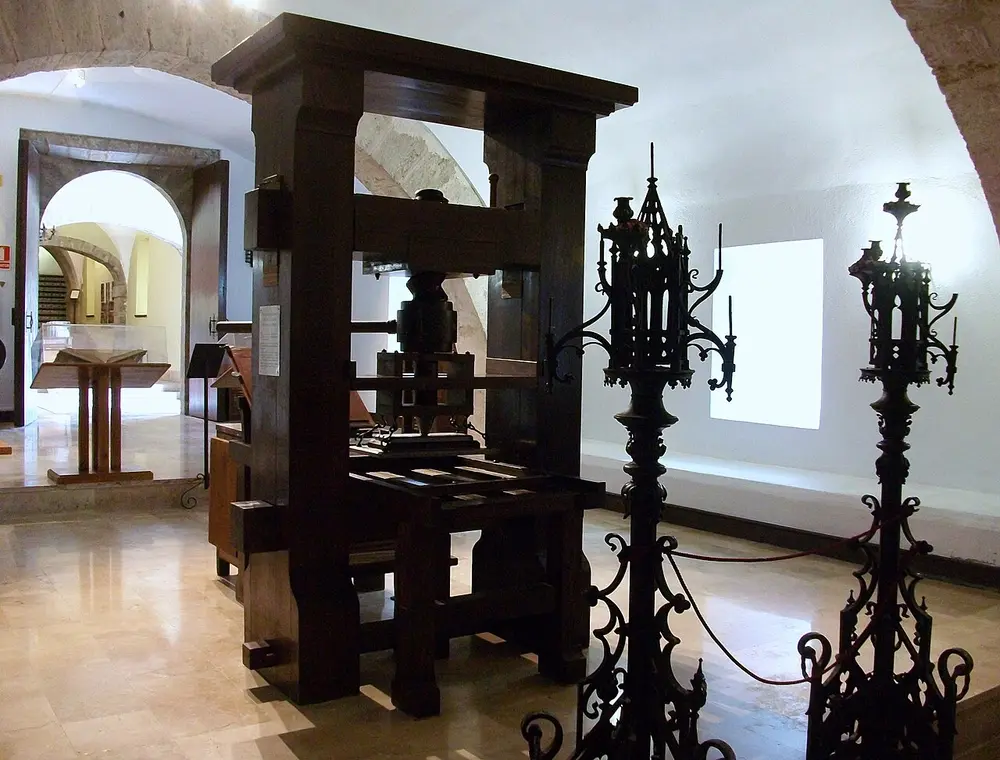
A tall, dark wooden hand press with a heavy upright frame and a big central screw, standing in a museum room with white arched walls beside two ornate black iron stands.
Picture: Joanbanjo. CC BY-SA 3.0.

Gutenberg's printing press

Where
Mainz, Germany. This replica is in the printing museum at El Puig, near Valencia, Spain
When
1440s; the Gutenberg Bible was printed in the 1450s
Who
Johannes Gutenberg, Germany
Made with
A wooden screw press, metal letters cast in a hand mould, and oil-based ink

Gutenberg cast thousands of small metal letters in a mould, all exactly the same size. A printer set them in lines to make a page, inked them, and pressed paper onto them with a wooden screw press, like the presses farmers used. After printing, the letters were taken apart and reused for the next page, which is why it is called movable type. His Bible, printed in Mainz in the 1450s, is also called the 42-line Bible because most of its pages have 42 lines. Books became far cheaper and faster to make, and new ideas spread across Europe.

Spot it by

A tall wooden frame with a big screw and a pulling bar, a flat bed that slides in under it, and a hinged frame to hold the paper.

Remember

Gutenberg, 1440s: letters you can move, in a press you screw down.

Don't confuse

Movable type was not new: it had been used in East Asia centuries earlier. What Gutenberg added was a complete system, from casting type to the press and the ink, that made printing fast.
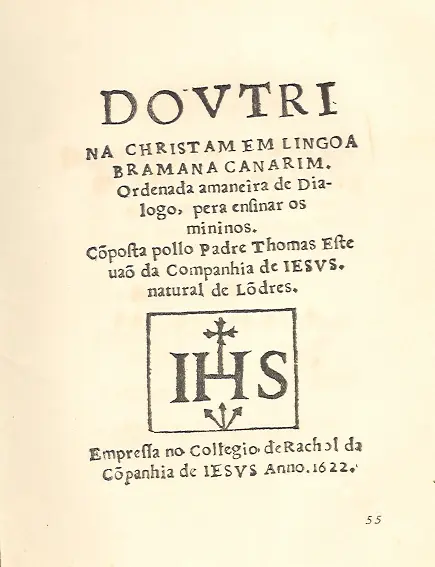
The title page of an old printed book, with the words Doutrina Christam em Lingoa Bramana Canarim at the top, a small emblem of the letters IHS with a cross in the middle, and a line at the bottom saying it was printed at the college of Rachol in 1622.
Picture: Thomas Stephens. Public domain.

India's first printing press

Where
St Paul's College, Old Goa
When
1556
Who
Jesuit missionaries, in Portuguese-ruled Goa

In 1556 a ship carrying Jesuit missionaries and a printing press stopped at Goa on its way from Portugal to Abyssinia (now Ethiopia). The mission there fell through, the clergy in Goa asked to keep the press, and it was set up at St Paul's College in Old Goa. That made it the first printing press in India, about a hundred years after Gutenberg. Its first known work, printed the same year, was a set of philosophy theses for students, and it went on to print mostly religious books. The title page shown here is from a later Goa book: Thomas Stephens's Christian teachings in Konkani, printed at the Jesuit college in Rachol in 1622.

Remember

Goa got India's first press in 1556, a century after Gutenberg.

Don't confuse

The first press was in Goa in 1556, but India's first newspaper came more than 200 years later, in Calcutta in 1780.
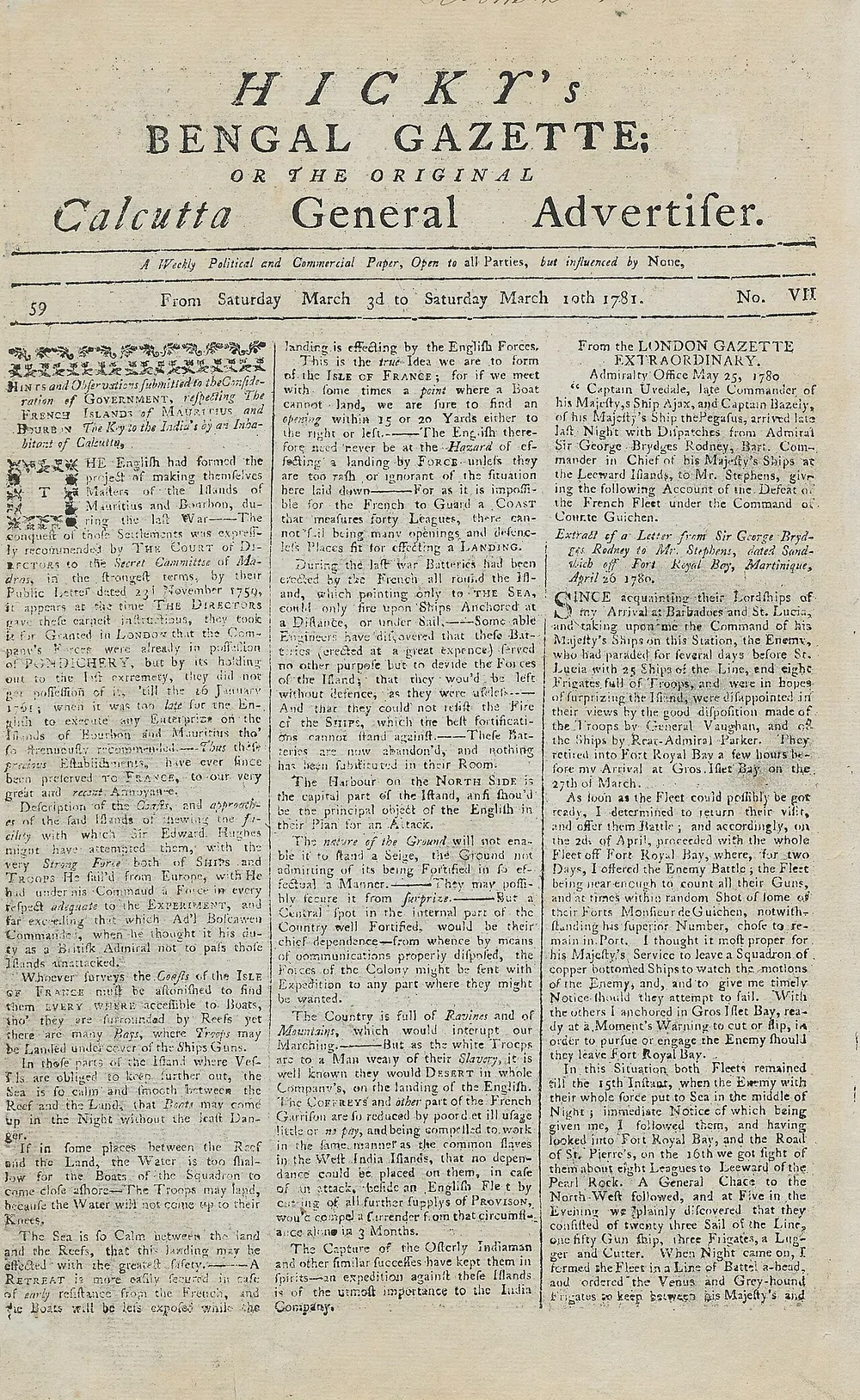
The front page of an old newspaper with the title Hicky's Bengal Gazette, or the Original Calcutta General Advertiser across the top, above three columns of small, dense printed text.
Picture: James Augustus Hicky. Public domain.

Hicky's Bengal Gazette

Also called The Original Calcutta General Advertiser

Where
Calcutta (now Kolkata), then the capital of British India
When
First issue 29 January 1780; closed in 1782. This page is from 10 March 1781
Who
James Augustus Hicky, an Irishman

India's first newspaper, and the first printed anywhere in Asia, was a weekly paper in English. Hicky began with news, gossip and advertisements, but soon attacked the Governor-General, Warren Hastings, and officials of the East India Company, accusing them of corruption. The Company stopped the paper from being sent by post, Hicky was jailed after libel cases, and in 1782 his printing type was seized, which ended the paper. It is remembered as the start of the fight for a free press in India.

Remember

Hicky, 1780, Calcutta: India's first newspaper.

In 1894 the painter Raja Ravi Varma opened a press in Bombay to sell cheap colour prints of gods and goddesses. Those prints, and the press, are covered in From Ravi Varma to the Bengal School.

The four ways to make a print

Printmaking means making many copies of one image from a prepared surface, such as a block, plate or screen. UCEED 2015 asked which terms belong to printmaking: serigraphy, lithography and etching do, but cartography is map-making.

Family How it prints Examples
Relief Ink sits on the raised parts; the parts cut away stay white Woodcut, linocut, Gutenberg's letterpress
Intaglio Lines are cut or eaten by acid into a metal plate, and the ink held in the grooves is pressed onto damp paper Engraving, etching
Planographic The surface is flat: a greasy drawing takes the ink while wet areas push it away Lithography, offset printing
Stencil Ink is pushed through the open parts of a stencil or a fine mesh Screen printing, also called serigraphy

Comics for Indian children

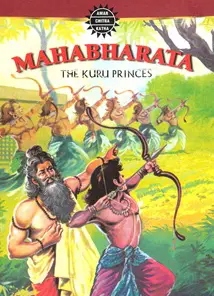
A comic book cover titled Mahabharata, The Kuru Princes, showing a bearded sage and a young prince drawing their bows and shooting arrows in a forest, with the round Amar Chitra Katha badge at the top.
Picture: Amar Chitra Katha. Copyright ACK Media, shown for teaching.

Amar Chitra Katha

Also called ACK, "immortal picture stories"

Where
Bombay (Mumbai), first published by India Book House
When
1967
Who
Anant Pai, known to readers as Uncle Pai

Anant Pai was dismayed when a 1967 quiz on Doordarshan showed that Indian children could answer questions about Greek myths but not say who Rama's mother was. That year he started Amar Chitra Katha with India Book House, to retell the epics, myths, legends, history and lives of great Indians as comics. The first Indian title was Krishna. The series became hugely popular, and for many Indian families it was the way children first met the Ramayana and the Mahabharata.

Spot it by

Painted covers of gods, heroes and kings in bright colours, the round ACK badge in a top corner, and an issue number.

Remember

Uncle Pai, 1967: Indian stories, comic-book style.

Don't confuse

Amar Chitra Katha retells myths and history. Pran's Chacha Chaudhary comics are everyday humour.
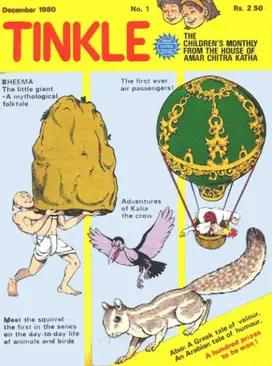
The cover of the first issue of Tinkle, dated December 1980, with the title in red on yellow and drawings of a strong man lifting a huge rock, a hot-air balloon, a crow and a squirrel.
Picture: Tinkle. Copyright ACK Media, shown for teaching.

Tinkle

Where
Bombay (Mumbai)
When
First issue 1980
Who
Anant Pai, its founding editor

Pai followed Amar Chitra Katha with Tinkle, a children's magazine of comics, stories, puzzles and quizzes, which also printed stories sent in by its readers. Its best-loved characters are Suppandi, a servant who follows every instruction far too literally, and Shikari Shambu, a timid hunter who wins only by luck.

Spot it by

A bright cover crowded with several small stories, the red Tinkle title, and the line "from the house of Amar Chitra Katha".

Remember

Tinkle is Uncle Pai's second idea: Suppandi and Shambu.
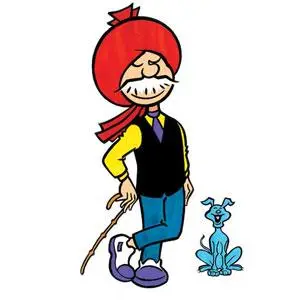
A cartoon of a small old man with a big white moustache, a red turban and scarf, a black waistcoat over a yellow shirt and a walking stick, standing beside a small blue dog.
Picture: Pran Kumar Sharma. Copyright Pran's Features, shown for teaching.

Chacha Chaudhary

When
Early 1970s, for the Hindi children's magazine Lotpot
Who
Pran Kumar Sharma (Pran), 1938 to 2014

Chacha Chaudhary is an ordinary old man who solves problems and catches crooks with common sense, not muscles, powers or gadgets. Fans say his brain works faster than a computer. Beside him is Sabu, a giant from the planet Jupiter who does the heavy lifting. Pran also created Billoo, Pinki and Shrimatiji, and was given the Padma Shri after his death, in 2015.

Spot it by

A red turban, a white moustache, a waistcoat and a stick, often with the huge Sabu standing behind him.

Remember

Chacha's brain is faster than a computer.

Reading a comic's balloons

Comics use the shape of a balloon to show how words are said. UCEED 2016 gave five dialogues and asked which balloon each belonged in.

Balloon What it shows
Smooth oval with a pointed tail Ordinary speech
Cloud shape with a trail of small bubbles A thought, not said aloud
Spiky burst Shouting, or a loud noise
Dashed outline A whisper
Rectangular box, often at the top of a panel A caption: the narrator, telling time, place or what happened

Cartoonists who drew the news

A cartoon here means a single funny drawing that comments on the news, usually with one line of words. A pocket cartoon is a small one that fits in a single column.

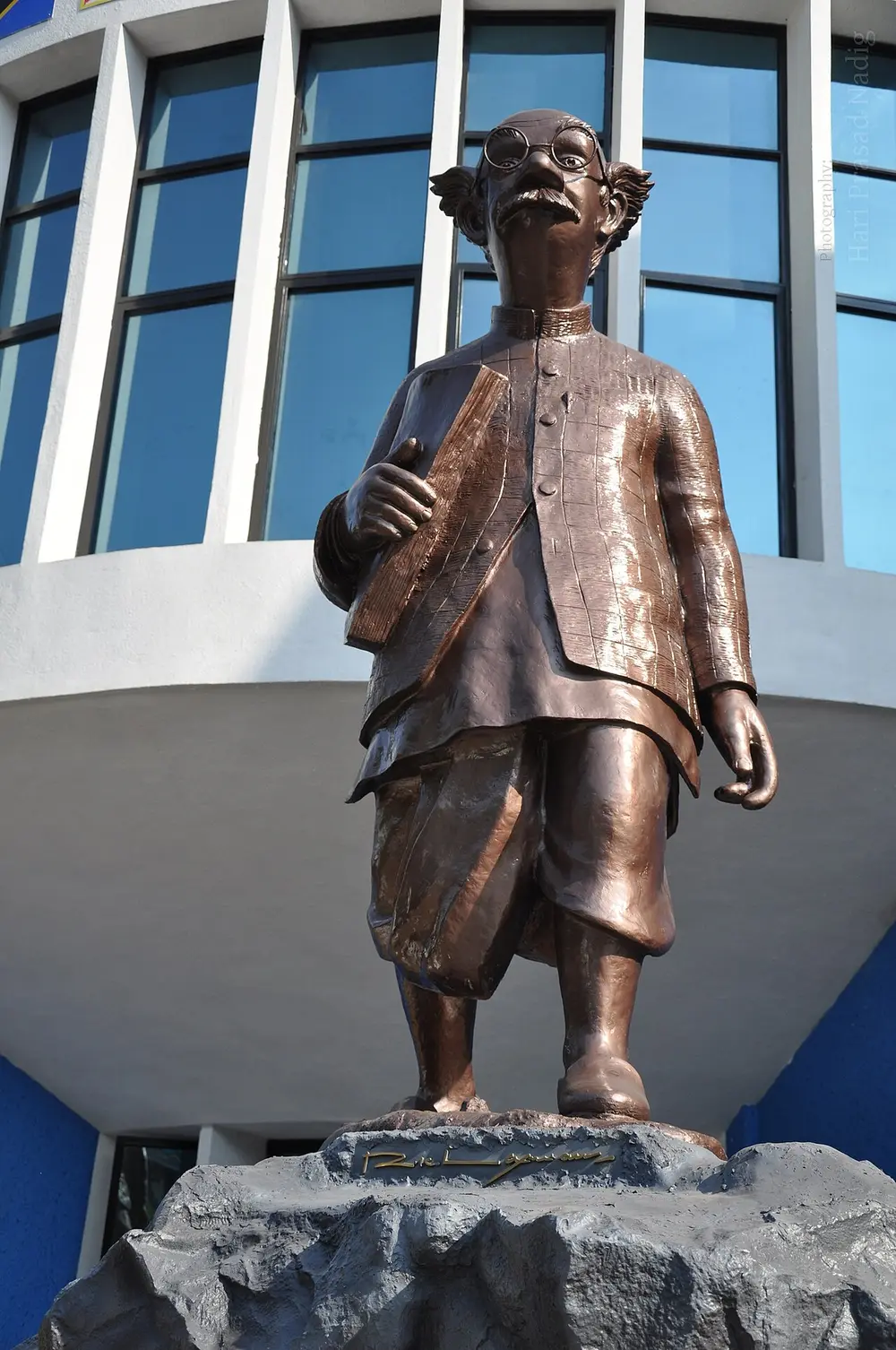
A tall bronze statue of a small, bald old man with round glasses, tufts of hair above his ears, a checked jacket and a dhoti, standing on a rough stone base in front of a building with blue glass windows.
Picture: Hari Prasad Nadig. CC BY-SA 2.0.

R.K. Laxman and the Common Man

Where
This statue stands at the Symbiosis campus in Pune
When
You Said It ran in The Times of India from 1951
Who
R.K. Laxman, 1921 to 2015

Laxman, the younger brother of the novelist R.K. Narayan, drew a daily pocket cartoon called You Said It in The Times of India for more than fifty years. Its hero, the Common Man, wears a checked jacket and dhoti and never says a word. He just watches, puzzled, while politicians and officials make a mess of things. Laxman also illustrated his brother's Malgudi stories, including the sketches for the Malgudi Days television series, and in 1954 he drew Gattu, the Asian Paints mascot. He received the Ramon Magsaysay Award in 1984 and the Padma Vibhushan in 2005.

Spot it by

A bald man with a wisp of white hair, round glasses, a checked jacket and dhoti, standing silently at the edge of the scene.

Remember

The Common Man watches everything and says nothing.

Don't confuse

UCEED 2016 asked students to match four cartoonists to their drawings. Laxman's was a quiet sketch of a small railway station, in the style of his Malgudi drawings, while Mario Miranda's was a crowded Goan street full of people.
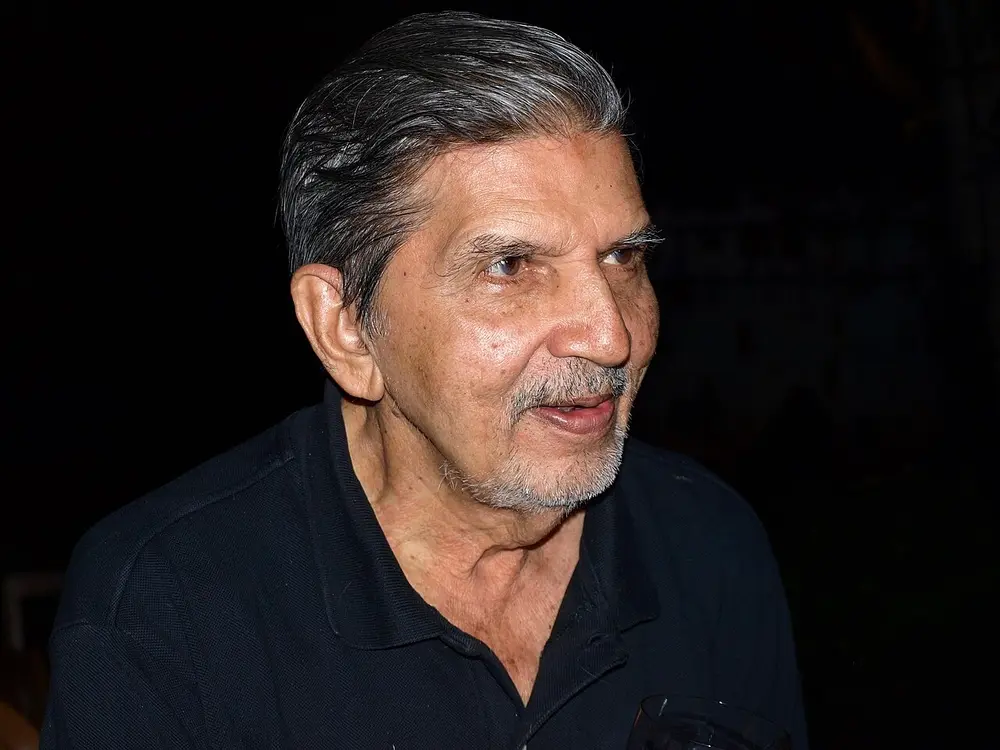
A photograph of Mario Miranda as an older man with swept-back grey hair and a short grey beard, smiling, in a dark shirt against a black background.
Picture: Frederick Noronha. CC BY 3.0.

Mario Miranda

Also called Mario de Miranda

Where
Loutolim, Goa; worked mostly for papers in Bombay
When
1926 to 2011
Who
Cartoonist and painter

Mario drew busy, good-humoured scenes packed with people: Goan villages, churches, markets, offices and parties, with every face given its own character. He became famous through The Illustrated Weekly of India and drew for years for The Times of India and The Economic Times, where readers met characters such as the glamorous Miss Fonseca. He received the Padma Shri in 1988, the Padma Bhushan in 2002, and the Padma Vibhushan after his death, in 2012.

Spot it by

Crowded black and white line drawings, round-faced people with big noses, and tiny details in every corner.

Remember

Mario packed all of Goa into one frame.
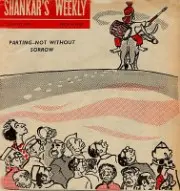
A small magazine cover titled Shankar's Weekly with the words Parting, not without sorrow, and a cartoon of a figure riding an elephant away along a road while a crowd of people watches from below.
Picture: Shankar's Weekly. Copyright Estate of K. Shankar Pillai, shown for teaching.

Shankar's Weekly

Where
New Delhi
When
1948 to 1975
Who
K. Shankar Pillai (Shankar), 1902 to 1989

Shankar, often called the father of Indian political cartooning, started this humour magazine in 1948, modelled on Britain's Punch. Prime Minister Jawaharlal Nehru, a friend, launched it and told him, "Don't spare me, Shankar." The weekly gave young cartoonists such as R.K. Laxman, Abu Abraham and Kutty a place to start. It closed in 1975, soon after the Emergency was declared. Shankar then gave his time to children: he had already founded the Children's Book Trust (1957) and Shankar's International Dolls Museum (1965) in Delhi, and he received the Padma Vibhushan in 1976.

Remember

Nehru said "Don't spare me, Shankar", and Shankar didn't.

Abu Abraham

Also called Abu

When
1924 to 2002
Who
Attupurathu Mathew Abraham, from Mavelikara, Keralam (Kerala until 2026)

Abu started at The Bombay Chronicle and Shankar's Weekly, then moved to London in 1953. In 1956 The Observer made him its first political cartoonist, and he later drew for The Guardian. Back home, he was the political cartoonist of The Indian Express from 1969 to 1981, and a nominated member of the Rajya Sabha from 1972 to 1978. His most famous cartoon, from the Emergency in 1975, shows President Fakhruddin Ali Ahmed in his bathtub while a hand pushes more ordinances (emergency laws) through the door for him to sign.

Remember

Abu's president signed laws from the bathtub.

Ads India remembers

Satyajit Ray worked as a visualiser at the Calcutta agency D.J. Keymer before he made films; see Indian cinema. The logos note covers brand mascots such as Air India's Maharaja and Asian Paints' Gattu.

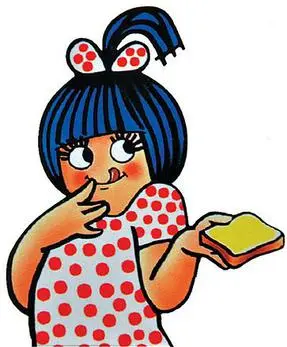
A cartoon of a chubby little girl with blue hair tied up with a bow, wearing a red polka-dot dress, licking her finger and holding a slice of buttered bread.
Picture: Amul. Copyright Amul (Gujarat Cooperative Milk Marketing Federation), shown for teaching.

The Amul girl and the Amul topicals

Where
Hoardings, starting in Bombay, then across India
When
1966 onwards; topical from 1967
Who
Sylvester daCunha and his art director Eustace Fernandes, of the agency ASP (Advertising and Sales Promotion)

When ASP won Amul's butter account in 1966, it needed a mascot simple enough for painters to copy by hand onto hoardings that changed often. It came up with a naughty little girl in a polka-dot dress, and the line "Utterly Butterly Delicious". Soon the hoardings turned topical: each one makes a pun on that week's news, from cricket and films to scams and politics, and ends with the girl and her butter. Some have annoyed the people they joked about, which only made them more famous. Sylvester daCunha's son Rahul later took the campaign over, and it is one of the longest-running ad campaigns in the world.

Spot it by

The blue-haired girl in a red polka-dot dress, a pun mixing English and Hindi, and Amul butter in the corner.

Remember

Utterly butterly, and always about this week's news.
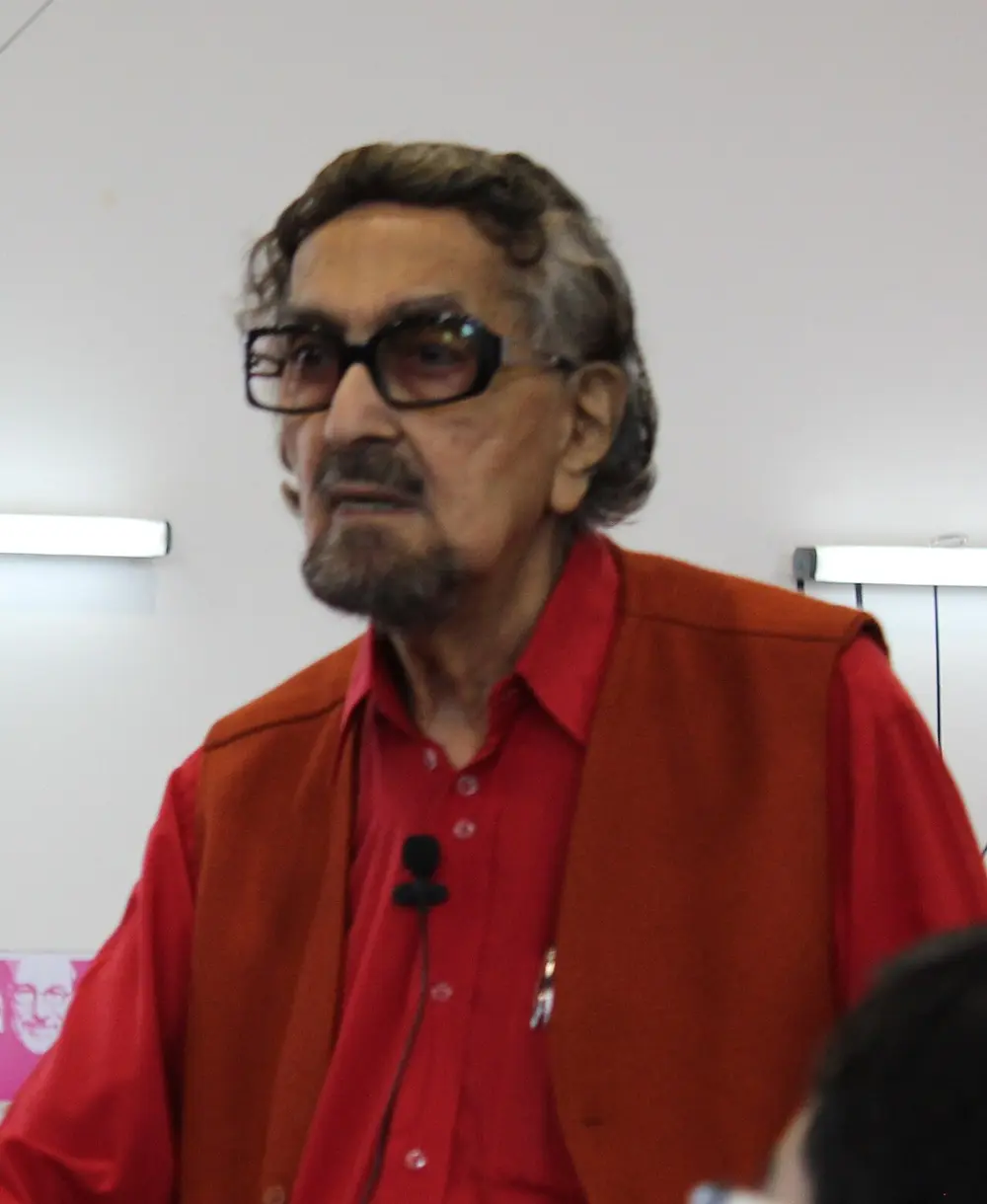
A photograph of Alyque Padamsee as an older man with grey hair, a grey beard and dark-framed glasses, in a red shirt and red waistcoat, with a small microphone clipped to his shirt.
Picture: Cooljais. CC BY-SA 3.0.

Alyque Padamsee

When
1928 to 2018
Who
Head of the agency Lintas in India, and a theatre director and actor
Key works
The Liril girl in the waterfall, Lalitaji for Surf, Hamara Bajaj, the MRF Muscle Man

Padamsee led Lintas in India for many years and made it one of the country's top agencies, and he is often called the father of modern Indian advertising. For Liril soap, his team filmed a young woman (Karen Lunel) laughing under a waterfall, selling the soap as a moment of freshness and freedom. For Surf, they created Lalitaji (played by Kavita Chaudhury), a sensible housewife who explains why paying a little more for a better detergent is the smart buy. He was also a leading figure in English theatre in Bombay, played Muhammad Ali Jinnah in the film Gandhi (1982), and received the Padma Shri in 2000.

Remember

Padamsee's Lintas gave India the Liril waterfall and Lalitaji.
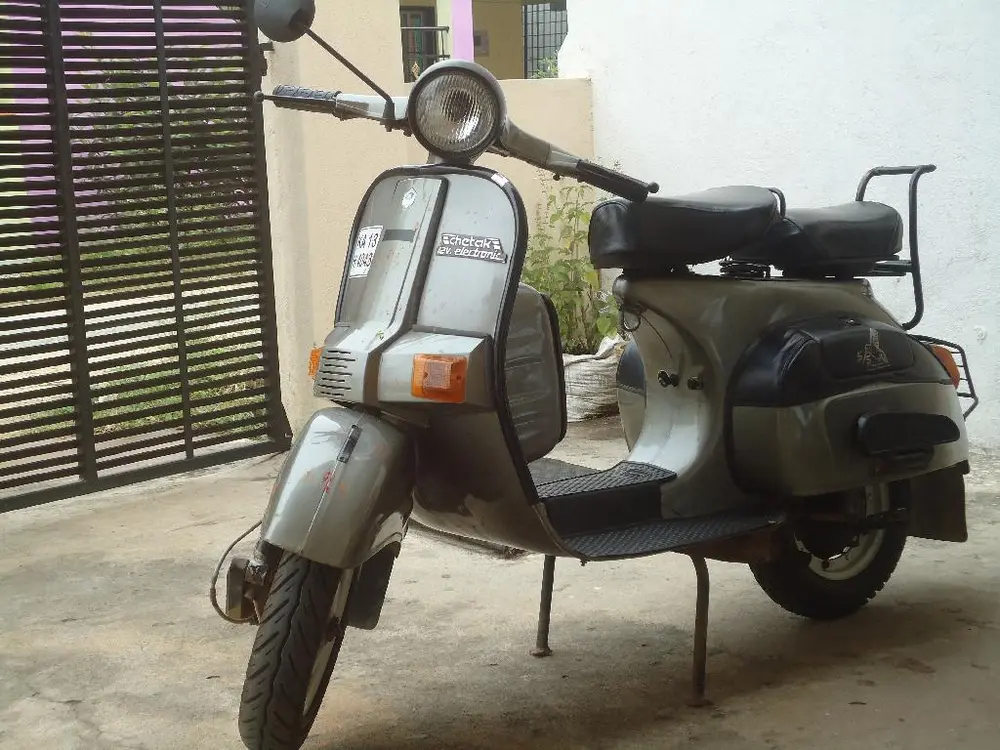
A restored grey Bajaj Chetak scooter parked on its stand beside a wall, with a round headlamp, a curved front shield and a long black seat.
Picture: Shakti muralidhar. CC BY-SA 4.0.

Hamara Bajaj

When
1989
Who
Lintas, under Alyque Padamsee, for Bajaj Auto

These television ads for Bajaj scooters, above all the Chetak, showed Indians of every region, religion and job riding a Bajaj, to a jingle that ends with the words "Hamara Bajaj" ("our Bajaj"). Instead of listing the scooter's features, the ads sold a feeling: one country sharing one ride, and pride in something made in India. The line became so well known that it was reused and remade for decades. The scooter in the photo is a restored 1996 Chetak.

Remember

Hamara Bajaj sold "our" scooter, not "my" scooter.
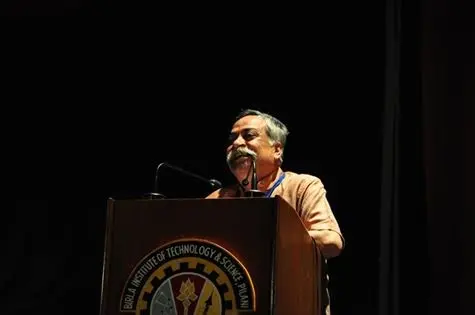
A photograph of Piyush Pandey, small in the frame, speaking into a microphone at a wooden podium on a dark stage.
Picture: Dhairikfuletra. CC BY-SA 4.0.

Piyush Pandey

When
1955 to 2025
Who
Creative head of Ogilvy India, born in Jaipur
Key works
Fevicol ads; "Har ghar kuch kehta hai" for Asian Paints; "Kuch khaas hai" for Cadbury Dairy Milk; the words of "Mile Sur Mera Tumhara" (1988)

Pandey joined Ogilvy in 1982 and led its creative work in India for decades, later becoming its worldwide chief creative officer. He is credited with making Indian ads talk in everyday Hindi, with small-town humour, instead of copying Western ones. His Fevicol films are visual jokes about things stuck fast, such as an overloaded bus from which no passenger ever falls. For Asian Paints, "Har ghar kuch kehta hai" means "every home says something". He received the Padma Shri in 2016 and died in October 2025, aged 70.

Remember

Pandey made ads talk like the neighbours.
Campaign Brand Made by
Utterly Butterly Delicious, the topicals Amul butter Sylvester daCunha (ASP)
The waterfall girl Liril soap Alyque Padamsee (Lintas)
Lalitaji Surf detergent Alyque Padamsee (Lintas)
Hamara Bajaj Bajaj scooters Alyque Padamsee (Lintas)
Har ghar kuch kehta hai Asian Paints Piyush Pandey (Ogilvy)
Kuch khaas hai Cadbury Dairy Milk Piyush Pandey (Ogilvy)

Posters on the walls

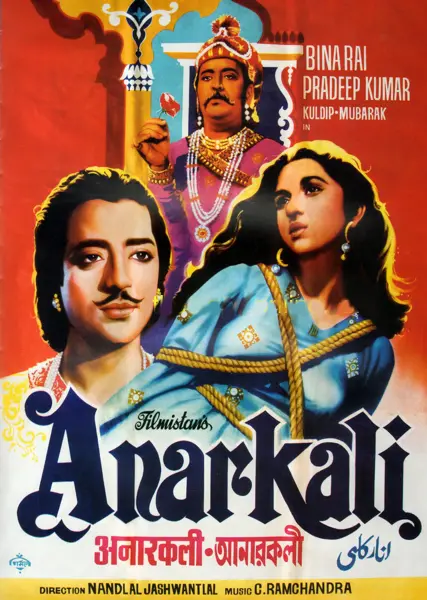
A colourful film poster for Anarkali (1953), with painted portraits of a moustached young man and a woman in a blue veil in front, a crowned emperor above them, and the title in large curly letters with smaller titles in Hindi and Urdu.
Picture: Unknown artist. Public domain.

Hand-painted film posters

Where
On walls, cinema fronts and hoardings across India
When
From the 1940s to the 1980s; this poster is from 1953
Made with
Paintings, reproduced in thousands by lithography

For decades, almost every Indian film was advertised with painted art. Studio artists painted the stars' faces in bold, glowing colours, often with several characters and scenes on one sheet, and the painting was printed in thousands and pasted on walls. Outside cinemas, painters made giant hoardings by hand. From the 1960s photographs crept into poster designs, and by the 1990s computer design and digital printing had replaced most of the painters.

Spot it by

Painted, not photographed, faces with shiny highlights, dramatic colours, several characters arranged in one picture, and hand-lettered titles, often in more than one script.

Remember

Before computers, film stars were painted.
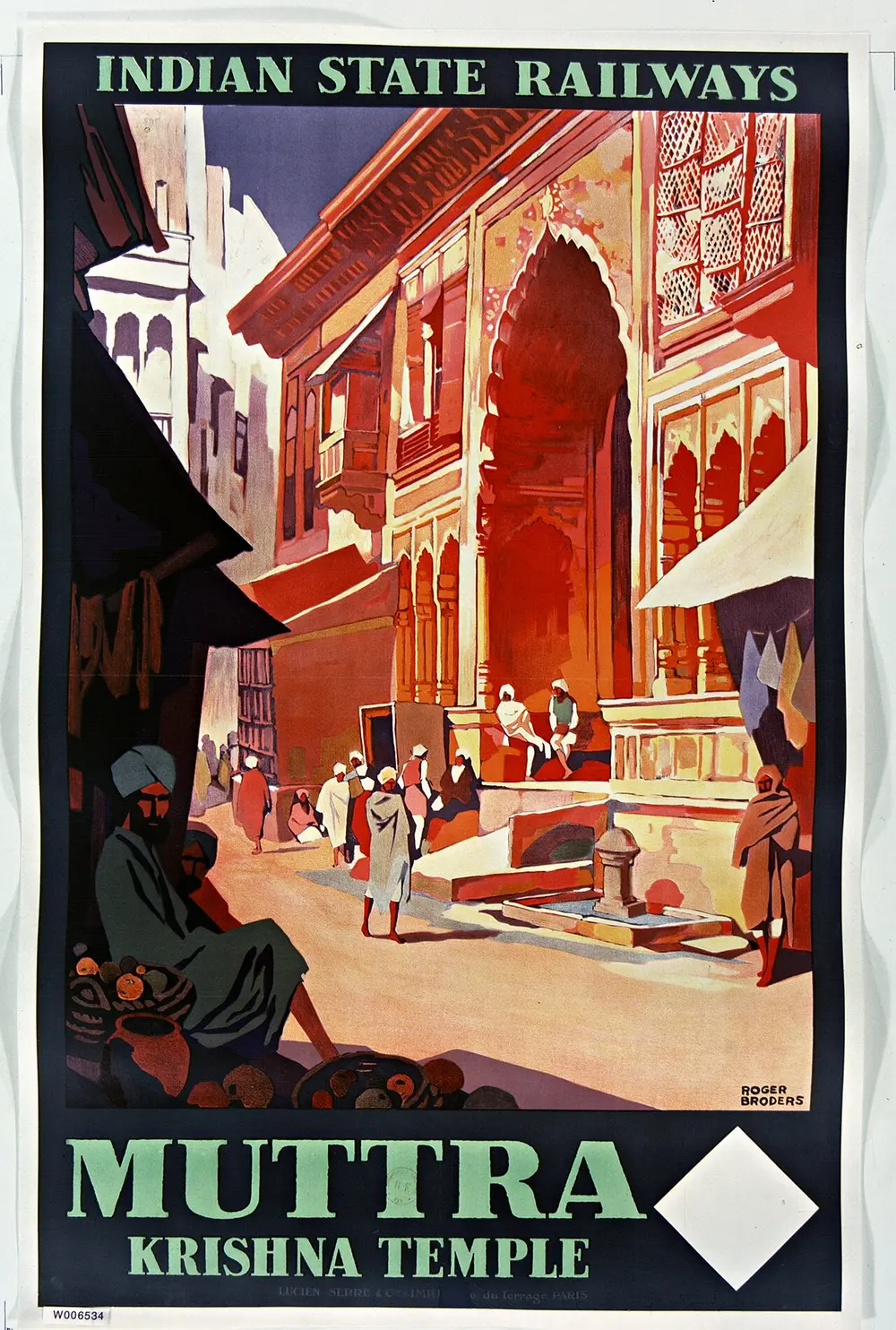
A travel poster headed Indian State Railways, showing a tall red sandstone gateway with carved balconies above a street with a few small figures, and the words Muttra, Krishna Temple in green capitals at the bottom.
Picture: Roger Broders. Public domain.

Indian Railways travel posters

Where
Printed in Paris for Indian State Railways
When
1928
Who
Roger Broders, a French poster artist (1883 to 1953)
Made with
Colour lithograph

In 1927 the Railway Board set up a Central Publicity Bureau in Bombay to bring tourists, especially foreign ones, onto India's trains. It ordered bright travel posters of places such as Benares, Kashmir, Darjeeling and Madurai, and showed them at stations and in shop windows abroad, with offices in London and New York. Most were drawn by British and European artists in the flat shapes and strong colours of the 1920s and 1930s. In 1931 Indian members of the legislature complained that foreign artists were paid far more than Indian ones and that some posters got India wrong. Muttra is the old British spelling of Mathura.

Spot it by

Flat blocks of bright colour, simplified buildings and figures, and bold capital letters naming the railway and the place.

Remember

The railways sold India as a holiday, one poster at a time.

Timeline

  1. 1440s

    Johannes Gutenberg develops printing with movable metal type in Germany

  2. 1450s

    The Gutenberg Bible is printed in Mainz

  3. 1556

    India's first printing press is set up at St Paul's College, Old Goa

  4. 1780

    Hicky's Bengal Gazette, India's first newspaper, appears in Calcutta (29 January)

  5. 1894

    Raja Ravi Varma opens his picture press in Bombay

  6. 1927

    The Railway Board sets up a Central Publicity Bureau in Bombay for travel posters

  7. 1948

    Shankar's Weekly is launched, with Nehru's "Don't spare me, Shankar"

  8. 1951

    R.K. Laxman's You Said It, with the Common Man, begins in The Times of India

  9. 1953

    The painted poster for Anarkali, from the age of hand-painted film posters

  10. 1966

    The Amul girl appears on hoardings

  11. 1967

    Anant Pai starts Amar Chitra Katha; the Amul hoardings turn topical

  12. 1975

    Shankar's Weekly closes soon after the Emergency is declared

  13. 1980

    Tinkle's first issue

  14. 1988

    Mile Sur Mera Tumhara, with words by Piyush Pandey, is broadcast

  15. 1989

    Lintas makes Hamara Bajaj for Bajaj scooters

  16. 2012

    Mario Miranda is given the Padma Vibhushan after his death

  17. 2015

    R.K. Laxman dies in Pune (26 January)

  18. 2018

    Alyque Padamsee dies

  19. 2025

    Piyush Pandey dies, aged 70 (October)

Test yourself

Question 1 of 8

Which cartoonist created the character shown in this statue?

Question 2 of 8

Which of these is India's first newspaper?

Question 3 of 8

Where was India's first printing press set up, in 1556?

Question 4 of 8

Who created this comic character?

Question 5 of 8

In a comic, which balloon shows that a character is only thinking, not speaking?

Question 6 of 8

Which printmaking method pushes ink through a fine mesh stencil?

Question 7 of 8

This mascot has joked about the news on hoardings since 1966. Which brand does she advertise?

Question 8 of 8

Lalitaji for Surf and the Liril waterfall girl were created at Lintas under which adman?

From past papers

Real exam questions on this topic, each with a full solution.

Finished this note?

Mark it as studied to track your progress through the course.

Was this note useful?

Each picture is credited underneath it. Pictures of works still in copyright are shown small, for teaching only. If you hold the rights to a picture and want it removed, tell us through the contact page and we will take it down.