Skip to content

Chapter 2: Sculpture and the story of Indian art

The classical age, Gupta to Chola

Indian sculpture from the Gupta Buddhas to Konark, about 400 to 1250 CE. The great reliefs of Udayagiri, Deogarh, Elephanta, Ellora and Mamallapuram, Chola bronzes and how they were cast, and later temple carving.

In one minute

5 facts to know

  1. The Gupta age (about 320 to 550 CE) set the calm, graceful look of Indian sculpture: Buddhas in see-through robes, and the first big Hindu reliefs, such as the boar-headed Varaha at Udayagiri.
  2. Elephanta's three-faced Shiva (6th century) and Ellora's Kailasa temple (8th century) are carved in basalt, the dark volcanic rock of the Deccan.
  3. The Pallava reliefs at Mamallapuram, including the Descent of the Ganga and the Mahishasuramardini panel, are carved in granite.
  4. Chola bronzes (about 9th to 13th century), above all Shiva as Nataraja, the Lord of Dance, were made by lost-wax casting, a method still used at Swamimalai in Tamil Nadu.
  5. Hoysala temples have madanikas, bracket figures of women carved in soapstone; Khajuraho and Konark cover their walls with gods, dancers, musicians and animals.

In this note, "classical" means the centuries when Indian sculptors settled the rules for showing gods: their poses, hand gestures, weapons and mounts. The rules were set under the Guptas in the north and carried south and east for the next 800 years.

The Gupta Buddhas from Sarnath and the Kushana Buddhas from Mathura are covered in the note on Gandhara, Mathura and Amaravati, and temple buildings in Temple styles of India. This note is about the sculpture.

Who made what, and in which stone

Site Region Rulers Stone
Mathura and Sarnath Uttar Pradesh Guptas Red sandstone at Mathura; buff (pale yellow-brown) Chunar sandstone at Sarnath
Udayagiri and Deogarh Madhya Pradesh and Uttar Pradesh Guptas Sandstone
Elephanta and Ellora Maharashtra Several dynasties; the Kailasa temple under the Rashtrakutas Basalt
Mamallapuram Tamil Nadu Pallavas Granite
Chola bronzes Tamil Nadu Cholas Copper alloy, cast by lost-wax
Belur and Halebidu Karnataka Hoysalas Soapstone (chloritic schist)
Khajuraho Madhya Pradesh Chandelas Sandstone
Konark Odisha Eastern Gangas Mostly khondalite (a local stone), with chlorite for the finest figures

Exams like to ask about the stone. Basalt is dark grey volcanic rock and covers most of the Deccan. Granite is very hard, which is why the Pallava figures have smooth, simple shapes. Soapstone is soft when freshly cut, which let the Hoysala carvers make lace-like detail.

The Guptas set the style

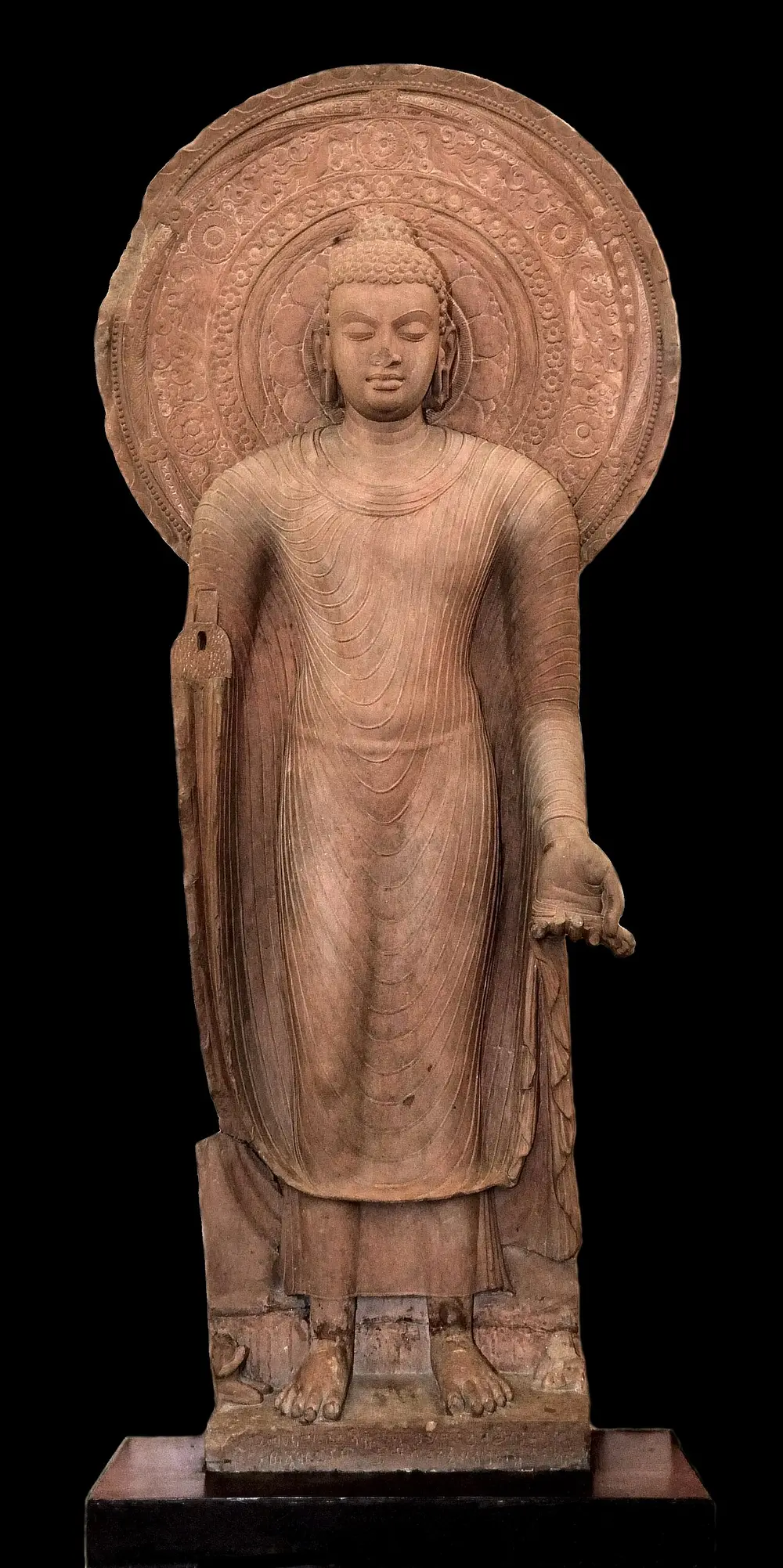
A red sandstone statue of the Buddha standing straight, eyes lowered, his robe covering both shoulders in fine string-like folds, in front of a large round halo carved with rings of flowers.
Picture: Biswarup Ganguly. CC BY 3.0.

Standing Buddha from Jamalpur

Where
Found at the Jamalpur mound, Mathura; now in the Government Museum, Mathura
When
5th century CE
Style
Gupta, Mathura school
Made with
Red sandstone

The Gupta Buddha of Mathura is still in red stone, like the older Kushana Buddhas, but everything else has changed. The body is slim and calm, the eyes look down, the head is covered in small curls, and the robe clings to the body like wet cloth, falling in rows of fine, string-like folds over both shoulders. Behind him is a huge halo carved with rings of flowers. At Sarnath, carvers made the same kind of Buddha in buff sandstone with an almost smooth robe.

Spot it by

Red stone, a robe over both shoulders in thin looping folds, lowered eyes, small curls, and a big flower-carved halo.

Remember

Gupta Mathura gives the robe lines; Gupta Sarnath smooths them away.

Don't confuse

A Kushana Mathura Buddha is also red, but round-faced and smiling, with the right shoulder bare.
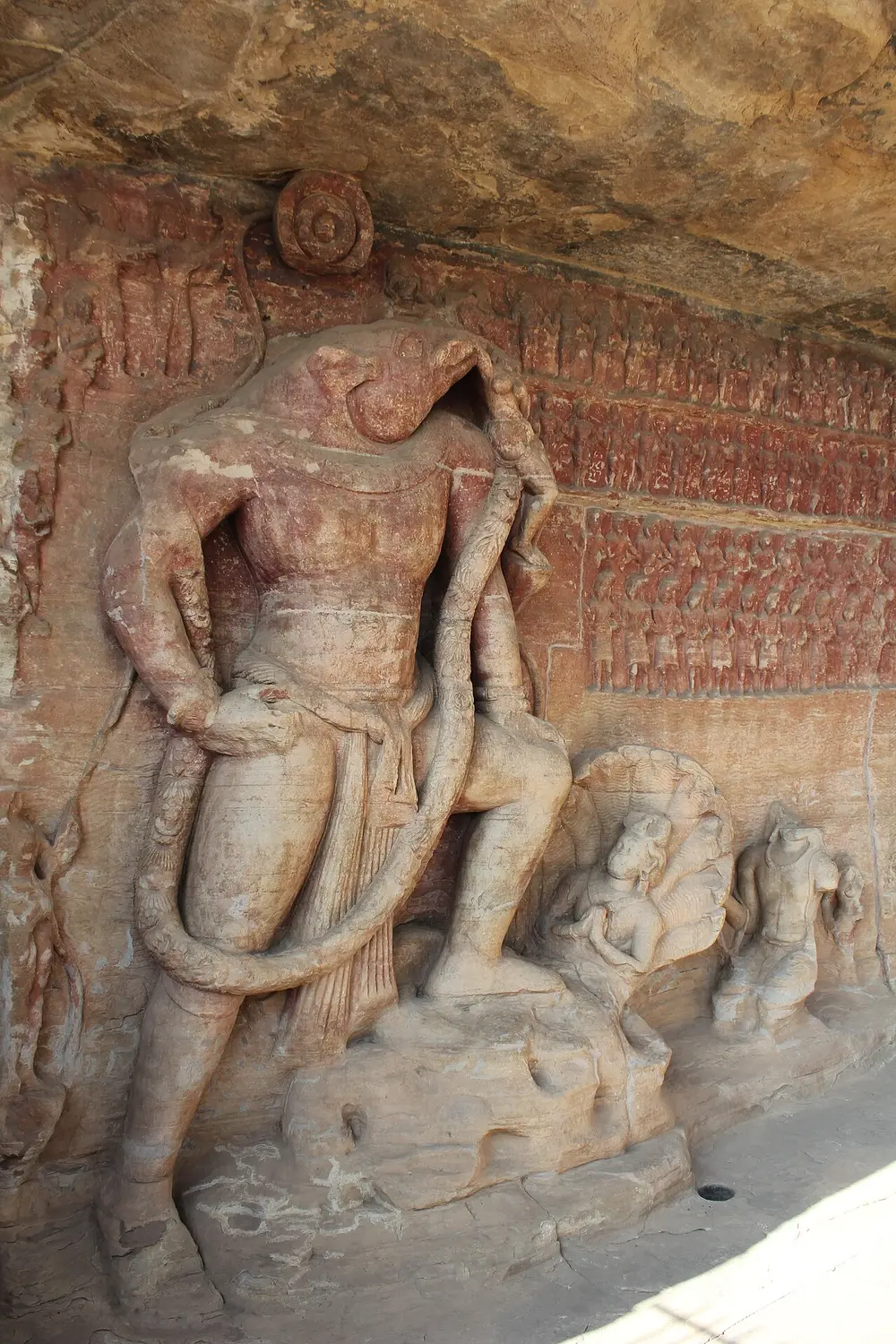
A huge relief in a rock face of a figure with a man's body and a boar's head, one foot raised on a rock, with a small female figure hanging from his tusk and rows of tiny carved figures filling the wall behind him.
Picture: Arian Zwegers from Brussels, Belgium. CC BY 2.0.

Varaha at Udayagiri

Where
Cave 5, Udayagiri Caves, near Vidisha, Madhya Pradesh
When
Early 5th century CE (an inscription at the site is dated 401 CE)
Who
Made under the Gupta emperor Chandragupta II
Style
Gupta rock-cut relief
Made with
Carved into a sandstone hillside

Varaha is the boar avatar (form) of Vishnu. In the story, a demon drags the Earth to the bottom of the cosmic ocean, and Varaha dives in to bring her back. Here he stands like a giant hero with one foot raised, a serpent king with a hood of snakes bows at his feet, and Bhudevi, the Earth goddess, clings to his tusk. Rows of gods and sages watch from the wall. It is one of the largest and most famous Gupta sculptures, and many historians read it as praise for the king, who had restored order to his empire.

Spot it by

A man's body with a boar's head, a tiny woman on the tusk, and rows of small watching figures behind.

Remember

Udayagiri means "sunrise hill"; its star is a boar.

Don't confuse

The Udayagiri and Khandagiri caves in Odisha are Jain caves with the same name. This Udayagiri is near Vidisha in Madhya Pradesh.
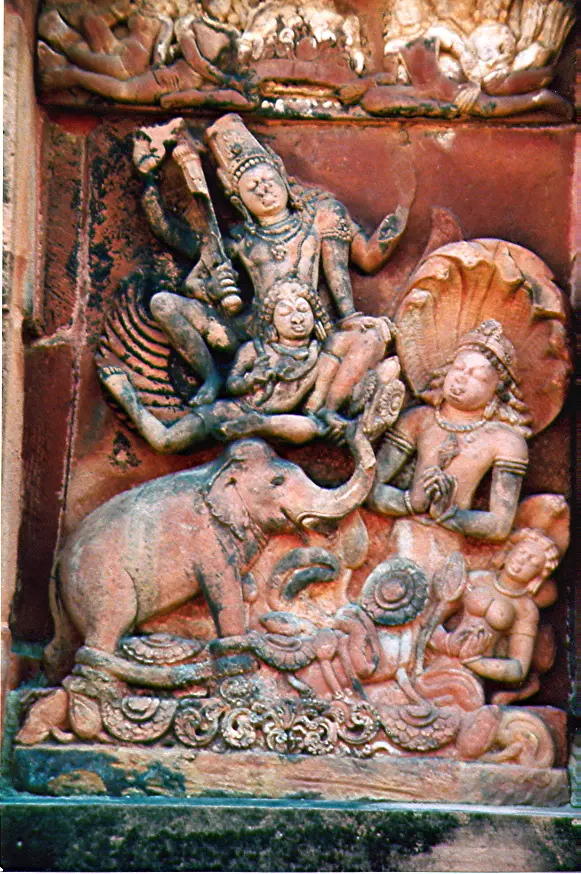
A red sandstone panel in a temple wall showing Vishnu riding on Garuda, a bird-man, swooping down to an elephant whose foot is caught by a snake king, who bows to Vishnu with folded hands.
Picture: Bob King. CC BY 2.0.

Dashavatara Temple panels, Deogarh

Where
Deogarh, Lalitpur district, Uttar Pradesh, near the Betwa river
When
About 500 CE (late 5th or early 6th century)
Who
Built in the Gupta period
Style
Gupta temple sculpture
Made with
Sandstone

One of the oldest surviving Hindu stone temples in north India, built for Vishnu. Three outer walls each have one large panel. One (shown) is Gajendra Moksha: an elephant king caught by a water monster prays to Vishnu, who arrives on Garuda to save him. The second shows the sages Nara and Narayana in thought, and the third shows Vishnu sleeping on the serpent Shesha (Anantashayana). Temple walls with story panels like these became normal in later Indian temples.

Spot it by

Framed panels of Vishnu stories set into the walls of a small, square sandstone shrine.

Remember

Dashavatara means "ten avatars", but the famous panels are three: the elephant, the two sages and the sleeping Vishnu.

Elephanta and Ellora

Both sites are cut into basalt near the west coast of Maharashtra, and both are full of Shiva. The difference: Elephanta is a small group of mainly Shiva caves on an island in Mumbai harbour, while Ellora has 34 caves of three religions side by side (Buddhist, Hindu and Jain). So Ellora has Shaivite sculpture, but not only Shaivite sculpture.

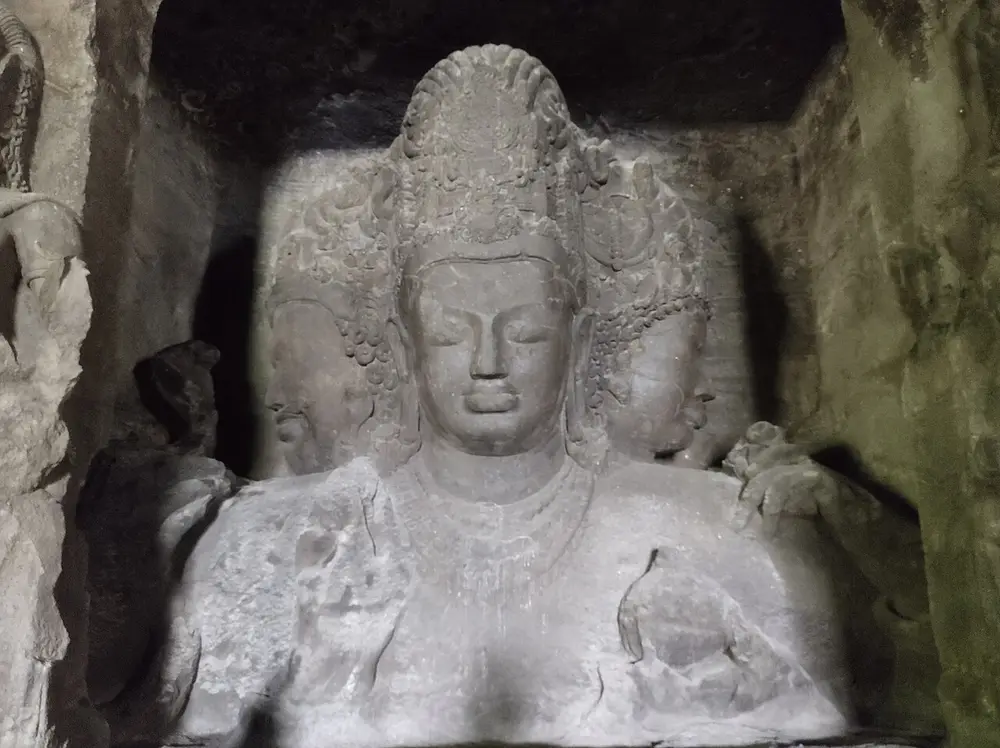
A giant carving of a crowned, three-headed bust in a dark rock-cut recess. The central face is calm with lowered eyes; two more faces look left and right from either side.
Picture: Saankav. CC BY-SA 4.0.

Trimurti of Elephanta

Also called Sadashiva, Maheshamurti

Where
Cave 1 (the Great Cave), Elephanta Island (Gharapuri), Mumbai harbour, Maharashtra
When
Mid 5th to 6th century CE (dates vary)
Style
Rock-cut relief
Made with
Basalt

The most famous sculpture at Elephanta is a huge bust of Shiva with three faces, carved into the back wall of the main cave, more than 5 metres high. The calm central face looks straight at you. One side face is fierce and moustached, with snakes; the other is gentle and holds a lotus bud. Together they show Shiva as creator, protector and destroyer at once. The island got its name from the Portuguese, who found stone elephants there.

Spot it by

Three crowned heads joined on one massive chest, filling a dark recess.

Remember

Elephanta's Shiva has three faces; it is not Brahma, Vishnu and Shiva, but Shiva alone in three moods.

Don't confuse

The word Trimurti is often used for Brahma, Vishnu and Shiva together. The Elephanta figure is a form of Shiva only.
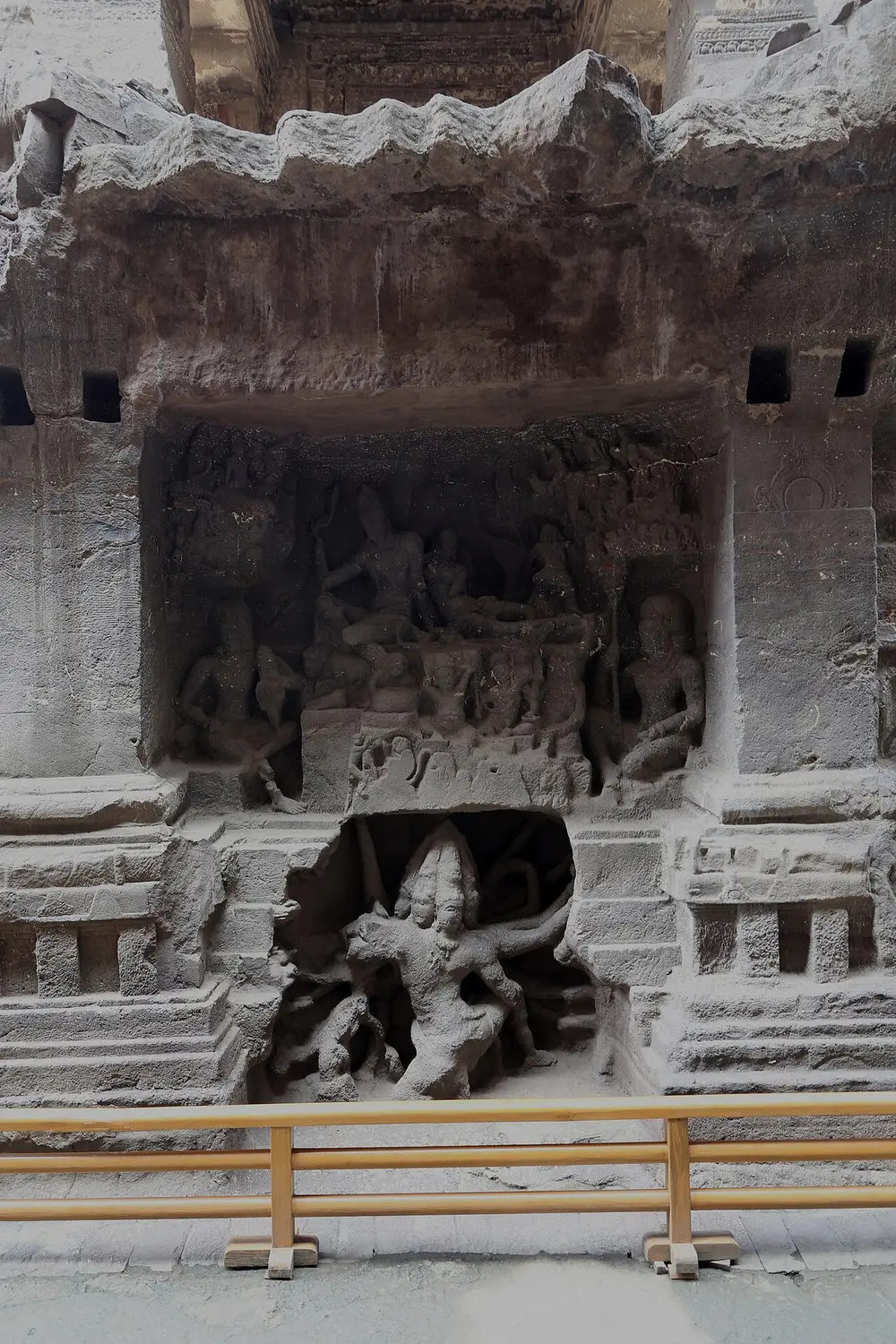
A deep relief cut into the side of a dark stone temple: above, Shiva and Parvati sit on a mountain with attendants; below, in a cave-like hollow, a many-headed, many-armed figure strains to lift the mountain.
Picture: Sailko. CC BY 3.0.

Ravana shaking Mount Kailasa, Ellora

Also called Ravananugraha

Where
Kailasa temple (Cave 16), Ellora, Maharashtra
When
8th century CE, perhaps finished a little later
Who
The Kailasa temple is credited to the Rashtrakuta king Krishna I (ruled 756 to 773)
Style
Rock-cut relief
Made with
Basalt

In the story, the demon king Ravana tries to lift Mount Kailasa, Shiva's home. Shiva simply presses down with his toe and traps him underneath. The carvers put Ravana, with his many heads and arms, in a dark hollow at the bottom, and Shiva and Parvati calm on the mountain above, with Parvati clutching Shiva as the mountain shakes. It is carved into the side of the Kailasa temple, itself cut from one mass of rock, so the mountain in the story becomes a mountain of real stone.

Spot it by

Ravana's many arms pushing up from a dark cave at the bottom, and a seated couple on top.

Remember

Kailasa temple, Kailasa mountain: the relief tells the story of the temple's own name.

Don't confuse

Cave 29 at Ellora (Dhumar Lena) has an older Ravana-and-Kailasa panel. The best-known one is on the Kailasa temple.

The Pallavas at Mamallapuram

Mamallapuram (Mahabalipuram) was the port of the Pallava kings of Kanchipuram. The town is named after Narasimhavarman I, called Mamalla, "the great wrestler" (ruled 630 to 668). The site as a whole, with its rathas and the Shore Temple, is in the note on World Heritage Sites; here are its two most famous carvings. Both are in granite.

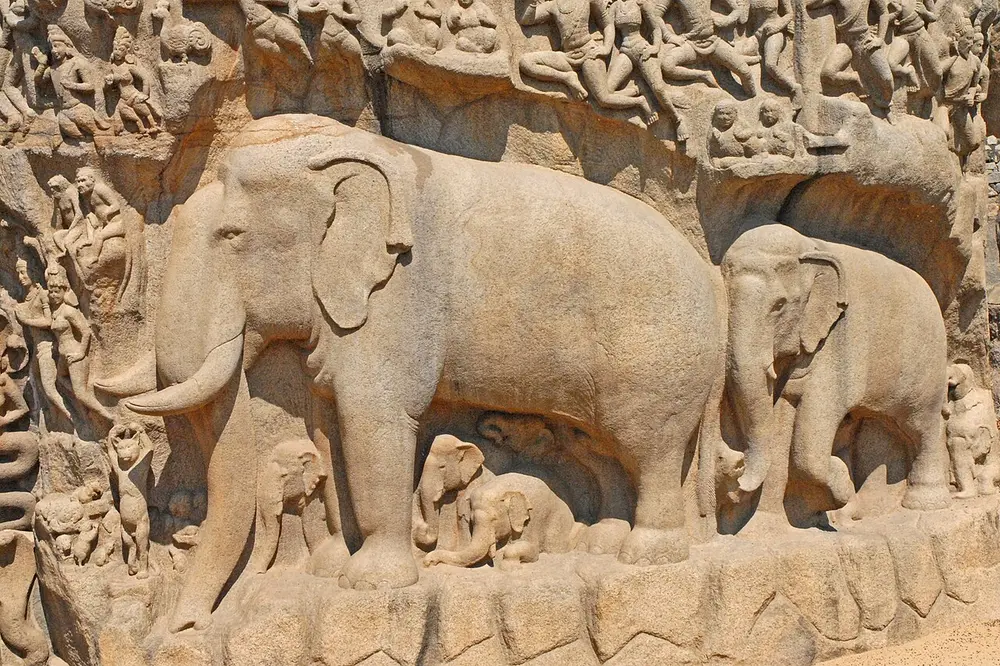
A close view of a huge granite rock carving: a life-size elephant and a smaller one walk side by side, with baby elephants sheltering under them, and rows of gods, people and animals carved above.
Picture: Jean-Pierre Dalbéra from Paris, France. CC BY 2.0.

Descent of the Ganga

Also called Arjuna's Penance

Where
Mamallapuram, Chengalpattu district, Tamil Nadu
When
7th century CE
Who
The Pallavas, usually credited to Narasimhavarman I
Style
Open-air rock relief
Made with
Granite, carved on two huge boulders

One of the largest open-air rock carvings in the world, nearly 30 metres long. A natural crack runs down between the two boulders; the carvers turned it into the river Ganga coming down from heaven, with snake gods (nagas) swimming up it, and water was once let down the crack from a tank above. Gods, sages, hunters and animals all rush towards the river. Scholars still argue whether the man doing penance (hard prayer) on one leg is Bhagiratha, who brought the Ganga down, or Arjuna, praying to Shiva for a weapon, which is why it has two names.

Spot it by

Life-size elephants with their babies, a long crack with snake figures, and a cat standing on one leg like a holy man doing penance.

Remember

The cat pretending to do penance is the joke in the relief, taken from a fable about a fake holy man.

Don't confuse

Ellora and Ajanta are carved in basalt. Mamallapuram is granite.
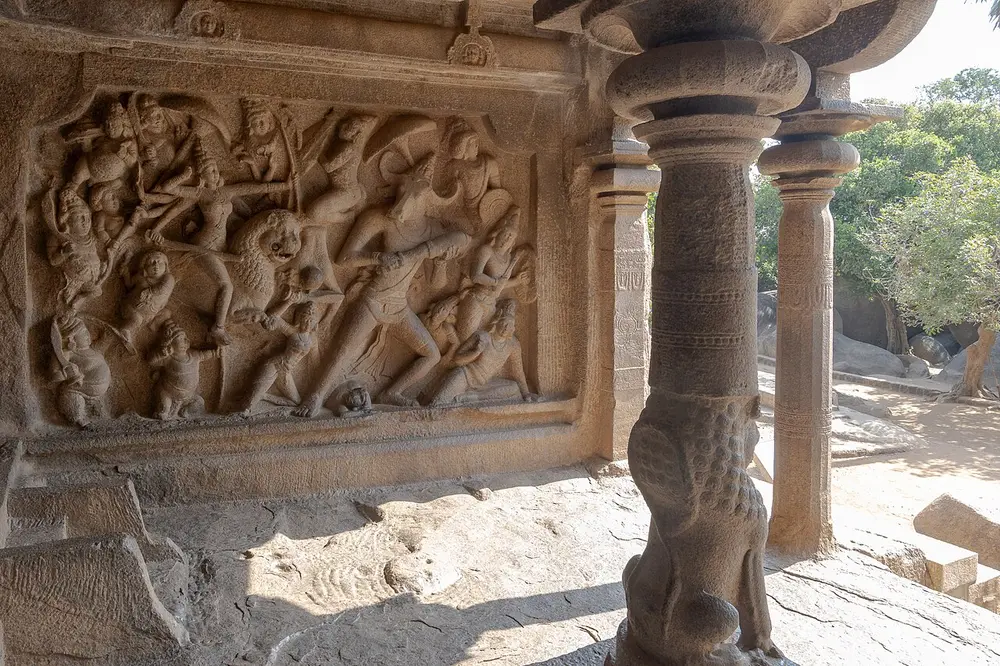
A crowded granite relief inside a cave hall: on the left, a many-armed goddess rides a lion and leads an army; on the right, a giant warrior with a buffalo's head draws back with a club. A carved pillar with a seated lion at its base stands in front.
Picture: Rainer Halama. CC BY-SA 4.0.

Mahishasuramardini panel

Where
Mahishasuramardini Mandapa (cave temple), Mamallapuram, Tamil Nadu
When
7th century CE
Who
The Pallavas
Style
Rock-cut relief inside a cave temple
Made with
Granite

Mahishasuramardini means "she who killed the buffalo demon Mahisha", a name of the goddess Durga. Here Durga, with eight arms, charges in on her lion with her army of dwarfs, while the huge buffalo-headed Mahisha steps back with his club. It is a moment of battle, not the usual quiet image of a victory. On the opposite wall of the same cave, Vishnu lies asleep on the serpent Shesha, so the cave sets fierce action against perfect calm.

Spot it by

A goddess on a lion with many arms, charging at a buffalo-headed giant; lion-based pillars in front.

Remember

Battle on one wall, sleep on the other.

Chola bronzes

The Cholas ruled Tamil Nadu from Thanjavur from the 9th to the 13th century, and their great age is the 10th to 12th centuries. Their temples were built in stone, but on festival days the gods went out into the streets. For that the temples needed images that could be carried, so the Cholas made metal statues. They are called bronzes, though most are mainly copper. The holes and rings on their bases are for the poles used to carry them in processions.

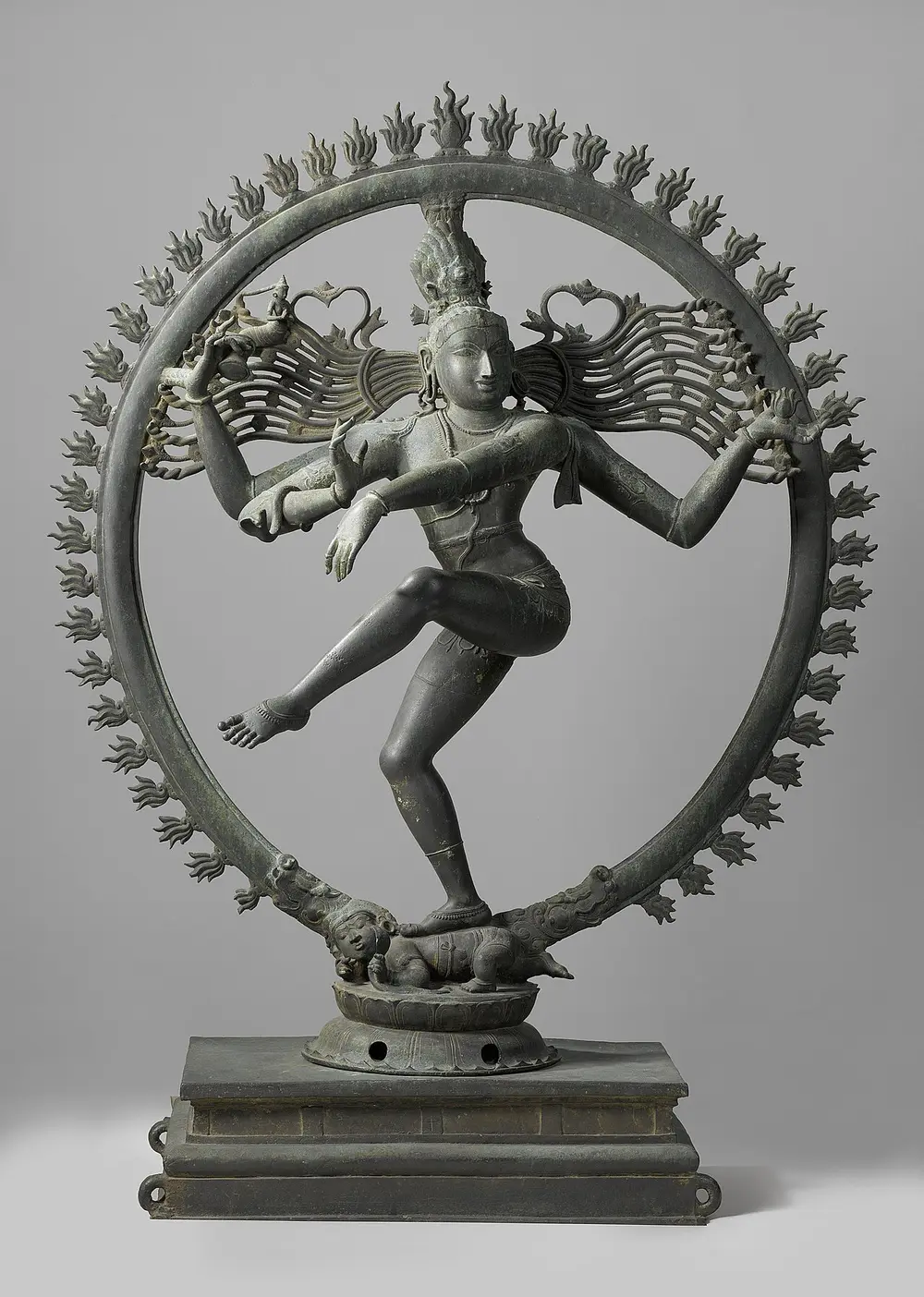
A dark metal statue of four-armed Shiva dancing on one leg inside a large ring edged with flames. His hair flies out sideways, one foot rests on a small crouching figure, and the other leg is lifted across his body.
Picture: Rijksmuseum. CC0.

Shiva as Nataraja

Also called Lord of Dance

Where
Tamil Nadu; this one is in the Rijksmuseum, Amsterdam
When
About 1100 to 1200 CE (this piece); the form matured around the 10th century
Who
Chola-period temple casters
Style
Chola bronze
Made with
Copper alloy, cast by lost-wax; this one is 1.53 metres tall

Shiva dances the ananda tandava, the dance of bliss, that keeps the universe going. Each part means something. His upper right hand holds a small drum (damaru), the sound of creation. His upper left hand holds fire, for destruction. His lower right hand is raised in the "do not fear" gesture, and his lower left hand points down to his lifted foot, where worshippers can find safety. He stands on a dwarf, Apasmara, who stands for ignorance. His locks fly out with the speed of the dance, and a ring of flames surrounds him. Chidambaram in Tamil Nadu is the great temple of Nataraja.

Spot it by

A dancing figure on one leg inside a ring of fire, hair flying sideways, a dwarf underfoot.

Remember

Drum to create, fire to destroy, a raised hand to protect, a foot on ignorance.

Don't confuse

A Dhokra figure is also made by lost-wax, but it is a tribal craft with a rough, wiry surface. Chola bronzes are smooth and follow strict temple rules.
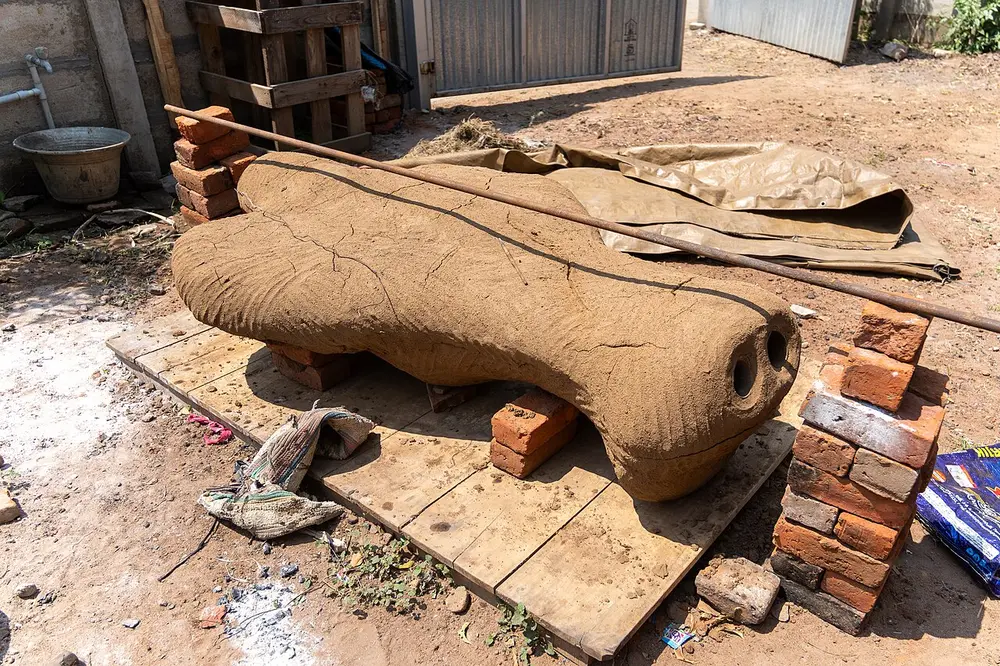
A long clay mould, cracked as it dries, lying on bricks in a workshop yard, with two round openings at one end.
Picture: Rainer Halama. CC BY-SA 4.0.

Lost-wax casting

Also called Cire perdue

Where
Still practised at Swamimalai, near Kumbakonam, Tamil Nadu
When
Used for Chola bronzes from the 9th century; still in use today
Made with
Beeswax mixed with resin and a little oil; fine clay; molten metal

The figure is first modelled in wax, with every finger and jewel. The wax model is covered in layers of fine clay, leaving a channel, and left to dry (the clay mould in the picture). The mould is then heated, so the wax melts and runs out: it is "lost". Molten metal is poured into the hollow it leaves. When the metal has cooled, the clay is broken away and the figure is chiselled and polished. Because the mould is broken every time, each piece is one of a kind. Swamimalai bronze icons got a Geographical Indication (GI) tag, a legal mark of a regional craft, in 2008 to 2009.

Spot it by

A clay mould with pouring holes, drying in a workshop yard.

Remember

Wax in, wax out, metal in, clay off.
Step What happens
1. Model The sculptor shapes the full figure in wax
2. Coat The wax is covered in layers of fine clay, with a channel left open
3. Heat The mould is heated; the wax melts and runs out
4. Pour Molten metal is poured into the empty space
5. Break The clay is broken off; the metal is chiselled and polished

Later temple carving

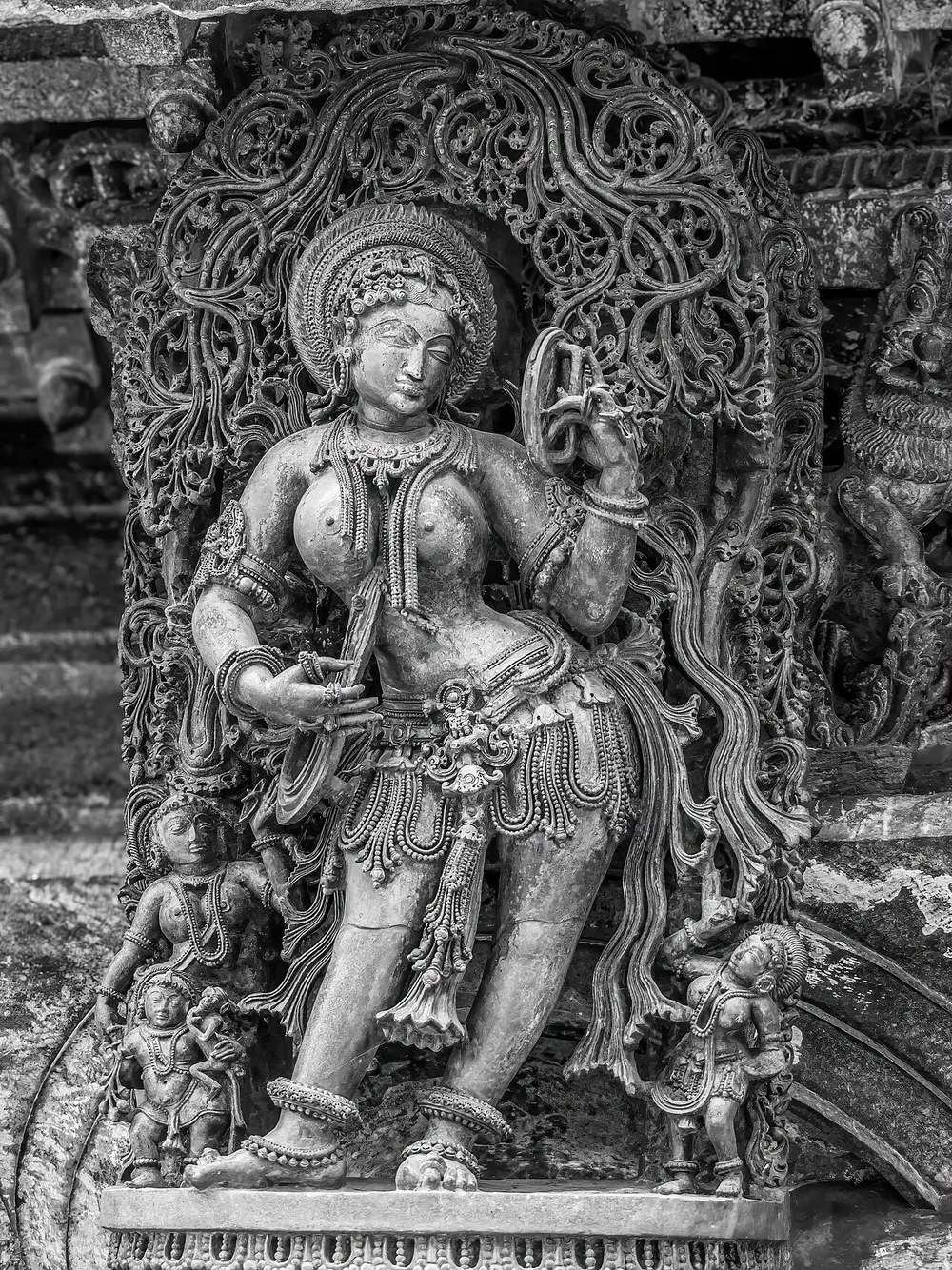
A black-and-white close view of a stone figure of a woman holding up a mirror and looking into it, covered in carved jewellery, under an arch of very fine lacy foliage; small figures stand at her feet.
Picture: Basavaraj M. CC BY-SA 4.0.

Madanikas of Belur

Also called Shilabalikas, bracket figures

Where
Chennakeshava Temple, Belur, Hassan district, Karnataka
When
12th century CE (temple begun 1117)
Who
Hoysala carvers, under King Vishnuvardhana
Style
Hoysala
Made with
Soapstone (chloritic schist)

A madanika is a carved figure of a woman set at an angle between the top of a pillar and the roof, as a bracket. Belur has 42 of them: 38 under the outer eaves and 4 inside the hall. Each shows a dancer, musician, huntress or a woman getting ready, under an arch of creepers so fine it looks like lace. The best known is Darpana Sundari, "the beauty with the mirror". The soft soapstone lets the carvers cut jewellery, hair and leaves in amazing detail.

Spot it by

A slim, jewel-covered woman, set at a slant under the roof edge, framed by lacy carved foliage.

Remember

Darpana means mirror: Darpana Sundari is the lady with the mirror.

Don't confuse

Khajuraho's heavenly women stand flat against the wall in sandstone. Belur's madanikas lean out from the roof as brackets.
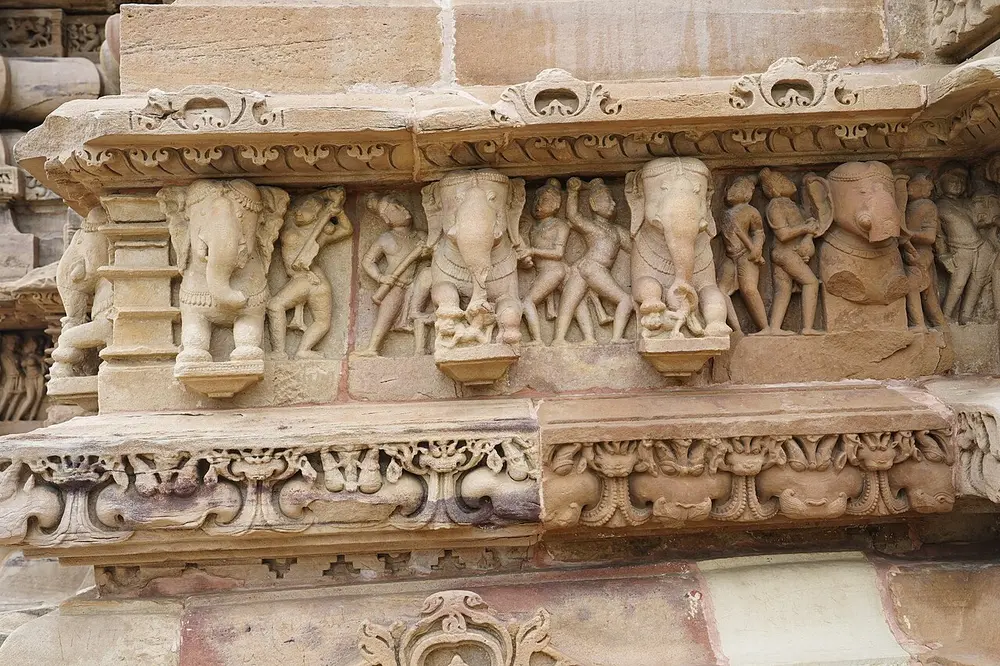
A long band of pale sandstone carving on a temple base: elephants face outwards between rows of soldiers, musicians and dancers, with bands of carved patterns above and below.
Picture: Amitabha Gupta. CC BY-SA 4.0.

Khajuraho sculpture

Where
Lakshmana Temple, Khajuraho, Chhatarpur district, Madhya Pradesh
When
10th and 11th centuries CE (the Lakshmana Temple has an inscription dated 954)
Who
The Chandela kings
Style
Central Indian (Chandela) temple sculpture
Made with
Sandstone

Khajuraho's temples are wrapped in bands of sculpture, outside and in. There are gods and goddesses, surasundaris (heavenly beauties) stretching, dancing or looking in mirrors, musicians, soldiers, elephants and scenes of daily life. Only a few of the carvings are the loving couples (mithunas) the site is famous for. Bands like this one, on the platform of the Lakshmana Temple, show processions of elephants, warriors and musicians.

Spot it by

Pale sandstone, band after band of figures in deep relief, wrapping the whole temple.

Remember

Khajuraho is famous for a few couples, but it is mostly gods, dancers, soldiers and elephants.
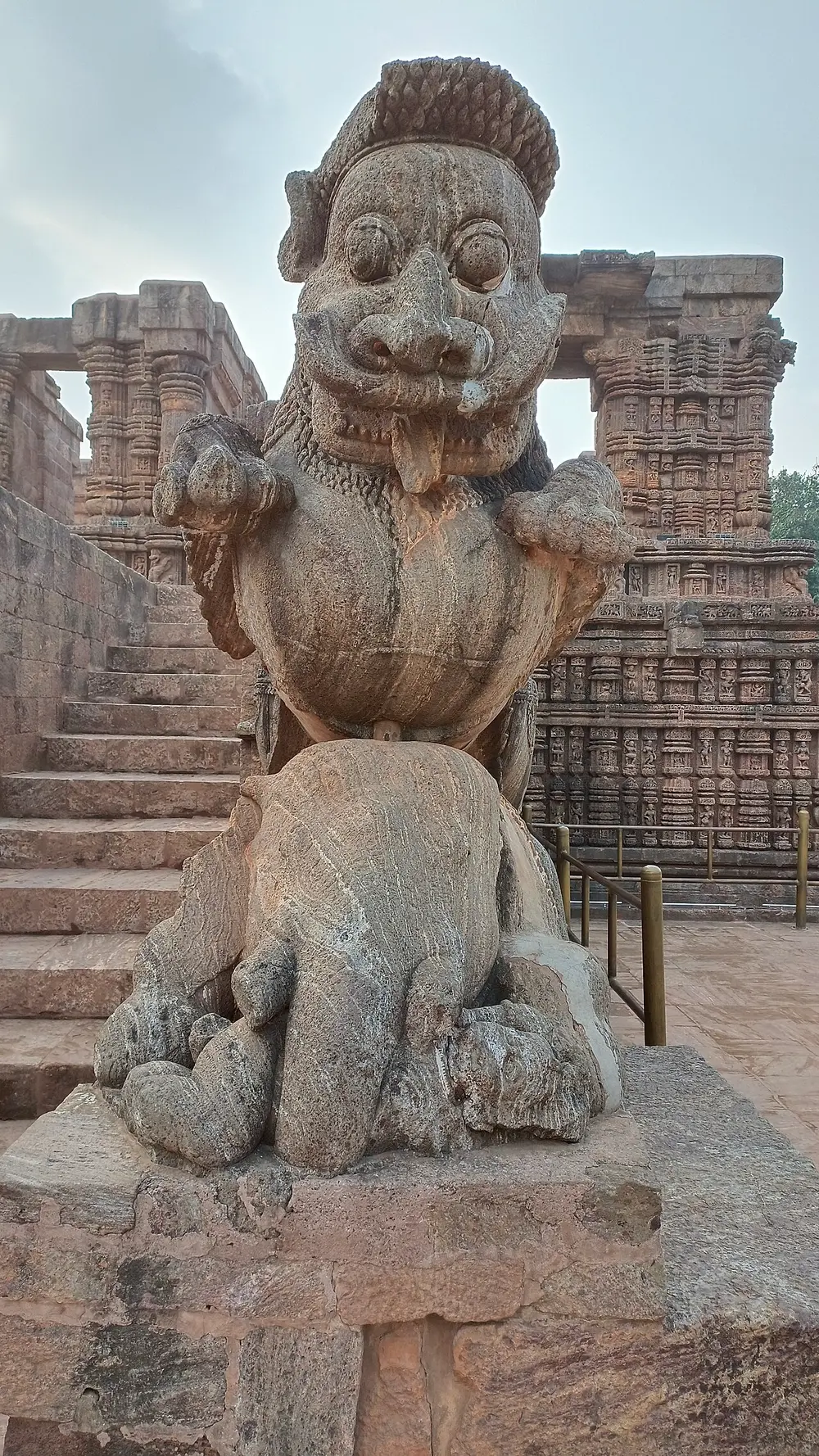
A large weathered stone lion with bulging eyes and a lolling tongue, rearing up on top of a stone elephant, at the foot of a flight of steps, with a carved temple hall behind.
Picture: Pacificangel. CC BY-SA 4.0.

Konark sculpture

Where
Sun Temple, Konark, Odisha
When
About 1250 CE
Who
King Narasimhadeva I of the Eastern Ganga dynasty
Style
Odisha (Kalinga) temple sculpture

Konark's temple to Surya, the Sun god, is a stone chariot (its wheels are in Temple styles of India), and its sculpture is just as bold. Two huge gajasimhas, each a lion standing on an elephant, which in turn stands on a man, guard the main eastern steps up to the dance hall. Giant horses strain beside the steps up to the assembly hall, and big stone musicians with drums, cymbals and other instruments stand on its roof terraces. The walls are covered with dancers, animals, couples and scenes of royal life.

Spot it by

A rearing lion on top of an elephant at the entrance steps.

Remember

Gaja means elephant and simha means lion: the lion stands on the elephant.

Timeline

  1. About 401 CE

    Under Chandragupta II, the Varaha relief is carved at Udayagiri, near Vidisha

  2. 5th century CE

    Gupta Buddhas at Mathura and Sarnath

  3. About 500 CE

    The Dashavatara Temple at Deogarh is built, with its three Vishnu panels

  4. 6th century CE

    The Great Cave at Elephanta is carved, with its three-faced Shiva

  5. 7th century CE

    The Pallavas carve the Descent of the Ganga and the Mahishasuramardini panel at Mamallapuram

  6. 8th century CE

    The Kailasa temple at Ellora is carved under the Rashtrakuta king Krishna I

  7. 10th century CE

    Chola bronzes reach their mature form; the Lakshmana Temple at Khajuraho is built

  8. 1117

    The Chennakeshava Temple at Belur, with its madanikas, is begun

  9. About 1250

    Narasimhadeva I builds the Sun Temple at Konark

Test yourself

Question 1 of 8

Which god is shown in this Gupta relief at Udayagiri?

Question 2 of 8

Where is this three-faced Shiva?

Question 3 of 8

Which of these is a Chola bronze?

Question 4 of 8

In a Nataraja bronze, what does the dwarf under Shiva's foot stand for?

Question 5 of 8

The Descent of the Ganga at Mamallapuram is carved in which stone?

Question 6 of 8

Which relief shows the goddess Durga fighting the buffalo demon?

Question 7 of 8

What are figures like this one at Belur called?

Question 8 of 8

In lost-wax casting, what happens to the wax?

From past papers

Real exam questions on this topic, each with a full solution.

Finished this note?

Mark it as studied to track your progress through the course.

Was this note useful?

Each picture is credited underneath it. Pictures of works still in copyright are shown small, for teaching only. If you hold the rights to a picture and want it removed, tell us through the contact page and we will take it down.