Skip to content

Chapter 8: Symbols, colour and brands

What colours mean

Red for brides, saffron for renunciation, white for weddings or for mourning: what colours mean in India and around the world, and the colour words exams use.

In one minute

6 facts to know

  1. A colour's meaning is learned, not built in: white is the bride's colour in the West, but in many parts of India and East Asia it is the colour of mourning.
  2. In many parts of India, red (sindoor, bridal saris) stands for marriage and good fortune, yellow (haldi, Basant Panchami) for spring and new beginnings, and saffron for renunciation.
  3. Krishna is painted blue because his name means "dark", and a black dot or thread is a common guard against the evil eye.
  4. No law says what the flag's colours mean. The famous explanation is S. Radhakrishnan's, in the Constituent Assembly on 22 July 1947: saffron for renunciation, white for light and truth, green for our bond with the soil.
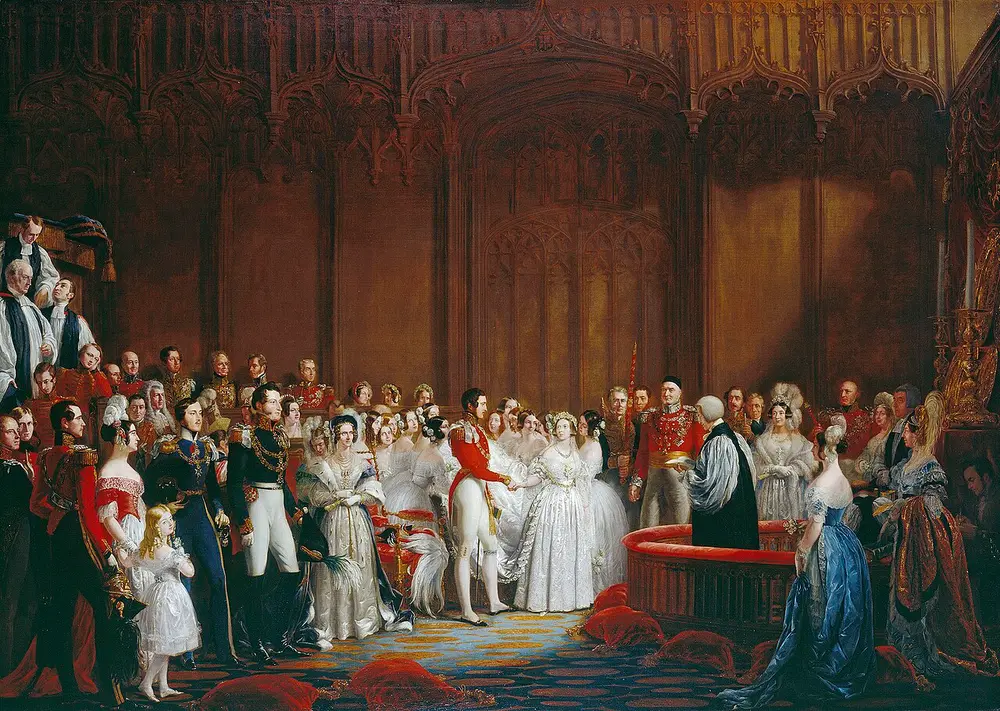
  5. Around the world: Queen Victoria's white dress (1840) made white weddings fashionable, red is lucky in China, Tyrian purple from sea snails became the emperors' colour, green is linked with paradise in Islam, and the word indigo means "from India".
  6. Colour words: warm and cool colours, complementary colours sit opposite each other on the wheel, analogous ones sit side by side, and hue, saturation and value describe any colour.

Colours in India

The same colour can mean opposite things in different places. Meanings also change between regions, communities and generations, so read every line below as "often" or "in many parts of India", never "always".

Colour Often stands for Where you see it
Red Marriage, good fortune Sindoor, bridal saris and lehengas
Yellow Spring, new beginnings Haldi before weddings, Basant Panchami
Saffron Renunciation, holiness Robes of sannyasis and sadhus, pilgrims
White Mourning, peace Funerals, widows' clothes in many communities
Green Nature and growth; Islam Fields, mosques, the flag's lowest stripe
Blue The divine Krishna and Vishnu in paintings
Black Protection from the evil eye Kajal dots, black threads, nazar battu
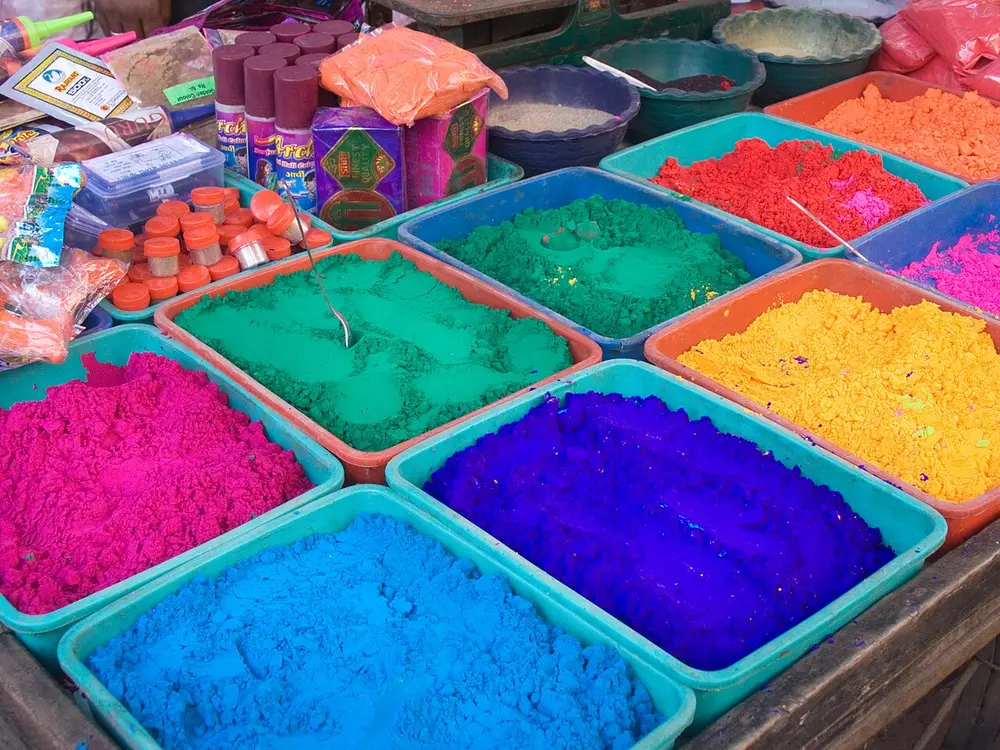
Square trays heaped with bright powder colours, pink, green, blue, purple, yellow and orange, on a market stall, with packets and squeeze bottles behind them.
Picture: Jorge Royan. CC BY-SA 3.0.

Holi

Also called The festival of colours

Where
Across India and Nepal; best known in the Braj region (Mathura, Vrindavan, Barsana)
When
The full moon of the month of Phalguna, usually in March
Made with
Gulal (dry coloured powder) and coloured water

Holi says goodbye to winter and welcomes spring. On the night before, people light bonfires for Holika Dahan, which recalls how the boy Prahlada was saved while his wicked aunt Holika burned: good beating evil. Next day, friends, families and strangers throw gulal and coloured water at each other. In Braj the festival is tied to the love of Krishna and Radha. The old colours came from plants: orange and red from the flowers of the palash or tesu tree, the "flame of the forest", and yellow from turmeric.

Spot it by

Heaps and clouds of bright powder, and faces and white clothes streaked pink, green and yellow.

Remember

Holi says goodbye to winter in every colour at once.
Red and yellow: weddings and spring

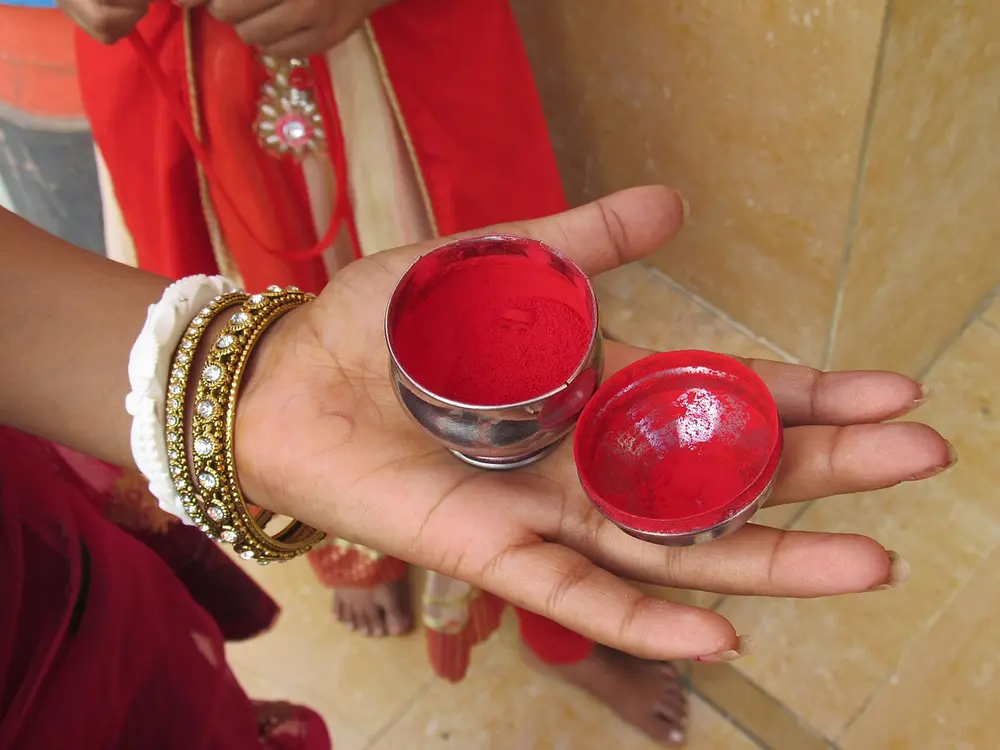
An open hand, with gold and white bangles on the wrist, holding a small round silver box and its lid, both filled with bright red powder.
Picture: Masum-al-hasan. CC BY-SA 3.0.

Sindoor

Also called Sindur

Where
Hindu communities across much of India and Nepal
Made with
Traditionally turmeric mixed with slaked lime or alum; later vermilion, ground from the red mineral cinnabar

Sindoor is a red powder that many married Hindu women wear in the parting of their hair. The groom first puts it there during the wedding, a ritual called sindoor daan, so it marks a woman as married, and widows traditionally stop wearing it. Red runs right through Indian weddings: it is the most popular colour for a bride's sari, because red is seen as auspicious, meaning it brings good fortune. Old recipes made sindoor from yellow turmeric and lime, because the lime turns turmeric red. Some cheap modern sindoor has been found to contain lead, which is poisonous.

Spot it by

A line of red in the hair parting, and small round boxes of red powder.

Remember

Red in the parting means married.

Don't confuse

Kumkum is a similar red powder, also made from turmeric and lime, put on the forehead between the eyebrows. Sindoor goes in the hair parting.
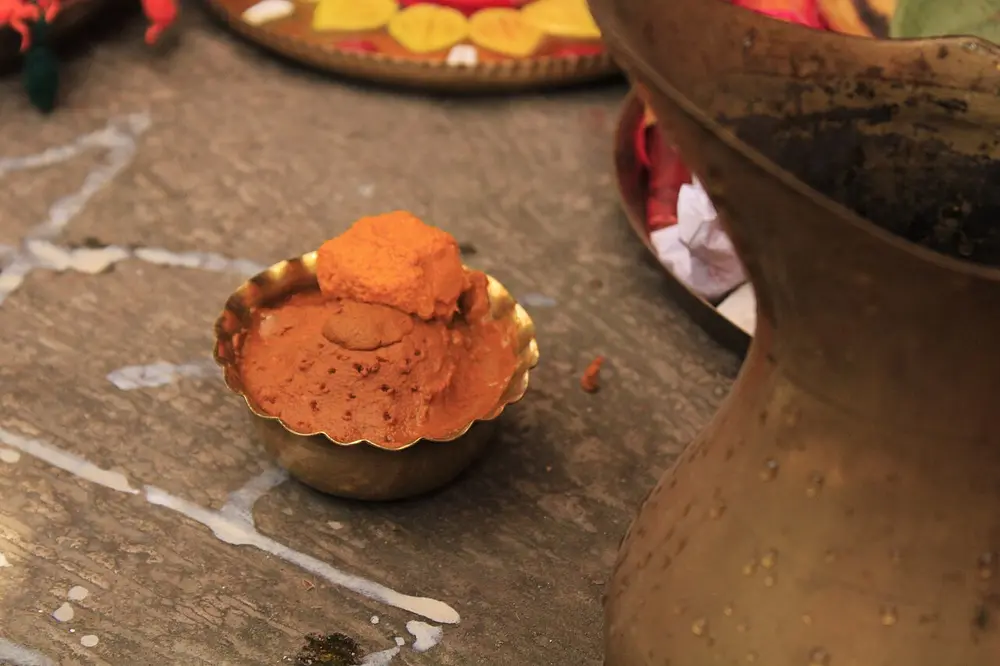
A small brass bowl heaped with orange-yellow turmeric paste, standing on a stone floor beside a large brass pot.
Picture: Debapriya Manna. CC BY-SA 4.0.

Haldi ceremony

Also called Mayian or ubtan in Punjab

Where
Weddings in many parts of India and Pakistan
When
Usually the day before the wedding
Made with
A paste of turmeric, often mixed with flour and oil

In the haldi ceremony, married women of the family rub a paste of turmeric (haldi) on the face, arms and legs of the bride, and separately of the groom, each in their own home. Women sing traditional songs, and sweets are handed out at the end. The yellow paste is a blessing on the couple just before their new life together begins. Afterwards the bride and groom bathe and get ready for the wedding.

Spot it by

A bowl of yellow paste, yellow clothes and marigolds, and a bride or groom smeared with yellow.

Remember

Haldi makes the couple yellow the day before they marry.
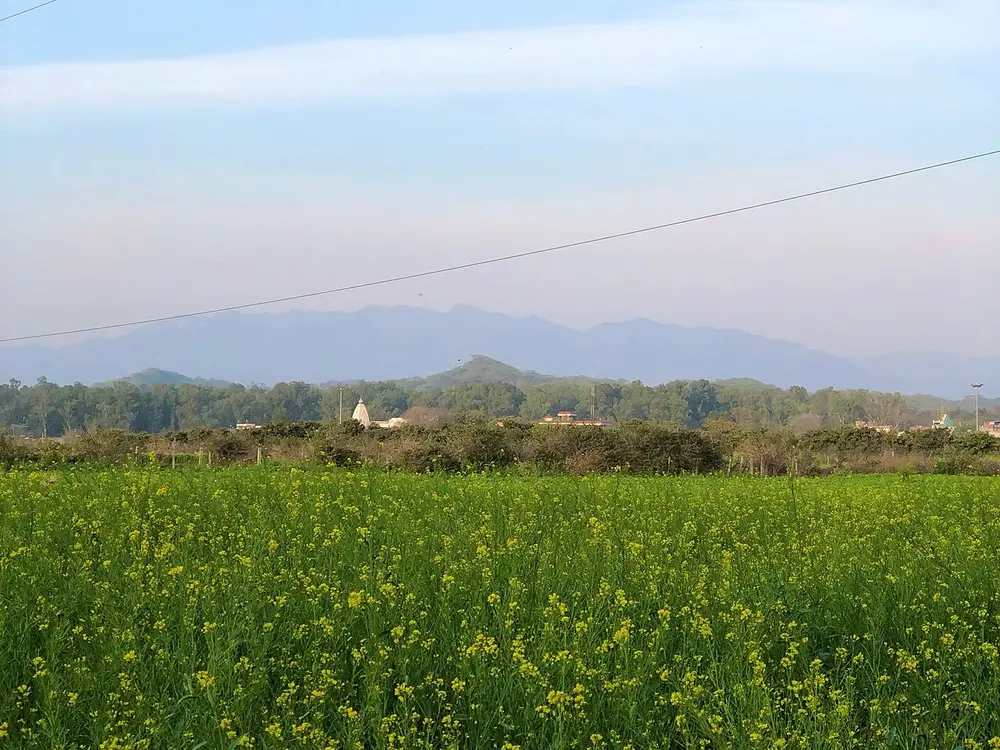
A wide field of yellow-flowering mustard under a pale blue sky, with low hills in the distance.
Picture: UnpetitproleX. CC BY-SA 4.0.

Basant Panchami

Also called Vasant Panchami, Saraswati Puja

Where
North and east India and Nepal; this mustard field is near Chandigarh, in Haryana
When
The fifth day of the bright half of the month of Magha, in late January or February

Basant Panchami gets ready for spring and honours Saraswati, the goddess of knowledge, music and the arts. Schools and homes, especially in West Bengal, Odisha and Bihar, hold Saraswati Puja, and many small children write their first letters on this day. Yellow is the colour of the festival. In Punjab and Haryana people wear yellow, eat yellow rice and fly kites, matching the mustard fields that are in flower at this time of year.

Spot it by

Yellow clothes, yellow rice and sweets, kites, and fields of yellow mustard.

Remember

Basant is as yellow as the mustard fields.

Saffron, blue and black

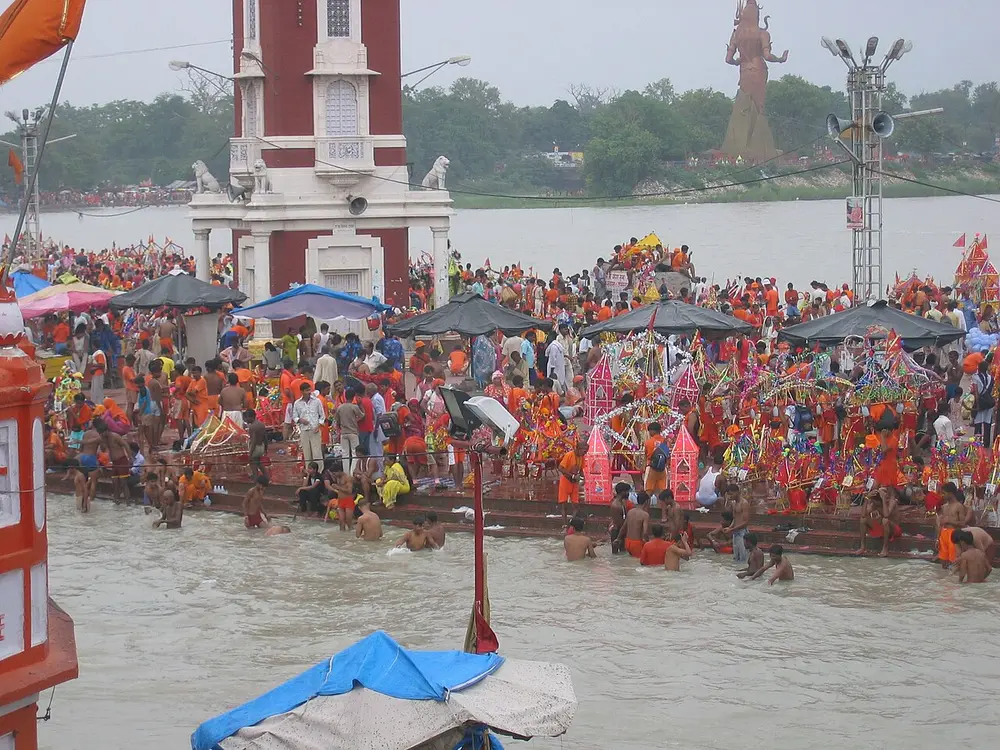
A huge crowd of pilgrims, most of them dressed in saffron and orange, fills the riverside steps and shallow water at Har ki Pauri in Haridwar, with a red clock tower behind them.
Picture: Nicolas C. CC BY-SA 2.0.

Saffron

Also called Bhagwa

Where
The photo shows pilgrims at Har ki Pauri, Haridwar, during the Kanwar Yatra

Saffron, a deep orange-yellow, is the colour of renunciation in Hinduism: giving up home, money and worldly ties. A sannyasi, someone who has taken vows to leave worldly life, is usually given an ochre or saffron robe, and many sadhus wear saffron. Pilgrims wear it too. Each monsoon, in the month of Shravan, crowds of saffron-clad kanwariyas carry Ganga water from places such as Haridwar back to Shiva temples, many of them on foot.

Spot it by

Saffron or ochre robes, worn by monks, sadhus and crowds of pilgrims.

Remember

Saffron means giving things up.
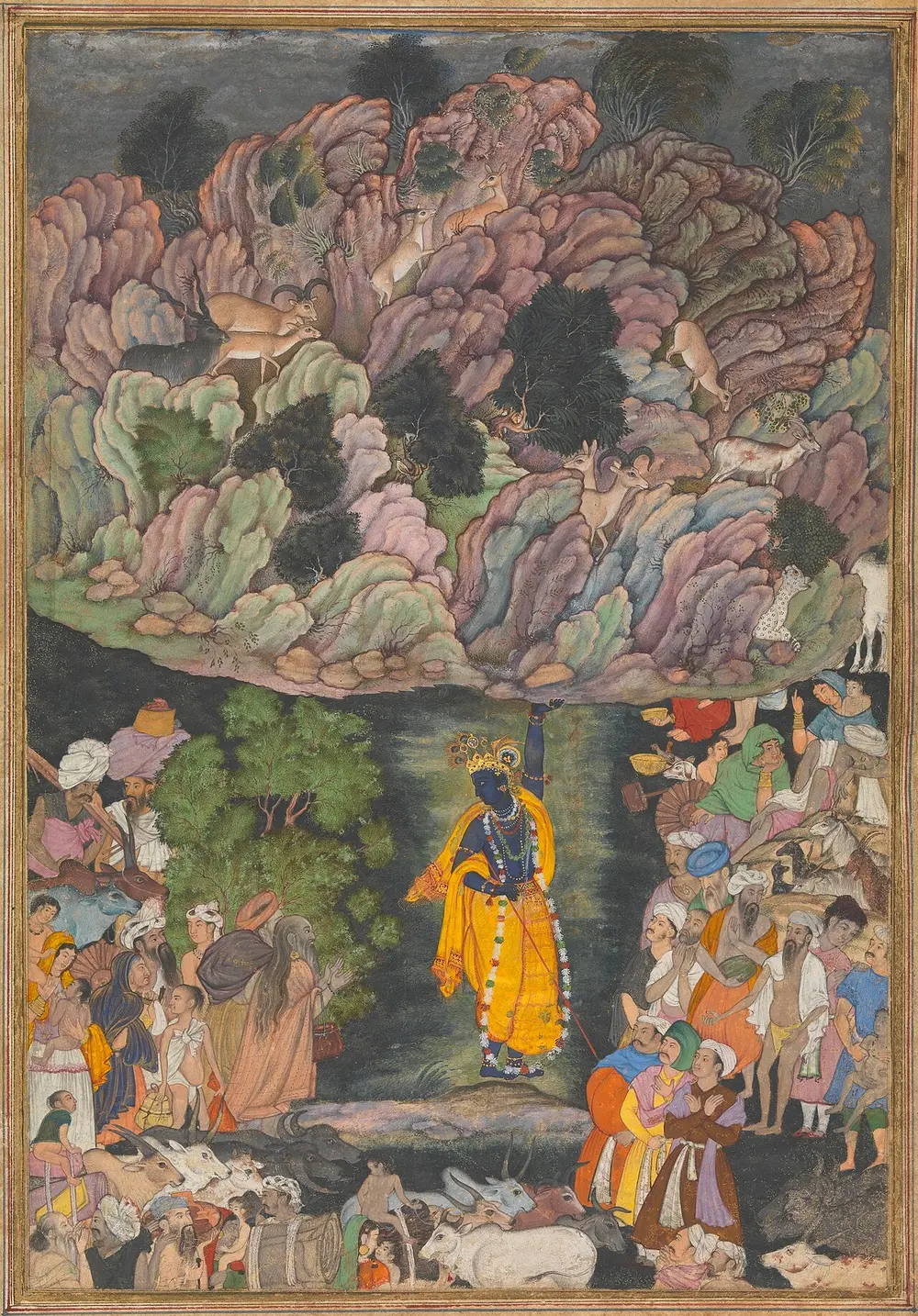
A Mughal miniature painting in which blue-skinned Krishna, in a yellow robe, holds up a huge rocky mountain while villagers, herders and cows shelter beneath it.
Picture: Miskin. Public domain.

Krishna's blue skin

Where
Painted at Akbar's court; now at the Metropolitan Museum of Art, New York
When
About 1590 to 1595
Who
Attributed to Miskin
Made with
Ink and colours on paper, a page from a Harivamsa manuscript

In Indian paintings and temple images, Krishna is nearly always shown with blue, black or very dark skin. The reason is his name: in Sanskrit krishna means "black" or "dark". Vishnu, of whom Krishna is an avatar, is shown the same way. In this painting Krishna lifts Mount Govardhan on one hand to shelter the people and cows of Braj from a terrible storm.

Spot it by

A blue-skinned figure in yellow, often with a flute and a peacock feather in his crown.

Remember

Krishna means "dark", so painters made him blue.
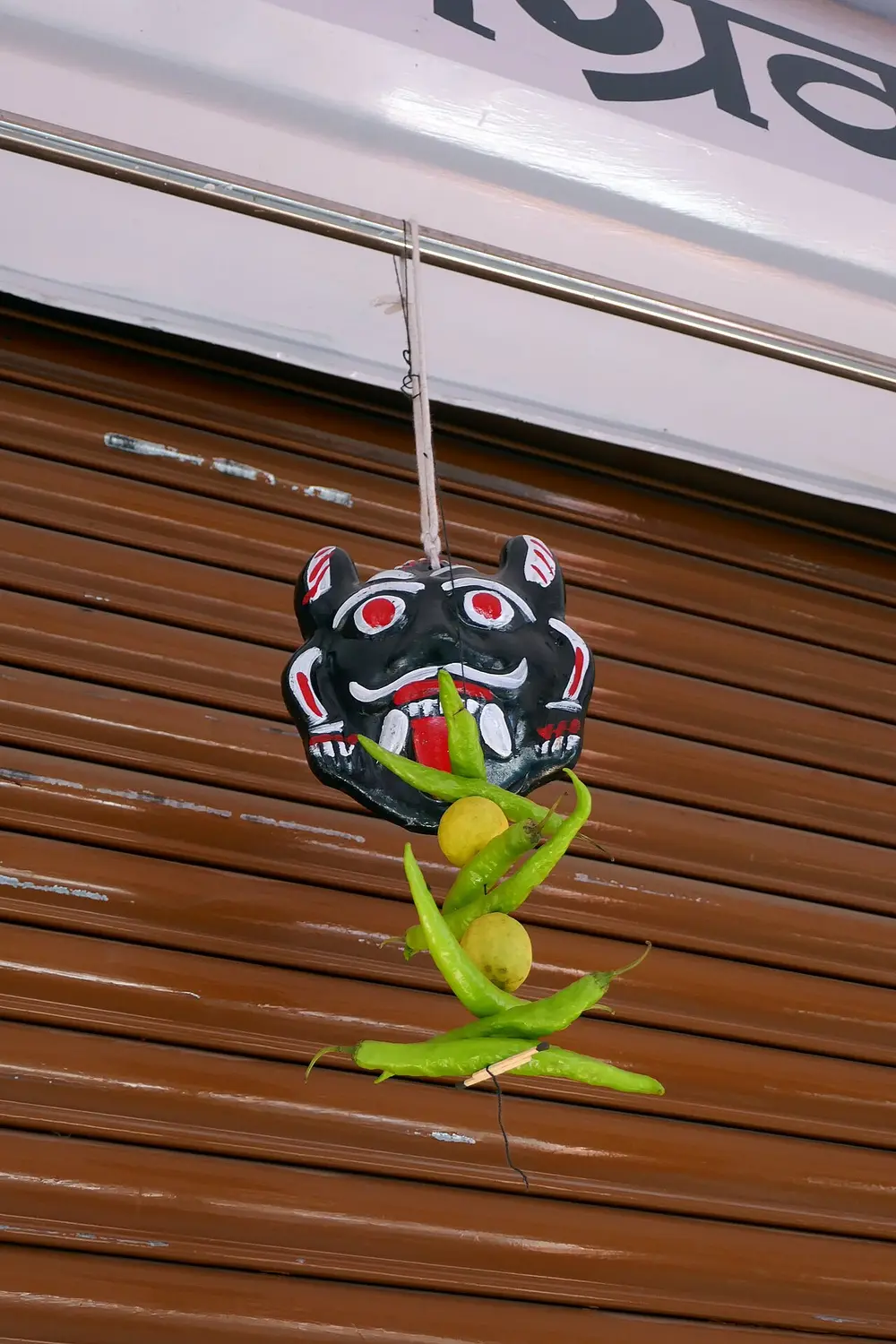
A small black demon-face mask with white eyes, fangs and a red tongue hangs above a string of green chillies and a lemon, in front of a brown shop shutter.
Picture: Ji-Elle. CC BY-SA 4.0.

Nazar battu

Also called A guard against the evil eye

Where
North India and Pakistan; this one hangs at a shop in Jaipur

Many families in South Asia believe that envy or too much praise, the evil eye or nazar, can bring bad luck. Black is the usual guard. A mother may put a small black dot of kajal on a baby's cheek or forehead, the kala tika, as a deliberate flaw that spoils perfection, and black threads are tied on wrists and ankles. A nazar battu is an object meant to catch the evil eye instead: houses, shops and trucks hang fierce black faces like this one, often with a lemon and green chillies (nimbu mirchi).

Spot it by

A black dot on a baby's face, black threads, and fierce faces or lemon and chilli strings over doors.

Remember

A black spot keeps the evil eye off.

Don't confuse

Some amulets copy the Turkish evil-eye bead, which is blue and white. The traditional Indian guard is black.

The flag's colours

No law gives the flag's colours official meanings: the 1947 resolution that adopted the flag only describes its colours, wheel and proportions. The explanation everyone quotes comes from the philosopher S. Radhakrishnan, later India's second President, speaking in the Constituent Assembly on 22 July 1947, the day the flag was adopted. In his words, saffron (bhagwa) stands for renunciation, so leaders should not chase personal gain; white is light, the path of truth; and green is our bond with the soil and the plant life all other life depends on. The wheel in the centre, the Ashoka Chakra, is the wheel of dharma. For the flag's design and history, see National symbols of India.

Around the world

A large oil painting of a royal wedding in a richly decorated chapel; the young queen in a white dress and veil stands at the altar beside Prince Albert, surrounded by courtiers and bridesmaids in white.
Picture: George Hayter. Public domain.

Queen Victoria's white wedding

Where
Chapel Royal, St James's Palace, London; the painting is in the Royal Collection
When
10 February 1840
Who
Painted by George Hayter

Before 1840, European and American brides usually married in their best dress, in almost any colour: blue, yellow, brown or even black, and red was popular too. Then Queen Victoria married Prince Albert in a white silk satin dress trimmed with lace made in Honiton, Devon. She was not the first bride in white, but pictures and reports of her wedding spread everywhere, and by the end of the 1800s white was the choice of wealthy brides on both sides of the Atlantic. Middle-class brides in Britain and America mostly followed after the Second World War. The dress survives, though it has aged to cream.

Spot it by

A bride in white with a long veil, in a grand 19th-century court scene.

Remember

Victoria made white the bride's colour in 1840.

Don't confuse

In many parts of India and East Asia, white is traditionally a colour of mourning, which is why red is the usual bridal colour there.
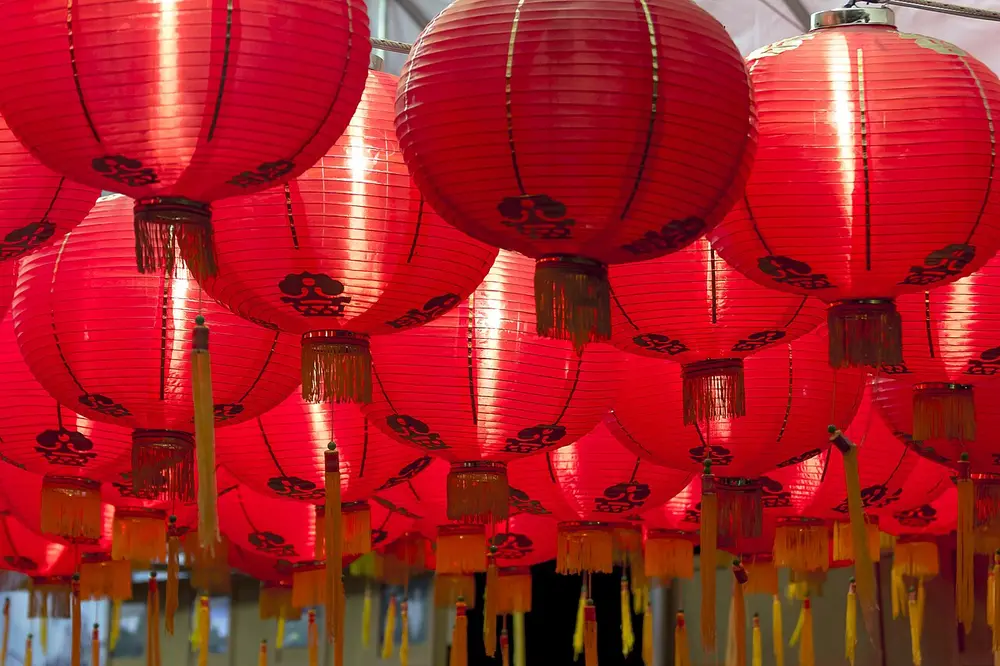
Rows of round red paper lanterns with golden tassels hanging close together.
Picture: wiroj from Pixabay. CC0.

Red for luck in China

Where
China and Chinese communities around the world
When
Seen most at Chinese New Year, the Spring Festival, in January or February

In Chinese culture red stands for good fortune, happiness and wealth. At New Year, streets and homes fill with red lanterns and paper decorations, and children and relatives are given money in red envelopes called hongbao. Traditional brides wear red, though white Western gowns are now popular too. Red is kept away from funerals, because the traditional colour of mourning in China, as in other parts of East Asia, is white. Yellow was once the emperor's own colour.

Spot it by

Red lanterns, red envelopes, and red and gold decorations everywhere.

Remember

In China red is lucky and white is for mourning.
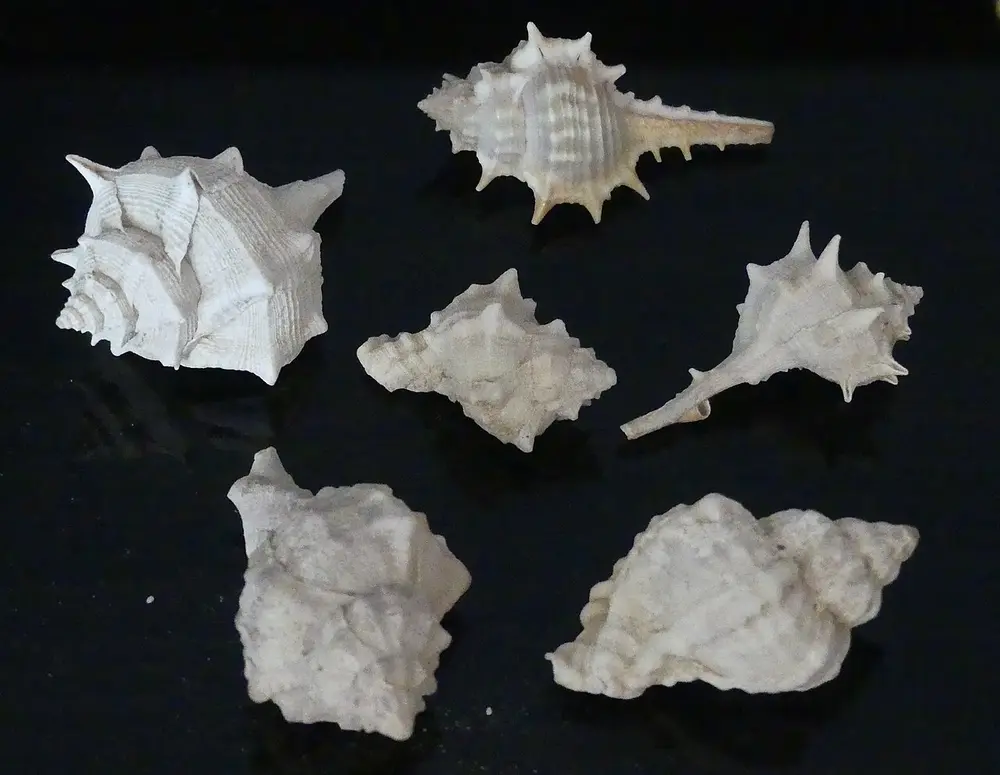
A group of white, spiky sea snail shells of different shapes laid out on a black cloth.
Picture: RomanDeckert. CC BY-SA 4.0.

Tyrian purple

Also called Royal purple, imperial purple

Where
Tyre in ancient Phoenicia, now in Lebanon, and around the Mediterranean; these shells are on show in a hotel in Tyre
When
Made by the Phoenicians from at least 1200 BCE; prized by the Romans and the Byzantine emperors
Made with
A slime from the glands of murex sea snails

Tyrian purple is a deep reddish-purple dye made from the slime of murex sea snails. It is named after Tyre, the Phoenician city whose dyers made it famous. In an experiment in the early 1900s, 12,000 snails gave only about 1.4 grams of dye, barely enough for the border of one garment, and in ancient times it was said to be worth its weight in silver. It did not fade easily. Senior Roman officials wore white togas edged with it, and by the 4th century CE only the emperor was allowed to wear it. That is why purple still means royalty in Europe.

Spot it by

Spiky murex shells, and deep purple robes on emperors in Roman and Byzantine art.

Remember

Purple was for emperors because it took thousands of snails.
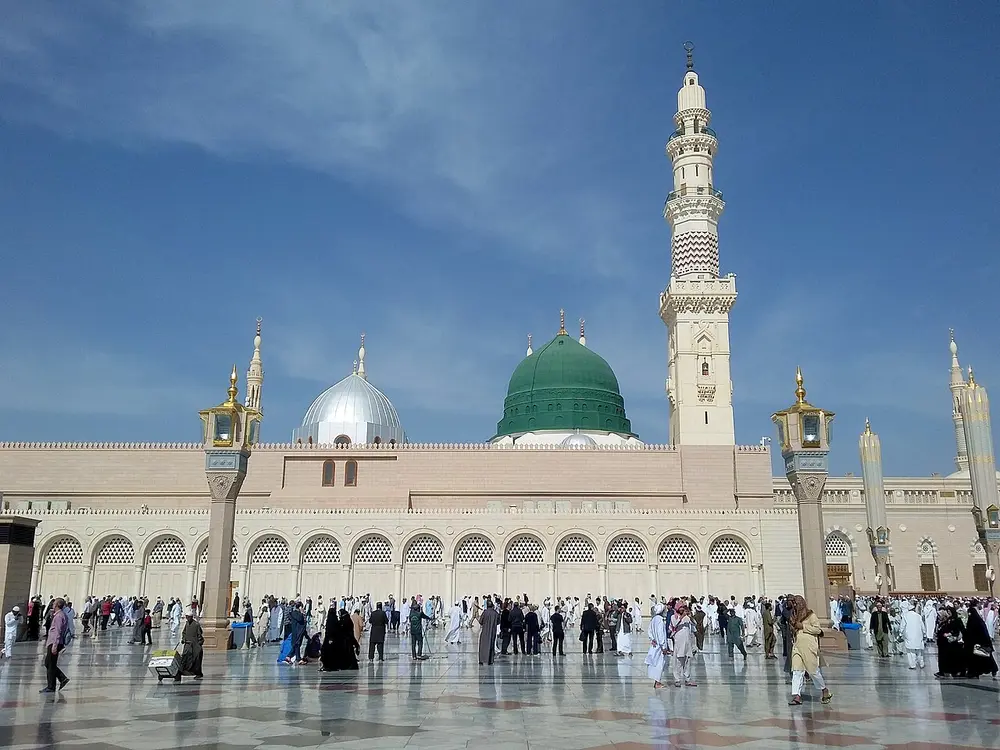
A wide white mosque courtyard with crowds of people, a tall pale minaret and a bright green dome under a blue sky.
Picture: King Eliot. CC BY-SA 4.0.

Green Dome, Medina

Where
The Prophet's Mosque (Al-Masjid an-Nabawi), Medina, Saudi Arabia
When
First painted green in the 1800s

Green is the colour most closely linked with Islam. The Quran describes the people of paradise dressed in green silk and resting on green cushions, so green suggests paradise, life and blessing. The best-known green landmark is the Green Dome over the tomb of the Prophet Muhammad in Medina. Green also appears on the flags of many Muslim-majority countries, such as Saudi Arabia and Pakistan.

Spot it by

A green dome beside tall minarets, and green flags and banners.

Remember

In Islam green is the colour of paradise.
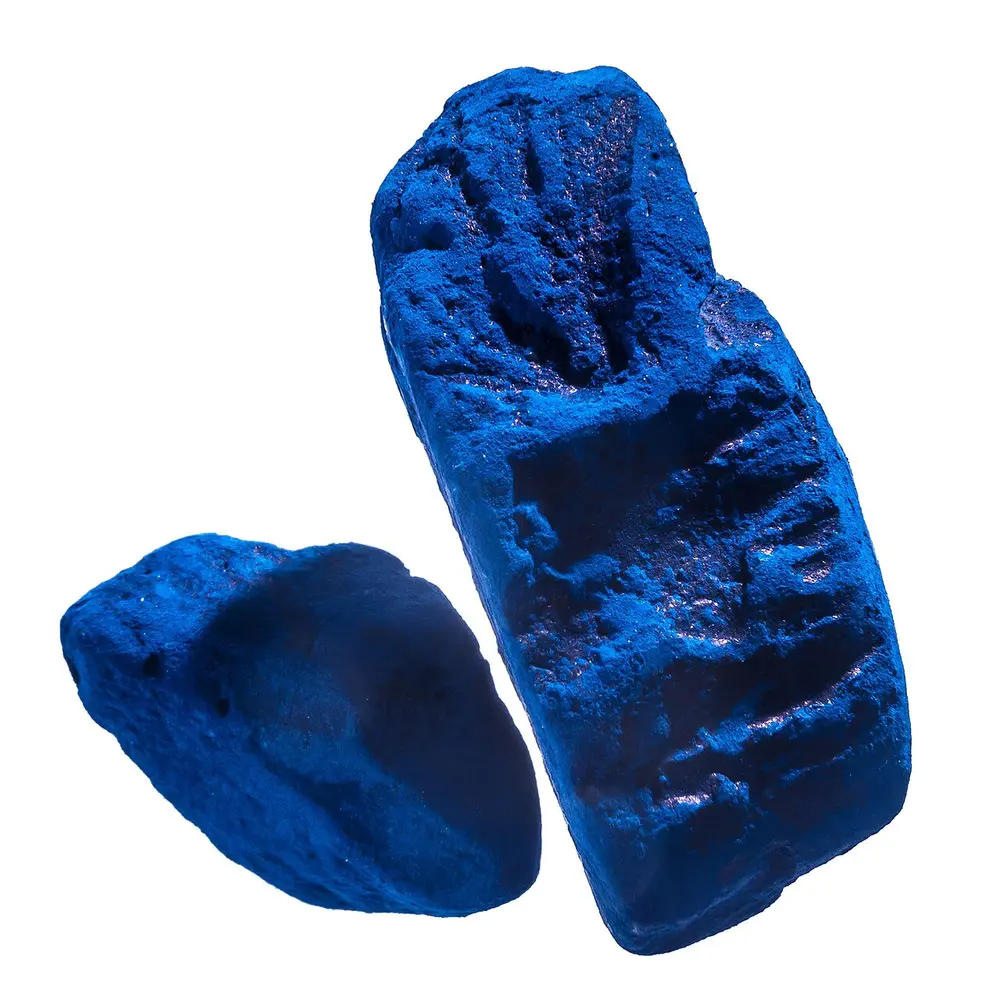
Two lumps of dried indigo dye, a deep bright blue, on a white background.
Picture: David Stroe. CC BY-SA 3.0.

Indigo

Also called Neel

Where
India was the main source for Europe for centuries
Made with
Leaves of the indigo plant, fermented in water and dried into cakes

Indigo was India's great blue export. It reached Greece and Rome more than 2,000 years ago, and the Greeks called it indikon, "from India", which became the English word indigo. It was sold as hard blue cakes like these. Under British rule, European planters forced farmers in Bengal to grow it, which led to the Indigo Revolt of 1859 and the Bengali play Nil Darpan by Dinabandhu Mitra. From 1897 the German company BASF made indigo from chemicals, and India's natural indigo trade shrank fast. Today indigo is the blue of jeans. How it is dyed is in Printed, dyed and tied.

Spot it by

Deep blue cakes or powder, and deep blue cloth.

Remember

Indigo means "from India".

Colour as a code

Colour is quick to read, so it is used for warnings. Safety signs use the same colours worldwide: a red circle with a slash forbids, a blue circle tells you what you must do, a yellow triangle warns, and green marks safe places such as exits. Reading icons and signs explains them. Indian number plates use colour to show what kind of vehicle it is. UCEED 2026 asked about these.

Letters Plate Vehicle
Black White Private
Black Yellow Commercial, such as taxis, trucks and buses
Yellow Black Rental vehicles you drive yourself
White Green Private electric
Yellow Green Commercial electric
White Blue Embassies and the United Nations
White, starting with an upward arrow Black Armed forces
Red Yellow Temporary, awaiting a permanent number

Brands use colour so you recognise them before you read a word. A few colours are so tied to one company that the law protects them: Tiffany & Co.'s pale robin's-egg blue was registered as a colour trademark in the United States in 1998, and Pantone mixes it as a private shade numbered 1837, the year Tiffany was founded.

Pantone's Color of the Year. Pantone, the company whose numbered colour guides designers use to match colours exactly, picks one colour each year as a guide to trends. As of October 2026 the current one is Cloud Dancer (PANTONE 11-4201), a soft white chosen for 2026 and announced in December 2025. It is the first white Pantone has picked. The colour for 2027 is usually announced in early December.

Colour words

Word What it means Example
Hue The colour itself, its place on the colour wheel. Software gives it as an angle round the wheel Red is 0 degrees, yellow 60, green 120, blue 240
Saturation How pure and strong a colour is, rather than greyish Bright red against dusty rose
Value How light or dark a colour is Pink is a light value of red, maroon a dark one
Warm and cool Warm colours feel like fire and sun; cool ones feel like water and sky Red, orange, yellow; green, blue, violet
Complementary Opposite each other on the painter's wheel, so they contrast most strongly Red and green, blue and orange, yellow and violet
Analogous Neighbours on the wheel, so they sit calmly together Yellow-orange, yellow and yellow-green
Monochromatic One hue in tints (white added), shades (black added) and tones (grey added) Pale blue, blue and navy

Test yourself

Question 1 of 8

Which colour was made from the slime of these sea snails?

Question 2 of 8

Why is Krishna usually painted with blue or dark skin?

Question 3 of 8

Which of these is hung up to ward off the evil eye?

Question 4 of 8

This 1840 wedding helped make which custom popular?

Question 5 of 8

Who gave the best-known explanation of the colours of India's flag, in the Constituent Assembly in 1947?

Question 6 of 8

On an Indian number plate, black letters on a yellow plate mean the vehicle is

Question 7 of 8

Which pair is complementary on the painter's colour wheel?

Question 8 of 8

Tints and shades of a single hue make which kind of colour scheme?

From past papers

Real exam questions on this topic, each with a full solution.

Finished this note?

Mark it as studied to track your progress through the course.

Was this note useful?

Each picture is credited underneath it. Pictures of works still in copyright are shown small, for teaching only. If you hold the rights to a picture and want it removed, tell us through the contact page and we will take it down.