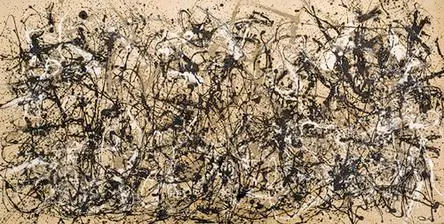
Autumn Rhythm (Number 30)
- Where
- Metropolitan Museum of Art, New York
- When
- 1950
- Who
- Jackson Pollock (1912 to 1956)
- Style
- Abstract Expressionism (action painting)
- Made with
- Paint poured and dripped onto unprimed canvas, more than 5 metres wide
Pollock laid his canvas flat on the floor of his studio and walked around it, pouring, flicking and dripping paint from cans, sticks and stiff brushes. There is no top, bottom or centre; the whole surface is one web of lines. Photographs of him at work made the process famous, and a critic, Harold Rosenberg, called this kind of art "action painting", because the painting is a record of the artist's movements. Pollock died in a car crash in 1956.
Spot it by
Tangled webs and drips of paint over the whole canvas, no shapes or objects, no single focus, often very wide.Remember
Pollock didn't paint the picture; he danced it, with dripping paint.Don't confuse
Willem de Kooning, the other great action painter, used big, slashing brushstrokes and kept a hint of a figure, as in his Woman I (1950 to 1952, MoMA). Pollock's paintings have no figures at all.