Skip to content

Chapter 3: Art of the world

The Renaissance

The painters, sculptors and builders of Italy and northern Europe from about 1300 to 1600, from Giotto and Brunelleschi to Leonardo, Michelangelo, Raphael, Van Eyck, Dürer, Bosch and Bruegel, with the techniques they made famous.

In one minute

6 facts to know

  1. Renaissance means "rebirth". From about 1400, artists in Italy looked back to ancient Greece and Rome and studied real bodies, light and space.
  2. Brunelleschi worked out linear perspective in Florence around 1415 and built the huge dome of Florence Cathedral (1420 to 1436).
  3. Leonardo da Vinci painted the Mona Lisa (Louvre, Paris), The Last Supper (Milan) and Lady with an Ermine, and drew the Vitruvian Man.
  4. Michelangelo carved the David and the Pietà and painted the Sistine Chapel ceiling, which includes The Creation of Adam. Raphael painted The School of Athens next door.
  5. North of the Alps, Jan van Eyck, Dürer, Bosch and Bruegel painted in oil with tiny, exact detail.
  6. UCEED has asked which pictures are by Leonardo, and which movement Duchamp belonged to when he drew a moustache on the Mona Lisa (Dada).

What the Renaissance was

The word Renaissance is French for "rebirth". It names a period, roughly 1400 to 1600, when European artists and thinkers turned back to the art and books of ancient Greece and Rome. It started in Florence, in Italy, and spread to Rome, Venice and then northern Europe.

Three things changed in art. Painters learned to make a flat wall look like a deep space, using perspective. They studied anatomy so that bodies looked solid and alive. And they began to sign their work and be famous as individuals, paid by rich patrons such as the Medici family of Florence and the popes in Rome.

Art historians split it into parts. The Early Renaissance (the 1400s) belongs to Brunelleschi, Donatello and Botticelli. The High Renaissance (roughly the 1490s to the 1520s) is the age of Leonardo, Michelangelo and Raphael. The Northern Renaissance is the same period in Flanders, the Netherlands and Germany. Giotto, a century earlier, is counted as the forerunner.

The forerunner and the Early Renaissance

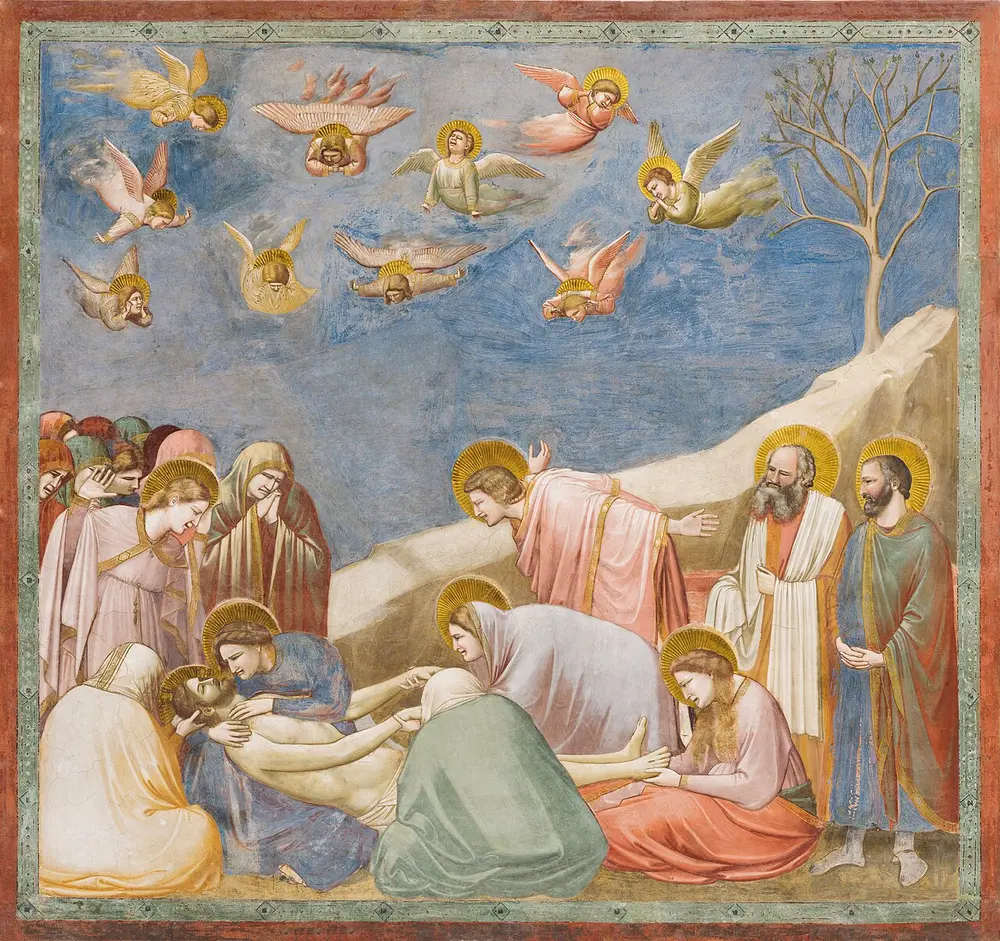
A fresco of mourners gathered around the body of Christ on the ground, with weeping angels flying in a blue sky and a bare tree on a rocky slope.
Picture: Gennadii Saus i Segura. Public domain.

Giotto's Lamentation

Also called The Mourning of Christ

Where
Scrovegni Chapel (also called the Arena Chapel), Padua, Italy
When
About 1305
Who
Giotto di Bondone
Style
Proto-Renaissance (the forerunner)
Made with
Fresco

Giotto covered the walls of a small chapel in Padua with scenes from the life of Christ. Before him, holy figures in Italian painting were flat and stiff, copied from Byzantine icons. Giotto gave them weight, real feelings and a stage to stand on, a hundred years before the Renaissance proper. That is why he is called its forerunner.

Spot it by

Solid, rounded figures in simple robes, strong blue backgrounds, gold halos, and people seen from behind so that you feel you are in the crowd.

Remember

Giotto came first: about 200 years before the Mona Lisa, he made saints cry real tears.
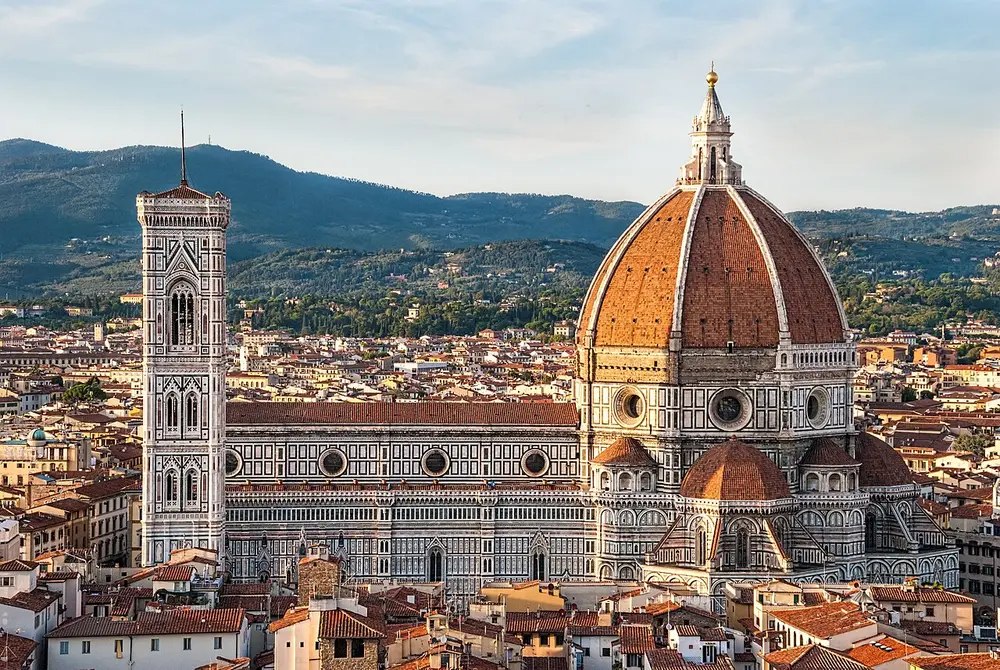
Florence Cathedral seen from above the city, with its huge red-brick dome ribbed in white stone and a tall striped bell tower to the left.
Picture: Gary Campbell-Hall. CC BY 2.0.

Brunelleschi's dome

Also called The dome of Florence Cathedral (Santa Maria del Fiore)

Where
Florence, Italy
When
Dome built 1420 to 1436; perspective worked out around 1415
Who
Filippo Brunelleschi (1377 to 1446)
Style
Early Renaissance architecture
Made with
Brick and stone, raised with lifting machines he designed

Brunelleschi was a goldsmith who became the founding architect of the Renaissance. He found a way to close the enormous gap over Florence Cathedral with an eight-sided brick dome, using lifting machines of his own invention. Around 1415 he also showed, with painted panels of Florence's buildings, how to draw a scene with linear perspective, the method painters used for the next four centuries.

Spot it by

The red-tiled dome with eight white ribs, sitting above the city's roofs. The striped tower beside it is the bell tower, Giotto's campanile.

Remember

Brunelleschi gave the Renaissance two things: its biggest dome and its perspective.
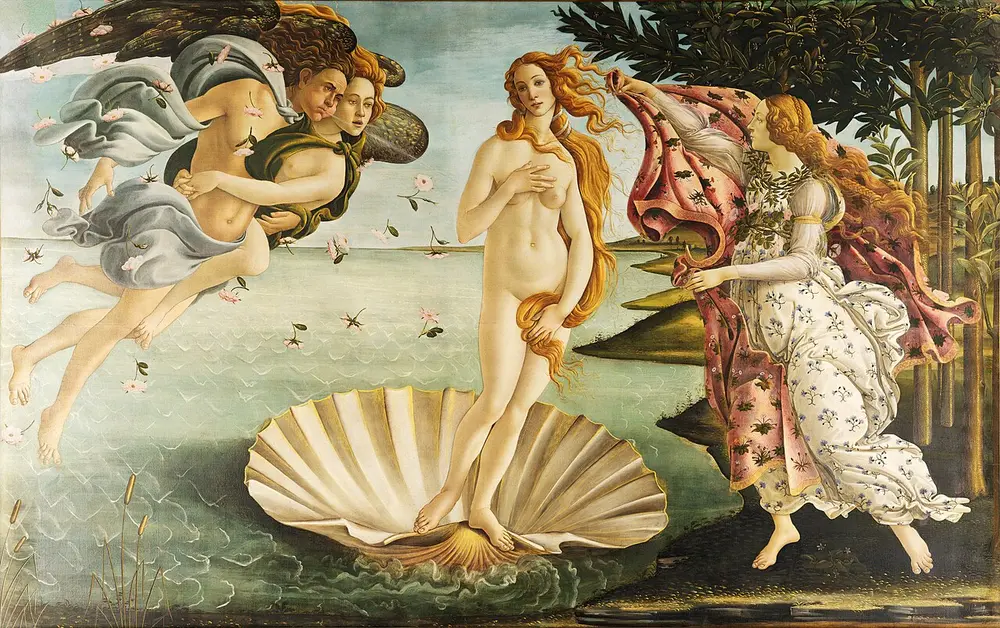
The goddess Venus, nude with long red-gold hair, stands on a large scallop shell on the sea while wind gods blow her to the shore and a woman waits with a flowered cloak.
Picture: Sandro Botticelli. Public domain.

The Birth of Venus

Where
Uffizi Gallery, Florence
When
Around 1485
Who
Sandro Botticelli
Style
Early Renaissance
Made with
Tempera on canvas
Key works
The Birth of Venus; Primavera (Spring), around 1480, also in the Uffizi

Botticelli painted the Roman goddess of love arriving on the shore on a shell, blown by the winds. A large painting of a story from Greek and Roman myth, with a nude goddess at its centre, was almost unheard of since ancient times, so it shows the Renaissance's new love of the classical past. His other famous painting, Primavera, shows Venus and other figures from myth in a garden in spring.

Spot it by

A pale goddess on a scallop shell, flowing golden hair, wind gods on the left, a woman with a cloak on the right, flat sea with little V-shaped waves, graceful outlines.

Remember

Venus arrives by shell, not by ship.

Don't confuse

Titian also painted Venus, but his are rich, glowing oil paintings from Venice. Botticelli's lines are crisp and his colours flatter and more matt, because he used tempera.

Leonardo da Vinci

Leonardo (1452 to 1519) was a painter, engineer and scientist. He finished few paintings, but each one changed art. He worked in Florence and Milan and died in France. UCEED 2016 showed four pictures and asked which were his: the right answers were The Virgin of the Rocks and the Mona Lisa; the wrong ones were a Raphael Madonna and a red-chalk study by Michelangelo.

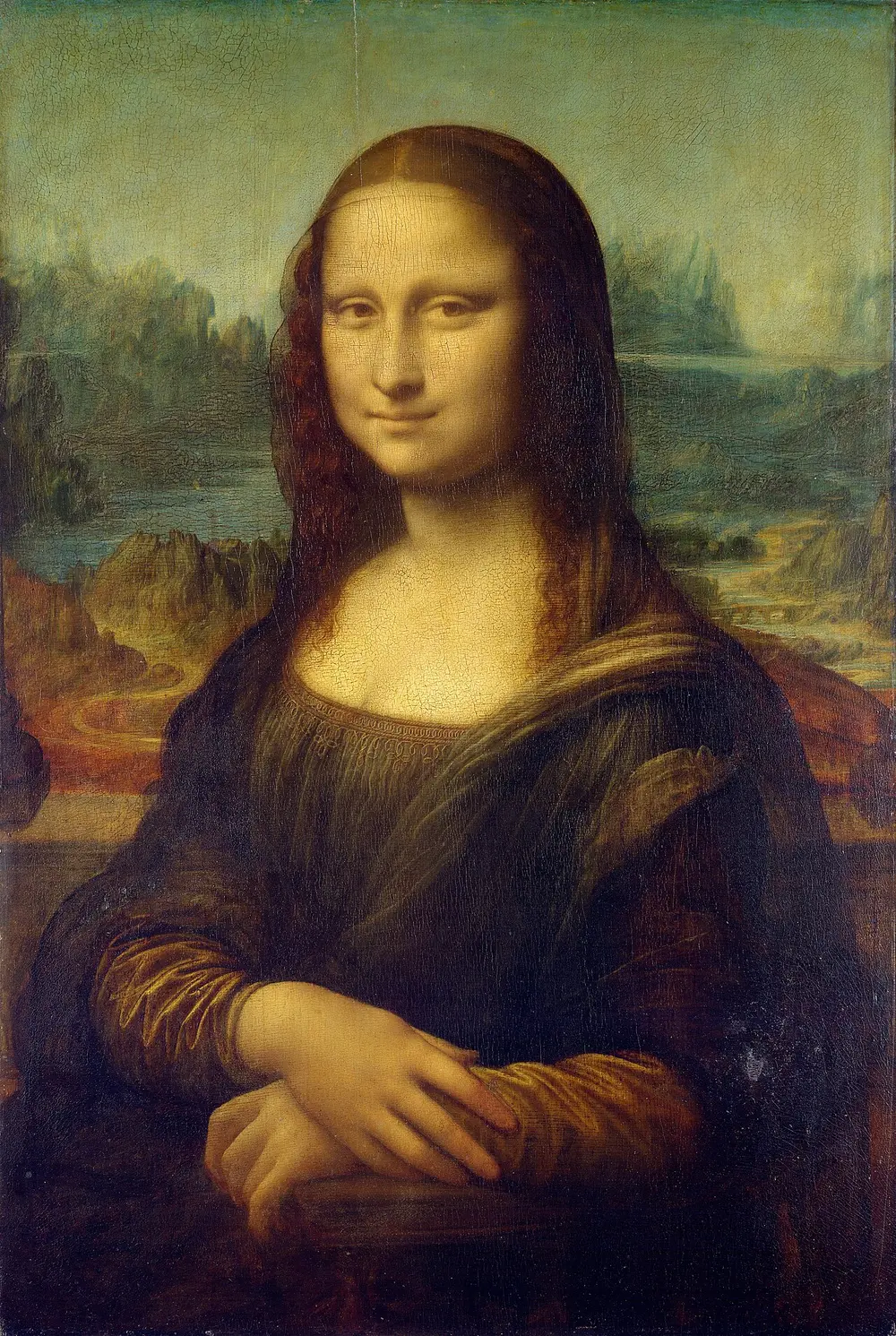
Half-length portrait of a woman in dark clothes with folded hands and a faint smile, in front of a misty landscape of winding paths, water and rocks.
Picture: Leonardo da Vinci. Public domain.

Mona Lisa

Also called La Gioconda

Where
Louvre, Paris
When
Begun in 1503; Leonardo was still working on it years later
Who
Leonardo da Vinci
Style
High Renaissance
Made with
Oil on a poplar wood panel

The sitter is thought to be Lisa del Giocondo, the wife of a Florence merchant. Leonardo kept the painting with him, and after his death it passed to the King of France, which is why it is in Paris. Its soft, smoky shading, called sfumato, makes her smile hard to pin down. It became world famous after it was stolen from the Louvre in 1911 and missing for more than two years.

Spot it by

Folded hands, no eyebrows, a faint smile, dark dress, and a hazy blue-green landscape that does not line up on the two sides.

Remember

The world's most famous smile lives in Paris, not Italy.

Don't confuse

In 1919 the Dada artist Marcel Duchamp drew a moustache and goatee on a cheap postcard of the Mona Lisa and called it L.H.O.O.Q. It mocked the idea of the untouchable masterpiece. UCEED 2025 asked which movement he belonged to: Dada.
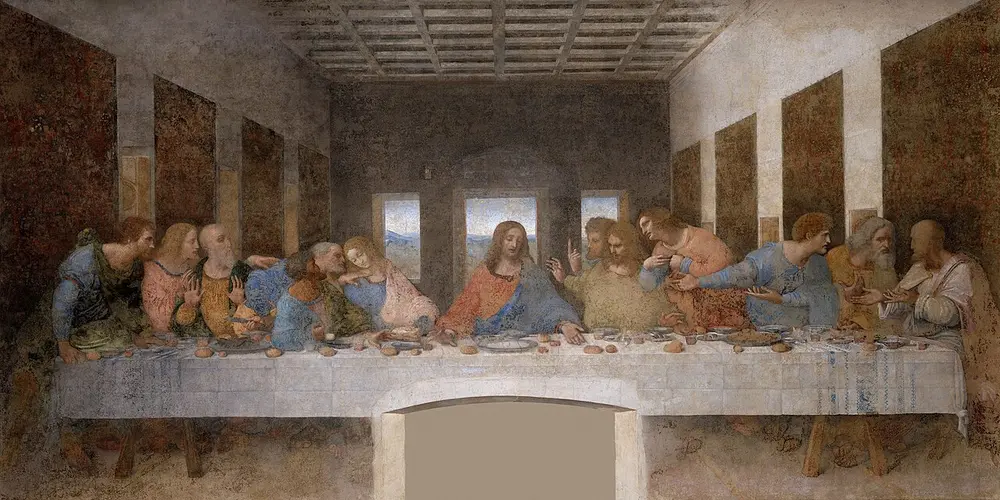
A long wall painting of Christ seated at the centre of a table with his twelve disciples in groups of three, reacting in alarm, in a room whose lines lead to a window behind him.
Picture: Leonardo da Vinci. Public domain.

The Last Supper

Where
Dining hall of the convent of Santa Maria delle Grazie, Milan
When
About 1495 to 1498
Who
Leonardo da Vinci, for Ludovico Sforza, Duke of Milan
Style
High Renaissance
Made with
Tempera on a dry plaster wall

Leonardo painted the moment Christ tells his disciples that one of them will betray him, and each reacts in his own way. All the lines of the ceiling and walls meet at Christ's head, so your eye goes straight to him. Leonardo did not paint it as a true fresco, so the paint soon began to flake. The last big restoration ended in 1999. The church and painting are a UNESCO World Heritage Site.

Spot it by

A long table seen from the front, Christ in the centre framed by a bright window, disciples in four groups of three, a coffered ceiling.

Remember

Every line in the room points to Christ's head: perspective as a spotlight.

Don't confuse

It is often called a fresco, but it is not one. Real frescoes, like Michelangelo's Sistine ceiling, are painted into wet plaster and last far better.
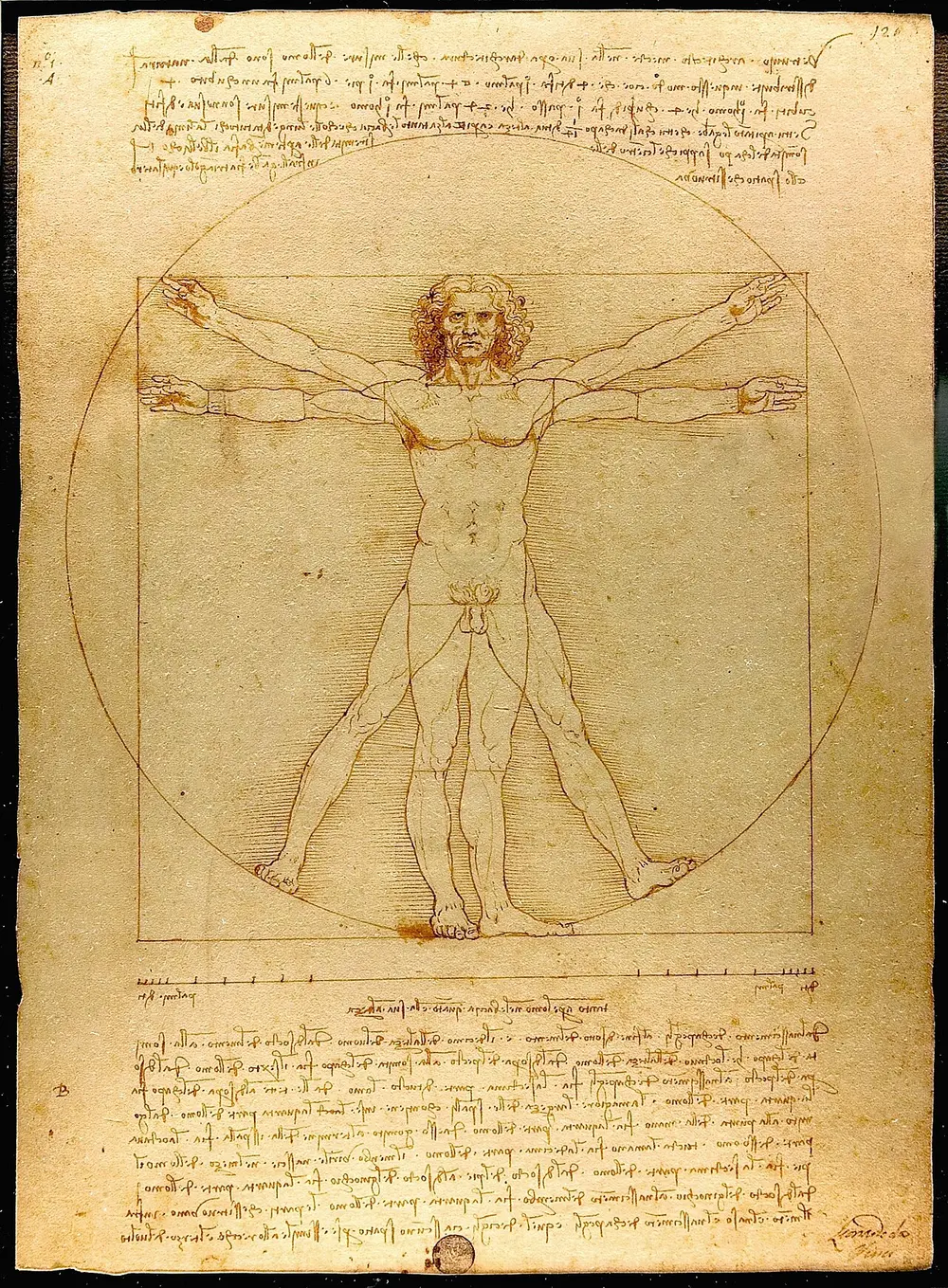
An ink drawing of a nude man with arms and legs in two positions at once, fitted inside both a circle and a square, with mirror-written notes above and below.
Picture: Leonardo da Vinci. Public domain.

Vitruvian Man

Where
Gallerie dell'Accademia, Venice (rarely shown, because light damages it)
When
About 1490
Who
Leonardo da Vinci
Style
High Renaissance
Made with
Pen and ink, with touches of watercolour, on paper

The Roman architect Vitruvius wrote that a well-built human body fits inside both a circle and a square. Leonardo tested the idea and drew it, with notes on the body's proportions. It joins art, maths and science on one sheet, which is why it has become a symbol of the Renaissance itself.

Spot it by

One man, four arms and four legs, a circle and a square, and Leonardo's backwards mirror handwriting.

Remember

Circle plus square equals Leonardo.

Don't confuse

UCEED 2015 showed a remake of it built from geometric lines. The original is a small ink drawing, not a painting.
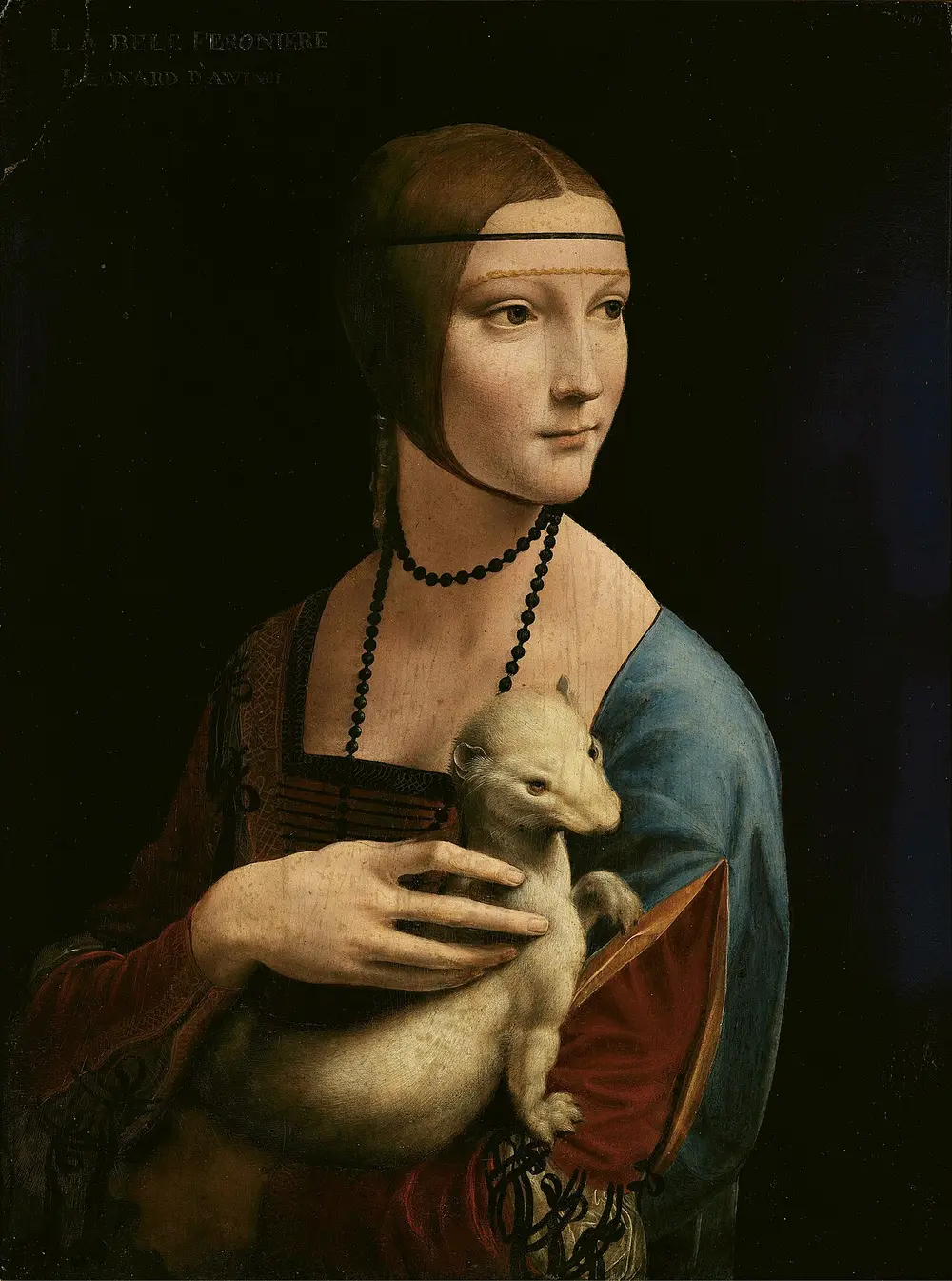
Portrait of a young woman against a black background, turning to her left and holding a white ermine, a slender weasel-like animal, in her arms.
Picture: Leonardo da Vinci. Public domain.

Lady with an Ermine

Where
Czartoryski Museum, part of the National Museum in Kraków, Poland
When
About 1490
Who
Leonardo da Vinci
Style
High Renaissance
Made with
Oil on a walnut wood panel

Painted in Milan, it shows Cecilia Gallerani, a young woman at the court of the Duke of Milan. Her body turns one way and her face the other, and the ermine twists the same way, which gives the picture life and movement.

Spot it by

A dark background, a white ermine in her arms, a thin band across her forehead, a long bead necklace, and her elegant raised hand.

Remember

The lady and the ermine look the same way.

Don't confuse

It is in Poland, not in Italy or the Louvre, so it is a good "where is it now" question.

Michelangelo

Michelangelo Buonarroti (1475 to 1564) saw himself as a sculptor first, but he also painted the most famous ceiling in the world and designed buildings. His figures are muscular and full of energy.

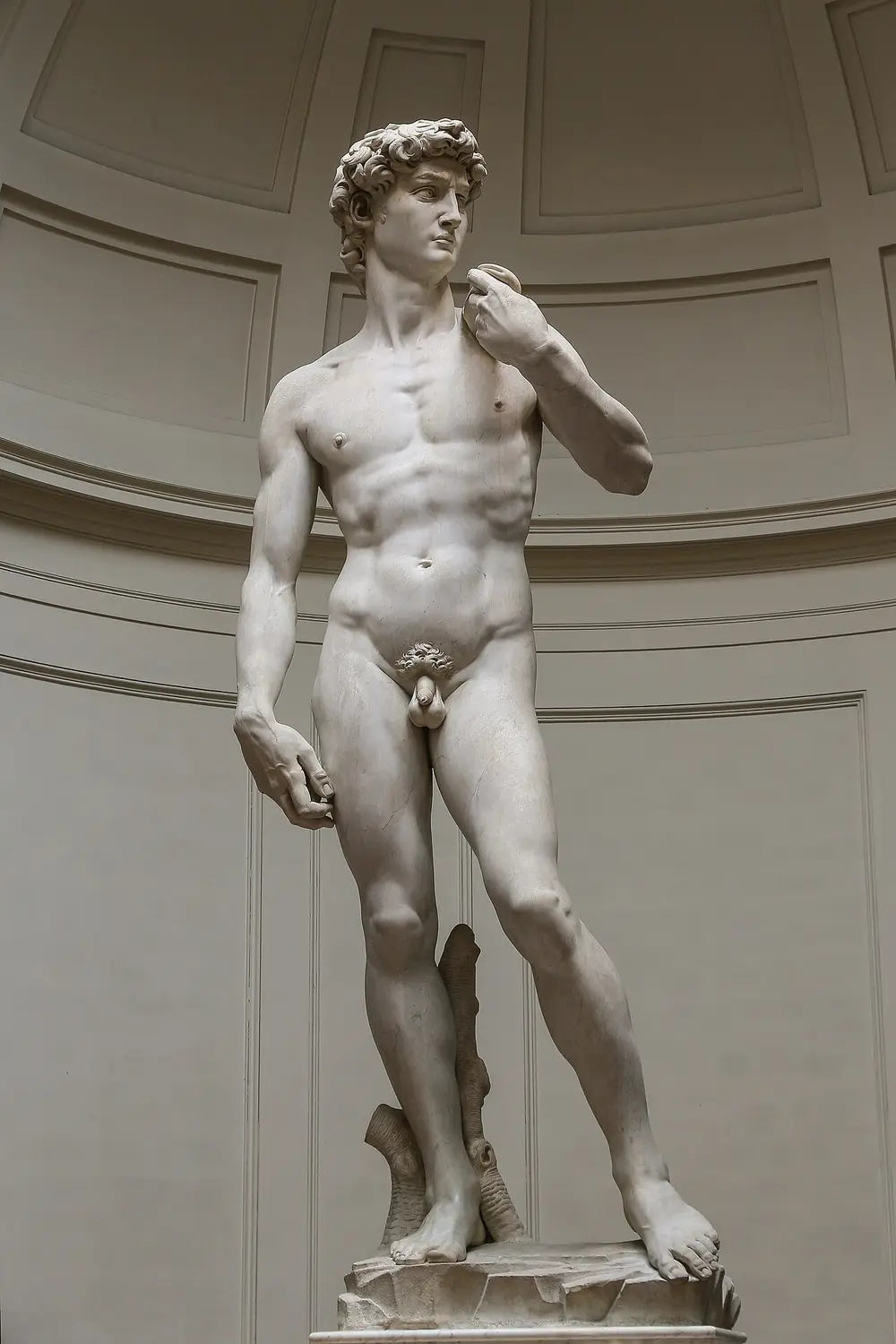
The marble statue of David, a nude young man standing with his weight on one leg, a sling over his left shoulder, looking sharply to his left.
Picture: Jörg Bittner Unna. CC BY 3.0.

David

Where
Galleria dell'Accademia, Florence (a copy stands in the Piazza della Signoria)
When
1501 to 1504
Who
Michelangelo
Style
High Renaissance
Made with
A single block of white marble, 5.17 metres tall

Michelangelo carved the Bible hero who killed the giant Goliath. He shows David before the fight, tense and alert, not after it. The statue first stood outside Florence's town hall as a symbol of the small city standing up to stronger enemies. It was moved indoors in 1873.

Spot it by

A giant nude marble youth, sling over the left shoulder, head turned to the side, weight on the right leg, oversized hands.

Remember

Michelangelo's David is waiting for the fight; he has not thrown the stone yet.

Don't confuse

Donatello's earlier bronze David, in the Bargello museum in Florence, is a much smaller boy in a hat, standing over Goliath's head after the fight.
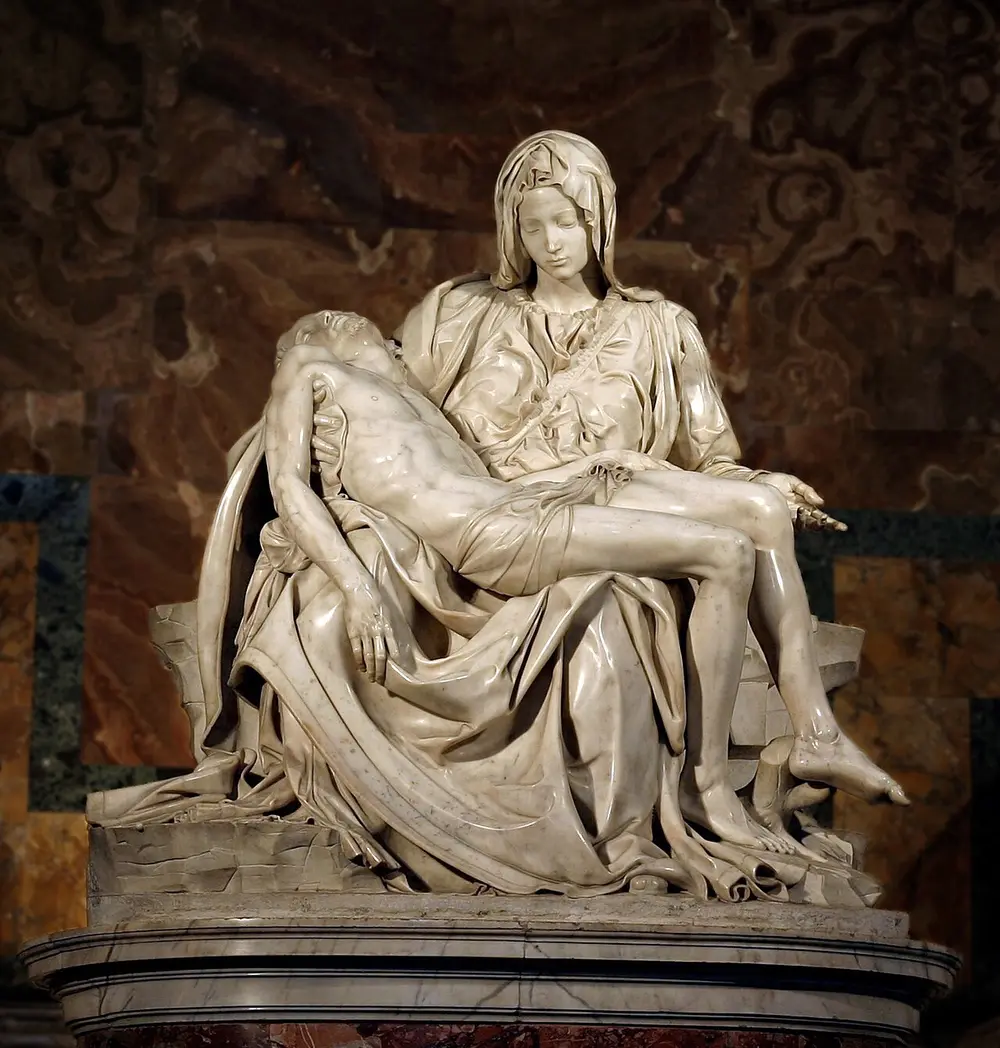
A white marble sculpture of a young-looking Mary seated, holding the body of the dead Christ across her lap, with deep folds in her robes.
Picture: original file by Stanislav Traykov. CC BY 2.5.

Pietà

Where
St Peter's Basilica, Vatican City
When
1498 to 1499
Who
Michelangelo, aged about 23
Style
High Renaissance
Made with
Carrara marble

Pietà means "pity". The sculpture shows Mary holding her dead son after he was taken down from the cross. Michelangelo made Mary young and calm, and fitted a grown man's body across her lap so that the group feels natural. He carved his name on the strap across her chest.

Spot it by

Mary seated in heavy marble drapery, Christ lying across her knees, a pyramid shape, behind glass in St Peter's.

Remember

Pietà is "pity": a mother holding her son.
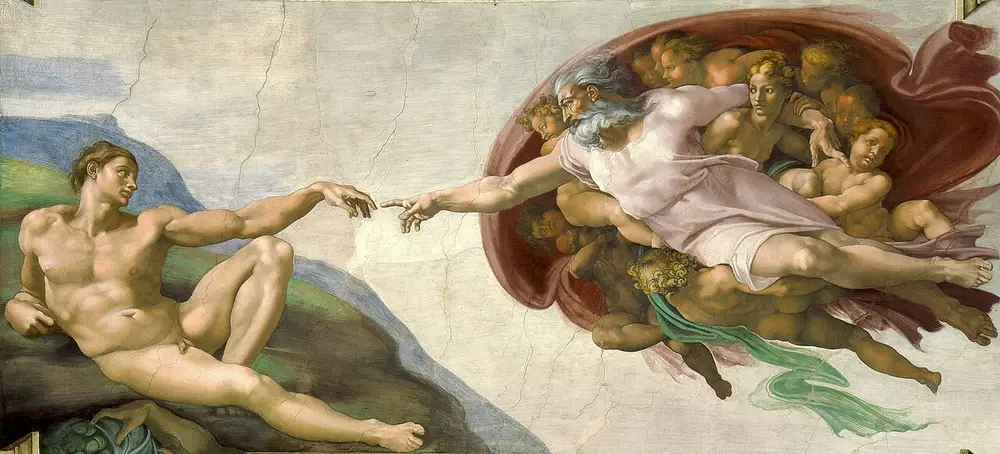
A fresco of a reclining nude Adam stretching out his hand towards God, an old bearded man carried through the air with angels, their fingers almost touching.
Picture: Michelangelo. Public domain.

The Creation of Adam

Also called Part of the Sistine Chapel ceiling

Where
Ceiling of the Sistine Chapel, Vatican City
When
Ceiling painted 1508 to 1512
Who
Michelangelo, for Pope Julius II
Style
High Renaissance
Made with
Fresco
Key works
The Sistine Chapel ceiling, with nine scenes from the Book of Genesis; The Last Judgment on the altar wall of the same chapel (1536 to 1541)

Pope Julius II asked Michelangelo to paint the chapel's ceiling, and he spent four years on it. The centre has nine scenes from the start of the Bible, including this one, where God reaches out to give life to the first man. More than 20 years later he came back and painted The Last Judgment, with hundreds of figures rising to heaven or falling to hell, on the wall behind the altar.

Spot it by

Two hands, two fingers almost touching, a gap between them; Adam lying on green earth, God in a red cloak full of angels.

Remember

Ceiling first (1508 to 1512), Last Judgment later (1536 to 1541), same chapel.

Don't confuse

UCEED 2015 showed it with a glass of drink in God's hand. The original is part of a fresco ceiling, not a separate canvas.

Raphael and Titian

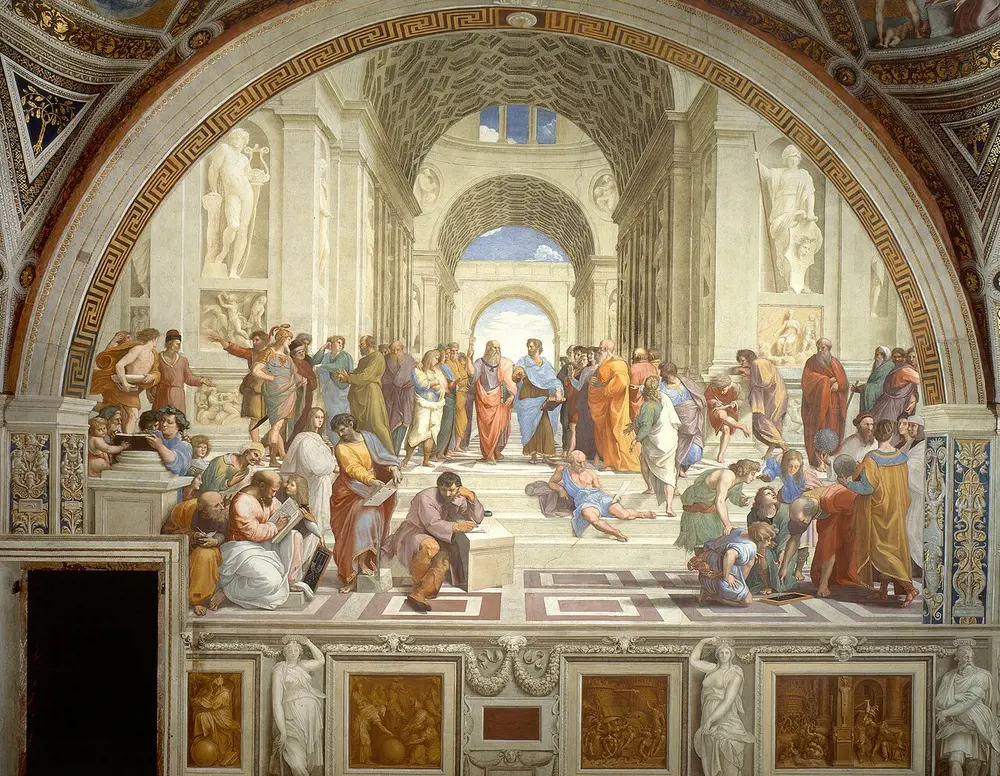
A fresco of a grand arched hall with many ancient thinkers on wide steps; at the centre Plato points up and Aristotle holds his hand out flat.
Picture: Raphael. Public domain.

The School of Athens

Where
Stanza della Segnatura, one of the Raphael Rooms in the Apostolic Palace, Vatican City
When
1509 to 1511
Who
Raphael (Raffaello Sanzio), for Pope Julius II
Style
High Renaissance
Made with
Fresco

Raphael filled an imaginary hall with the great thinkers of ancient Greece. Plato points up to the world of ideas; Aristotle holds his hand flat towards the real world. The perfect perspective of the arches pulls your eye to the two of them. Raphael is thought to have given Plato the face of Leonardo, and he painted himself near the right edge.

Spot it by

Huge arches going back into the distance, Plato and Aristotle walking out of the centre, people on steps, a man sprawled on the stairs.

Remember

Plato points up, Aristotle points down, and perspective points to both.

Don't confuse

Raphael's soft, sweet Madonnas are often placed next to Leonardo's work in exams. Raphael's faces are rounder and calmer, with clear outlines and bright colour.
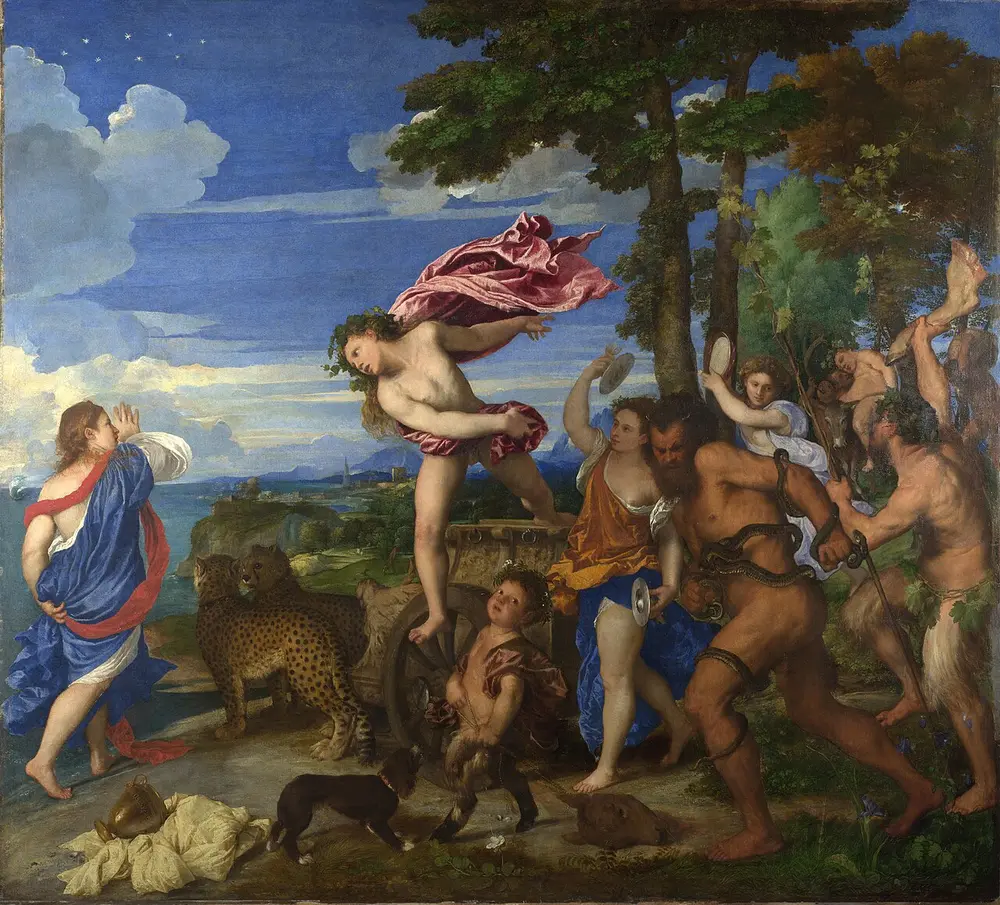
The wine god Bacchus leaps from a chariot pulled by two cheetahs towards the startled Ariadne on the shore, under a deep blue sky, with a noisy crowd behind him.
Picture: Titian. Public domain.

Bacchus and Ariadne

Where
National Gallery, London
When
1520 to 1523
Who
Titian (Tiziano Vecellio), died 1576
Style
High Renaissance, Venetian school
Made with
Oil on canvas
Key works
Bacchus and Ariadne; Venus of Urbino (Uffizi, Florence)

Titian was the great painter of Venice, where artists cared most about colour. Here the wine god Bacchus jumps from his chariot when he falls in love with Ariadne. The sky is painted with costly ultramarine blue, made from the stone lapis lazuli. His Venus of Urbino later inspired Manet's Olympia.

Spot it by

Deep blue sky, rich reds, glowing skin, movement and noise, oil paint laid on in soft layers.

Remember

Florence drew; Venice coloured. Titian is the colour of Venice.

The Northern Renaissance

In Flanders (today's Belgium), the Netherlands and Germany, painters cared less about ancient Rome and more about exact detail. They were early masters of oil paint, which let them build up thin, glowing layers.

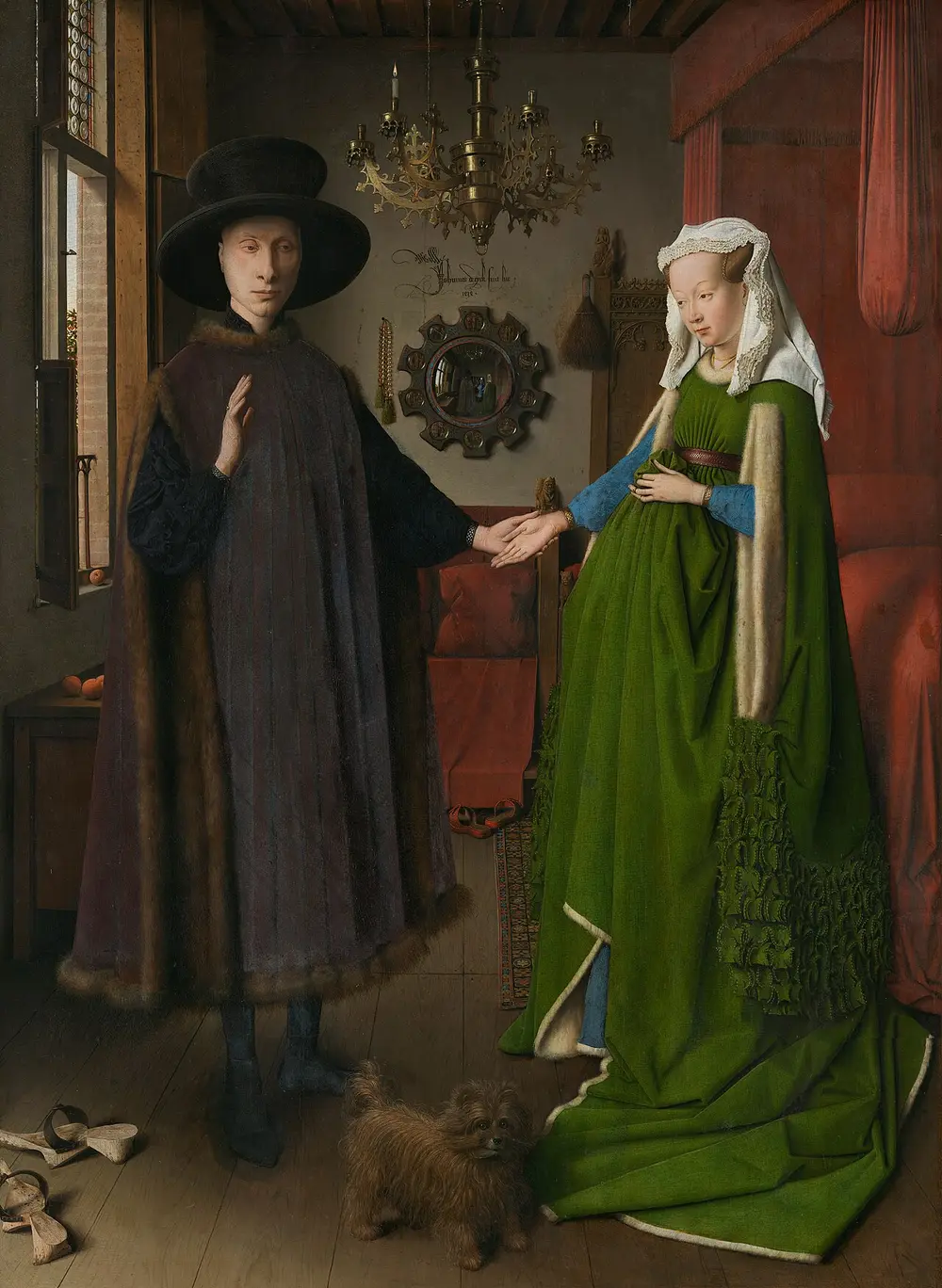
A man in a large black hat and fur-trimmed robe holds the hand of a woman in a green dress in a room with a brass chandelier, a round mirror on the back wall and a small dog at their feet.
Picture: Jan van Eyck. Public domain.

The Arnolfini Portrait

Where
National Gallery, London
When
1434
Who
Jan van Eyck
Style
Northern Renaissance (Early Netherlandish)
Made with
Oil on an oak panel

A rich Italian merchant and his wife stand in their room, probably in their home in Bruges. Every surface, from the fur to the brass chandelier, is painted in tiny detail. The round mirror on the back wall shows the couple from behind and two more people in the doorway. Above it, Van Eyck wrote in Latin "Jan van Eyck was here 1434".

Spot it by

Big black hat, green dress, joined hands, a convex mirror, a chandelier with one candle, a small dog, wooden shoes on the floor.

Remember

Look in the mirror: the painter signed himself into the room.
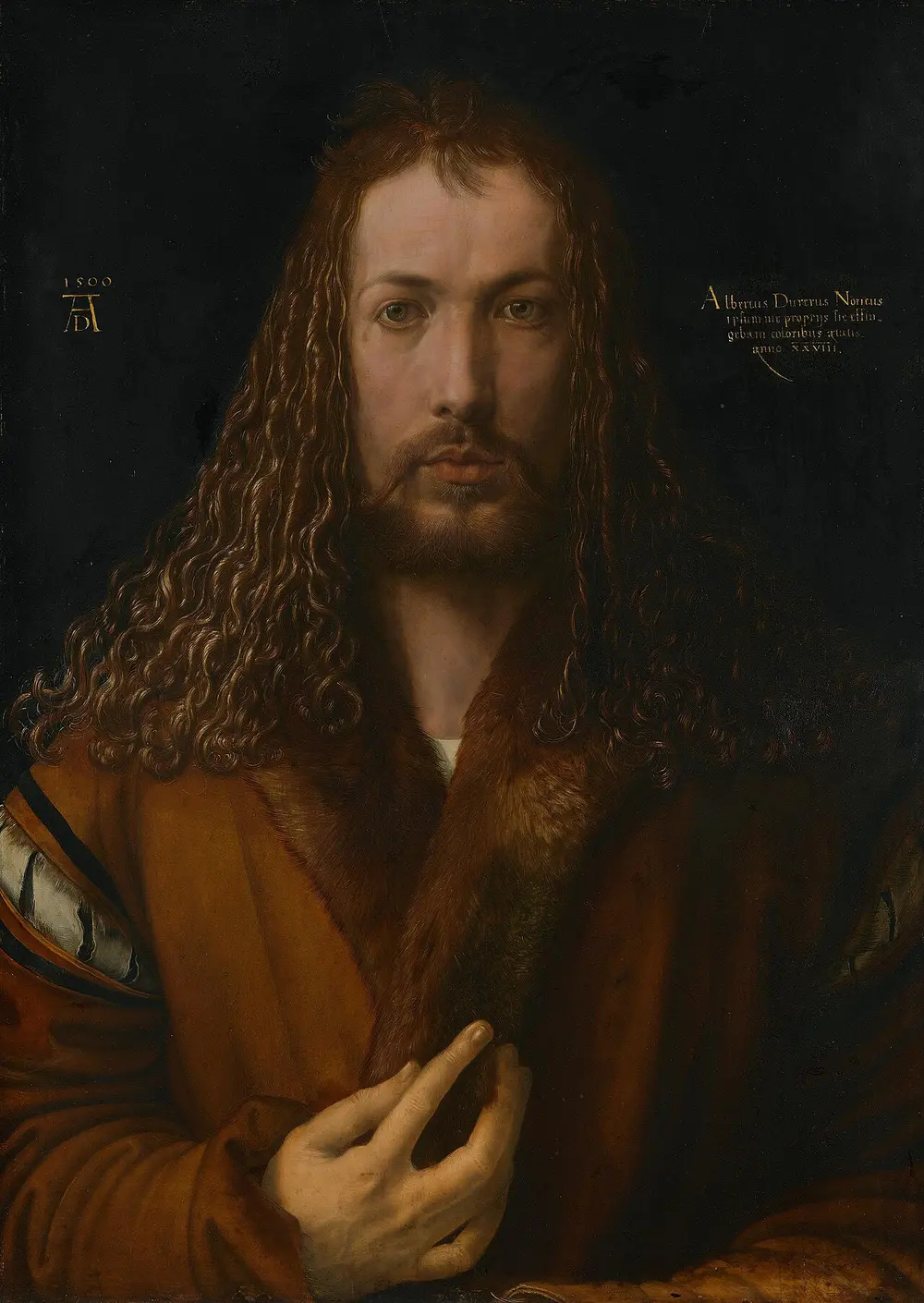
A front-facing portrait of a young man with long curling hair and a beard, wearing a fur-collared coat, one hand raised to his chest, against a dark background with the date 1500.
Picture: Albrecht Dürer. Public domain.

Dürer's Self-Portrait of 1500

Where
Alte Pinakothek, Munich
When
1500
Who
Albrecht Dürer of Nuremberg, aged 28
Style
Northern Renaissance (German)
Made with
Oil on a limewood panel
Key works
Self-Portrait (1500); Rhinoceros (woodcut, 1515)

Dürer painted himself straight on, posed like the pictures of Christ of his time, a bold claim for an artist to make. He was also a famous printmaker. His woodcut Rhinoceros of 1515 shows an Indian rhinoceros that had arrived in Lisbon. Dürer never saw it; he worked from a written description and a sketch, so he gave it armour plates and an extra little horn, and Europe believed his picture for more than two centuries.

Spot it by

A face seen from the front, long symmetrical curls, fur collar, the date 1500 and his monogram, a large A with a D inside it.

Remember

Dürer drew a rhino he never saw, and painted himself like a saint.
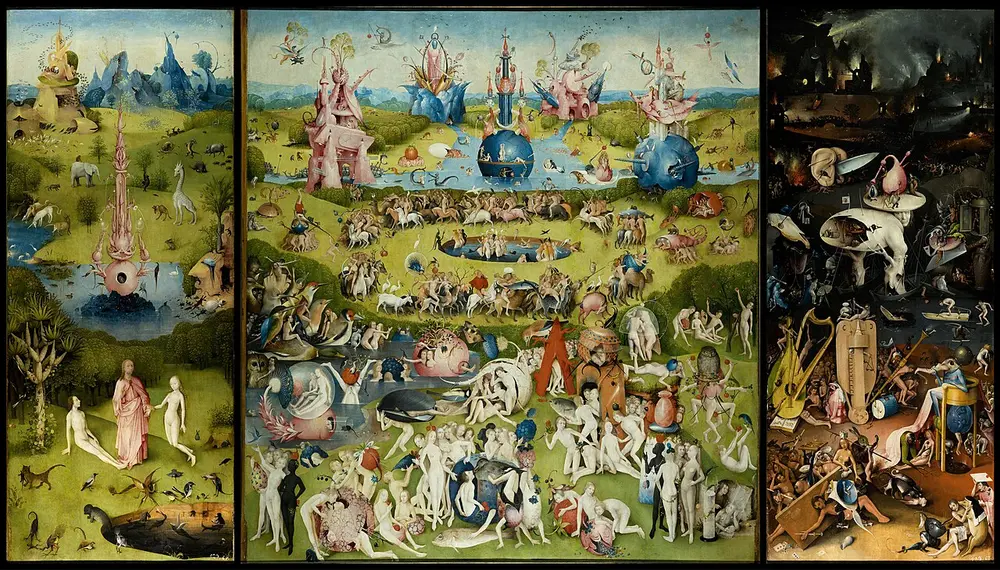
A three-panel painting: on the left a calm Garden of Eden, in the middle a crowded park full of nude figures, giant fruit and strange pink towers, and on the right a dark, burning hell.
Picture: Hieronymus Bosch. Public domain.

The Garden of Earthly Delights

Where
Museo del Prado, Madrid
When
Around 1500
Who
Hieronymus Bosch
Style
Northern Renaissance (Early Netherlandish)
Made with
Oil on oak panels, as a triptych (three hinged panels)

Read it from left to right. The left panel shows Adam and Eve in Eden, the centre a dreamlike world of people chasing pleasure, and the right panel a nightmare hell. It is usually read as a warning about giving in to temptation, though experts still argue about its meaning.

Spot it by

Three panels, hundreds of tiny pale figures, giant birds and fruit, glassy bubbles, and a dark fiery right panel.

Remember

Bosch tells a story in three panels: paradise, pleasure, punishment.

Don't confuse

Bruegel also painted crowds, but of real village life. Bosch's are fantasy and nightmare.
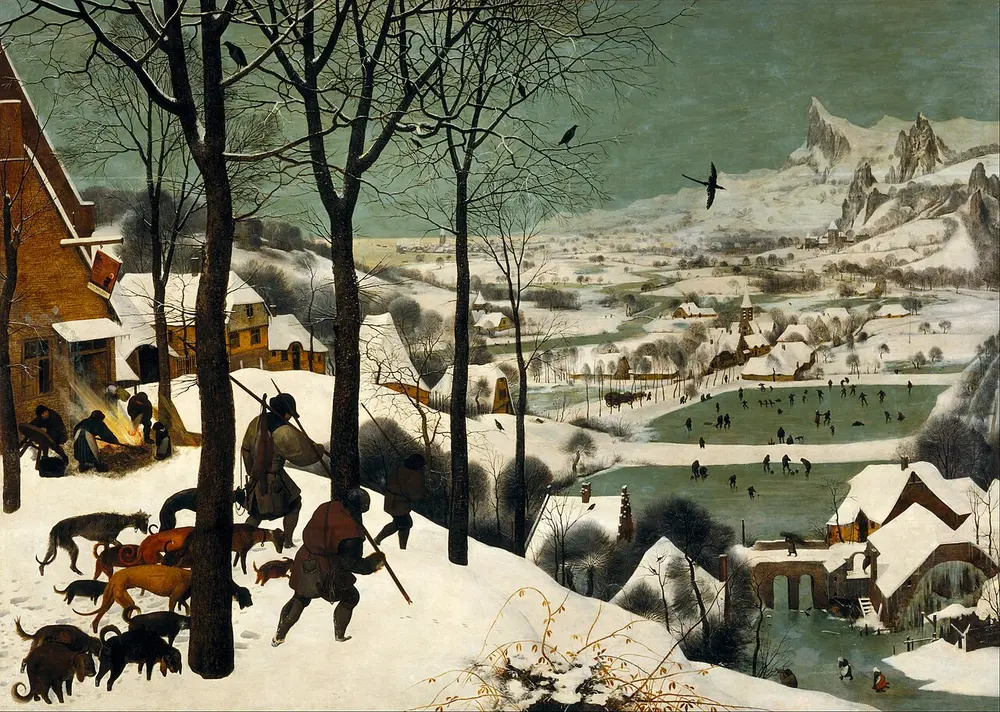
A winter scene of hunters and dogs trudging over a snowy hill past bare trees, looking down on a valley with frozen ponds full of skaters and jagged mountains beyond.
Picture: Pieter Brueghel the Elder. Public domain.

The Hunters in the Snow

Where
Kunsthistorisches Museum, Vienna
When
1565
Who
Pieter Bruegel the Elder
Style
Northern Renaissance (Flemish)
Made with
Oil on wood panel
Key works
The Hunters in the Snow (1565); The Tower of Babel (1563), also in Vienna, with a smaller version in Rotterdam

Bruegel painted ordinary country people, not saints or gods. This is one of a series on the times of the year. Tired hunters come home with little to show, while villagers skate on the ice below. In The Tower of Babel he painted the Bible's tower as a vast, half-built stone wedding cake, swarming with workers.

Spot it by

White snow, black bare trees, dark figures from behind, tiny skaters on green-grey ice, a view that falls away to far mountains.

Remember

Bruegel is the painter of peasants and seasons.

Techniques to know

Technique What it is Famous example
Linear perspective Straight lines going into the distance all meet at one vanishing point, so a flat picture looks deep The School of Athens; The Last Supper
Sfumato Italian for "smoky": edges and shadows blend softly with no hard lines The Mona Lisa's face
Chiaroscuro Italian for "light-dark": strong light and shadow that make shapes look solid Lady with an Ermine
Fresco Painting into wet lime plaster, so the colour becomes part of the wall Giotto's chapel; the Sistine ceiling; The School of Athens
Oil paint Pigment mixed with oil; it dries slowly and can be laid on in thin, glowing layers The Arnolfini Portrait; the Mona Lisa
Tempera Pigment mixed with egg; quick-drying, crisp and slightly matt The Birth of Venus; Primavera

Where they are now

Work Artist Where it is now
Mona Lisa Leonardo Louvre, Paris
The Last Supper Leonardo Santa Maria delle Grazie, Milan
Vitruvian Man Leonardo Gallerie dell'Accademia, Venice
Lady with an Ermine Leonardo National Museum, Kraków
David Michelangelo Galleria dell'Accademia, Florence
Pietà Michelangelo St Peter's Basilica, Vatican
Sistine ceiling, Last Judgment Michelangelo Sistine Chapel, Vatican
The School of Athens Raphael Apostolic Palace, Vatican
The Birth of Venus, Primavera Botticelli Uffizi, Florence
Bacchus and Ariadne Titian National Gallery, London
Arnolfini Portrait Jan van Eyck National Gallery, London
Self-Portrait of 1500 Dürer Alte Pinakothek, Munich
The Garden of Earthly Delights Bosch Prado, Madrid
The Hunters in the Snow Bruegel Kunsthistorisches Museum, Vienna

Timeline

  1. c. 1305

    Giotto finishes painting the Scrovegni Chapel in Padua

  2. c. 1415

    Brunelleschi shows how linear perspective works, in Florence

  3. 1420

    Work begins on Brunelleschi's dome for Florence Cathedral (finished 1436)

  4. 1434

    Jan van Eyck paints the Arnolfini Portrait in Bruges

  5. c. 1485

    Botticelli paints The Birth of Venus

  6. c. 1490

    Leonardo draws the Vitruvian Man and paints Lady with an Ermine in Milan

  7. 1495

    Leonardo begins The Last Supper (finished about 1498)

  8. 1498

    Michelangelo begins the Pietà in Rome (finished 1499)

  9. 1500

    Dürer paints his front-facing self-portrait

  10. 1501

    Michelangelo begins the David (finished 1504)

  11. 1503

    Leonardo begins the Mona Lisa

  12. 1508

    Michelangelo begins the Sistine Chapel ceiling (finished 1512)

  13. 1509

    Raphael begins The School of Athens (finished 1511)

  14. 1515

    Dürer makes his Rhinoceros woodcut

  15. 1519

    Leonardo dies in France

  16. 1536

    Michelangelo begins The Last Judgment (finished 1541)

  17. 1565

    Bruegel paints The Hunters in the Snow

  18. 1919

    Marcel Duchamp draws a moustache on a Mona Lisa postcard (L.H.O.O.Q.), a Dada joke

Test yourself

Question 1 of 8

Which of these is by Leonardo da Vinci?

Question 2 of 8

Who painted this?

Question 3 of 8

Which of these has a round mirror that reflects two more people standing in the doorway?

Question 4 of 8

Which of these is by Pieter Bruegel the Elder?

Question 5 of 8

Where is this painting today?

Question 6 of 8

In 1919 Marcel Duchamp drew a moustache and beard on a postcard of the Mona Lisa. Which movement was he part of?

Question 7 of 8

What is the soft, smoky blending of light and shadow in the Mona Lisa's face called?

Question 8 of 8

Who worked out linear perspective in Florence around 1415?

From past papers

Real exam questions on this topic, each with a full solution.

Finished this note?

Mark it as studied to track your progress through the course.

Was this note useful?

Each picture is credited underneath it. Pictures of works still in copyright are shown small, for teaching only. If you hold the rights to a picture and want it removed, tell us through the contact page and we will take it down.