Skip to content

Chapter 3: Art of the world

Modern art breaks the rules, 1900 to 1945

Fauvism, Expressionism, Cubism, Futurism, Dada, Surrealism and the first abstract paintings, with the works exams show, how to recognise each movement, and Frida Kahlo and the Mexican muralists.

In one minute

6 facts to know

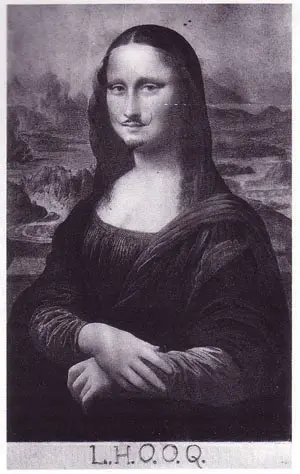
  1. Dada mocked art itself. Its most famous joke is Marcel Duchamp's L.H.O.O.Q. (1919): a postcard of the Mona Lisa with a moustache drawn on.
  2. Cubism, started by Picasso and Braque from 1907, breaks objects into flat, angular pieces seen from several sides at once.
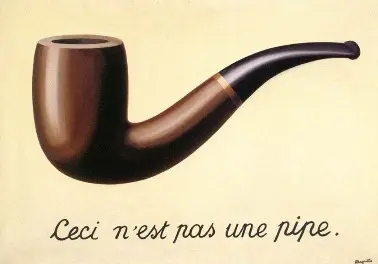
  3. Surrealism, launched in Paris in 1924, paints dreams: Dalí's melting clocks and Magritte's "This is not a pipe".
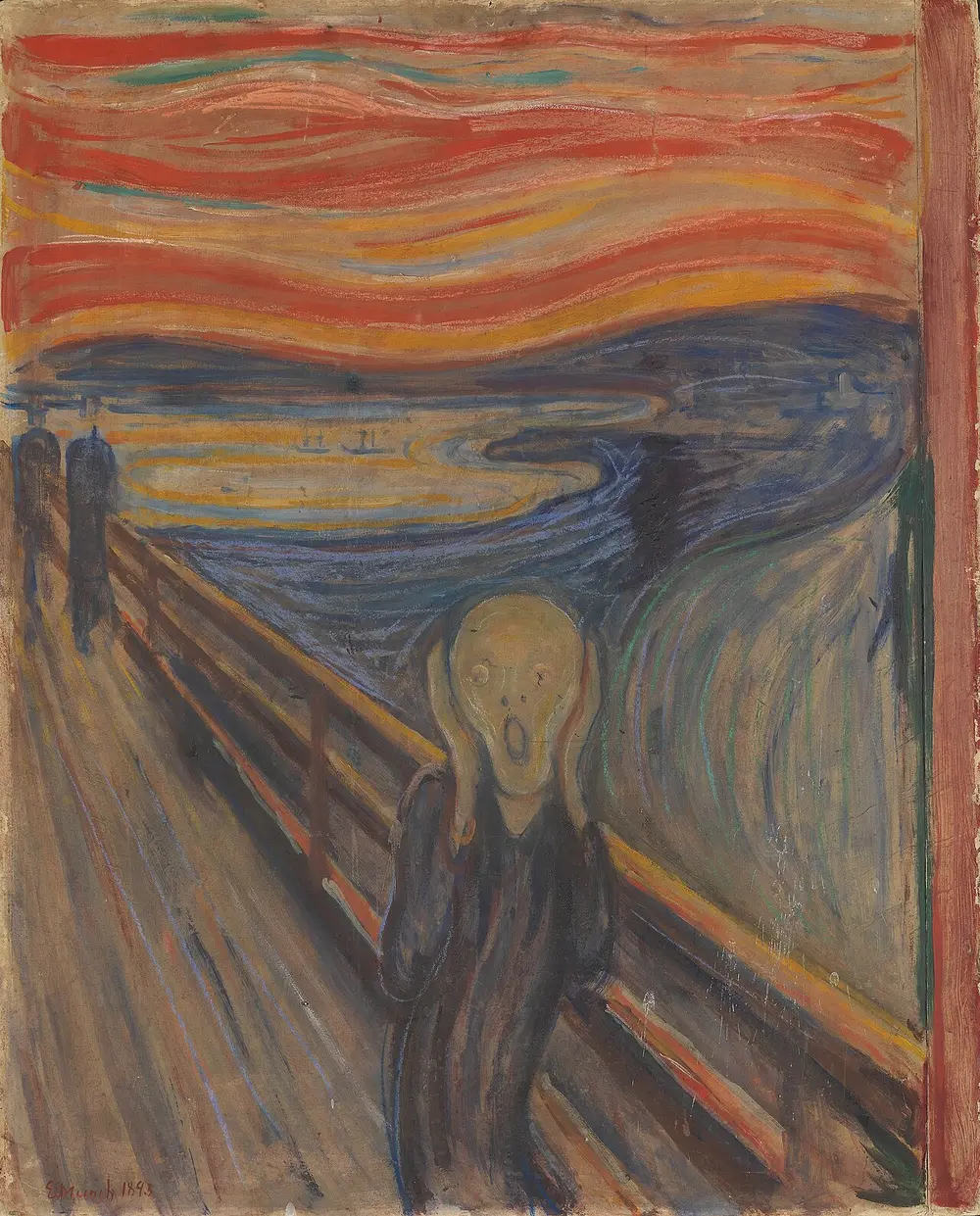
  4. Expressionism paints feelings rather than appearances. Munch's The Scream is its best-known image.
  5. Fauvism (Matisse, 1905) used wild, unnatural colour. The name means "wild beasts".
  6. Kandinsky, Klee, Mondrian and Malevich led the move to abstract art. Kandinsky and Klee both taught at the Bauhaus.

Before the break: Vienna around 1900

Around 1900, young artists all over Europe were tired of official academies that only rewarded realistic history paintings and portraits. In Vienna they walked out and started their own group.

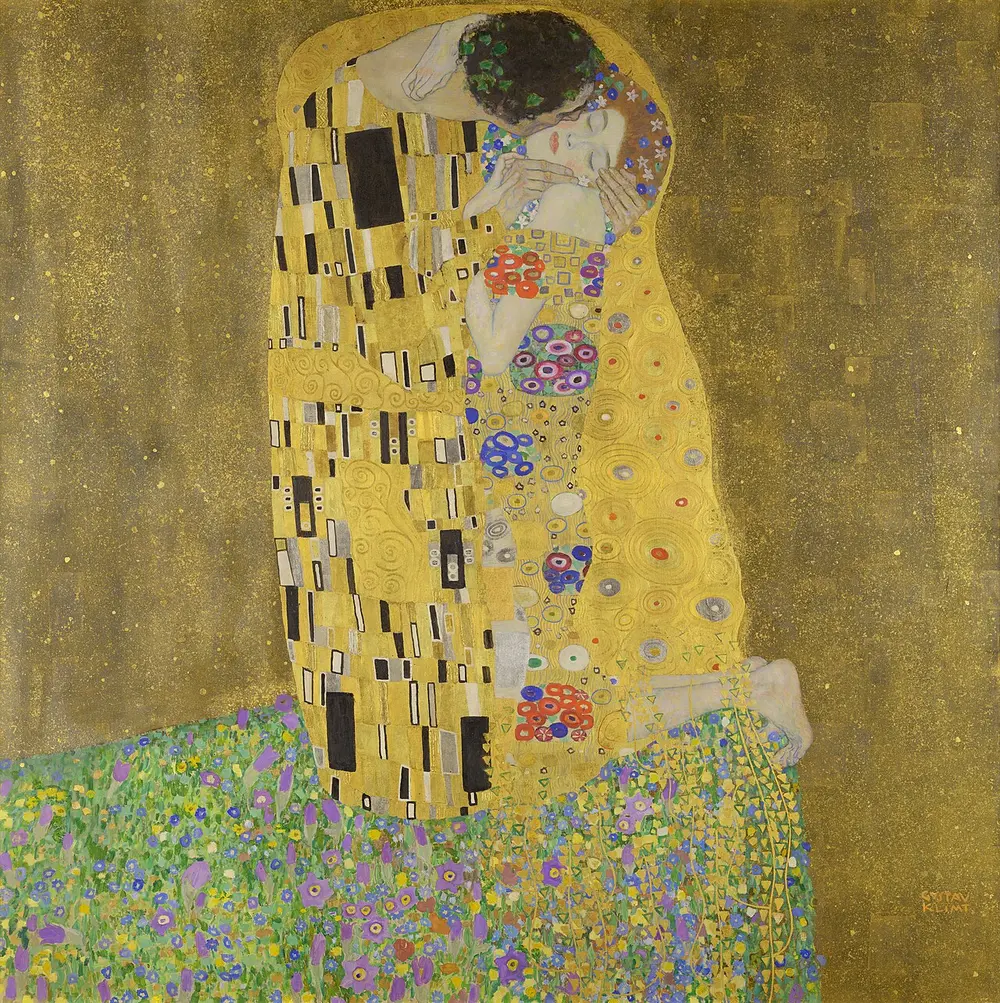
A man and a woman embrace on a meadow of flowers, wrapped together in a long robe covered in gold patterns, against a speckled gold background.
Picture: Gustav Klimt. Public domain.

The Kiss

Also called Der Kuss

Where
Belvedere, Vienna
When
1907 to 1908
Who
Gustav Klimt, Austria
Style
Vienna Secession
Made with
Oil paint and gold leaf on canvas

In 1897 Klimt and other Austrian artists broke away from Vienna's official art society and formed the Vienna Secession, with Klimt as its first president. The Kiss comes from his "golden period", when he laid real gold leaf onto his paintings. The couple's bodies almost vanish into flat decoration: black and white blocks on the man's robe, circles and flowers on the woman's. The Austrian state bought it when it was first shown in 1908.

Spot it by

Gold leaf everywhere, flat patterned robes, and soft, realistic faces and hands set inside a flat mosaic of shapes.

Remember

Klimt means gold. If a painting glitters with gold pattern, think Klimt.

Don't confuse

Mucha's Art Nouveau posters also show flowing women and decoration, but they are printed posters with lettering, not gold-leaf paintings.
Colour and feeling: Fauvism and Expressionism

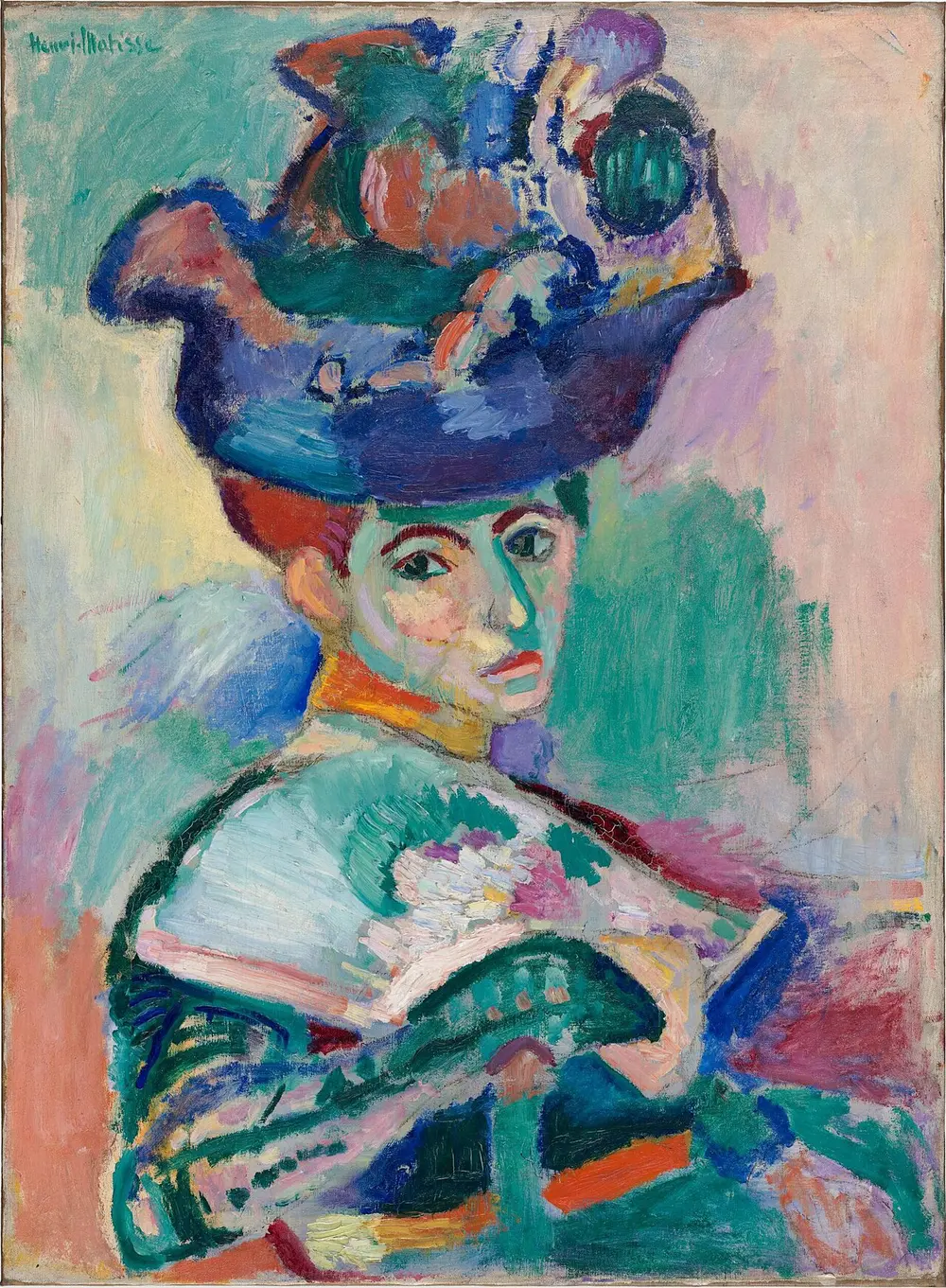
A portrait of a woman in a huge, colourful hat. Her face is painted in patches of green, pink and orange, with rough, quick brushstrokes.
Picture: Henri Matisse. Public domain.

Woman with a Hat

Also called Femme au chapeau

Where
San Francisco Museum of Modern Art
When
1905
Who
Henri Matisse, France
Style
Fauvism
Made with
Oil on canvas

At the 1905 Salon d'Automne in Paris, Matisse, André Derain and their friends hung paintings in colours so bright and unnatural that the critic Louis Vauxcelles called them fauves, French for "wild beasts". The name stuck. This portrait of Matisse's wife, Amélie, has a green-shadowed face and rough brushwork, and it caused a scandal. Fauvism lasted only a few years, but it freed colour from having to match real life.

Spot it by

Very bright colour chosen for feeling, not realism: green or blue faces, orange shadows, thick visible brushstrokes and simple drawing.

Remember

Fauve sounds like "fierce": fierce colour, Paris, 1905.

Don't confuse

Expressionists also used strong colour, but to show fear and unease. The Fauves used colour for joy and decoration.

Expressionism means painting what you feel instead of what you see. Shapes are bent and colours exaggerated to express an emotion. It grew strongest in Germany, in two groups: Die Brücke (Dresden, 1905) and Der Blaue Reiter (Munich, 1911).

A pale figure with a skull-like face holds its hands to its cheeks on a bridge, under a swirling sky of red and orange stripes over a dark blue fjord.
Picture: Edvard Munch. Public domain.

The Scream

Where
National Museum, Oslo
When
1893 (this version)
Who
Edvard Munch, Norway
Style
Expressionism (an early example)

A figure on a bridge clutches its face while the sky and water seem to swirl around it. Munch made several versions of the image, in paint, pastel and print. It shows what panic feels like rather than what the evening looked like, which is the central idea of Expressionism. It came before the movement had a name, so Munch is usually called a forerunner. UCEED 2018 used it as the picture for Expressionism.

Spot it by

A wavy, distorted landscape, a skull-like face with hands on its cheeks, and a sky of swirling red and orange bands.

Remember

The Scream is the emoji of Expressionism.
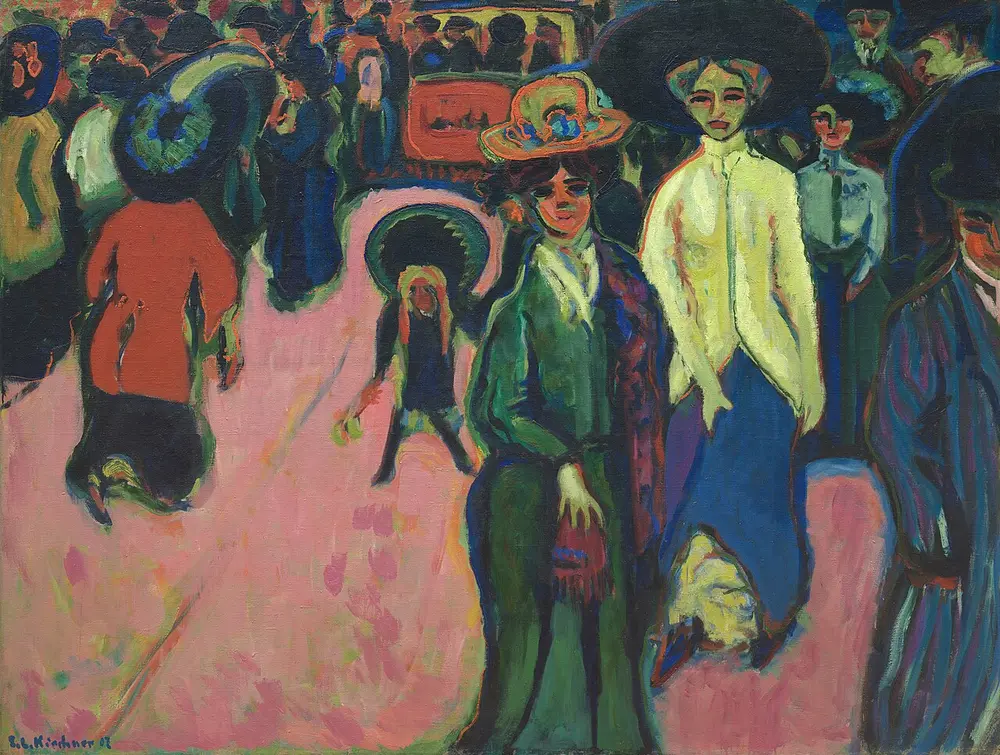
A crowd of women in big hats walk along a hot pink street. Their faces are green and mask-like, and the colours clash.
Picture: Ernst Ludwig Kirchner. Public domain.

Street, Dresden

Where
Museum of Modern Art, New York
When
1908, reworked 1919
Who
Ernst Ludwig Kirchner, Germany
Style
Expressionism (Die Brücke)
Made with
Oil on canvas

Kirchner and three friends founded Die Brücke ("The Bridge") in Dresden in 1905, the first group of German Expressionists. Here a smart shopping street becomes a crowd of mask-like faces on a pink pavement. The harsh colours and stiff figures express how lonely and uneasy modern city life could feel.

Spot it by

Mask-like faces, clashing pinks, greens and acid yellows, jagged outlines and crowded city scenes.

Remember

Die Brücke is a bridge to a new art, built in Dresden in 1905.

Don't confuse

Der Blaue Reiter ("The Blue Rider", Munich, 1911) is the other German Expressionist group. It formed around Wassily Kandinsky and Franz Marc, painter of blue horses, and moved towards spiritual and abstract art.

Cubism: Picasso and Braque

Cubism was invented in Paris by Pablo Picasso and Georges Braque, working side by side from about 1908. Instead of painting an object from one fixed spot, they showed it from several angles at once, broken into flat, angular pieces. The name came from a critic who said Braque reduced everything to little cubes.

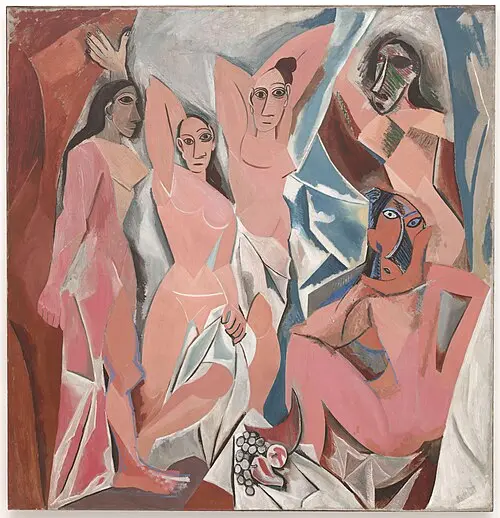
Five nude women, standing and seated, painted as flat, sharp, angular shapes in pink and blue. The two on the right have faces like masks.
Picture: Pablo Picasso. Copyright Succession Picasso, shown for teaching.

Les Demoiselles d'Avignon

Where
Museum of Modern Art, New York
When
1907
Who
Pablo Picasso, Spanish, working in Paris
Style
Proto-Cubism (the start of Cubism)
Made with
Oil on canvas, about 2.4 metres high

Five women are painted as sharp, flat shapes, and the two faces on the right look like masks. Picasso drew on ancient Iberian (early Spanish) sculpture and on African and Oceanic masks he saw in Paris museums. Even his friends were shocked when they saw it. It set Picasso, and soon Braque, on the road to Cubism. Picasso changed style many times, from realistic student work to the sad blues of his Blue Period (about 1901 to 1904) and on to Cubism. UCEED 2018 asked students to put four of his self-portraits in date order.

Spot it by

Angular, broken bodies, faces like masks and a background cut into sharp shards.

Remember

1907, the Demoiselles: the door to Cubism.
Phase When What it looks like Example
Proto-Cubism 1907 to 1908 Bodies flattened into sharp planes, faces like masks Picasso, Les Demoiselles d'Avignon (1907)
Analytic Cubism about 1909 to 1912 Objects shattered into many small facets, almost only browns, greys and greens, hard to read Picasso's portrait of the art dealer Kahnweiler (1910)
Synthetic Cubism from 1912 Bigger, flatter shapes, brighter colour, printed letters and pasted paper Picasso, Still Life with Chair Caning (1912); Braque, Fruit Dish and Glass (1912)

Collage, from the French coller, "to glue", began here. In 1912 Picasso glued a printed oilcloth pattern of chair caning onto a painting, and Braque made the first papier collé ("pasted paper") by sticking strips of wood-grain wallpaper onto a drawing.

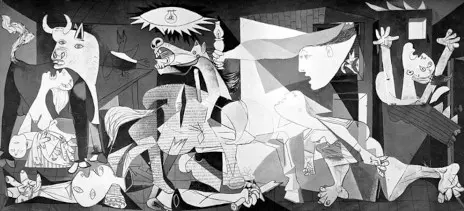
A wide black, white and grey painting crowded with a screaming horse, a bull, a mother holding a dead child, a fallen soldier and an eye-shaped lamp.
Picture: Pablo Picasso. Copyright Succession Picasso, shown for teaching.

Guernica

Where
Museo Reina Sofía, Madrid
When
1937
Who
Pablo Picasso
Style
Cubism, used to protest against war
Made with
Oil on canvas, about 3.5 by 7.8 metres

In April 1937, during the Spanish Civil War, German and Italian planes bombed the Basque town of Guernica. Picasso answered with this huge painting for the Spanish Republic's pavilion at the 1937 Paris World's Fair. A screaming horse, a bull, a mother with her dead child and broken bodies are painted only in black, white and grey, like a newspaper photograph. It is now one of the best-known anti-war images in the world.

Spot it by

Black, white and grey only, a very wide canvas, a horse with an open mouth, a bull, and a lamp shaped like an eye.

Remember

Guernica is grey, the colour of news photos and ashes.

Speed and nonsense: Futurism and Dada

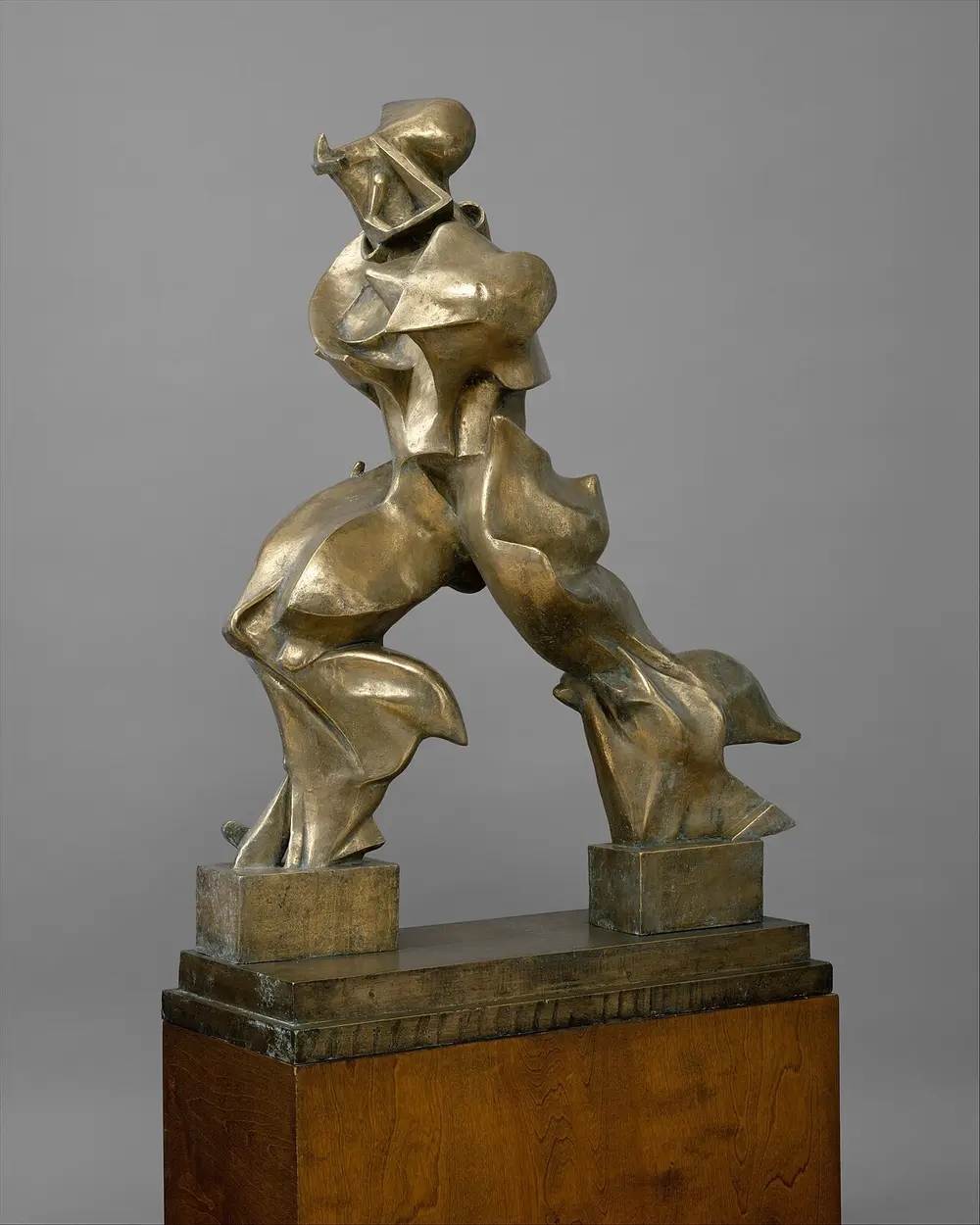
A bronze striding figure with no arms, its legs and body stretched into flame-like, wind-blown shapes, standing on two small blocks.
Picture: Umberto Boccioni. CC0.

Unique Forms of Continuity in Space

Where
This cast is at the Metropolitan Museum of Art, New York; others are in Milan and elsewhere
When
Made in 1913; this bronze was cast around 1950
Who
Umberto Boccioni, Italy
Style
Futurism
Made with
Bronze

Futurism began in 1909, when the Italian poet Filippo Tommaso Marinetti published a manifesto praising speed, machines, cities and even war, and calling for the old museums to be swept away. Boccioni's striding figure seems to be pulled apart by wind and speed. The sculpture appears on Italy's 20 cent euro coin. Boccioni was killed in the First World War in 1916. In painting, Giacomo Balla showed movement by repeating the legs and lead in Dynamism of a Dog on a Leash (1912).

Spot it by

Motion turned into solid form: repeated limbs, lines of force, and bodies or machines that seem to rush forward.

Remember

Futurism is 1909's need for speed: cars, trains and motion.

Don't confuse

Cubism breaks objects into pieces that sit still. Futurism uses broken forms to show movement.
A black and white postcard of Leonardo's Mona Lisa with a thin moustache and a small beard drawn on her face, and the letters L.H.O.O.Q. written below.
Picture: Marcel Duchamp. Copyright Association Marcel Duchamp / ADAGP, Paris, shown for teaching.

L.H.O.O.Q.

When
1919
Who
Marcel Duchamp, France
Style
Dada
Made with
Pencil on a postcard of the Mona Lisa

Dada began in Zurich in 1916 at the Cabaret Voltaire, a club where artists and poets disgusted by the First World War put on nonsense shows. Dada mocked everything, including the idea of art itself. Duchamp took a cheap postcard of Leonardo's Mona Lisa, drew on a moustache and a beard, and gave it a rude French pun as a title. Two years earlier he had sent a shop-bought urinal, signed "R. Mutt" and titled Fountain, to an art show in New York. He called such everyday objects chosen as art "readymades".

Spot it by

Everyday objects or famous images turned into jokes, nonsense words, collage and a deliberately shocking idea.

Remember

Dada sounds like baby talk: art that refuses to make sense. A moustache on the Mona Lisa means Dada.

Don't confuse

Pop Art (1950s and 1960s) also borrowed everyday images, but to enjoy popular culture, not to attack art. UCEED 2025 offered Pop Art, Cubism and Impressionism as wrong answers for this work.

Dreams: Surrealism

Surrealism was launched in Paris in 1924, when the poet André Breton published the first Surrealist manifesto. Inspired by Sigmund Freud's ideas about dreams and the hidden mind, Surrealists painted scenes where impossible things happen. Max Ernst added new tricks such as frottage: rubbing a pencil over paper laid on wood or leaves to pick up their texture.

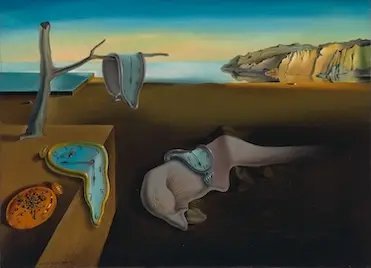
Soft, melting pocket watches drape over a branch, the edge of a box and a strange sleeping creature, in an empty landscape with golden cliffs and sea behind.
Picture: Salvador Dalí (1904-1989). Copyright Gala-Salvador Dalí Foundation, shown for teaching.

The Persistence of Memory

Where
Museum of Modern Art, New York
When
1931
Who
Salvador Dalí, Spain
Style
Surrealism
Made with
Oil on canvas, only 24 by 33 cm

Soft pocket watches melt over a branch, a box and a strange creature, in front of the cliffs of Catalonia, Dalí's home region. Everything is painted with photo-sharp detail, which makes the impossible scene feel real, like a vivid dream. The painting is surprisingly small, a little bigger than a sheet of A4 paper.

Spot it by

Dream scenes painted in sharp, realistic detail, melting or impossible objects, and empty landscapes with long shadows.

Remember

Melting clocks mean Dalí, and Dalí means Surrealism.
A smooth brown tobacco pipe painted on a plain cream background, with the words "Ceci n'est pas une pipe." written neatly underneath.
Picture: René Magritte (1898-1967). Copyright C. Herscovici, Brussels, shown for teaching.

The Treachery of Images

Also called Ceci n'est pas une pipe (This is not a pipe)

Where
Los Angeles County Museum of Art
When
1929
Who
René Magritte, Belgium
Style
Surrealism

Under a plain painting of a pipe, Magritte wrote "Ceci n'est pas une pipe", French for "This is not a pipe". He is right: it is only a picture of a pipe, and you cannot smoke it. Magritte's Surrealism is calm and clearly painted, but it plays tricks with words, images and ordinary things. In The Son of Man (1964), a man in a bowler hat has a green apple hovering in front of his face.

Spot it by

Ordinary objects such as pipes, apples, bowler hats and clouds, painted plainly but placed in puzzling situations, often with words.

Remember

Magritte makes you think; Dalí makes you dream.

Don't confuse

Both are Surrealists. Dalí's world melts and twists; Magritte's objects stay solid but don't make sense.

Pure shape and colour: the first abstract art

Abstract art shows no people, places or things, only colour, line and shape. Four painters led the way between about 1910 and 1930.

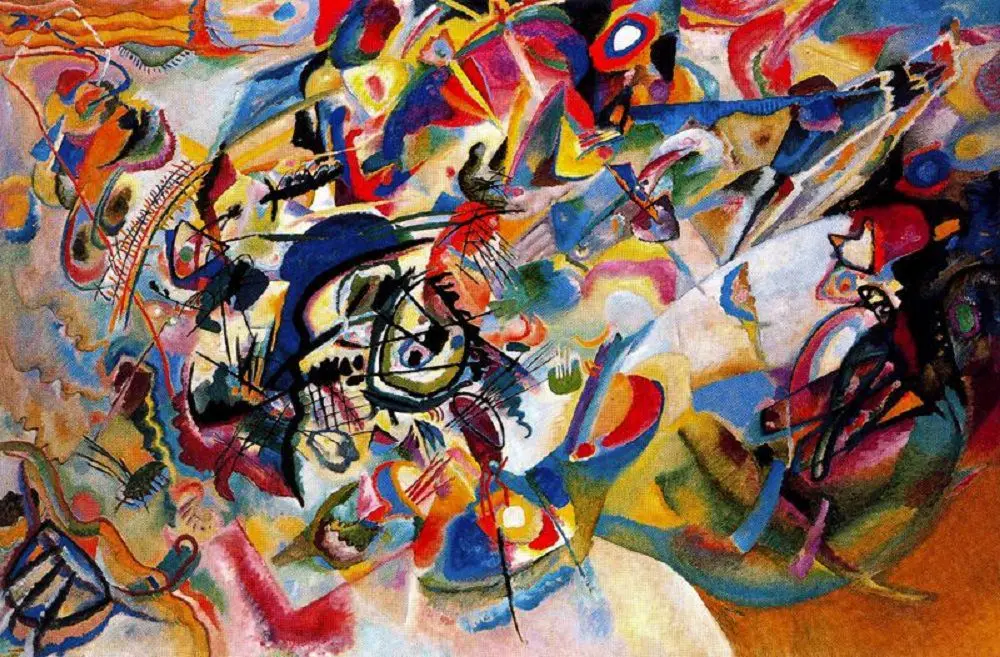
A large, crowded abstract painting full of swirling colours, black lines, circles and patches of red, blue and yellow, with no recognisable objects.
Picture: Wassily Kandinsky. Public domain.

Composition VII

Where
State Tretyakov Gallery, Moscow
When
1913
Who
Wassily Kandinsky, Russia (worked in Germany)
Style
Abstract art (Der Blaue Reiter)
Made with
Oil on canvas, about 2 by 3 metres

Kandinsky is often named as one of the very first painters of purely abstract pictures. He believed colours and shapes could move people the way music does, so he called his works Compositions and Improvisations, like pieces of music. He co-founded Der Blaue Reiter in Munich in 1911 and later taught at the Bauhaus design school in Germany.

Spot it by

An explosion of colour, line and shape with no objects at all, and musical titles such as Composition or Improvisation.

Remember

Kandinsky painted music.

Don't confuse

Mondrian's abstract art is calm and ruled with straight lines; Kandinsky's is loud and swirling.
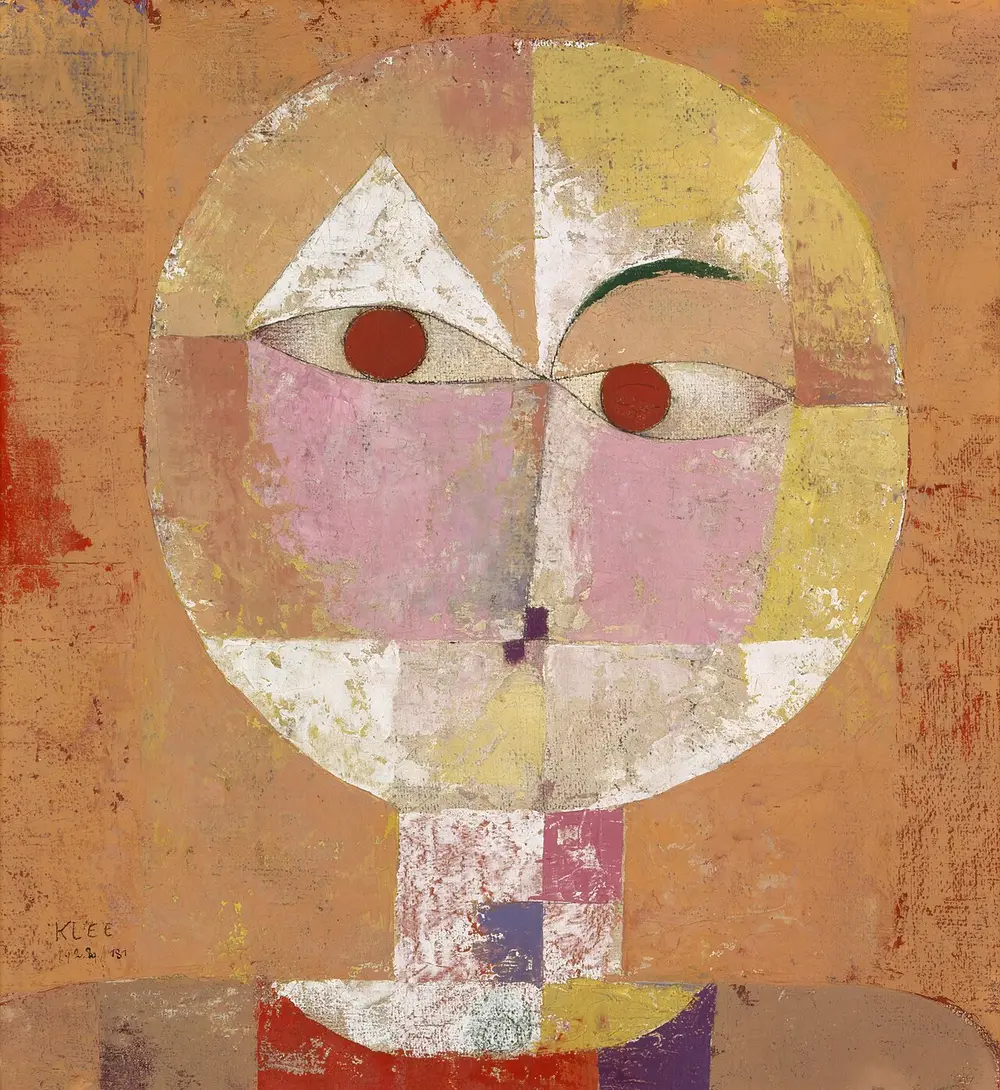
A round, mask-like face split into soft squares of orange, pink, yellow and white, with two red dot eyes, on an orange background.
Picture: Paul Klee. Public domain.

Senecio

Where
Kunstmuseum Basel, Switzerland
When
1922
Who
Paul Klee, Swiss-born, worked in Germany
Style
Klee fits no single movement; he is grouped with abstract art and taught at the Bauhaus

Klee taught at the Bauhaus through the 1920s, alongside Kandinsky. His pictures are small, playful and full of signs, letters and childlike figures built from thin lines and patches of colour. He described drawing as taking a line for a walk. In Senecio, a round head is split into soft squares of colour, like a mask or a harlequin's costume. UCEED 2015 showed four paintings and asked which ones were by Klee.

Spot it by

Small, childlike and playful pictures, grids of soft colour patches, thin wandering lines, and little symbols, letters and faces.

Remember

Klee is playful, like a child let loose with a pencil and a paint box.
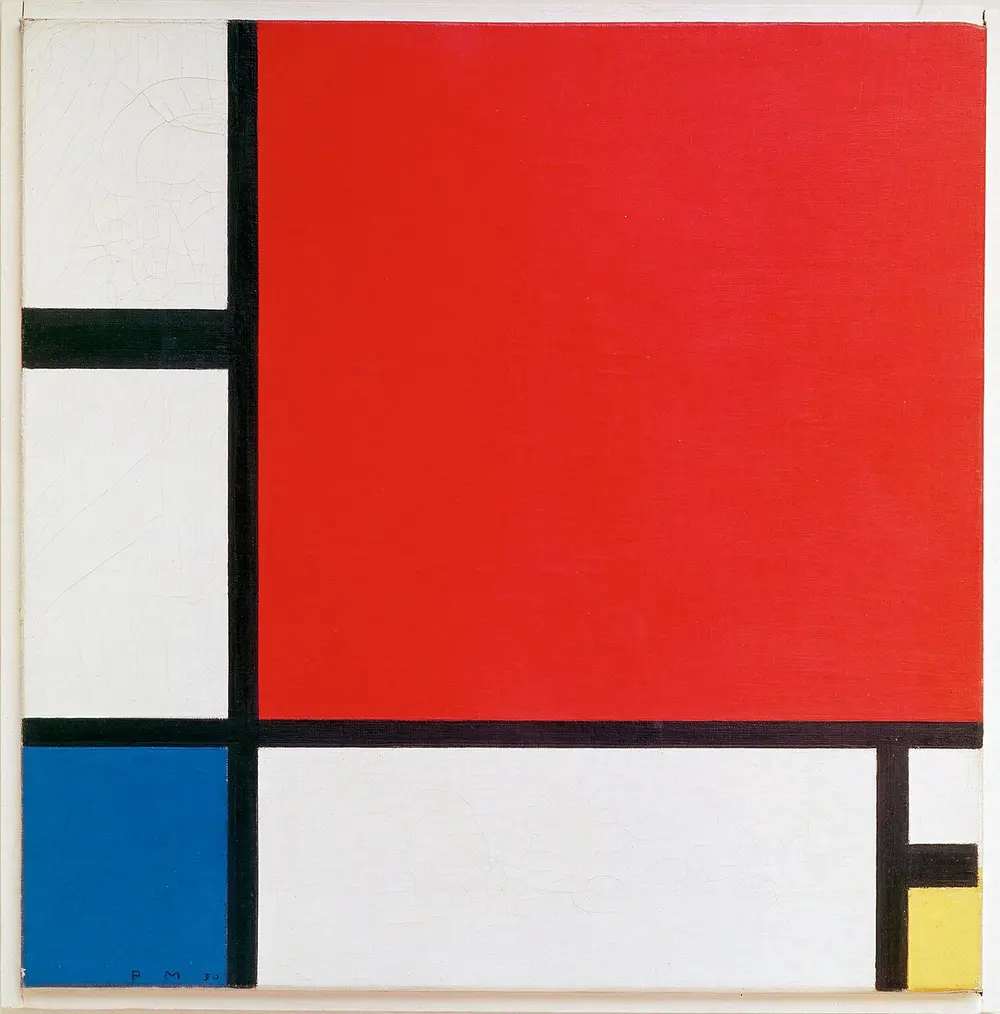
A square painting divided by thick black lines into white rectangles, one large red square, a small blue rectangle and a tiny yellow one.
Picture: Piet Mondrian. Public domain.

Composition II in Red, Blue and Yellow

Where
Kunsthaus Zürich, Switzerland
When
1930
Who
Piet Mondrian, Netherlands
Style
De Stijl (Neoplasticism)
Made with
Oil on canvas

Mondrian cut painting down to its basics: straight black lines crossing at right angles, the three primary colours (red, blue and yellow), and white, grey and black. He called this Neoplasticism. In 1917 he was a founding member, with Theo van Doesburg, of De Stijl ("The Style"), a Dutch group that applied the same rules to furniture, buildings and graphics. CEED 2026 used a Mondrian painting as its example of De Stijl.

Spot it by

A white grid of thick black lines with a few blocks of pure red, blue and yellow, and no curves or diagonals.

Remember

Mondrian is the grid with red, blue and yellow.

Don't confuse

Malevich also used flat geometric shapes, but they float and tilt on white, with no grid.
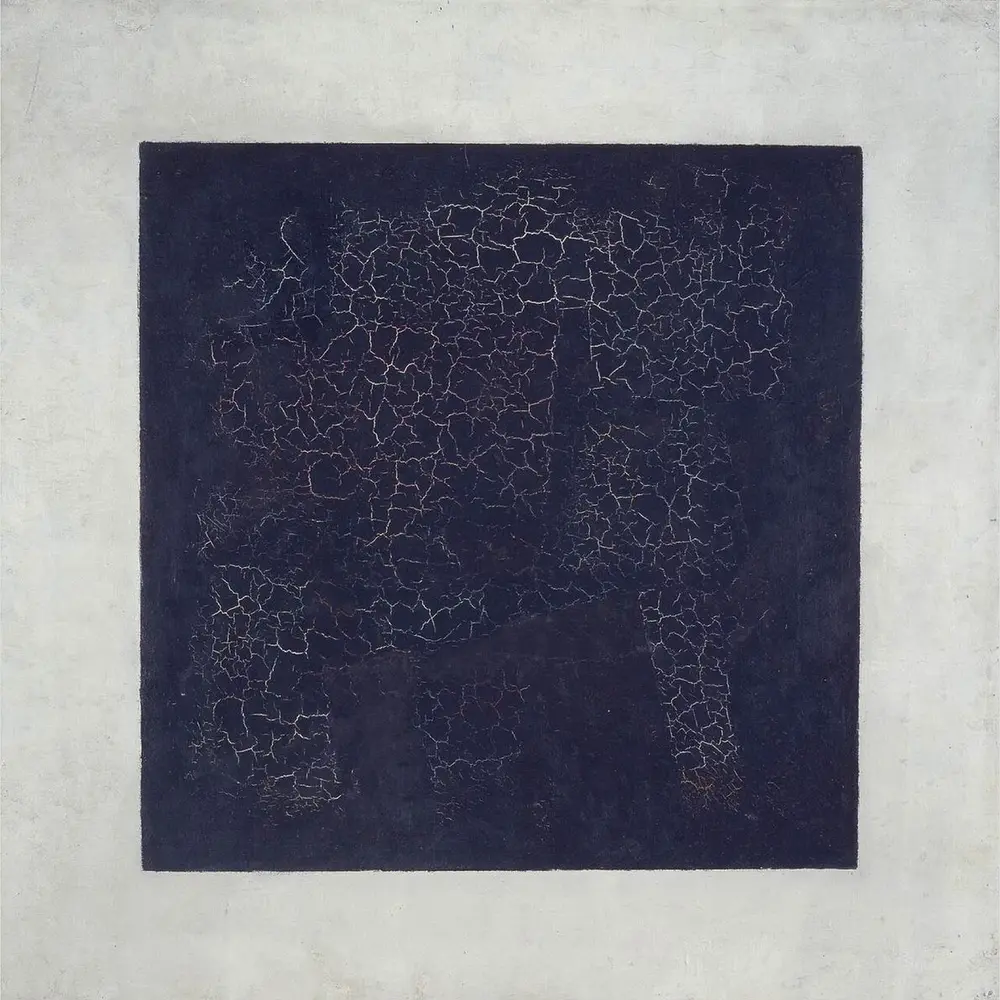
A black square, its paint covered in fine cracks, on a white background.
Picture: Kazimir Malevich. Public domain.

Black Square

Where
State Tretyakov Gallery, Moscow
When
1915
Who
Kazimir Malevich, Russia
Style
Suprematism
Made with
Oil on linen

A black square on a white ground is the whole painting. Malevich first showed it in December 1915 at an exhibition called "0,10" in Petrograd (now St Petersburg), hung high across a corner of the room, the place where Russian homes traditionally hung a religious icon. He called his new art Suprematism: the supremacy of pure feeling over pictures of things.

Spot it by

Flat geometric shapes such as squares, crosses and bars floating on white, in very few colours.

Remember

Malevich took painting all the way down to one black square.

Mexico: Frida Kahlo and the muralists

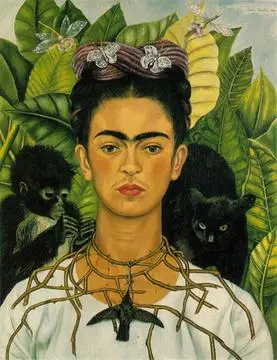
Frida Kahlo looks straight out, with joined dark eyebrows, wearing a necklace of thorns with a dead black hummingbird hanging from it. A monkey and a black cat sit behind her shoulders among large green leaves.
Picture: Frida Kahlo. Copyright Banco de México Diego Rivera Frida Kahlo Museums Trust, shown for teaching.

Self-Portrait with Thorn Necklace and Hummingbird

Where
Harry Ransom Center, University of Texas at Austin
When
1940
Who
Frida Kahlo, Mexico
Style
Mexican modern art, often linked with Surrealism
Made with
Oil on canvas

Kahlo was badly hurt in a bus accident as a teenager and began painting while she recovered in bed. Many of her paintings are self-portraits full of pain, Mexican dress, plants and animals. Here a necklace of thorns cuts into her neck, with a dead hummingbird hanging from it. André Breton called her a Surrealist, but she said she painted her own life, not dreams. She married the muralist Diego Rivera in 1929.

Spot it by

A direct, unsmiling self-portrait with joined eyebrows, Mexican clothes and flowers, and animals, thorns or plants used as symbols.

Remember

Frida painted Frida.

Don't confuse

CEED 2023 mixed portraits by Kahlo, Klimt and Modigliani in one grid. Modigliani's faces are long and mask-like, often with blank eyes; Klimt's sit in gold pattern.
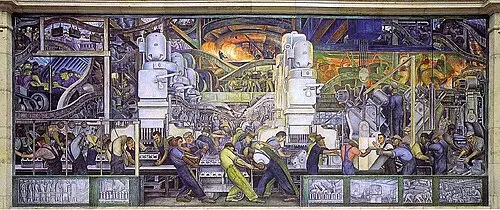
A long wall painting of a car factory, crowded with workers pulling, lifting and operating huge grey machines.
Picture: Mural: Diego Rivera / photo: User:Cactus.man on EN-WP / cropped version: User:JopkeB. Copyright Banco de México Diego Rivera Frida Kahlo Museums Trust, shown for teaching.

Detroit Industry Murals

Where
Detroit Institute of Arts, United States
When
1932 to 1933
Who
Diego Rivera, Mexico
Style
Mexican muralism
Made with
Fresco (paint on wet plaster), 27 panels

After the Mexican Revolution (1910 to 1920), Mexico's government paid artists to paint huge murals on public buildings, telling the nation's story where everyone could see it. Diego Rivera, José Clemente Orozco and David Alfaro Siqueiros became known as los tres grandes, "the big three". In Detroit, Rivera painted the workers and machines of Ford's car factory in 27 fresco panels that cover all four walls of a courtyard.

Spot it by

Huge wall paintings crowded with workers, machines and history, with solid, rounded figures and a strong social message.

Remember

Rivera painted walls; Kahlo painted herself.

How to spot each movement

Movement Where and when Spot it by Names to know
Vienna Secession Vienna, from 1897 Gold leaf, flat decorative pattern Gustav Klimt
Fauvism Paris, 1905 to about 1908 Wild, bright, unnatural colour Henri Matisse, André Derain
Expressionism Germany and Norway, about 1905 to 1920 Distorted shapes and colours that show fear or unease Munch, Kirchner, Kandinsky, Franz Marc
Cubism Paris, from about 1908 Objects broken into flat, angular pieces seen from several sides Picasso, Braque, Juan Gris
Futurism Italy, from 1909 Speed, machines, repeated limbs, lines of force Boccioni, Balla, Marinetti
Dada Zurich, then Paris, Berlin and New York, from 1916 Jokes, nonsense, readymade objects, collage Duchamp, Hugo Ball, Hans Arp
De Stijl Netherlands, from 1917 Black grid, primary colours, right angles Mondrian, Theo van Doesburg
Suprematism Russia, from 1915 Flat squares and bars floating on white Malevich
Surrealism Paris, from 1924 Dream scenes painted realistically, impossible objects Dalí, Magritte, Max Ernst
Mexican muralism Mexico, from the 1920s Huge public murals of workers and history Rivera, Orozco, Siqueiros

Timeline

  1. 1893

    Edvard Munch paints The Scream in Norway

  2. 1897

    Klimt and others found the Vienna Secession

  3. 1905

    The Fauves shock the Salon d'Automne in Paris; Die Brücke forms in Dresden

  4. 1907

    Picasso paints Les Demoiselles d'Avignon

  5. 1908

    Klimt's The Kiss is first shown in Vienna

  6. 1909

    Marinetti publishes the Futurist manifesto

  7. 1911

    Kandinsky and Franz Marc form Der Blaue Reiter in Munich

  8. 1912

    Picasso and Braque make the first Cubist collages

  9. 1913

    Boccioni makes Unique Forms of Continuity in Space; Kandinsky paints Composition VII

  10. 1915

    Malevich shows Black Square in Petrograd

  11. 1916

    Dada begins at the Cabaret Voltaire in Zurich

  12. 1917

    Duchamp's Fountain; De Stijl is founded in the Netherlands

  13. 1919

    Duchamp draws a moustache on the Mona Lisa in L.H.O.O.Q.

  14. 1924

    André Breton's first Surrealist manifesto

  15. 1929

    Magritte paints The Treachery of Images

  16. 1931

    Dalí paints The Persistence of Memory

  17. 1932

    Rivera begins the Detroit Industry Murals

  18. 1937

    Picasso paints Guernica

  19. 1940

    Kahlo paints Self-Portrait with Thorn Necklace and Hummingbird

Test yourself

Question 1 of 8

An artist copied the Mona Lisa and drew a moustache on her. Which art movement was he part of?

Question 2 of 8

Which movement does this painting belong to?

Question 3 of 8

Which of these paintings is by Paul Klee?

Question 4 of 8

A critic looked at paintings like this one in 1905 and gave the movement its name. What does the name mean?

Question 5 of 8

Which of these belongs to De Stijl?

Question 6 of 8

This striding bronze figure seems to be pulled apart by speed. Which movement is it from?

Question 7 of 8

Which painting shows a pipe above the words "This is not a pipe" in French?

Question 8 of 8

Which Mexican artist painted huge murals of car workers at the Detroit Institute of Arts?

From past papers

Real exam questions on this topic, each with a full solution.

Finished this note?

Mark it as studied to track your progress through the course.

Was this note useful?

Each picture is credited underneath it. Pictures of works still in copyright are shown small, for teaching only. If you hold the rights to a picture and want it removed, tell us through the contact page and we will take it down.